I wrote this essay in 2011 as a Facebook Note. Those pieces are getting harder to find, so when I encounter ones I wish to save, I have been posting them here. I have made a few revisions. For one thing, the son in question has since earned both a bachelor’s and a master’s degree.
June, 2011
On Monday, my firstborn child will take a few more of the steps into adulthood. He will walk across the platform and receive the diploma that marks the close of his public school education. With scores of other parents in the seats, and thousands across the nation, I will applaud him. My heart will fill with joy and pride, and my eyes with tears.
Adulthood is not conferred by arbitrary markers such as age, education, or achievement, but it is suggested by them, sometimes even confirmed by them. My son will be very little more mature on Tuesday than he is today (I can hope for at least a little bit), but this is one of the milestones used by our society that shouts loudly indeed. Even though I’ll continue to support him for some time to come – college tuition comes to mind – even in my eyes he can no longer be the boy I’ve known so long.
I hope I’ve been a wise father. In some ways I suppose I resemble the metaphorical “helicopter parent,” hovering over my children. I still read aloud to my children every night, and they still tolerate it. I still walk to the bus stop in the morning with them. This Thursday I saw my son onto a school bus for the last time.
If I am a helicopter father, I’m one who has chosen to tell a central truth. Life comes with pain, and pain comes with life. I had few options about concealing this truth. At a very young age my son learned a great deal about pain and fear, when his baby sister needed treatment for a life-threatening illness. I didn’t try to lie to him about pain, and risk, and heartbreak, and fear. These are realities of the world, and even the most loving parent in the world lacks the power – not the desire, the power – to hold them all in check.
I hope I’ve succeeded in doing what I set out to do instead: to make it clear that though I could not necessarily protect him, I could be with him. There is pain, but there is also comfort. There is death, and there is life. There is sorrow, and there is joy.
I don’t know how well I did with that. It’s a life lesson, and he’s plenty of time to learn it. For the moment, I ache for his disappointments. I ache for mine as well, but I ache especially for his. To some extent, I know, he has made or found his own comfort. To some extent, I fear, his hurts endure.
And I know, imperfect person that I am, that I have inflicted or contributed to some of those hurts, for which, my son, I am most sorry.
I am a minister of the Gospel, and he’s paid some of the price for that. I spent too many evenings away from the supper table, unable to lend my voice to the bedtime story. He has endured the pressure of being a “P.K.,” pressures I can’t wholly know. I lost my relationship with his mother, and I can hardly imagine the tears he’s shed for that, only know that they had an echo in my own.
And it must be said that my flaws of personality, intelligence, and wisdom have nothing to do with that vocation at all, and he’s suffered for those, too.
My son sees, and he dreams. He dreams, and he thinks. He thinks, and he writes. He writes, and he speaks. He’s eloquent, and far more wise than I remember being at that age. He clothes himself in black, to make something of a suit of armor for himself, even though he knows it does not protect him and cannot. And he still he dreams of Camelot: of “the powerful fighting for the powerless, instead of exploiting them.”
My son, go forth and make it real. There is pain, and there is no armor that will keep it from you; there is no shield you can place before anyone else that will entirely prevent them from suffering. But there is also brilliance, and eloquence, and wisdom. There is generosity, and joy, and courage. There is strength and resilience and endurance. There is faithfulness and honor, there is love, and laughter.
My son, there is life. You have it in abundance.
So go forth into Tuesday morning, and the Tuesday mornings that follow. There are books and classes still to come for you, there is time to splash about in the lake. There are long trips and short excursions, there are embraces and there are kisses. There is sorrow and loss and disappointment, and son, there is life.
And if you’d like someone to stand with you when you stand in your armor, hoping your courage will last, call. I walked to the bus stop with you. It’s just one more step.
I wrote this essay on May 30, 2010, as a Facebook “Note.” Those Notes are getting harder to recover, and so when I’ve found one that I still appreciate, I’ve been adding them to my blog here. The original title was “Forgiving the Internet,” but I’ve revised that. I’ve also made revisions that reflect the intervening fourteen years since its composition.
My career in ministry has been marked with a consistent theme: I repeatedly find myself doing things that I either utterly failed to anticipate, or that I specifically said that I’d never do. I actually said aloud in seminary that I never wanted to serve as an interim pastor; I spent nearly ten years doing just that. For seventeen years I spent the vast majority of my time on electronic publishing and communication media that simply didn’t exist when I graduated from school over twenty years before. Today I serve a church on Hawai’i Island, a place I never imagined I’d visit, let alone live.
With the rise in social networking, I led a number of workshops on the Church’s relationship to social networking phenomena, and how to adapt ‘safe church’ practices to the virtual world. While these utilities were still very young themselves (Facebook was only six years old when I composed this essay), I was obviously just one step ahead of anyone in the workshop groups, and sometimes two or three steps behind…
But there’s a characteristic of the Internet that, I think, cries out for a word from the Church, from Christians, and from people of a wide variety of faiths. The characteristic is the longevity, the durability of information in the Internet. My workshop leadership partner successfully found the text of a paper she’d submitted for a class in the 80’s — somehow, it had been posted to a database, ‘spidered’ by Google, and there it was for anyone to find.
At the same time, we keep hearing of firms and institutions evaluating the applications of potential employees with searches of the Internet and, particularly, of their ‘personal’ social networking profiles. According to a 2009 Proofpoint study, 8% of US companies with over 1,000 employees had fired staff for misbehavior related to social networking. How many weren’t hired in the first place?
In the past, we’ve been able to leave our errors behind us. The indiscretions of youth, the sins of ignorance, and the painfully-overcome failures associated with addictions or with strongly-held, sadly mistaken beliefs. Graduation, change of residence, change of job, new affiliations all brought a New Start.
With the Internet, we’ve probably lost that, and it’s probably gone for good.
So we’re going to have to learn to forgive.
I can’t think of anything more counter-cultural, neither at the time I first composed this reflection or at this moment. This is a judgmental time. The ideological politics we bewail has deep roots in the inability to tolerate or forgive dissent. A political victory in one issue makes collaboration on another issue prohibitively difficult.
In 2008, the United States led the world in the percentage of its population which was behind bars. I strongly suspect that in prior years, and in other countries, at least some of those imprisoned offenders would have been confronted differently than they are today.
With the political mechanisms paralyzed, with huge numbers of citizens released from prisons and anticipating a short stay ‘outside’ before they’re returned, with all of our long-since-forgotten but electronically preserved peccadilloes waiting for us to find them again, we’d better learn to forgive.
Forgiveness is not the same as forgetting, and it never was. Forgiveness does not release anyone from responsibility. I’d argue that until there is repentance, there can be no forgiveness.
Forgiveness is the restoration of relationship; it is the acknowledgement of prior failure and the commitment to a new way of success. Forgiveness reinforces responsibility even as it relieves the offender from the consequences of offending.
Forgiveness has always been a foundational Christian value. It has always strengthened families and communities. It has always been praised when publicly displayed — remember Pope John Paul II and his attempted assassin, Mehmet Ali Agca — while simultaneously dismissed as a virtue with utility in the ‘real world.’
The real world and the virtual world now, I think, demand that we deliberately, systematically, and steadfastly employ this virtue of forgiveness. When forgetfulness will no longer permit new life, then forgiveness must take its place.
I think this is one of the central challenges for the Church of Jesus Christ in this age: to summon society to this new virtue, for its survival and salvation.
Toward the end of 2022, someone asked me what I thought of Elon Musk’s acquisition of Twitter, the “micro-blogging” service whose brief post format had attracted a good number of users over the years, including me. Musk had owned the company less than two full months at that point, but had already taken steps to slash the workforce, relax the hate speech restrictions, and suspend legitimate journalists. The questioner expected I’d be supportive of Musk’s claims to provide a platform with truly open speech. I replied that I thought he’d make the platform unusable in about six months.
I am lousy at predictions. I was off by about six months.
I no longer post to Twitter – or to X, its rebranded moniker. I still check it from time to time, and find less and less that informs or inspires me. I’ve downloaded the archive of what I’ve posted over the years, and I suspect that someday, a day not too far into the future, I will close my account entirely.
I’m sad about it. During my sojourn as a communications specialist for a UCC Conference, I spent a lot of time in the emerging world of social media. I remember, for example, that you had to establish a connection to a university to join Facebook (really!), which I did. I joined Twitter despite my skepticism that it could facilitate human community building while maintaining a 140 character message limit.
In 2011 I realized I was wrong about that. That was the year of the “Arab Spring,” when populations from Syria to Libya began demonstrating against their unresponsive governments. In some places, they won new freedoms with peaceful protests. But in others, civil wars erupted. In March a young man in Libya named Mohammed Nabbous, who had practiced citizen journalism via Twitter as well as his own website, died from a sniper’s bullet in Benghazi, Libya. He had gained the trust and support of a number of professional journalists, including National Public Radio’s social media specialist, Andy Carvin. When Carvin announced Nabbous’ death on his Twitter feed, the community came together to mourn and to comfort one another. It was a moment I’ve never forgotten.
At 140 characters a post, people performed the most elemental of human compassionate acts: comforting the grieving. Twitter could and did provide a communications medium of human community.
Twitter continued to be that kind of medium for many years (even if it did double the character limit). As with all communities, it developed rules of conduct that members had to follow, or find another group. Every community does this, whether it’s a social club, a religious organization, or a political entity. There are things we do not do in this setting together. There are other things we (usually more informally) expect people to do.
Twitter’s enforcement of those rules raised questions, of course, though I usually heard more complaints about the rule violations that didn’t provoke an effective response. I suppose that says something about the kind of people I choose to pay attention to. By and large, they do not speak with venom and bile. They were unlikely to violate Twitter’s community standards.
One of the first things that happened after the Twitter acquisition was the relaxation of those standards. Those rules had been developed with the input of the users over a decade. Suddenly they no longer mattered. Studies showed a rapid rise in hate speech rooted in racism, sexism, and homophobia, and a corresponding decrease in effective response. Some users began to leave the platform because of the level of the abuse.
That was what I had in mind when I answered that question about Twitter in December 2022.
Something else, however, was happening, and it took me a while to realize what it was.
I do not follow Elon Musk’s Twitter handle. I have not blocked it, but I do not follow it. Suddenly, I began to see posts from him – not in the general feed, but in my Notifications, an area that, in theory, reflects activity by accounts I have specifically selected or, increasingly, from accounts identified by an algorithm. I had definitely not chosen to be notified of Musk’s posts. Nor had I interacted with them such that they should be selected by the algorithm. Unless… the algorithm had been adjusted so that the service owner’s posts would be highlighted for service users, one and all.
I have no real objection to a media company owner insisting that his opinions be highlighted by the media outlet he owns. Publishers do that all the time. Frankly, I do it myself on this blog, where I am the only contributor. That’s the nature of media companies.
But Twitter used to be a community. Now… it isn’t.
My decision to stop posting to Twitter, therefore, is a choice to no longer contribute uncompensated material to a publisher. Yes, it means that I’ll have somewhat more difficulty in reaching potential members of my own audience, but to be honest, they’re spending a lot less time on Twitter, too. The service has ceased to function to foster and support developing community. It has made the transition to media company (relying primarily for content on people they’re not paying) and, more to the point, it has chosen to spotlight the contributions of its owner.
I’ve looked over the last few items that Mr. Musk’s algorithm has dropped into my Notifications. Without exception, they have no value to me. They are mostly jokes that are, frankly, not funny. Some are offensive. Some are sexist. Some are racist. I don’t need to know any of it, and I’m happier not knowing any of it.
Mr. Musk has nothing to say that is worth my attention.
I will miss the community. It was rough and ready, and for certain the participants did not always rise to the standards of care and compassion which marked the response to Mohammed Nabbous’ death. I will miss the challenge of sorting information posted during a crisis into more- or less-likely. I will miss the #3tweetsermon, which has moved to my church’s Facebook Page as the #3postsermon, a much less evocative name. I’m still surprised that I was, if not unique, so close to it that I never found anyone else posting with that hashtag.
Farewell, Twitter. I will miss you. You’ve been fading away for over a year, and the time has come to say, “Goodbye.”
Author’s Note: This reflection was originally published as a Facebook Note (the platform’s never-fully-and-no-longer-much-at-all-supported blogging utility) on January 9, 2011. I’m reposting some of those Notes here because they’re difficult to find in Facebook now, and in some cases impossible.
January 9, 2011
As I was shoveling my driveway this morning, my next door neighbor had a question for me. ‘You’re a man of the cloth,’ he said, ‘Do you believe God makes it snow?’
‘Well, not at any particular time,’ I said. ‘I mean, I think God set the laws of nature that make snow happen, but that it snowed today rather than…’ and I waved my hand vaguely.
He nodded. ‘I don’t think God makes it snow,’ he replied. ‘If he did, you wouldn’t be out there shoveling it now.’
I laughed, but I also thought to myself, ah, but if somebody I really disliked were shoveling this snow right now, I might be inclined to think God had brought it for this moment. That would feel to me like divine justice. Or at least as if God were responding to my concerns in the world.
As I shoveled and thought, I realized that what I was thinking about (and not shoveling) wasn’t divine justice, but magic. Not the public performances of illusion we enjoy, but the exercise of power through invocation of other forces.
The appeal of magic is that it is reliable (stay with me here). That is, if I do the spell correctly, I get a predictable result. In the history of human religious thinking, gods were frequently invoked in the performance of magic. I recall that many years ago, archaeologists found a storehouse of papyrus fragments in Egypt, many of which had clearly been sold in the marketplace as spells of protection, blessings, or even curses against someone else. As I remember, the God of Israel was among the deities invoked, and also, I think, Jesus…
But the God I know is not one who is ‘magical.’ The God I know isn’t so controllable, so predictable, that I can call down snow on the unjust. Those ancient spells are attempts to control and to direct divine powers. The God I know merely smiles at the very idea.
The God I know invites human beings into relationship, into friendship, into mentorship, into worship. The God I know sends rain (and snow) onto the just and the unjust, and invites both to accept the free gift of divine grace. The God I know listens, considers, and acts in the world: but I would never pretend to predict just what this God will do. Merely be thankful when I recognize those acts for the blessings they are.
And to appreciate, as well, the wonders of random, not-necessarily-specifically-directed, and ‘magical’ in a different sense, snow.
The photo was taken by Eric Anderson on January 12, 2011, in Portland, Connecticut, after another snowstorm.
January 2023 started with an eruption in Halema’uma’u Crater at the summit of Kilauea. The new lava continued to raise the crater floor. As it happened, two more eruptions would do the same during 2023, adding bit by bit to the island of Hawai’i.
Church of the Holy Cross UCC began the year with a gathered congregation and continued to live stream the service to those, far and near, who needed to worship from their homes. In the spring we ceased to require masking for those attending service. A number of people continue to do so. We experienced a few members falling ill with COVID-19 during 2023, but nobody reported a serious bout with the disease. I kept up with my vaccines as best I could.
I switched cameras this year, joining the ranks of mirrorless photographers. Even with pretty basic lenses I’ve been very pleased with the results.
This photo comes from February in Lili’uokalani Gardens in Hilo. It’s one of my favorite images of the year.
In addition to appearing on-camera live each Sunday morning, I continued to offer a song each Wednesday, and a reflection piece (What I’m Thinking) each Tuesday (a change in schedule). Another change was to resume the Community Sing, a gathering for people to choose songs for everyone to sing together. Because copyright issues would rapidly arise, those gatherings haven’t been streamed or recorded, but I did change the Community Concert series so that it includes both a live audience and a live stream.
I wrote seven songs this year, but only six have been recorded. The seventh piece is designed for background music during worship. I wrote it for the first gathered ‘Aha Mokupuni of the Hawai’i Island Association in May. The other six, however, have all been sung during one of the Wednesday performances, and like last year, I plan to create a “Songs of 2023” post shortly. I didn’t buy any new instruments in 2023, and for this grace I breathe a sigh of relief.
I sang with a new singing group in the area for two concert series. Big Island Singers, led by Holy Cross’ choir director Doug Albertson, performed in April, just after Easter, and in November, just before Thanksgiving. The music was lovely, varied, and definitely challenging. As 2024 arrives, my calendar already has rehearsal times marked on it.
I did have visitors, but not as hoped or expected either time. In March my brother Chris and his wife Linda visited, and I came down with a nasty stomach bug the day they got on the plane for Hawai’i. They ended up staying at a local hotel, and I wasn’t up to spending time with them until the last couple days of their visit. They put a lot of miles on my car, though, and I was glad to be at least a little of a decent host.
My cousin Peter and his wife Diane visited in September. The good news is that as they arrived Kilauea had a spectacular summit eruption. The bad news is that I had no hot water in my house. Again, they stayed in a local hotel until I had a water heater that worked. They discovered that there are tours down into Waipio Valley, which I hadn’t known, and I was really happy to join them on the tour and see a part of the island that I hadn’t seen before.
My own travel consisted of a trip to Indianapolis, Indiana, for General Synod, and about ten days vacation in New England afterward. It was a simple delight to see my friend Karen Georgia Thompson raised to become General Minister and President of the UCC and to see my daughter Rebekah taking part in worship leadership during the closing service. My schedule was that of a delegate (though I had voice only, no vote), which was more than challenging. I hope I’m able to return to the next Synod in my former guise as a reporter and photographer.
My trip east included my friend John Madsen-Bibeau’s retirement party and a gathering of former employees of the Connecticut Conference, for which I was most grateful. I also enjoyed time with my brother and sister-in-law, who were very gracious considering that I hadn’t hosted them all that well, with Paul and Kimberly Bryant-Smith, lots of the extended family, and of course Brendan and Bekah.
Those two have both moved since last July to their old college haunts. Bekah now lives in Northampton, Massachusetts, and Brendan in Burlington, Vermont. Bekah continues to work for the Julian Way, an organization working on the intersections between theology and disability, and Brendan started a post with the University of Vermont Medical School in December. I have informed them that visits from Dad will now take place in the summer.
Toward the end of the year, one of my stories appeared in Act Fast, a Lenten devotional published by the United Church of Canada, which is quite exciting.
I spent the year as Chair of the Hawai’i Conference Council and on the Board of Directors of the Hawai’i Conference Foundation; the first leads to the second. As 2024 approaches, we plan to do some review and evaluation of our work toward achieving goals set out in a six year old strategic plan. Since three of those years included a global pandemic, we have had plenty to distract us. In November I actually chaired an in-person meeting of the Council, the first since I received the position in October 2020. I found myself wondering if I knew how to chair a meeting with people present rather than small rectangles on a screen… I am looking forward to passing the gavel to someone else next June, but before I do, I also hope to lead an in-person ‘Aha Pae’aina.
I continued to serve on the Committee on Ministry of the Hawai’i Island Association this year, work I have been very glad of. During the fall I was asked to become mentor and advisor to Keoki Kiwaha, who was entering the ordination process and had been licensed as Kahu of Puka’ana Congregational Church UCC. That is one of the real highlights of my year.
At the end of 2021, I commented on the lost promise of that year. Despite the warnings of epidemiologists and other medical professionals, I like others hoped that the advent of vaccines would end the pandemic, or at least reduce its risks. As 2022 began, however, we were in the midst of the highest level of COVID-19 transmission we’d seen. Church of the Holy Cross UCC continued to worship online-only until the Sunday after Easter – a disappointment for certain.
Still, we did welcome a congregation into the sanctuary in April and were able to observe Pentecost, All Saints, and Christmas with gathered worshipers. We maintained precautions even then. The congregation did not sing hymns until December, so that the first songs they sang were Christmas carols. Our choir director, Doug Albertson, assembled a thirty-five plus voice choir plus string orchestra for a magnificent performance of Ralph Vaughan Williams’ Fantasia of Christmas Carols. It was great fun to take part in that ensemble.
A glance at my photos will make someone wonder why I didn’t seem to get around as much as in previous years. There are a lot of flowers but not a lot of varied scenery. COVID remained a factor – I wanted to minimize my exposure so that it would minimize the risk I presented to others – but so was my transportation. Though the Chrysler 300 I’d bought on moving to Hilo continued to run just fine, some of its parts were definitely showing its sixteen years, and I began to avoid long drives. In November I replaced it with a new Kia, leading to the inevitable joke that this pastor finally has a Soul.
I did travel during the year. I attended my first in-person off-island conference since 2020 in May. I went to O’ahu for a disaster response event and spoke about the interfaith response to the Kilauea eruption of 2018. At the end of August I flew east to visit family and friends. I even managed to attend the Wyman family reunion (my paternal grandmother was a Wyman) and The Blandford Fair on Labor Day weekend. I enjoyed seeing everyone, and entirely forgot to get selfies with a good many of them. The trip home afforded the opportunity to get photos of a sunset over the Pacific.
For the most part the family is doing well. My kids continued to share an apartment this past year, but both are looking to moves in 2023. I have hopes that Rebekah’s ordination will come this next year, and Brendan is working toward beginning a Ph.D. program in English literature. Bekah has been working for The Julian Way, an organization focused on education and empowerment with, for, and by, persons of diverse embodiments. They work with congregations and other faith institutions to foster fully inclusive environments.
In October I attended the Pastoral Leaders’ Retreat on O’ahu, the first time we’ve had a full gathering for that event since 2019. Though I wasn’t on the leadership team, I was asked to find a musical selection for the occasion – and as is typical of me, I couldn’t think of one. The result was the song that leads the 2022: A Year video above: “Take the Labyrinth Road.”
It was a busy year musically. During Lent, I set a goal of writing one song for each of the six weeks of Lent. I did it (see: A Lenten Success). By year’s end, I’d written twelve new songs, equaling those produced in 2021. I sang one of my original songs each Wednesday and presented hour-long concerts via live stream twice a month. You can see them all (oh, my) on my YouTube channel in the Music playlist.
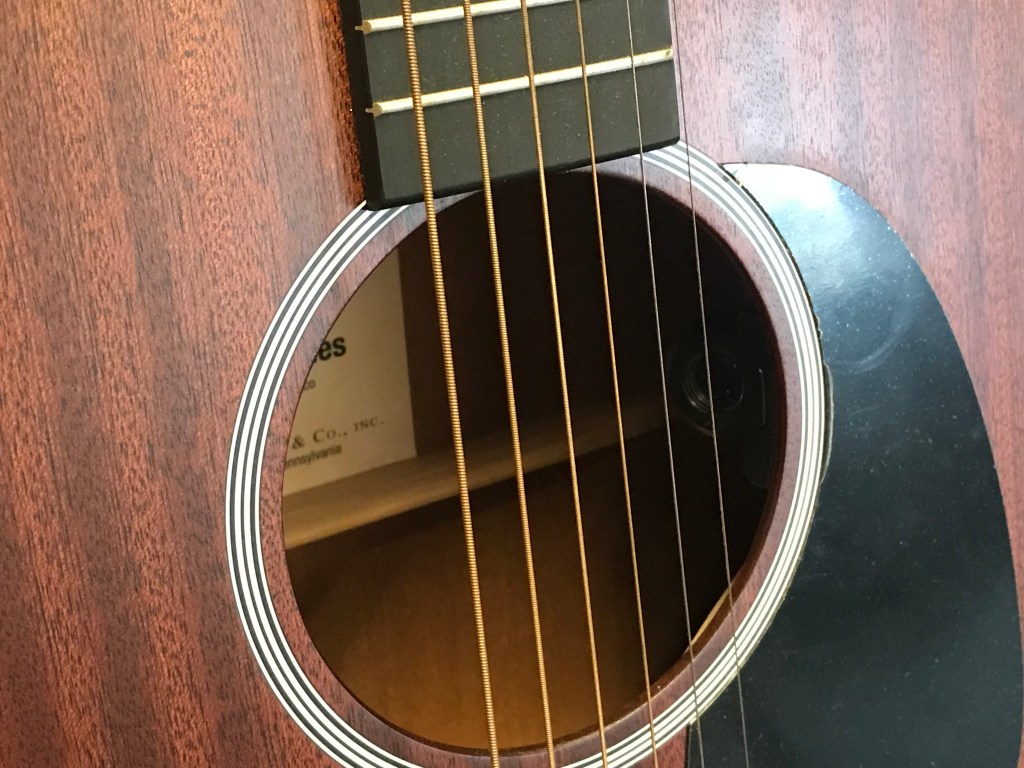
Music gave me a couple ways to deal with the stress of the year – and 2022 was certainly stressful. It was a creative outlet, of course, both in composition and in performance, though it could also be exhausting. It also became one of my chosen methods of “retail therapy” this year. During the pandemic I found that I would feel calmer while I waited for a package to arrive. In 2022, three of those packages contained new instruments: a Martin D-10E guitar in sapele wood in March, a Kala KA-ATP6-CTG 6-string ukulele in May, and a Kala KA-EBY-TE in striped ebony in July.
2022 brought some terribly painful times. I officiated at a series of funerals in the spring for people I had known and treasured, and there were more as the year went on. In June my friend and former colleague Drew Page stepped down from his work with the Southern New England Conference UCC. He had been suffering from cancer for two years and the disease had reached a stage where he wanted to give his time to family and friends. In July we talked via video chat. I wrote “To the Banks of the River Jordan,” and about four hours after I sang it live, he died.
I told a few other friends not to make me write such a song for them any time soon.
As the year ended, one of my cousins from my father’s generation, Don Pease, died. Once more my heart wept.
2022 has not been an easy year for grief. In May the United States suffered its one millionth death from COVID-19. At year’s end, many whose lies had contributed to the death toll via social media had recovered access to some of the platforms they’d abused. If I’d doubted that COVID was still around, I’d have been disabused of the notion by catching it in November. It laid me out exhausted for days. I did not fully recover my stamina until late December, just in time for the Christmas services (whew).
I was reelected Chair of the Hawai’i Conference Council in June and will serve until June 2024. My term as President of Interfaith Communities in Action will end in February of 2023, though I expect to continue working with the Steering Committee and Working Group on Family Homelessness. I was asked to rejoin the Hawai’i Island Association’s Committee on Ministry as we have a shortage of ordained ministers on the island who can serve. I have also continued on the Board of Directors of the Ku’ikahi Mediation Center.
Drew liked to tell the story of how we met. My daughter had signed up for a winter event at Silver Lake Conference Center, and I had asked if I could volunteer with the other age group that weekend. Drew and Debby led the group I wanted to work with.
Although it’s always useful to have adult counselors at these events, Drew wasn’t at all sure he wanted to include this unknown “helicopter parent” who might both distract the other group and leave him without a fully engaged counselor. I assume he got enough reassurance from the camp directors because he and Debby welcomed me with no signs of his reluctance.
I confess that I brought my own hesitations. Drew set off all sorts of alarm bells going back to my teenage years. He was tall with a booming voice. He was an athlete. His hair was closely cropped. He led the event with an air of confident authority. He reminded me of too many people I’d had painful relationships with many years before.
And… he was tall. He had a booming voice. He was an athlete, winning a bronze medal in his age group at the US National Fencing Championships in 2016. He did change the length of his hair, but it was never very long. He did carry himself with confident authority.
That weekend also demonstrated the incredible depth of his heart and soul. Drew had trained to be a public school teacher because of his passion for teaching and inspiring young people. He left the classroom because the administrative overhead frustrated him more than he would accept (my father, who worked many years as a public school administrator and teacher, would have sympathized). He poured that commitment to teaching into coaching. He founded a fencing school in Willimantic, Sword in the Scroll, which offered both modern fencing and German broadsword.
When we met, one of the other counselors for the weekend, a college-age student, was nursing some bruises from a mistake in her guard. Drew the coach was both sympathetic, making certain that she wasn’t doing things that would delay her recovery, and also evaluative, helping her understand what she’d done so that she could do it better next time.
It was a good weekend.
I didn’t yet know I’d made a friend.
Some time later the Silver Lake directors asked me to consider becoming a dean for a week-long summer conference. “We’ll set you up with experienced deans,” they said. So in summer 2008 I joined Drew and Debby Page as the third wheel dean for “I Learned it All in Volleyball.” Volleyball, incidentally, is an enthusiasm Drew and I shared. Among the trio, Drew was known as the “alpha dean,” Debby as the “beta dean,” and I was the “omega dean.” It worked so well that we did it again the next summer (and my son Brendan came along as a counselor).
In the meantime, Drew and I had started to spend a lot more time together. At the end of 2008, we offered him the position of Media Assistant for the Connecticut Conference UCC. It was not an easy choice. We had some really solid candidates who offered very different sets of talents and skills. The position was new and none of us really knew what it would become. In the end we settled on Drew because he was not only skilled, he was constantly adding to his skills. He would do so throughout his work with the Connecticut Conference and the Southern New England Conference over the next 13 years.
Drew joined me in a large but rather noisy and visually chaotic office on the “Garden Level” (basement) of United Church Center in Hartford. Noisy? Drew’s desk sat next to three servers and other network appliances whose fan noise varied but never ceased. Visually chaotic? Shelves around the room contained computer equipment, reference manuals, and stacks of storage media. I had a habit of retaining the packing boxes of computers we’d recently purchased in case a defective unit needed to go back. And I had an, um, elastic notion of “recently purchased.”
Drew settled in to maintain mailing lists, postal and electronic. He assisted with feeding various databases. He was a solid copy editor, cleaning up my more awkward constructions (and I’d rather like him to read this piece right now). He took on writing projects for our printed and online publications. His first byline, as far as I can tell, appeared in spring 2009. He stepped behind a video camera at Conference events, and like his boss (me), carried a still camera on his shoulder.
He’d done some of these pieces in other parts of his life before, but he learned new things incredibly fast, as well as combining these skills in ways that really served the ministry we were doing. Drew’s ideas rose from a deep understanding of what we were trying to accomplish, what benefit we were trying to bring to the people of the conference. We didn’t try everything he thought of. Not everything we tried worked. A couple things that I thought worked well took more time than we had for them – I really regret the video reporting we couldn’t do.
We gave Drew more hours. Drew took those hours and turned them into precious gifts.
We shared an office. I remember one spring when we had a very heavy workload. We were preparing for a spring meeting of the Conference. We were also filming and editing 32 brief videos in which Silver Lake deans invited young people to their conferences. Each one lasted a minutes, but – there were 32 of them!
The two of us recorded them together during a gathering of the deans. He’d film one group while I filmed another. When we were back to the office, Drew sat down at his computer and forged through those recordings, reviewing each take (there was always more than one), adding transitions, fixing the audio as best he could, and putting in the titles. It was hours of work – and he did it so well that Silver Lake has continued to do much the same in the eight years since.
Sharing an office isn’t just about work. You learn things about office mates that you don’t learn about the folks who work down the hall. When Drew was preparing for competition at the national level (this was before 2016), he changed his diet and work habits – by which I mean, he made sure to move around more and avoid stiffening up at the desk. When he suffered increasing shoulder pain from an old injury – and when that injury was aggravated – I was one of his companions in the journey to heal.
And then we started going out to lunch.
I have… irregular meal habits. I frequently skip lunch entirely. Drew, a much more careful person around health and diet, did not. It might be light, but he made sure his body was being properly sustained.
But then once or twice a week we’d go out to lunch along with Emily (then Hale) McKenna (who may have got this started in the first place). There were several places we enjoyed in that immediate West End neighborhood. We’d take the opportunity of workers everywhere to gripe about our workloads (I was formally Drew’s boss, remember), but mostly we talked about the important things outside of the working life of the church. We talked about music and kids and dreams. We told stories about our pasts and imagined things for our future.
In the office we were partners and collaborators. At the table we were friends.
I can’t remember more than a fraction of the stories. I can’t remember more than a portion of the dreams. What I remember was the assurance of friendship, or companionship, of faith in one another as well as in God.
Friends at a table – Drew is just behind me.
When I left the Connecticut Conference and moved to Hawai’i, Drew told me that he’d committed to making only three phone calls to ask me about a problem. Those calls, by the way, were more than fair. I’d left a working system, but I’d left a system that, for the most part, I’d built. There were a lot of things that, despite my best efforts to document them as I was leaving, I was probably the only one who knew. I expected that Drew would have to make more than three calls despite his best efforts and intentions.
He only made two.
In February 2020 Drew received a diagnosis of colon cancer. He went through radiation and surgery, writing about them quite frankly in his blog, Drew’s 2 Cents – and he did it during a global pandemic. He had a reassuring season, but in January of this year learned that the cancer had spread to lungs and lymph nodes. Though there were treatment options, none would have much impact on the course of the disease, and all would reduce his ability to enjoy the life he had. He chose to enjoy that life.
“In otherwise,” he wrote, “dream of the things you want to do, enjoy the life right in front of you, and try like hell to be good to other people. If you have the skill, knowledge, or talent to impact other’s lives, do it. If you have the opportunity to witness something amazing, don’t hesitate. And don’t underestimate what can amaze.”
Last week I wrote a song for Drew, performing it during my weekly live stream. Its formal title is “To the Banks of the River Jordan,” but truthfully it’s Drew’s Song to me. About four hours after I sang it, Drew went from our care to God’s.
When I heard Drew had died, my prayers were not suitable for human ears. God may be excused for not listening for a while. They weren’t coherent. I was not blaming anyone, not God or a person or even that demon “Cancer.” I was just blistering the metaphorical air with my hurt.
It didn’t take too long for me to be mad at the world. “Why aren’t you stopping?” I shouted (silently). “My friend has died! Stop! Just STOP!”
Neither the world, nor I (to be honest), stopped. When has it? When, to be honest, have I?
Drew was far more than my experience of him. We were co-workers and friends. Drew was also a husband. It was a joy to witness his relationship with Debby. He was a father, and over the years the only thing that grew faster than Duncan and Dani was his love for them. He was a teacher and coach, and I had only a glimpse of that. He was a musician, and oddly enough the two of us didn’t make much music together, though we played the same gig once.
In the end, what can I say but this: He was my friend, and I have rarely made a better choice than to enter this friendship. Now he is gone, and I am deeply sad. The memories remain in their precious fragility, but more than that the love endures, and will endure beyond the end of time.
Just a brief warning: this essay claims to share no great wisdom. It won’t give you either step-by-step hints about technology (a la An Ordained Geek Becomes a Televangelist) or assist you with deep reflection on a subject (a la… um). If you know you are interested in the way a pastor/writer/musician’s life works, this seems like something you’d appreciate. If you’re not, or don’t think you are, it’s harder to predict. Give it a try. Who knows? As well as learning something about me, you might learn something about you.
One of the most frequent descriptions people apply to me is: “storyteller.” It’s a title I receive with gratitude. I like telling stories. I like listening to stories. I like preparing stories for others to hear. I like interacting with them while I do.
As a pastor, I have always told stories, most often as part of a “Children’s Time” or “Moment with the Children” in worship. I’ve told stories in other contexts as well – places like summer camp or vacation Bible school – but for the most part they’ve had a place in worship.
For many, many years of my ministry, I prepared no more than a sketch for each story. I preached from notes. For stories I used no notes at all. Occasionally I would take time afterward to write the narrative in full, but that usually only happened when I’d had a specific request. As much as people told me they appreciated the stories, those requests were rare.
Then the stories became rare. For about fifteen years of my ministry I did not serve a local church. My responsibilities as a member of a UCC Conference staff did not include a great deal of worship leadership. I preached little and I told stories less – in part, because I developed the habit of telling one particular story the first time I spoke anywhere (that story isn’t on this blog, which I ought to correct at some point).
In 2016 I laid down my responsibilities in New England and took up the pastorate of Church of the Holy Cross UCC in Hilo. For the first time in a long time, I had to prepare a weekly sermon. For the first time in a long time, I had to prepare a weekly story.
During the preceding years, I’d made a big shift in my preaching practice. I’d switched to preparing a full manuscript rather than using notes. I’d done it, in fact, when I was invited to the pulpit of the church in which I worshiped. They had two Sunday morning services and the timing was a little tight. I had to control for time. A manuscript did the job. By the time I came to Hilo, I’d settled into the pattern and was happy with it.
I had not, however, made a similar adjustment with stories. The stories received no more than a few sparse notes. Within a few weeks I decided that I did want to share a written version of each one, so I began writing each story up on Sunday afternoon. The first was “Sun Astonished” in May 2016.
It turned out that this work process of Sunday afternoon note expansion wasn’t sustainable. Many of the church’s boards and committees met on Sunday afternoons, further separating the writing from the storytelling. Putting the sermon online required more work as we added an audio recording. The church’s electronic newsletter demanded attention on Sunday afternoons so that the office manager could send it Monday mornings. Gaps began to appear. In November 2018 “The ‘Apapane’s Own Song” became the last story to appear on this blog for over three years.
How have they returned?
Thank you, COVID.
When Church of the Holy Cross moved to an online-only worship format in March 2020 in the first days of the pandemic, I made a new shift in preparing sermons and stories. A streamed worship service, I felt, needed to take less time. I dropped several elements, mostly hymns and musical responses. I also merged the story with the sermon, or rather, I led the sermon with the story. For over two years the first words out of my mouth after the Scripture had been read were the first words of a story.
I began to craft the story as part of the sermon, and that meant that it would receive a full manuscript in its composition. That made sense for my writing process but it also made sense for the worship experiences I was trying to support. Along with the worship outline and response materials, I posted a written text of my sermon to the church website before worship each Sunday. Those with hearing difficulties or technical difficulties would have the sermon text to read as well as that of the pastoral prayer.
And, because it was the first thing in the sermon manuscript, they had the story.
On April 24, 2022, we resumed worshiping with a gathered congregation. On that first Sunday I continued the practice of combining the story and the sermon. I received some feedback, some very clear feedback, that that would not do. The young people liked the stories, but they also liked the time with their pastor, a time which said that they were important to me and to the Church and to God. Time with the Children returned on May 1.
When it did, I did not return to my long-time practice of brief notes. I kept writing the full manuscripts, and I also write the story before beginning the sermon proper. We continue to live-stream the service over the Internet, and that means a backup copy could easily be helpful. So now each worship service on our website includes a manuscript of the sermon, of the pastoral prayer, and of the story.
Those experiences do not and cannot match. In a virtual worship service, I could and did (mostly) read the story as written. With a congregation present – with children present – I do not use notes for the story except to remember certain words I’m likely to forget. I may have written a complete text, but I am still working from an outline in my memory.
Sunday afternoon has gained a new task. I still post the sermon text to the church’s website along with a video of the worship service. Side by side with that I post the prepared story text to Ordained Geek, accompanied by video of how the story was actually told in worship.
And that’s why stories have returned to Ordained Geek.
The video will premiere at noon HST on Good Friday, April 15, 2022.
These seven poems and the song are based on Scriptures associated with “the Seven Last Words of Jesus” – strangely, there are eight lessons. The video includes reading of the Biblical texts, reading of the poems, and performance of the song, “As We Bring Him Down.”
You strode those streets to teach, to worship and to heal. You strode those streets to cast the moneychangers from the Temple courts.
And now, with failing strength, you stumble up the street, too weak to bear the instrument of death. Where once you rode in festival parade they follow you to mourn for what has been and what will be.
I’m sure that Pilate knew just what he said. This is what happens to the ones who claim they have no emperor but Caesar. King of the Jews? Claim the title if you like, but know that title brings you only here, to die upon a cross, not reign upon a throne. So Jesus, claiming spiritual rule, will offer up his spirit to the Roman callousness and fear.
How strange a criminal, whose deeds “deserved” a death of torture, understood the reign of God much better than the priests, much better than the Roman Governor, much better than the monarch, better even than the ones who followed Jesus. “Jesus, remember me when you come into your kingdom.” For Jesus, entry to that realm was not through gates of stone, but gates of death. Beyond those gates our eyes see only shadow, but to his, and to this criminal, the shadows have been thrown by brilliant light.
Your friends look on, O Jesus. See? Your mother Miriam: she weeps with Miriam and Miriam. She will not urge you to a wedding feast, not now, or prompt you to transform the vinegar of death into a vintage rich with life. Instead, as scarlet stains your hands and feet, you transform stranger into son, and woman into mother. Here amidst the panoply of power and of hate, you fill the purifying jars of love.
Who could not bear to watch from heaven? Was it the sun, ashamed to the Savior die? Was it the moon, unable to divert its gaze? Was it the angels who had praised Messiah’s birth? Or was it simply that the clouds must gather, too, and witness bear, and mourn, and weep?
Forsaken the Anointed One. It seems so strange that Son of God, Messiah should cry out in abandonment – or… Does it?
Do we not hear the question echo down the years, the centuries, and on, “I was your God, and you my people, and you turned away.” We worship a forsaken God.
I could not blame you, Christ, if you let “It is finished” be your final word. You only came to do us good, and we? We desecrated you, we desecrated the tree on which we watched you die.
I could not blame you, Christ, if you decided that we had rejected your salvation – for we did – and now could live in suffering – as we do. And you, who stood for truth, nearly let us live the lie, but you could not let “It is finished” be the end.
The calloused feet that trod the miles. The mobile lips the formed the smiles. The fingers that bathed his friends’ toes Are still – are unmoving – Are released from the world and its woes.
[Chorus]
Hold him gently as we bring him down. Throw aside the bitter thorn crown. Lay him in the cloth we could find. The world has been cruel to the kind.
The sparkling eyes that held yours in peace. The worker’s hands that feared no disease. The ears that heard more than we knew Are still – are unmoving – Are now just memory for a few.
[Chorus]
The open arms we have crossed on the chest Where the loving heart beats not in his breast. Draw the fabric across the dear face So still – so unmoving Oh to see it again. Oh to find such a place.
Author’s Note: I wrote this essay in January 2012 responding to a video produced by some people completing their seminary education. Those people have become treasured colleagues and effective leaders in the Church – they also decided to make that video private, so sharing the link won’t do anything.
I posted the original essay to Facebook. I’ve returned to it because the Memories feature drew it to my attention.
A video appeared in my News Feed ten years ago. I watched it. I recognized one of the actors. I chortled. I laughed out loud. And, being somewhat cautious in the language I use in public, I hesitated to re-Share it on my own Wall. It was, after all titled “[Stuff] people say to ministers.”
The word was not “Stuff,” of course. It did begin with the letter “S.”
I’ve been an ordained minister for thirty-three years. And I’ve heard most of the questions asked in the video over that time (I’m particularly fond of a sequence of blank stares). OK, I haven’t been asked about being a nun, and I haven’t heard many of questions about the Mayan calendar. I suspect that’s just chance. But I’ve certainly been asked what I do when it’s not Sunday, and people clearly stop before telling me certain jokes.
I watched it. I recognized the people being played by the actors. I chortled. I laughed out loud.
And I hesitated before sharing it on my own Wall, because I knew that this light, playful, slightly wistful mirror on the life of an ordained minister, which had been created by four people still in the early days of that life, could so easily be seen and heard as a dismissal of those earnest, honest people who dared to lay aside their ignorance and ask a question.
It wasn’t, and I know it isn’t, and so I commend the filmmakers, my colleagues and friends (alums of my own seminary), for their gentle humor, their earnest wrestling with the new shape of their lives, and their courageous honesty. I offer them my sympathy for the misunderstandings that did, indeed, come their way.
There are so many ways in which members of the clergy share the experience of other professionals, other “experts” in a field of study. We are sought out for what we know and what we know how to do – for exposition of texts treasured by communities for thousands of years, for comforting the bereaved in the midst of shock and loss, for expressing the needs and longings of a community to powers beyond us – and we are also subject to being dismissed for filling those expectations. The therapist frustrated by the client who rejects the advice “that sounds like something a psychologist would say” and the safety consultant dismissed for being “over-cautious” will recognize the experience of the preacher whose warnings about selfishness go unheeded because that, after all, is “what ministers always say.”
Like these other professionals, ministers may be discounted if they seem to step outside their field. The auto mechanic is unlikely to be taken seriously when giving stock advice, and the securities trader may be ignored when suggesting a remedy for car trouble. The minister faces this problem in the week-to-week exercise of the profession, however, attending to the management of a physical plant and to the oversight of financial resources. Not all ministers are good at these things. I, for example, am far better at recognizing plumbing problems than fixing them. Those who are highly skilled, however, may find it difficult to have their skills recognized by congregation leaders.
Ordained ministry comes with a huge load of cultural expectations, some of which have been confused amidst the shifts of culture, some of which have combined expectations from disparate traditions, and some of which have been muddled by imperfect transmission of the traditions. In a society increasingly disconnected from a common religious heritage, this puzzling welter of expectations is likely to only get more scattered.
As I said, I’ve been asked what I do when it’s not Sunday. It’s not really a bad question. Very few people prepare a new public presentation every week, so it’s difficult to appreciate the planning time required for a sermon (and indeed, the entire worship service). One hundred years ago, the pastor’s house-to-house visits which kept the community aware of its members’ needs were easily visible down the street or across the fields. Today, the pastor’s car blends in with the rest, and in cities and suburbs the pastoral visit is a rare event since families are only briefly together at the close of day. Planning meetings, hospital visits, and convalescent home calls are mostly invisible. It’s Sunday morning that can be seen.
But some of the questions reveal the power – and the constraints – placed upon clergy by others’ expectations. “Oh, so you’re a minister? I used to sleep around a lot in college.” It’s funny; it’s also a statement of profound honesty that I can’t imagine being addressed to a member of very many other professions. The mere mention of the vocation’s name invited a memory and a moral reflection. It’s an invitation (potentially, anyway) to a deeper conversation. The same is true of “Why do bad things happen to good people?” and “Can you lead us in grace?”
How many people, walking into a room, communicate the compassion of a community, and of a Power greater than any community, simply by their presence?
Likewise the constraints: the questions about musical tastes, and sexuality, and drinking, and swearing. “It’s so great that the church lets you out.” Oh, yes, and my favorite, the puzzled stares. Those are real. There’s a line in the ordination service which is so true it’s nearly universally ignored: “Set apart by the laying on of hands.” The cultural expectation, however muddled and confused, follows right along. Ordained people are, in some way we may not entirely understand, different. Set apart. Subject to a different set of expectations. Accountable in entirely different ways.
The best example I can come up with is the expectation about, well, dumb questions. Every professional, every worker in a trade, gets them. Few will be surprised at the occasional annoyed outburst. Hurt, perhaps, but not surprised.
From clergy, it’s not acceptable.
That’s not unique – many of the other helping professions come with the same expectation – but I recall the degree of shock and even some outrage which greeted Lillian Daniel’s exasperated (though considered) response to one-too-many casual “I’m spiritual, but not religious” conversations with strangers. She should have listened to the person, I read. There may have been wisdom she hasn’t heard.
Perhaps she should. Perhaps there was.
But if she was a therapist with years of study in her field and twenty years of counseling practice, would we so easily endorse a questioner’s statement, “I don’t need therapy for my failings. I’ve got my own resources.”
Perhaps we should. Perhaps he has.
But perhaps he doesn’t.
What do people say to ministers? They accept the invitation of the calling and the office to go places they might not go with anyone else in the world, powerful places of self-examination and spiritual exploration. They project upon the minister, the rabbi, the priest, the monk, all the power of spiritual community and spiritual Power, and reaching through that projection, they sometimes find the real thing.
And what do people say to ministers? They may also project their mistaken understandings of the office and the calling, and stumble into conversations that will take huge effort to end up somewhere good. Sometimes they’re innocuous and humorous – for Protestants, at least, that describes the questions about sex – but sometimes they’re not. “Well, I don’t believe that the world was created in seven days, so I don’t believe in God.” That’s a place it’s hard to move on from. Not impossible, but very, very hard.
Full credit to these, my now-and-future colleagues in this puzzling, precious calling. They’ve dared to ask the questions, because they’ll be faced with them as they live their lives: lives set apart by the laying on of hands.











 ordainedgeek