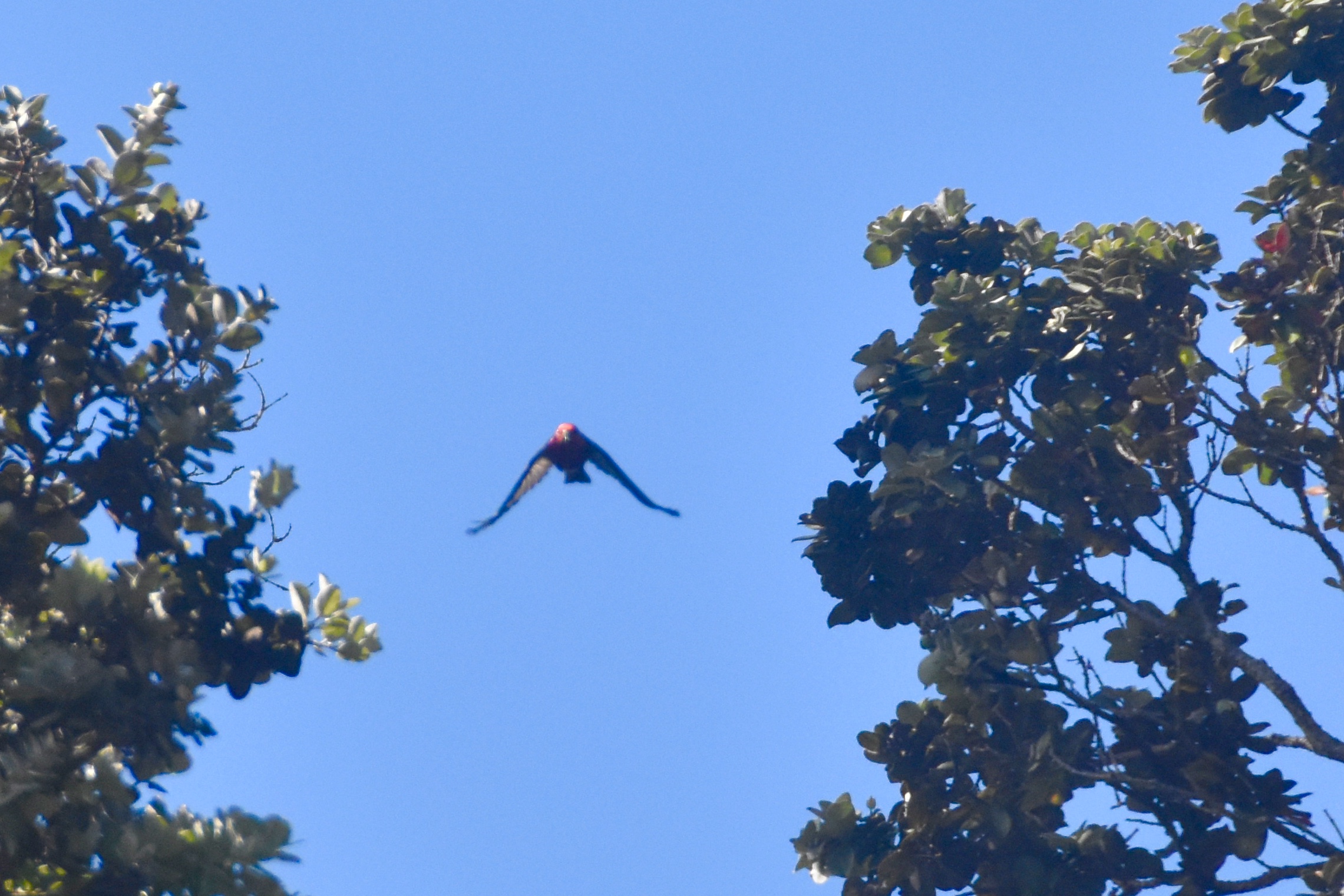
‘Apapane Solo

Once a young ‘apapane learned to sing (which is not unusual).

He grew up to sing with his family, with his friends, and with pretty much any other ‘apapane around. They liked to sing to each other in the trees as they sought the nectar from ohi’a lehua.

Singing just made this little bird feel good. Hearing the songs of the other birds around him made him feel even better. He wasn’t alone. He wasn’t forgotten. He was part of a flock, and they loved and cared for each other as they sang.

As ‘apapane go, he was an adventurous one. He would fly some distance away just to see what was there. He wanted to see new things, and discover new things, and (of course) going to a different part of the forest helped him find ohi’a that was in blossom.

The rest of the flock liked it when he’d explore, and they liked it when he came back, because he often could lead them to the next stand of trees bearing the bright red blossoms that sustained them.

One day, though, he went farther than usual. He was gone far longer than he’d been before, and while he was gone, the other ‘apapane realized they had to move on. The lehua on their stand of trees were going to seed. Making the best guess at the direction he’d taken, they set out after him.

They guessed wrong. Where he flew mauka, up the mountain, they flew makai, toward the lower slopes. They were sure he’d catch up, or they’d find him. But they didn’t.

When he made his long flight back to the ohi’a grove he’d left that morning, he found himself alone.

Sitting in the last tree with fading flowers, he felt very sorry for himself. He took a sip of the last nectar, and munched on some incautious insects, but mostly he felt alone. He opened his beak to make a sound something like a sob. It was a very sad noise.

In a moment, though, it shifted, because all his life he’d sung the ‘apapane song. His lungs and throat and beak all took that shape, purely by reflex, and he began to sing. He sang solo, no other ‘apapane replied, but in the song he realized that he still carried the ‘apapane music with him. His flock was with him, even if he had no idea where they were. They were with him in the song.

He carried on singing until he fell asleep.

The next day, he made a guess at which way the flock had flown, and they made another guess about where they might find him. They’d fly, and settle in the trees, and sing the ‘apapane tune. This time, good fortune was on the wing. He heard them first (there were more of them to hear, after all), but they soon heard his merry reply.

And so they sang once more together.

There is always something connecting us. Sometimes it’s a song, sometimes it’s a feeling. Always, though, it’s love – aloha – that links even people who are very far apart. Even when it seems that we’re at our loneliest, there is always someone who loves you, and best of all, there is always God who loves us best.

The video comes from the American Bird Conservancy’s YouTube channel.


The Many Forms of the Land

20170727 Kamokuna entryA little boy came to his grandmother one day because he had an urgent question. He had to decide what he’d do with the rest of his life.

His grandmother thought he had plenty of time to figure this out yet, since he was only nine or ten years old, but there was no stopping him when he got going on something. So she sat with him and listened.

First, he wanted to become a race car driver, and get behind the wheel of a big and powerful car, and zoom around the track at incredible speeds, and win great big trophies beneath the waving checkered flag. Oh, how he wanted to be a race driver.

“But, grandmother,” he abruptly said, “I don’t think I can do it. I don’t think I’m tall enough. You have to be really tall to drive a race car, right?”

Grandmother tried to break in that he had plenty of time to grow, and she didn’t think you had to be really tall to drive a car, but he didn’t give her a moment to speak. He was off again.

This time, he wanted to be an airplane pilot. He imagined soaring high above the clouds, and seeing places far away, and looking down on the land or the ocean from his airplane above. Oh, how he wanted to be a pilot.

“But, grandmother,” he abruptly said, “I don’t think I can do it. To fly an airplane, you have to go really high. I don’t even like climbing ladders. I don’t think that will work.”

Grandmother tried to tell him that he might learn to be more comfortable on ladders, and she’d seen him racing along the upper levels of the playground equipment, but he didn’t give her a chance to say a word. He was off again.

Now he wanted to be an explorer. He wanted to meet new people who’d never seen other people before. He wanted to be the first to see rivers and waterfalls, and find new kinds of plants and animals. He wanted to wear a leather jacket and a big hat, and speak fifty languages to the people who marched through the wilderness with him. Oh, how he wanted to be an explorer.

“But, grandmother,” he abruptly said, “I don’t think I can do that, either. After all, I really just like to stay at home.”

Grandmother was quick, this time. She jumped in before he picked another thing he’d love to do, but for some reason could never do. I think the hug might have been what worked to help him listen rather than keep talking.

“Grandson, listen to me for a little while,” she said. “I want you to close your eyes and imagine the things I describe to you.

“Imagine the mountaintop,” she said. “You’ve been there. You’ve seen how hard and sharp the rocks are. It’s a harsh, rugged place. And that’s the land. Yes, that’s what land is.”

Going on, she said, “Now imagine the beach. On the beach, it’s soft sand. It settles beneath your foot, and it tickles your toes. You can lie down on it and it cradles you. And that’s the land, too. Yes, that’s what the land is.

“Now imagine the forest, with its soaring trees and ferns growing wildly everywhere. In some places there are rocky outcrops, and in others swamps and reeds. The trees reshape the land as time passes. And that’s the land, too. Yes, that’s what land is.

“And now, grandson, imagine the volcano. Imagine the hot, liquid rock flowing down the mountainsides. Imagine it pouring red-hot into the ocean, and imagine the way it makes new land where there was water before. And that – the liquid lava and the bursting sand, and the hardened rock of the growing shoreline, that’s the land. Yes, that’s what land is, too.

“Land is like all of that, and even more things. Land doesn’t have an imagination; it doesn’t dream of the things it can be, and yet it takes all these shapes.

“Now imagine, grandson: if land can take on so many forms without a will or purpose or imagination, what makes you think that you’re more limited than the land? You have a brain to consider all sorts of things that might be.

“And grandson, you might make any of them happen.”

The photo is of lava entering the Pacific Ocean at Kamokuna, Hawai’i, on July 27, 2017. Photo by Eric Anderson.

Sometimes You’ve Just Got to Fly

The koa’e kea (or white-tailed topic bird) lives on the cliff sides around Kilauea. Well, some of them do. Some of them lives elsewhere around the islands.

White-tailed_tropicbird by YooshauThe koa’e kea flies down to the ocean to search for fish in the tossing waves. It is a strikingly beautiful bird, with bright white feathers set off by jet black ones. Plus, it has a long, narrow tail – the tail is longer than its body! It streams out behind it in flight.

This one koa’e kea was a serious kind of bird. He wanted to be certain to take care of things that were important. That meant, first of all, keeping himself properly fed, so he was often found scanning the sea for signs of fish or squid (sorry, calamari). He did not want his energy to flag because he’d skipped a meal.

He also paid a great deal of attention to making sure he had a proper nesting place. He looked carefully for the best place, where the nest would be safe from predators (or from accidentally falling down the cliff side).

He paid attention to other important things, too. He knew the importance of friends. So he joined in the conversations and the controversies, and he was always there with a joke.

(I’m afraid I’ve never been able to properly appreciate the humor of the koa’e kea. It mostly sounds like “SQUAWK!” to me.)

He found himself puzzled by his friends, however. Sometimes, for no apparent reason, everybody would take off and start to circle around Kilauea’s summit. They’d dip and dive, and climb and soar. They weren’t hunting anything (food was four thousand feet below in the ocean), they weren’t telling jokes (since every conversation went something like, “SQUAWK!” “What did you say?”), and they certainly weren’t tending nests.

It was all rather baffling.

Worse, he seemed to be the only one who didn’t understand it. His friends did it, but so did their parents. So did their parents’ friends. So did his parents. Everybody, from time to time, would just soar about the volcano.

Everybody except him.

He asked his friends about it, but they were just vague. “Why fly about the volcano? Well, no reason, I suppose,” they’d say. He swallowed down his annoyance. And finally asked his mother.

“Son,” she said, “you’re a good son.”

He nodded his thanks.

“But sometimes I think you miss things from doing everything so seriously. Life is more than keeping fed; it’s also about enjoying the fish you caught. It’s more than having a nest; it’s also about rejoicing in the chicks you raise. It’s more than chatting with friends; it’s also about enjoying their company in silence.”

“Son,” she said, “I know you can use you wings to get from place to place. But did you ever just stretch them out and fly?”

He looked puzzled.

“Sometimes,” she told him, “you just need to fly.”

You and I, well, we don’t have hollow bones and feathered arms. We’ll have to fly in other ways. But when we do find those ways – a song to sing, or a hill to climb, or a picture to make, or a thought to think – that’s when we, too, can fly.

And I assure you that this koa’e kea: he learned to fly.

20170819 Kilauea panorama

Kilauea Summit (Photo by Eric Anderson)

Photo of white-tailed topic bird (koa’e kea) in flight by Yooshau – Own work, CC BY-SA 3.0, https://commons.wikimedia.org/w/index.php?curid=18333581.

The Patient Honu

Honu swimmingThere are plenty of things to like about being a honu, a sea turtle. Just to start, there’s the joy of swimming in warm tropical waters, and of dipping down deep for the refreshing coolness, and rising to the surface again for a breath of air. Oh, yes, that’s something to like.

Swimming will also bring you down to the beds of sea grass, where you can nibble the tips from their shoots. Well, yes, I expect the honu would enjoy that more than you would, or than I would, for that matter. But we’d all enjoy doing acrobatics in the water, and when you’re ready for a rest, I know we share with the honu a huge affection for naps in the warm sun on the beach.

A young honu had done all this and more. Born on a beach on this island, he’d actually made a swim all the way around, and further, he’d taken a little expedition over to Maui. He’d seen different kinds of fish, watched seabirds float on the air, and tasted different sorts of seaweed. He’d sunned himself on white sand beaches, gray sand beaches, black sand beaches, and even a green sand beach. He rather thought he’d seen it all.

But he found one older honu rather puzzling.

He found her one day after she’d pulled herself up on a beach for a nap in the sun. The trouble was, there wasn’t any sun. It was clouds from one edge of the sky to the other. She appeared to take no notice as she lay there placidly on the beach, just as still and calm as if the sun were beaming down.

The younger one hauled himself up close to her and asked her what she was doing.

Then he asked again. And again. He had to tap her flippers once or twice to catch her attention. When this honu napped, she took her naps seriously. Finally she was awake enough to hear his question.

“What are you doing?” he asked.

“I’m napping in the sun,” she said.

He took another look about to make sure of his facts. No, he didn’t see any sun.

“But it’s cloudy,” he told her.

“I know,” she said.

“There’s no sun,” he said.

“That’s true,” she replied. “At least not now.”

“Then what…?”

“There are things in life that only come along once or twice,” she told him. “There are some kinds of fish you’ll see only once, or maybe even never, that your elders can tell you about. There are seaweeds that only grow in special places. There are friends who’ll decide to move about and you may not see them for years.”

“But there are other things,” she went on, “that come and go all the time. The kohola (humpback whale) visits in the winter, and swims away in the spring, and comes back the next year. You eat the tips of the sea grass, and they grow more. The tides roll up and roll back on the island shores.

“Sunshine is like that. It’s waiting behind those clouds. There will be sun on the beach.”

Sure enough, the clouds parted and a sunbeam glistened on the beach and on the water. Just for a moment, as it happened. And not where the two honu were talking. In fact, it disappeared almost as quickly as it appeared.

“It will be back,” the older honu sighed. “For some things — sea grass, rain, waves, tides, and sun — all you have to do is wait.”

And she laid her head back down on the sand, closed her eyes, and resumed her nap in the sun — the sun which would come as she waited.

Honu on beach

The Puzzled Nene

20170729 NeneThere was a young nene — that’s the Hawaiian goose, by the way, and did you know that it’s Hawai’i’s state bird? Good!

There was a young nene who lived on the slopes of Kilauea. Sometimes he’d be high up on the mountain, flying in search of ripe ‘ohelo or grass seeds or naupaka berries. Sometimes he’d fly makai, down to the rocky shoreline, where the other naupaka might be ripe.

It was on one of those days — when he was happily swallowing down the white ripe naupaka berries with some friends — when something unexpected appeared. A tall creature, standing easily five or six times his own height, came around a rock and stopped abruptly, standing on two legs. Three or four others appeared as well, stepping up onto rocks and coming into view.

The nene gave a small honk of greeting, but the creatures made no such understandable sound back. They did seem to be calling to each other.

They didn’t approach; in fact, they drew back some after the initial encounter. The nene found that puzzling. He was surprised that they didn’t come near.

Even more puzzling, they each produced flat rectangular objects that they held between themselves and the little group of nene. That made no sense at all to young bird, or to any of his friends. Did these creatures not want to look at them?

Most puzzling of all, after a time of box-holding, non-sensical noise-making, and back-drawing, the creatures turned on their two heels and walked away. Without eating a single naupaka berry.

To a hungry nene, that was the most puzzling thing of all.

If the nene ever learned what it was all about, I never heard about it. There were many things he didn’t know. He didn’t know that he and his friends were rather rare, and that humans had come to care about them. He didn’t know that humans aren’t supposed to approach nene, and if they do, they’re supposed to step away without troubling them. He didn’t know that humans are supposed to leave their food alone, so that the nene have enough to eat. He didn’t know any of that.

He didn’t know that there were people watching over him and his cousins, to see that they had every chance to live a good and healthy nene life.

Unlike the nene, we do know that God watches over us. We may not know precise how God is caring for us at any given moment, but we do know that God care at every single moment.

We know that God is always there.

Photo by Eric Anderson, taken with a flat rectangular object that shielded his face from the nene.

The Hungry Kohola

humpback calfShe was born in the waters that lie between Maui and the Kohala Peninsula of Hawai’i Island. At birth, she was already about twenty feet long.

Were any of you twenty feet long when you were born? No? Hm. I guess none of us are twenty feet long now, either.

She was, in fact, a whale. A humpback whale, a kohola. As she grew, she’d swim with her mother in the warm Pacific Ocean. She learned to eat the food that her mother and father and myriad cousins ate: She dive into the deeps, and open her mouth wide. As the water swirled in, it carried fish and shrimp and squid (it helps if you think of it as calamari) and tiny animals and floating plants. Then she’d close her mouth, push the water out, and sweeps everything else from her baleen plates with her tongue, and swallow.

Ah, now that’s a meal! If you’re a kohola, anyway.

But then her mother said it was time to leave Hawai’i and swim north to the Bering Sea. Away they went.

As they swam, the water got colder. The young kohola started to worry. The cool water felt fine to her, but what about the other creatures of the sea? More to the point, what about the ones she liked to eat? What if they didn’t like cold water? Would they still be there when she dove and opened her mouth wide?

What if there wasn’t any food in cold water?

But she’d follow her mother and the rest of the pod as they dove, and every time they did, they found fish and shrimp and squid (sorry, calamari) and everything else she liked to eat. They never had trouble keeping her growing belly full.

She rose to the surface to breathe, and sang, “They’re everywhere!”

Well, she was young. Fish and shrimp and squid (calamari) aren’t everywhere in the ocean, though it may seem so. What is everywhere, though, is the love of God. It always surrounds us, always feeds us, always sustains us, even when we don’t know.

The love of God is everywhere. You’ve nothing to worry about there.

The image of a kohola mother and calf was taken in the waters off Maui, and comes from the National Oceanographic and Atmospheric Administration collection. Public Domain, https://commons.wikimedia.org/w/index.php?curid=79963

All the Way

The Bible is filled with stories about people who traveled a lot. There’s Abraham (just for starters), and there’s Jacob, and King David, and the prophet Elijah. There’s Moses and Joshua, the Apostle Paul, and, of course, there’s Jesus.

Once upon a time God’s friend — have I mentioned God’s friend to you? God’s friend likes to hang out with God, and ask God questions, and sometimes even poke a little fun at God. A lot of my friends like to pick on me a little bit. How about your friends? Do they tease you sometimes?

No? Really? Well, what about the adults in here?

Ah, yes. We’ve got some people who’ll answer a question honestly.

In any case, God has a friend who likes to tease.

Anyway, God’s friend found God watching a person’s journey. The journey, I must say, was not going well. God had a notion about where the person should go, but the person was struggling to get there.

God would put up signs along the way to show the direction. Sometimes the person would look at them, check the arrow, and go off in the right direction. More often, though, the person simply didn’t look, and would turn or go straight more or less at random. Sometimes that had the person going the right way, but more often than not it was a side road.

When the journey came to a traffic circle, like the one in Pahoa, that’s when things got really interesting. The person came to the traffic circle no less than four times. After six turns around the circle the first time, the person headed off in the wrong direction. On another circle around, the person actually started back the way they’d come in the first place.

All told, the journey wasn’t going smoothly.

God’s friend watched God watching all this. And God showed not a sign, not an inkling, not a tremor of frustration or impatience during it all. God simply watched, and put up more signs, and from time to time God smiled.

God’s friend has less patience.

“This is taking forever,” God’s friend said. “I don’t know that this person will ever get where You want them to go. How long are you going to stay with them on this journey?”

God smiled. And then God said:

“All the way. I’ll be with them all the way.”

Which is, of course, how God stays with us, my friends. All the way.

All the way.

2016 Rainbow over road

A rainbow over the road in Waimea, Hawai’i, November 14, 2016. Photo by Eric Anderson.

The Kind Peacock

Peacock_Quinn DembrowskiThis story is more about a peahen than it is about a peacock. Well, it’s about a choice she wanted to make.

She was looking for someone to share her life with. Not everyone wants to, and not everyone can, but she could and did and so she was taking a look at all the peacocks around her to see who would make a good life companion. It turned out to be a problem, not because there too few (there were plenty), and not because there were too few nice peacocks (there were plenty of those, too), but, well…

There were too many to choose from. And frankly, they were very much alike. How do you choose when they’re all so similar?

They all had glorious fans of tailfeathers, with the bright emerald eyes glinting in the sunlight whenever they displayed them. They all had a very similar grace in the way they moved about, nearly dancing as they moved the fan left, and right, and forward, and back. They bowed their gleaming azure heads and necks with politeness and respect. They were even able to talk the good talk to her and the other peahens.

Well, all right. They were able to squawk the good squawk. It comes to the same thing.

With so many options, how was she to choose?

As it happened, it was the chickens that helped her decide.

No, they weren’t offering advice. They were sharing their living grounds and feeding area. There were nearly always chickens about.

Most of the peacocks ignored them most of the time. They didn’t say “Hello,” and they didn’t ask about their day. They’d readjust their fans so it faced a peacock, not a chicken.

There were other times when they stopped ignoring them, and it turned out to be a Bad Thing. They’d scream at them to go away, and they’d rush them with their wings batting away, and they’d even start pecking them with their sharp beaks.

One peacock, however, didn’t act that way. When the chickens showed up at break of day, he’d squawk a polite “Good morning.” When other peacocks started chasing chickens about, he’d stand between them and glare until they stopped. When he found a particularly good bunch of seed, he’d call out an invitation to everyone to come and share: peacocks and chickens alike.

That, decided the peahen, is the peacock for me. This is somebody who can care for creatures other than those like himself. If he’s kind to chickens, he’ll be kind to me.

Are you ready for the ending? Are you?

They lived happily ever after.

Photo by Quinn Dombrowski. Used by permission under Creative Commons license.

Ahi Afloat

Yellowfin_tuna_nurpAs far as this one newly hatched ahi was concerned, it all happened very quickly. One moment he was floating, newly hatched, in a sea filled with eggs. The next moment he was surrounded by newly hatched ahi, a cloud of silvery motion.

As ahi do, he grew quickly, and with the others he swam with the school of larger adults. They taught him what fishes were good to eat, and they taught him what fishes were good to swim away from, and they taught him how to swim very very fast when other fishes thought he might be good to eat. He learned a lot.

After all, he was in school.

(Moans from the congregation)

Now, really. You knew I was telling a story about a schooling fish and thought I wouldn’t make that pun?

(Rueful laughter. The children, by the way, were not impressed with the pun.)

There was one other thing they taught him. They told him not to swim too deep. They probably didn’t have to, because when he looked down, he saw the water get darker and darker, and it seemed pretty threatening to him. He had no interest in falling into the depths.

But he did start wondering how he would keep from doing so.

You see, that was something of a mystery to him. He saw other things descending from above, and sinking down into the murky depths.

No, not rocks. There aren’t a lot of rocks coming down from the surface in the middle of the ocean. Just take it from me there’s stuff that goes down.

He didn’t want to go down with it. And he couldn’t figure out why he didn’t.

Because he could swim? Well, yes. That was part of it. But mostly, it was because he was surrounded by water. He didn’t even think about it, it was so much a part of his life. You and I, we move pretty easily through the air and don’t think much about it. He was pushing against the water all the time with his tail to get himself moving, and with his flippers to change direction, and never thought about the water being there to push against at all.

It was the very water whose depths frightened him that held him up.

Now, the love is God is not like the water. But just as the water surrounded him so much that he stopped being aware of it, God’s love is around us all the time, so that we might not be aware of it. It’s around us, and even inside us.

And because it’s there all the time, it’s easy to forget God’s love is there. Yet there it is.

Oh, yes: there it is.

The Overburdened Albatross

Laysan_Albatross_RWD2There are creatures in the world who love to collect things. Lots of things.

There’s the bowerbird of Australia and New Guinea, who assembles a collection of brightly colored objects (from shells to flowers) to impress a potential mate. There’s the pack rat of the Americas, who will use anything and everything to construct a nest.

And then there’s people. We might be the greatest collectors of all. We are amazing.

If there’s one creature who shouldn’t, and doesn’t, collect a lot of things, it’s the albatross. They spend most of their time far out at sea, gliding on the trade winds over the ocean, landing on the water’s surface from time to time to snatch a meal. Sometimes it’s fish, sometimes it’s squid. They like squid.

You don’t think squid sounds very tasty? Some people like it better if you call it calamari.

Did that help?

Whether you like squid or calamari (or neither), it’s a difficult life for a collector. Nevertheless, there was once a young albatross who set out to do precisely that. I have no idea why.

He started with pebbles he found along the shoreline near the nest where he’d been hatched and grown to become a young adult. I guess he found the colors or the shapes interesting, and they made a nice addition to the nest. Then he added different kinds of grasses that he found. When the old ones blew away, he brought new ones.

Soon there were sea shells piled around his nesting spot, and inevitably the trash that humans leave behind. Some albatrosses get very sick by eating these things, but he just picked them up and put them down again. There were bits of plastic, and shreds of cloth, and his grandest prize of all: the better part of a beach blanket that had floated away from somebody one day.

That wasn’t any of yours, was it? Oh, good.

As his collection got bigger, his circle of friends got smaller. Not because they objected to his hobby, no: but because the season was passing, and they started leaving the nesting site. They were riding the winds out over the Pacific Ocean, with an occasional descent to the surface to catch calamari.

Or squid, if you prefer.

But this young albatross didn’t want to leave his collection. Oh, he tried to take it with him. He wanted to soar over the ocean, too. But when he tried to carry everything on his back, between his wings, he couldn’t manage to take off. When the load was light enough to fly, everything tumbled off. He tried gripping things in his beak, but he quickly realized that he couldn’t eat that way. It’s hard to hold things in a webbed foot, and when he wanted to use two feet to carry things, well, he found that it didn’t work.

And it was also painful.

Finally, it was hunger that made him see the true worth of his piles of pebbles and shells and even the magnificent beach towel. However lovely they might appear to his eyes, they didn’t feed him. No, they didn’t feed him.

Not the way that the skies of the Pacific fed him. Not the way that the waters of the Pacific fed him. And certainly not the way that the squid (or the calamari) of the Pacific fed him.

So he stepped carefully away from his collection, gave it one last look, spread his broad wings, leaped into the air: and flew.

Photo credit: By DickDaniels (http://carolinabirds.org/) – Own work, CC BY-SA 3.0, https://commons.wikimedia.org/w/index.php?curid=18611723