Food in the Gaps

ohia-blossoms

Ohi’a lehua (Ohi’a blossoms)

This story is about a young ‘apapane – a small bird which is part of the Hawaiian “honeycreeper” family – who was looking for food.

As a nestling, he’d been raised to eat whatever his parents put in his mouth, which works pretty well when you’re a young bird. He’d grown bigger, he’d learned to fly, and he’d learned to sip nectar from the ohi’a lehua, the blossoms of the ohi’a tree. In fact, that’s what he’d eaten ever since leaving the nest.

He thought it was delicious.

But now, he was hungry. Trees don’t blossom all the time; the flowers come and go. The bit of forest where he’d grown up had gone through its cycle, and the other, older ‘apapane had already flown off to find food elsewhere, and he hadn’t quite noticed.

He was pretty sure that there were other stands of blooming ohi’a, though – at any rate, he certainly hoped there were! – so he flew up the mountain and down the mountain and from side to side. Truthfully, he ended up flying in circles for quite some time without covering a lot of territory. And the whole time he got hungrier and hungrier.

Finally, he got lucky. One of his circles swept farther away than he’d gone before, and he heard the singing of other ‘apapane. That caught his attention. If they were singing, he thought, then they’re probably not hungry, and that means: Food. And off he flew toward the singing.

Sure enough, there were ‘apapane in the trees, and the trees were festooned with ohi’a lehua.

He gratefully gripped a branch between two clusters of blossoms, and got ready to dip his beak into their flowers. Before he did, something moved along the twigs in front of him. Startled, he took a second look.

There were small insects sharing the tree with him. They were just as attracted by ohi’a lehua nectar as he was, and quite a number were hopping between the blossom clusters.

His first thought was probably similar to what any of us would think: “Ick! There’s a bunch of bugs on my lunch!” But his second thought, which happened between his belly and his beak without spending much time in his brain, was: “I’m hungrier than I ever remember being before. I’ve flown all around, and I need food. Rich food. In fact, I need…”

CRUNCH.

Yep. He ate the bugs.

Now, I don’t think anyone expected me to compare the goodness of God with eating bugs, but that’s precisely what I’m doing here. Our ‘apapane knew what was good to eat, and he searched for it, and he found it. What he hadn’t imagined was that in the gaps between what he knew, there’d be something he didn’t know, something that would meet a more desperate hunger than he’d felt before.

That’s true for us. Between what we know are the new things God may do for and with us, which will nourish us in ways we haven’t been before, and haven’t needed to be before.

I’ll just mention that the ‘apapane at the bugs and he thought they were pretty good.

What God has for us, waiting between what we know, is even better.

Gripping the Tower

block-game

Photo by Igor Trepenshchenok, distributed by Barn Images. Used by permission under Creative Commons license.

You may remember that a couple weeks ago I brought in a tower of blocks, one that’s a game.

You probably know how the game goes. The players each have to remove one block from the tower in their turn. And you keep going around to see who ends up pulling the block that makes the tower fall down.

Those who like to win select their blocks very carefully, and they move them gently, slowly sliding them out from their place and leaving it just that much harder for the next person.

Those who like to watch block towers fall down, well, they play it differently.

This story is about two girls who liked to win. One of them had been playing the game at her friend’s house, and when she got home, her mother noticed that she looked angry and upset.

“What’s wrong,” she asked, “Didn’t you have fun?”

“No,” announced her daughter. “She cheated. Every time she went to pull a block out of the tower, she held onto the tower with her other hand. That’s against the rules. She cheated.”

She continued on this theme for some time, more time than I really have to tell you this story. Eventually, so ran out of steam.

And her mother, who’d been thinking about this for some time, said:

“You know, if both of you held the tower while you were pulling your blocks out, that would still be fair, wouldn’t it?”

“Well, yes,” said her daughter, “but it’s against the rules. It’s wrong.

“Yes,” her mother nodded, “but which would you like better: To play the game with your friend, or to be right?”

“I want to do both,” said the little girl.

“I’m sure you do,” laughed her mother, “but we don’t always get to do both.”

It took the little girl some time to make that choice. It wasn’t easy at all!

But the next day, she was back at her friend’s house, and they each held the tower as they gently pulled out their blocks.

Because the game could go on.

The Appreciative Goat

mauna-kea-from-the-air

Mauna Kea from the air. Photo by Eric Anderson.

A few weeks ago, I revealed that I didn’t know that there were wild goat living on Hawai’i Island. So I went to learn a little more about them, and thus today’s story is about…

Wild goats living on Hawai’i Island.

It’s not an easy life being a wild goat on Hawai’i Island. They tend to live up the slopes of the mountains, where the big lava flows have left a landscape of broad swathes of old lava rock, with just a few plants growing in crevices. If you’re a goat, that’s what you eat, and so you spend most of the day looking for something to eat.

If you’re the small goat in the herd, you get last place for everything: for a spot under a tree when it rains, or for water at the high lake or spring, and, of course, for food when the herd has found a patch of green.

Now, the herd thought this one small goat was actually rather peculiar.

You see, when the herd found something to eat, they’d shoulder him aside, and he’d stand and wait to see what was left for him. But as they looked up and saw him standing there, sometimes he’d be looking up to the sky, as if he were watching the clouds.

“What are you doing?” they’d ask, and he’d say, “I’m watching the clouds.”

“Do you see how they come and wrap around the mountain, and then tail off into feathers as they blow away downwind?”

“Not really,” said the other goats, and went back to eating.

A little while later they’d look up, and he was gazing down the mountain to where the sea glowed in the distance. “What are you doing?” they demanded.

“I’m looking down at the ocean,” said the goat, “with all its shades of blue, and I’m watching how it fades up into the blue sky, and how all those blues come together so beautifully.”

“Huh,” said the other goats, and went back to eating.

As day ended, and they were actually feeling full (they’d found a good patch), they glanced up and there he was, staring into the distance again. “What are you doing?” they sighed.

“I’m watching the sunset,” said the small goat. “Look at the reds, and the oranges, and the purples. They’re all over the sky and the clouds and even reflected in the sea.”

“Ah. Right. You’re just crazy,” said the other goats, ignoring this. “Come and eat.”

Now I’ll be honest. I’m not really certain that a goat can appreciate the sunset, or the ocean, or the clouds. I hope they can, but I really don’t know.

I do know that people can appreciate the sunset (or the sunrise!), and the ocean, and the clouds above. I know that people can. And I know that some do not.

I hope that you’ll be people who do look up at the clouds with wonder, and the ocean with amazement, and the sunset with awe. I hope that you’ll do it always.

Tough Enough

9e42e40a-58c1-4c02-a3ab-94f914855df3I’m afraid that this story begins in much the same way that another story I told you began. I don’t think I’m running out of ideas already, but actually, I can imagine a lot of stories might begin this way, so…

Perhaps I’d better begin again.

This story begins with some children playing. All was as it should be, that is: just a bit exuberant, just a bit frenetic, just a bit noisy.

I’m not entirely sure what they were doing, whether it was throwing a ball, or a Frisbee, or having a game of tag, or something completely different. What I do know is that as they were running through the grass, one of them tripped and fell down, and the One Rule of Grassy Fields is that where your knee lands is where the rock is.

All the adults in the room seem to know this; did you hear them all groan?

Well, the little girl that fell and skinned her knee: She was determined to be tough. She got right up and she didn’t let it stop her, even though it looked pretty bad. I mean there were lots of cuts, and it was starting to bruise, and all in all I don’t want to think about what it looked like so let’s just skip it.

I can tell you it hurt her pretty badly.

But she was tough, and so when she went home you know there were two people she didn’t tell about it, right? It was Mom and Dad, of course. She wasn’t going to make a fuss about it, or ask for help.

So for the next couple of days she put on long blue jeans each day so that nobody could see her scraped up knee. She’d have been much more comfortable in shorts or a dress, especially because the hard fabric of the blue jeans rubbed right on the gouges. It hurt her a lot, but she was tough, and she wasn’t going to show it.

It was her mother who figured out that something was going on, and she finally got it out of her. So the next few minutes were filled with cleaning off the scratches, and putting ointment on them, and covering them with a bandage so they stopped rubbing against things.

Only then did her mother ask, “Now. Why didn’t you tell me about this?”

Her daughter sat up straight and said, “I’m a tough kid. I can handle things. I want to handle things myself.”

Her mother sat for a moment. Then she replied:

“I’m glad that you want to be strong. I’m glad that you want to take responsibility for yourself. I’m glad that you want to be your own person. I’m glad you want to be tough.

“I also want you to think about the thing that was too tough for you to do: telling me and your dad. I want you to be tough enough to tell the truth. I want you to be tough enough to say what’s happening with you. I want you to be tough enough to say that you need help when you need it.”

I hope I’m tough enough to tell the truth, too.

Wrasse-ling with Destiny

cleaning_station

Cleaner wrasses at work on a Hawaiian reef. Photo by Mbz1 (see below)

I’d like to apologize for the pun in the title. Unfortunately, I can’t, because I haven’t repented it. I do offer my regrets for any pain that it may cause.

I’m going to tell you about a small fish of a type called a “wrasse.”

This little wrasse was, well, just a bit of a thing when he hatched. He darted about with his many brothers and sisters through the water, and any time something drifted by that looked about the right size for their mouths, they’d snatch at it to see if it was food. Sometimes it was, and sometimes it wasn’t, but you know, when you’re a little fish in a big ocean, that’s as good a way to find out as any.

Come to think of it, human children take much the same approach… Pick up, put in mouth… Yuck!

But I digress.

As he grew, this young wrasse discovered that he had been born into a family business, which is kind of unusual for a fish. His parents and aunts and uncles and grandparents and so on would hang out at certain spots on the reef, where other fish – much bigger fish – would come and gather. The adult wrasses would swim around them, poking at their scales to find weeds and little creatures that latched onto them. Then they’d pick those little things off and eat them.

That was their supper.

Aren’t you glad that you’re not a cleaner wrasse?

Well, this little one wasn’t sure he wanted to be a cleaner wrasse. He’d watch wide-eyed as the older ones would swim right around the huge fins and gills, and even dart between their long sharp teeth to pick the parasites out of their mouths. All he could do was gulp and wonder.

But it was the family business, so…

The day came when he took his place on the reef with everyone else, and up swam a great big fish. He gave the “clean me” signal, so the little wrasse started in. He picked away little crabs and loose scales (and incidentally, he thought they were delicious).

But he still hesitated when he got to the big fish’s mouth.

He stopped, and looked the big fish right in the eye, and asked, “Um. Are you going to eat me if I go in there?”

The big fish seemed to think about it.

“Well, if I eat you,” asked the big fish, “will you come back and clean these little nuisances of critters that are driving me crazy?”

“Well, um, no,” said the little wrasse. “If you eat me, I wouldn’t do that.”

“Oh,” said the big fish. “In that case, I won’t eat you now.”

“In fact,” it continued, “I won’t eat you next time, either. How does that sound?”

It sounded pretty good to the little wrasse, who went back to work in the family business and never looked back.

And that’s how thing are on the reef: In the big ocean, there are creatures who now that they need each other. They need each other just as we need other people. They need each other just as we need every other living thing on this Earth.

Photo credit: By Wikimedia user Mbz1 (assumed based on copyright claims). – No machine-readable source provided. Own work assumed (based on copyright claims)., CC BY-SA 3.0, https://commons.wikimedia.org/w/index.php?curid=2660436

The Best Bakers

img_0583

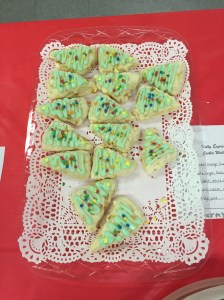
Cookies!

I’d like to tell you a story about the best baker in all the world.

He could do wonders with flour and butter and eggs and salt. He made French pastires filled with custard and covered with chocolate. He brought Italian biscotti to that perfect balance of sweetness and crunch. He could turn out a Japanese mochi that danced with tart and sweet.

He made apple pies. Lemon cakes. Liliko’i tarts. And, of course, because no baker’s repertoire is complete with them: malasadas.

He knew he was the best baker. He had time and he had the means, so he traveled all of the world, and all over the world he’d sample pastries, and pies, and breads, and filled buns. He ate tres leches cake in Mexico, and sesame cake in China.

And wherever he went, he never tasted anything without knowing – because he’d tried it – that he’d made one that was better.

The trouble was, he was the only person who knew this. He was the only person who ever tasted what he baked, or fried, or steamed.

I’ve never known why this was so. Maybe he was shy, and didn’t want to embarrass himself (as if he would). Maybe he was just plain greedy and selfish and didn’t want to share. Maybe he wanted us all to be healthy and didn’t want to feed us so much sugar. I don’t really know.

But he was the only person who ever tasted what he made.

So… Let me tell you about the second-best baker in the world.

She, too, made amazing cakes, and pies, and tarts, and rolls, and pastries, and (of course) an astounding malasada. Hers weren’t always the best – I know, for instance, that the best squash pies are made by someone who lives in Norwalk, Connecticut – but on the whole, she was the best baker that anybody had every known.

You see, everybody believed that she was the best baker in the world, because she shared. When she made cookies, other people got to eat them. Her cakes got cut up and shared at parties. They went far and wide.

People tasted her glazes and their eyes would glaze over in wonder.

They’d go pie-eyed in astonishment at a bite of her pies.

And as her pastries disappeared, those who enjoyed them wore grins pastried plastered all over their faces.

Now, if I could choose between being one of them or the other…

If I could choose between being the best baker in the world and never seeing the joy on another face from tasting my work, or being the second-best baker in all the world and sharing widely, I know exactly which I’d be.

I’d be the second-best, and I’d share.

May all of us always, always, choose the same.

This story was told in worship during the installation of the Rev. Eric Anderson as Pastor of Church of the Holy Cross UCC in Hilo, Hawai’i, on September 10, 2016.

Imagine the Ocean

0B2B5449-9B2D-4584-80D6-5228A482F2E8

Lava enters the Pacific Ocean in August 2016. Photo by Eric Anderson

This week I’m not going to tell you a story about a sport that you don’t play (or that I don’t play), so we don’t have to worry about not knowing the rules.

Instead, I invite you to use your imagination. That’s something all of us can do.

Imagine the ocean, the seas of this planet, as if it were a person: someone who could think, someone who could feel, and someone who could talk.

Imagine the ocean rising up all around the earth as the skies poured with rain for years and years and years.

Imagine the ocean flexing its currents as they started to move about.

Imagine the ocean, as its surface climbed higher and higher above the sea floor, wondering aloud if would cover all the earth.

Imagine God looking over it all, and saying, “No. I think not. There won’t be quite so much water for you, Ocean. There will be dry land in the world.

“But…

“Even on the highest peaks, Ocean, there can be water.

“Even on those highest peaks, Ocean, water will fall in rain or snow. In fact, the highest summits of Earth will always wear a crown of snow.

“Above those highest peaks, Ocean, clouds may float: your water, suspended in mid-air, raining down from time to time to return to you again.”

And so, to this day, the Ocean drinks in the rain and snow that falls above land or sea. And to this day, the Ocean grumbles at the shores, constantly reshaping and reforming the boundaries of the land, hoping, perhaps, to one day cover all the globe.

And to this day, slowly but surely, land still rises higher in places, pushed from below by currents of rock.

And to this day, in other places the currents of rock run down the mountainsides, where they may reach the ocean and win new land from the sea amidst a scarlet glow, and the water hisses and fumes.

And to this day, God looks upon land and ocean, and smiles.

Soccer Woes

Emerald Dragons play soccer

Photo by Andy Elck – Used by permission under Creative Commons license.

In introducing this story, I asked if the kids were soccer players, because a few weeks ago I told a story about baseball, hoping they played it and would know about it. Well, I struck out. Then I tried telling a story about a Yu-Gi-O, the card trading game, hoping they played that. And I ended up with an empty hand.

So this week I turned to soccer, which everybody plays now, right? and once again, I failed to score. I think they’re due a penalty kick…

There was a boy who really wanted to play soccer. He loved it and he was always eager to play, so he joined a league and he joined a team.

There was only one problem: it turned out he wasn’t very good at it.

There are kids who run fast. He wasn’t one. There are kids who can kick the ball any direction they like. He could kick it pretty much anywhere but where he wanted it to go.

He kept forgetting that you can’t touch the ball with your hands, and he’d reach out to grab it as it sailed by. And the first time he tried to “head” the ball, which is to hit it with his head, it went very badly indeed. Not only did he miss the ball, he managed to trip himself and fell face-first into the grass.

It’s hard on a team when there’s a player who’s not very good. Sometimes, though, those players bring a sunny spirit to the game, and they make everybody else feel good. It happens.

But… not this time. Every time he missed a kick, he’d mope. He griped about his slowness and his clumsiness, and he moaned every time the team lost, which, it has to be said, was most of the time. It wasn’t his fault (entirely), but they weren’t winning.

His teammates, frankly, would have been just as happy to see him go. He wanted to play, though, and his coach said he could stay, so he did. Poor skills and sour attitude and all.

As the weeks went on, though, his teammates began to notice that he was always at practice. He never missed a game. He moaned and groaned, but he worked hard to get better.

And he did get better. Not a lot, it’s true, but he kept trying and trying. He stopped raising his hands to catch the ball, and he stopped tripping over his own feet. He didn’t get fast, but he got faster. He didn’t kick the ball terribly hard, but more and more it went his way.

He never got worse. Each time, he was a little bit better. Never very good, but always a little bit better.

The rest of the team noticed. First one or two, then two or three, and then the rest: they noticed he was getting better.

And if he could get better, they thought, so could they. So they did.

They worked the way he worked, and sure enough they got better. They got better, and they started to win games. By the end of the season, they had more wins than losses.

As for this one boy who wanted to play soccer, it’s true that he was never a very good player, let alone a great one. But he was a leader. He was the one who led his friends to improve, just a little, each time, to be come a pretty good team.

Sunglasses

IMG_1399

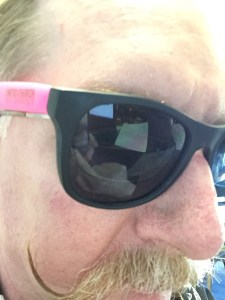
Why yes, I do have United Church of Christ themed sunglasses. Why do you ask?

Before worship began, I wore these sunglasses as I walked down to church from my house. And they worked really well. I could see where I was going, and I wasn’t squinting in the bright sunlight. That’s pretty cool.

Now, however, I’m wearing them here in the church. And it’s not working so well. In fact, I can’t see very well at all.

If anybody’s looking to sneak out without my noticing, this is probably a good time.

In fact, is anybody still here?

When I take them off: Look! There you all are!

In bright daylight, the sunglasses help me to see.

But in a darker place, taking the sunglasses off helps me to see.

There are lots of things in life that are like this. They work in some places, and they don’t work in others. You have to try and see what helps in this situation, but don’t assume that what works now works then, and that what didn’t work then doesn’t work now.

Life can be complicated.

One thing always works, though: seeing the world through Jesus. Seeing the world through the love and kindness and compassion that he showed. Seeing people around us as beloved by God. Seeing the world God made as lovely and precious.

It’s better than sunglasses in a dark room.

It’s even better than sunglasses on a bright sunny day.

When Did God Create Music?

IMG_1373Well, I don’t know when God created music.

I’ve sometimes liked to say that God created music on the fifth day of Creation (as it’s described in Genesis): “And God created the birds of the air (who sing!) and the fish of the sea (who sing in water!), and it was morning and it was evening, and it was choir night: the fifth day.”

That, of course, comes from spending time in several churches whose choirs rehearsed on Thursday night.

But in truth, I like to believe that God created music first.

I like to think that God created music by singing first into the vastness of the universe, one voice ringing in the void.

I like to think that the stars and galaxies came to be so that the music could echo from them – and become the music of the spheres.

I like to think that when the planets formed, the sighing of wind and waves carries the songs of God.

I like to think that birds began to sing so that they could join the melodies of God.

I believe that you and I exist so that we might harmonize with our Creator, that we might make the music even greater.

Sometimes we’ll join with instruments or voices, blending with each other to swell the chorus of the ages. Sometimes we’ll join with dance, with swaying bodies or lilting hands. Sometimes we’ll join by building other harmonies: with kindness, compassion, love, and care for people, creatures, and this created planet of ours.

I believe that when we make our harmonies, God smiles…

And keep on singing.