“[Peter said,] ‘This Jesus is ‘the stone that was rejected by you, the builders; it has become the cornerstone.'” – Acts 4:11
Your Honor, I am here accused. They say I spoke of resurrection. Yes, I did. They say I said this comes from Jesus, and: I did. They say what you can plainly see. I am no educated scholar, no respected sage, no doctor of the law.
Because of this, they take me up before you as an agitator who disturbs the peace, the truth, the faith, the way, the light. They say I should be silenced, voice unheard, the things I’ve seen forgotten, left untold, until no one remembers anything.
Were I to make a strong defense, I’d tell you that your officers misheard our words, misunderstood what little they had heard. We made no claims like those of which we stand accused. We spoke of resurrected hopes alone, within this man who now can walk.
Alas, I make no strong defense. Instead, I’ll make those claims again for you to hear. In Jesus there is resurrection of the body and of hope, of healing and of joy restored. And neither John nor I can hold our tongues from sharing this great news.
I’m sorry, in a way, that my defense is only to repeat the offense that has brought me here before you in this place. I’m sorry that it grieves you, and I hope beyond imagination, that it moves you to a mercy given, mercy then
received.
A poem/prayer based on Acts 4:5-12, the Revised Common Lectionary First Reading for Year B, Fourth Sunday of Easter.
The image is a part of the Sarcophagus of Marcus Claudianus (ca. 330-335, Palazzo Massimo, Rome): Detail, The Arrest of Peter. Photo by Dick Stracke – Own work, CC BY-SA 3.0, https://commons.wikimedia.org/w/index.php?curid=31956813.
I believe I mentioned a few weeks ago that if there’s something edible up in the ohi’a and koa forests – bugs, berries, fruit, sap, nectar, caterpillars, and so on – there’s an ‘amakihi eating it. They’re not picky eaters. They’re enthusiastic eaters.
Except for one young ‘amakihi. She was perfectly picky.
I don’t know how it got started, but I do know that early on she’d only eat bugs that she’d seen fly. I guess that meant they were fresher, somehow? Which meant that she would no longer eat the crawling bugs or the caterpillars, and there would be no spiders in her diet.
I know. You’re thinking, good choice. Along with you, I am pretty happy not to eat bugs at all. We are people, though, and not ‘amakihi.
Then she wouldn’t eat tree sap that came from cracks in the bark. I know – again, it sounds like a good choice for a human. But if you’re not going to eat tree sap that comes from cracks in the bark, how are you going to get to it at all? An ‘amakihi beak isn’t a good shape for making holes in bark. She’d removed another entry from her diet.
Then she decided not to eat fruit or berries unless it was perfectly ripe. That cut out a whole lot of fruit that was almost ripe, and it cut out a lot of fruit that was just past ripe, all of which feed other ‘amakihi perfectly well.
Her family started to notice that she was maybe getting a little thinner.
When she decided that the only nectar she’d sip would be from perfectly formed ohi’a flowers, that really did it. Go up to the ohi’a forests and you’ll find plenty of flowers on the trees. But are they perfectly formed into red puffballs? Not exactly. Some flowers show just a few scarlet tendrils. Some form ovals or just plain look squashed.
She wouldn’t eat from them. She wouldn’t even eat the flying bugs that landed on them.
She was hunting through an ohi’a tree that was bright red with blossoms – but very few of them perfect blossoms – when the branch jumped with another bird landing. She looked up and saw her grandmother watching her. Grandmother watched her pick over a big bunch of lehua, sip from none of them, and hop over to another, and sip from none of them.
“What are you doing, granddaughter?” asked grandmother.
“Eating,” said the picky ‘amakihi. “I’m hungry.”
“Eating what?” asked grandmother, who hadn’t actually seen her granddaughter eat anything.
“Nectar,” said granddaughter.
“Where?” asked grandmother.
“From the good ones,” said her granddaughter. “I only eat from the perfect flowers, Tutu.”
Grandmother looked at the tree full of blossoms and didn’t see many perfect ones. “You won’t find many perfect ones, granddaughter,” she said. “Not here, and not anywhere.”
She watched the picky ‘amakihi skip perfectly good (if imperfectly formed) ohi’a flowers for a little longer and said, “I think you should eat from some of the imperfect ones, young one.”
Granddaughter, who was annoyed, poked her beak toward a flower that basically had two red tendrils and no visible nectar, and said, “You mean like that one?”
“No, child,” said grandmother. “Not like that one. There’s nothing there. But the question isn’t whether a flower is perfect or not. The question is whether it feeds you.”
The picky ‘amakihi thought about this a while. And she really was hungry. With a glance at her grandmother, she put her beak into a bright red ohi’a flower which, to be honest, wasn’t perfect, and fed.
by Eric Anderson
Watch the Recorded Story
I write these stories ahead of time, then tell them in worship without notes. As a result, they change in the telling.
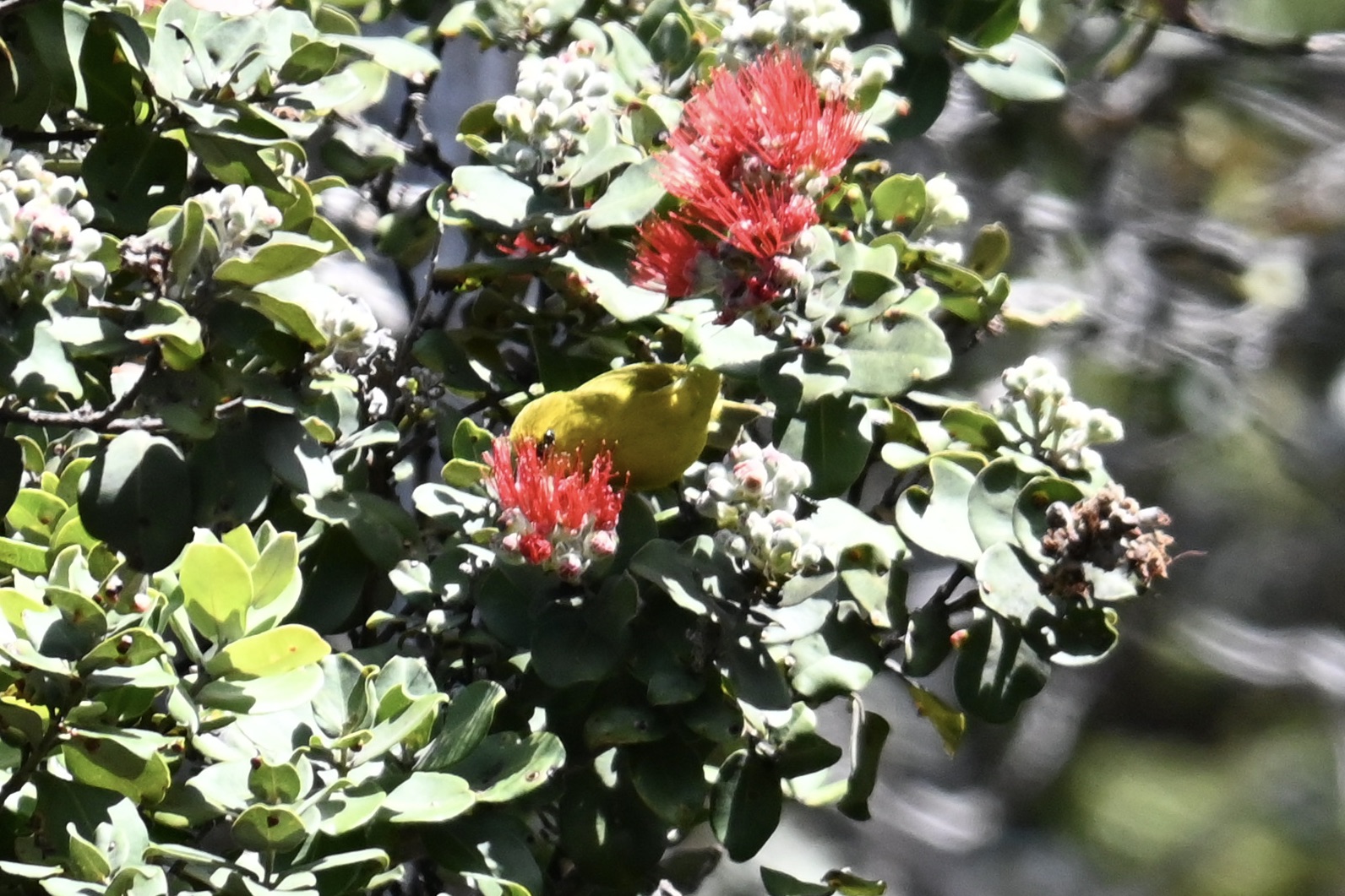
Photo of an ‘amakihi feeding at imperfect ohi’a flowers by Eric Anderson.
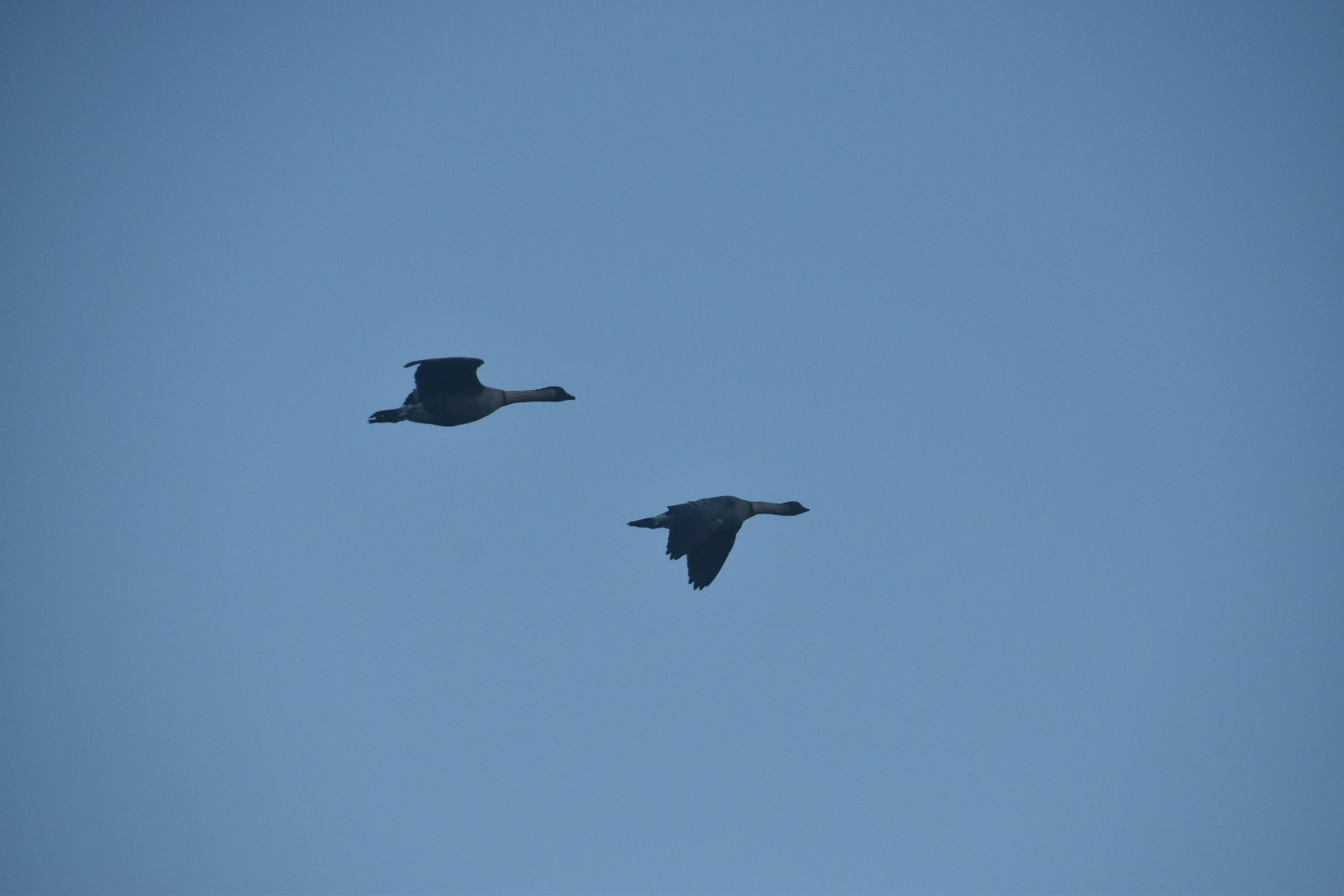
Most of the birds of our island fly by themselves, or in a loose flock. Around Hilo we’re mostly likely to see a pair of finches or a larger group of mynas flying together. Myna flocks tend to be rather chaotic, with birds crossing back and forth and no real attempt to build a formation and stay in it.
There’s an exception to that, and it’s the nene. I’ve mentioned nene school to you. I haven’t told you about the origin of nene school, which goes back so far that nobody really knows when it started. The nene don’t, and if the nene don’t, I certainly don’t.
The problem was that the nene liked to fly together and chat while they flew. They make that “Ne. Ne,” sound as they go. In the days before the foundation of the nene school, however, the cheerful “Ne. Ne,” would be interrupted by screeches and cries to veer off, and sometimes by the distressing sounds of wing feathers scraping over one another, and then the groans of pain and, of course, angry squawks of denunciation.
The problem, of course, was that nobody knew, when flying together, what any other goose would do, so they were making goose guesses. Actually, since there’d be more than one goose guessing, there’d be geese guesses. If one was young, you’d have gosling guesses. And if you had a visiting goose, there’d be guest goose guesses.
When one of these geese guesses was wrong, you’d get geese gripes.
When they founded the first nene school, everybody was eager to take part, and everybody came to the first class. And the second. And the third.
But one goose guessed wrong about when the fourth class was being held, and he missed it. He did show up for the fifth class, and, well, he made more goose guesses that goofed. The nene flying that day lost feathers, altitude, and tempers.
The teacher took him aside when class was over. She didn’t ask him why he’d missed the previous class. She just told him that what he’d missed, he’d have to learn.
“This is why we started this school in the first place,” she said. “We’re learning to fly together, to fly the same speed at the same time holding the same distance. We’re learning to be predictable and trustworthy in our own flying so that we can trust what the other nene will do. No more goose guessing.”
So he stayed and flew, and this time he learned the things he’d missed from the previous lesson, and he learned the things he’d missed from the lesson he’d just taken but hadn’t learned anything because his goose guesses had gone so goofy.
There are plenty of things in our human lives that we do separately, each in our own way. But there are also lots of things that we do together. We need to know what our fellow Christians are going to do, and they need to know what we’re going to do, so that we make things happen together.
It goes better than geese guesses.
by Eric Anderson
Watch the Recorded Story
I write these stories ahead of time (it’s the text you just read) but I tell them from memory without notes. And so they change in the telling.
“[Thomas said,] ‘Unless I see the mark of the nails in his hands, and put my finger in the mark of the nails and my hand in his side, I will not believe.'” – John 20:25
So now I, too, demand, O Christ, to see your wounded hands and side, your living skin, as Thomas asked, and I, too, will agree that second-hand report tends toward chagrin. As much as I appreciate the word that blessed are they – am I – those who believe without the gift of sight, the centuries have blurred what they reported. Some try to deceive us, with their testimonies falsified. They do not claim you dead, but kill your way of all-surpassing love. That they deride, your new commandment now they disobey. For centuries we have embraced this strife Instead of taking hold of your new life.
A poem/prayer based on John 20:19-31, the Revised Common Lectionary Gospel Reading for Year B, Second Sunday of Easter.
As an undergrad, I studied stage lighting. Caravaggio’s use of light and shadow taught me a great deal. In this painting, the shadows on Thomas’ bright forehead reveal his stunned astonishment.
As in (some) years past, I wrote a new song for Easter to play and perform for the post-Easter Sunday episode of What I’m Thinking, my weekly video program at holycrosshilo.com. It’s a song that refers both to the events of the first Easter and of the Sunday that followed.
Am I thinking this week after Easter Sunday? Well, no, not yet. But I am singing “Tell Me to Turn Around.”
Here’s a transcript:
In the week after Easter Sunday I’m afraid I find it difficult to think about much of anything. That’s sad, because the Gospel lesson for this coming Sunday is the story of Thomas and his doubts (John 20:19-31). Poor Thomas gets less of my thinking than he deserves.
As a result, What I’m Thinking this week is What I’m Singing. This is something I have done a few times at Easter over the years, and so I’m pleased to bring you this song: “Tell Me to Turn Around.”
Where have you brought him? How can I see him? I want to know why these ugly things happen. But for now, just tell me. Tell me to turn around.
[Chorus]
Turn around, look behind, where I haven’t looked before. Turn around, clear my eyes. The life is glowing, and I am crowing That the world has changed since I turned around.
[Verses]
You told me already we’ve lost him completely. I want to know why these ugly things happen. Mary, what more can you tell me today? Tell me to turn around.
You told me, and told me, but what good are your stories? I want to know why these ugly things happen. Why are you lying about his wounds, brothers? And you tell me to turn around.
In the gospel stories about Easter, there’s a common theme. It’s unbelief. People heard – from angels, initially – that Jesus had risen from the dead, and… they didn’t believe them. Later people heard from other people that Jesus had risen from the dead, and they didn’t believe the people. I guess that makes sense. If you don’t believe angels, how likely are you to believe people?
Once there was an ‘apapane who didn’t believe in love.
If that seems hard to believe, well, it was hard to believe. He had been raised with two sisters by attentive parents who fed them well, kept them warm in the rain, and taught them all to sing. They flew with him, they brought him to good trees to find bugs and nectar, and they kept him company when the nights got long and lonely.
But he didn’t believe in love.
You might be thinking that his sisters teased him all the time and that’s why he didn’t believe in love. It’s true. They teased him. But not much, really. More to the point, the teasing didn’t bother him. He teased them back and they all would laugh at the silly things they’d say.
Still, he didn’t believe in love.
“You’re just taking care of me because it keeps the family going,” he told his parents, who really didn’t know what to say about that.
“You’re just good to me because you expect I’ll be good to you,” he told his sisters, and he was good to them, but as he said, it was because he expected them to be good to him.
I suppose it might have been because nearly the entire time since he’d cracked the shell that the skies had been gray, the winds had been cold, and the rain had plummeted down.
I sometimes find it hard to believe in love after too many days of cold, grey, windy rain.
He and his sisters had put in a hard day of nectar- and bug-seeking. There might have been ohi’a flowers in blossom, but they were hard to see in the grey light. The bugs were hiding from the rain, not even troubling to go find nectar to eat. The three siblings huddled for the night on a branch, cold, wet, and hungry.
He was grateful for their warmth but he still didn’t believe in love.
When morning came, he blinked his eyes to an unfamiliar light. The clouds had cleared overnight, and the wind gently rustled the leaves. He and his sisters, all three, stared at the golden light of the sun rising over the trees. As it got higher, the ohi’a blossoms opened in scarlet and gold glory. As it got higher, its warmth dried their feathers.
“Wow,” said the sisters. “What a difference that makes.”
“More than you know,” said their brother. “It’s like a completely different world.”
“Is this a world where you can believe in love?” asked one sister.
He thought about it for a while.
“You know, I think it might be,” he said.
They helped one another get their drying feathers into shape – that’s kind of an ‘apapane hug – and flew off into the sunrise over the glorious bloom of ohi’a.
As they flew, they sang together. You know what they sang?
“I think I believe in love.”
by Eric Anderson
Watch the Recorded Story
I write these stories ahead of time, then tell them from memory – memory plus whatever I feel like saying in the moment.
You and I are familiar with mynas. They’re all over the place, for one thing. And they have a habit of shrieking at us for no particular reason. Here at Church of the Holy Cross, we’re also used to picking up after them because they try to build nests under the eaves and they’re remarkably bad at doing it.
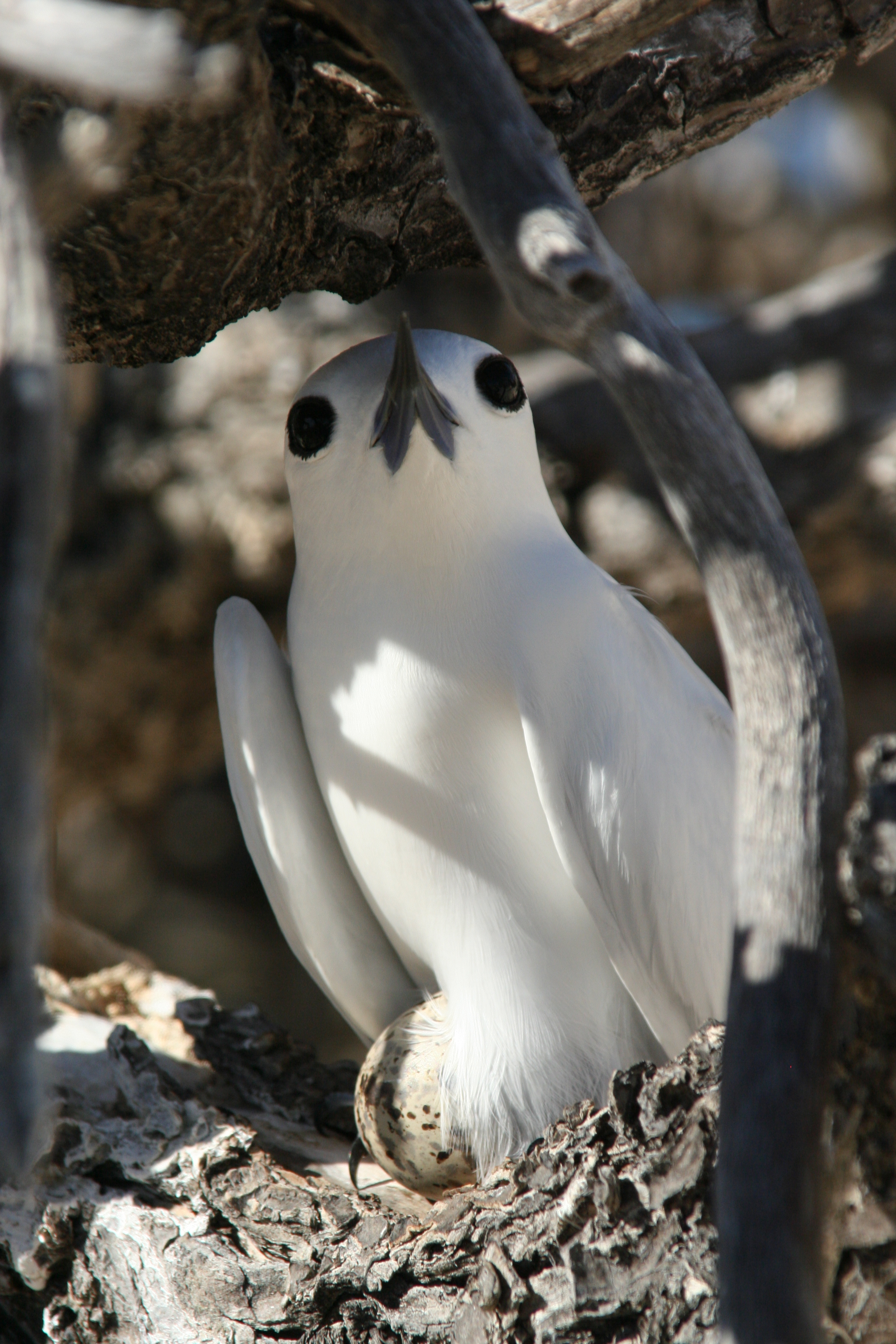
You and I aren’t so familiar with the Manu-o-Ku, known in other parts of the world as the white tern. They tend to be a little bigger than a myna with longer wings. The myna has brown feathers with black feathers on the head and that distinctive yellow mask around the eyes leading to the bright yellow beak. The Manu-o-Ku is all white except for black eyes and a straight black beak. They don’t live here on Hawai’i Island, but you’ll find them – and mynas – living on O’ahu.
Two mynas were watching a manu-o-ku family prepare for laying an egg, and they were pretty critical about it. I may think mynas build messy nests, but the mynas were surprised that the manu-o-ku didn’t build a nest at all. “Where is the egg going to go?” asked one. “They haven’t done anything about a place to keep it from rolling away,” said the other.
The manu-o-ku ignored all this – they heard it, of course, because mynas aren’t usually quiet. They just flew from branch to branch, checking things out, and didn’t fetch a single piece of grass to build a nest.
Finally they settled onto a spot where a branch forked. It made a little spot with a hollow, like the bowl of a spoon – a very shallow spoon. I don’t think I’d have noticed it, but the manu-o-ku did. Somewhat later, the mynas returned to find that a single egg rested in that little depression, and that the father and mother manu-o-ku were taking turns keeping it warm.
“I’m shocked,” said one of the mynas. “I am, too,” said the other. “That egg is going to fall off.” “And if the egg doesn’t,” said the first, “the chick will.”
The manu-o-ku heard this and said nothing.
About a month later, the egg hatched, and the newborn chick’s feet were able to easily hold onto the forked branch of its nest. The parents brought fish and squid from the ocean to feed it. “That will never work,” said the mynas to one another. “That chick is doomed for sure.”
But it wasn’t. It took its first flight. It stayed nearby and the parents continued to bring it meals. It learned to catch its own food. It took to the skies.
“That shouldn’t have worked,” said the first myna. “It was an awful risk,” said the second.
“It’s a good thing that it worked, then, isn’t it?” called one of the manu-o-ku, and flew away in a flurry of white feathers.
You know, Jesus took a risk when he taught people to love one another, because some people don’t want to do that and they got angry about it. He took a risk when he loved people enough that he didn’t act violently when they came to be violent to him. He took a risk by going to the cross, and that risk took him to the grave. If you want to make things better, those actions shouldn’t work.
Jesus rose from the dead, and suddenly all those actions did work, all those risks of love and of peace and of death itself. It was more precarious than a manu-o-ku egg on a branch, but on that Easter Day love won, and it will always win.
By the way, we have taken a risk this morning. We’ve placed Easter eggs around the church and in a moment we’re going to ask you to find them. The risk is that if you don’t find all the real eggs, in a couple of days of sunshine they’ll get really warm and smelly. So help us out here. Make something good happen for yourself and for all of us. Find those eggs. It will be an Easter risk that worked.
by Eric Anderson
There is no video of this story, which I told before the young people headed out for their Easter Egg hunt. For the record, all the colored boiled eggs were retrieved.
The word may come on the phone or in print, or over the ether. The news I’ve been fearing too long, and a loss beyond my bearing. Come sit… with me… Until… the word comes… And wait with me in the silence.
I’ve been longing to know the answer: Maybe yes. Maybe no. My heart is beating so swiftly, and my veins are leaping and pounding. Come sit… with me… Until… the word comes… And wait with me in the silence.
This is the night of shadows and I know what will be. Until then I will weep my prayer for deliverance I won’t receive. Come sit… with me… Until… the soldiers come… Just wait with me in the silence.
Come sit… with me… Until… the dawn comes… Wait with me in the silence.
I had set a goal to write a new song for this Holy Week. I was pleased to have this song to play today.




 ordainedgeek
