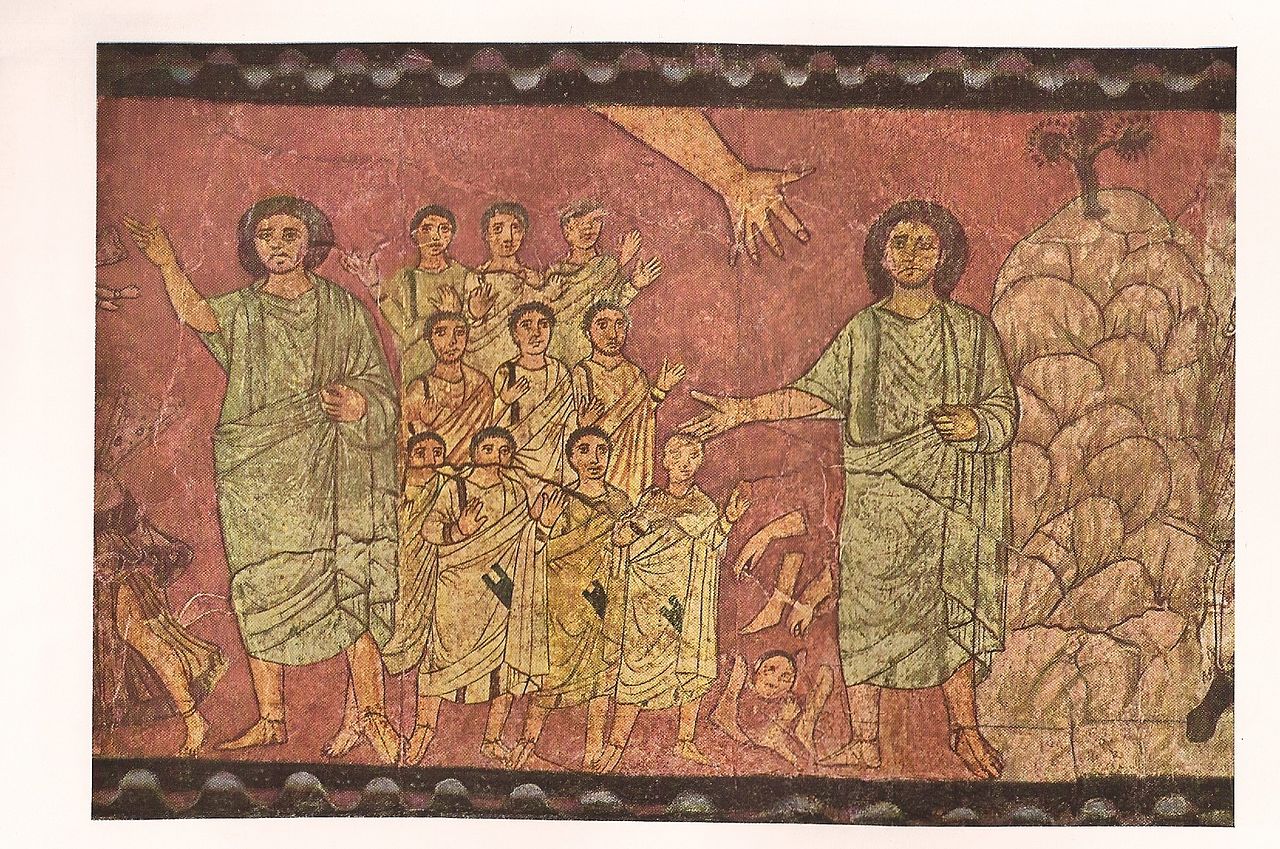
Rattling Vision

“So I prophesied as I had been commanded; and as I prophesied, suddenly there was a noise, a rattling, and the bones came together, bone to its bone.” – Ezekiel 37:7

No vision, this… I smelled the chalky dust
that rose from dried and crackling bones.
I felt the beating sun as hot upon my frame
as it had been to strip the blood and sinew from
the moldering skeletons and leave
no sign of moisture there, just calcium
to rise and linger, pause and settle,
paste the taste of chalk upon my tongue.

“Can these bones live?” you asked. In this…
experience… how can I know what bones can do?
“Speak to the bones,” you urged, “and promise breath
and flesh and sinew. So they will know God.”
I spoke, and as I spoke, I heard the clattering rattle
of the desiccated bones, the scraping as they found
their place. I smelled the tang of blood and sinew, then
the salt as sweat appeared upon the new-formed skin.

“Speak to the breath,” you urged, “to all four winds,
and let the breath come to these slain, and live.”
I spoke again, and with a sigh the breezes swept
across the flesh-strewn valley. Now a moan
arose as lungs took air once more, and then
a sigh as breath emerged again between
the moistened lips. “These bones,” you said,
“they live to be a sign of hope for Israel.”

And so the… vision? faded. But its hope endures.
I know no valley filled with dusty bones
has gone from silence to a rattling sound,
nor of a sudden taken on the scent of sweat,
or speech emerged from lips new-formed
upon a skull. The slain are slain; the dead are dead.
But we who live may see a better day, and by
the power of God, the dead may rise to life.

A poem/prayer based on Ezekiel 37:1-14, the Revised Common Lectionary First Reading for Year A, Fifth Sunday in Lent.

The image is a synagogue wall painting at Dura Europos (ca. 244) in eastern Syria – Dura Europos synagogue, Public Domain, https://commons.wikimedia.org/w/index.php?curid=25556794.

Story: Your Fault!

March 19, 2023

Ephesians 5:8-14
John 9:1-41

The two i’iwi – I don’t know whether they were husband and wife or brother and sister or cousins or friends, but there was he and there was she – were very excited. Setting out early in the morning, they had found an ohi’a tree that had gone into full blossom overnight. From its lowest branches to the tip of its crown, it glowed bright red in the dawn. The scent of nectar – which I can’t smell, can you? But they could – wafted out among the other trees, some of which had a few blossoms, but nothing compared to this marvel.

They settled in to feed.

“Let’s keep this for ourselves,” said he to she.

“We’ll keep this for ourselves,” said she to he.

Shortly after they arrived, along came an ‘amakihi eager for breakfast. The two i’iwi promptly drove him away, determined to keep all the nectar for themselves. Another i’iwi appeared and they chased him off, too. As the sun slowly rose into the sky, the two birds kept others away as they appeared, sipping nectar in between to keep their strength up.

About mid-morning an ‘apapane sniffed out the nectar and the blossoms and the tree and flew straight into the walloping wingbeats of the i’iwi. “Go away and never come back!” shrieked the “he” i’iwi. “And don’t tell anyone else about this tree!” screamed the “she” i’iwi.

“Uh, oh,” said he to she.

“What?” said she to he, though she knew.

“That’s an ‘apapane. They’ll tell anybody,” said he to she.

“They’ll tell everybody,” said she to he.

Sure enough, the birds began to arrive in larger numbers. Before it had been just one at a time. Now they came in pairs, in double pairs, in sixes and sevens and eights. The two i’iwi zoomed around the tree, using their bright red feathering and bright red voices to startle other birds away. As she chased some ‘amakihi away, he noticed an ‘apapane – it as the same one who’d spread the word earlier – swoop in, settle on a cluster of blossoms, and get a good sip of nectar before he took off again, with the he i’iwi in pursuit.

“That was your fault!” said he to she.

“That was your side of the tree!” said she to he.

The birds kept coming – i’iwi, ‘apapane, ‘amakihi, mejiro, and I do know who all. They kept coming and no two birds in the entire world could have kept them all away. Still, the forest rang with the angry shouts of the two i’iwi.

“That was your fault!” said he to she.

“That was your fault!” said she to he.

In fact, they’d lighted on an ohi’a branch to better carry on the argument rather than chase other birds away from the tree. They didn’t even eat, despite the deep red blossoms glistening with nectar next to them.

“Ahem,” said a voice. They stopped their shrieks and turned to see that first ‘apapane, the one who’d spread the word, perched nearby.

“Thank you,” he said. “It’s been a delicious breakfast.”

With one motion, the two i’iwi pointed their beaks at the ‘apapane and screamed, “This is your fault!”

“It might be, I suppose,” he mused, “but whose fault it is doesn’t get you any breakfast.” And off he flew.

The two i’iwi, hungry, throat-sore, and tired from all the morning’s chases, looked at one another, looked at the flowers, and had breakfast.

by Eric Anderson

Watch the Recorded Story

I tell my stories from my memory of the text I’ve prepared. Inevitably, it is different from what I’ve prepared.

Photo of an i’iwi by Gregory “Slobirdr” Smith – https://www.flickr.com/photos/slobirdr/32085166458/, CC BY-SA 2.0, https://commons.wikimedia.org/w/index.php?curid=93213259.

Open and Closed

“But they kept asking him, ‘Then how were your eyes opened?'” – John 9:10

From a Jerusalem street to the Pools
of Siloam, spittle-moist dust awash
in the waters, a new sense a-born
to beguile his return to the place
where the Healer no longer is found.

“How’s this?” they asked. “How can your eyes
be opened? You’ve never known sight
since the day you arrived.” “The man Jesus
made mud and he told me to wash;
when I did, my vision was born.”

Hard hurrying queries and skeptical
silences, speech disbelieved or
discounted or scoffed. Speaking a
simple story of fresh mud washed free,
but the hearts, not the eyes, were fast closed.

Is it part of our nature, God, something
inherent that makes human beings choose
their answers ahead? We question
and search but will not find a truth
when we’ve chosen the word we’ll accept.

Praise God for your vision, O once
sightless man, but praise God the more
for your wide-open heart, to hear
and to trust the man Jesus who said,
“Go the pool now and wash.”

A poem/prayer based on John 9:1-41, the Revised Common Lectionary Gospel Reading for Year A, Fourth Sunday in Lent.

The image is The Blind Man Washes in the Pool of Siloam (Le aveugle-né se lave à la piscine de Siloë) by James Tissot (between 1886 and 1894) – Online Collection of Brooklyn Museum; Photo: Brooklyn Museum, 2008, 00.159.173_PS2.jpg, Public Domain, https://commons.wikimedia.org/w/index.php?curid=10957455.

Oh My, How Rude

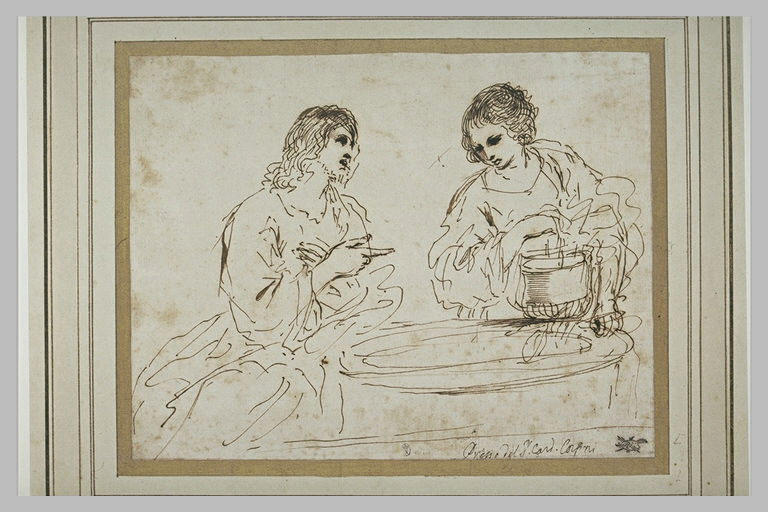
A Samaritan woman came to draw water, and Jesus said to her, “Give me a drink.” – John 4:7

Not even a “please?” Oh my, how rude
to ask – demand – a drink of water here.
This well is deep, and every drop I raise
for you, you stranger, is a drop I need
to raise again, and carry to my home.
You should have brought a bucket, sir.

Not even a “please?” Oh my, how rude
to ask – demand – my time and labor here.
I’ve things to do now, Jesus, as you know
(and as you knew that woman did as well),
some obligations of which you’d approve.
What could I raise to satisfy your thirst?

Not even a “please?” Oh my, how rude
to hint – imply – that your refreshment does
much more than mine. Your invitation comes
with obligation, we both know, and yet…
And yet… I thirst, O Jesus, how I thirst.
May I be satisfied in you.

A poem/prayer based on John 4:5-42, the Revised Common Lectionary Gospel Reading for Year A, Third Sunday in Lent.

The image is Christ et la samaritaine, dessin by Guercino (ca. 1640) – http://www.culture.gouv.fr/public/mistral/joconde_fr?ACTION=CHERCHER&FIELD_2=AUTR&VALUE_2=GUERCINO IL, Public Domain, https://commons.wikimedia.org/w/index.php?curid=3792308.

Story: The ‘Amakihi’s New Feathers

March 5, 2023

Romans 4:1-5, 13-17
John 3:1-17

The ‘amakihi was concerned. He was about 15 months old, feeling something like an adult – I know that’s young for a human being but he was an ‘amakihi, and they grow faster. Come to think of it, they haven’t got quite as much growing to do. He could fly. He could find food. He could sing. All in all, he had a pretty good ‘amakihi life.

He didn’t want it to change.

His feathering was still that of a younger ‘amakihi, which is basically a medium green with some hints of yellow. Some birds might think it dull – the bright red i’iwi might say so – but he rather liked it. It matched the leaves of an ohi’a tree rather nicely. Sometimes he thought of that as safety from circling i’os. Sometimes he thought of it as a fashion statement. Anyway, he liked his feathers, their color, and their shapes.

He didn’t want it to change.

But… it was starting to change and he knew it.

Already he’d had a couple of his big wing feathers fall out and grow back, and more were coming. He’d been through feather molting before, and he knew what was coming. The wing feathers would go and grow, and then the smaller feathers on his head and chest. Even with the first wing feathers he could see the change in color. They were less green, more yellow, and he knew that when the new feathers came on his chest they’d be bright yellow in the sun.

And he didn’t want it to change.

He couldn’t think of a single thing to do about it, so he went to his grandmother. “Tutu,” he said, “what do I do? My color is changing and I don’t want it to!”

“What’s wrong with it?” she asked.

“Nothing, but I like how I am now. I don’t want to change.”

“You don’t want to change?” she asked, and when he said no, she took to her wings and called, “Follow me!”

The first thing they saw was a butterfly flitting through the air. When they landed, there was a caterpillar on the branch. “One of these,” said Tutu, “made a big change to become one of those,” and she pointed her beak at the butterfly. “Do you think it was worth it?”

“To fly? Yes, I do,” said her grandson, and flew off after Tutu again.

They took a look at an ‘amakihi nest, where two young birds had hatched, grown, and taken their first flights over the previous several weeks. They were about ready to leave for a life of their own. “Did you want to stay in the nest?” asked Tutu.

“Of course not,” he said.

“But that was a change.”

“I suppose it was,” he said.

“Life is filled with change,” said Tutu. “Some are big, like the caterpillar that becomes a butterfly, or the ‘amakihi that leaves the nest. Some are smaller, like the bright yellow feathers that are coming to you. Perhaps you’ll become a parent, and that’s a big change, and perhaps there will be a lava flow in our forest, and that’s a big change.”

“So what do I do?” he asked.

“Make the best new you as you grow and change,” said Tutu gently. “Find delight in new things where you can, and make delight when the new things come hard. You’ll always be a new you. Be a loving and caring new you.”

by Eric Anderson

Watch the Recorded Story

I tell my Sunday morning stories from memory of what I’ve written. Memory and what’s written… rarely match.

Photo of an ‘amakihi in mature feathering by Bettina Arrigoni – Hawaii Amakihi (male) | Palilia Discovery Trail | Mauna Kea | Big Island | HI|2017-02-09|12-21-50.jpg, CC BY 2.0, https://commons.wikimedia.org/w/index.php?curid=74674240.

Changing, Changed, Changeless

“Nicodemus said to him, ‘How can anyone be born after having grown old? Can one enter a second time into the mother’s womb and be born?'” – John 3:4

You knew, Nicodemus, and Jesus knew you knew
that humans do not live a static life.
They grow, adapt. They shift and change.
Sometimes they even make a brand new start.

Sometimes they start as fresh as wandering wind,
as pure as water droplets glistening.
Where do they go? Who knows? The wind
goes where it will, just like the Holy Spirit.

Though none can set or stay the Spirit’s way,
one thing remains more firm than stone,
more sure than night or day. Yes, God so loved the world
not to condemn, but raise in radiant life.

A poem/prayer based on John 3:1-17, the Revised Common Lectionary Gospel Reading for Year A, Second Sunday in Lent.

The image is Nicodemus by JESUS MAFA, from Art in the Christian Tradition, a project of the Vanderbilt Divinity Library, Nashville, TN. https://diglib.library.vanderbilt.edu/act-imagelink.pl?RC=48385 [retrieved February 28, 2023]. Original source: http://www.librairie-emmanuel.fr (contact page: https://www.librairie-emmanuel.fr/contact).

Story: The Untempted ‘Apapane

February 26, 2023

Psalm 32
Matthew 4:1-11

I think you may have heard the story I’m not telling, the one about when the Tempter tried to tempt Jesus. He challenged him to turn stones into bread because Jesus was hungry, and Jesus said, “No.” He challenged him to prove he was the Messiah by jumping off the Temple roof, and Jesus said, “No.” He challenged him to rule the nations of the world by worshiping him, that is, Jesus worshiping the Tempter, and Jesus said, “No.” Then the Tempter went away.

But I’m not telling you that story.

I’m telling you what happened next, which is that the Tempter was angry and fed up and feeling like a failure. What do people do when they need a break? That’s right. They go on vacation in Hawai’i.

I promise you that most of the visitors aren’t angry Tempters.

But the Tempter walked the koa and ohi’a forests and tried to feel better about things, which wasn’t working. One of the problems with being a Tempter is that you never really do find peace inside yourself. So he decided that instead of peace, he’d find success. He’d tempt something, and this time he’d win.

He went searching, and he found an ‘apapane.

“’Apapane,” he said, “have I got a deal for you. I will give you the power to turn these stones into bread. Just do that, and you’ll never worry about being hungry ever again.” The Tempter demonstrated by turning some lava rock into bread. The scent rose into the air.

The ‘apapane gave it a sniff, and then flew a short distance to an ohi’a tree, where he sniffed at the nectar from a bright red blossom. He gave it a taste.

“No, thank you,” he said. “I’ll stick to nectar.”

The Tempter was very disappointed with this, but not ready to quit. He brought the ‘apapane to the top of the highest tree in the forest. “All you have to do is prove that God takes care of all God’s creatures,” the Tempter said. “Throw yourself down from this tree, and let the angels catch you.”

The ‘apapane looked at the ground far below, stretched out his wings, and flew. “I think I’ve got that one covered already,” he said.

The Tempter realized that this temptation had been a bad mistake, and he was rattled. Still, he was undaunted. He was going to have a success. This time he swept the ‘apapane all the way to the summit of Mauna Kea, and there he showed the bird all the nations and forests and mountains of the world. “Worship me,” said the Tempter, “and all of this will be yours.”

The ‘apapane shivered in the cold, and pecked experimentally at a small bug on a rock. “I’d rather live in the ohi’a forest,” he said. “It’s warmer and things taste better there.”

At that the Tempter gave up, both on tempting an ‘apapane and on his Hawaiian vacation. I believe he went to sulk in Antarctica, where there’s a lot of empty space to sulk in.

The ‘apapane went back to the forest and, when other birds asked him about his adventure, simply said, “I just chose to be myself, to enjoy my life and its nectar. It’s not really much of a temptation to be something or someone else than myself.”

If you’re tempted, friends, choose to be yourself, the best and truest self you can be. Send the Tempter sulking to Antarctica.

by Eric Anderson

Watch the Recorded Story

I write the story. I tell the story. In the telling, there are departures from the writing.

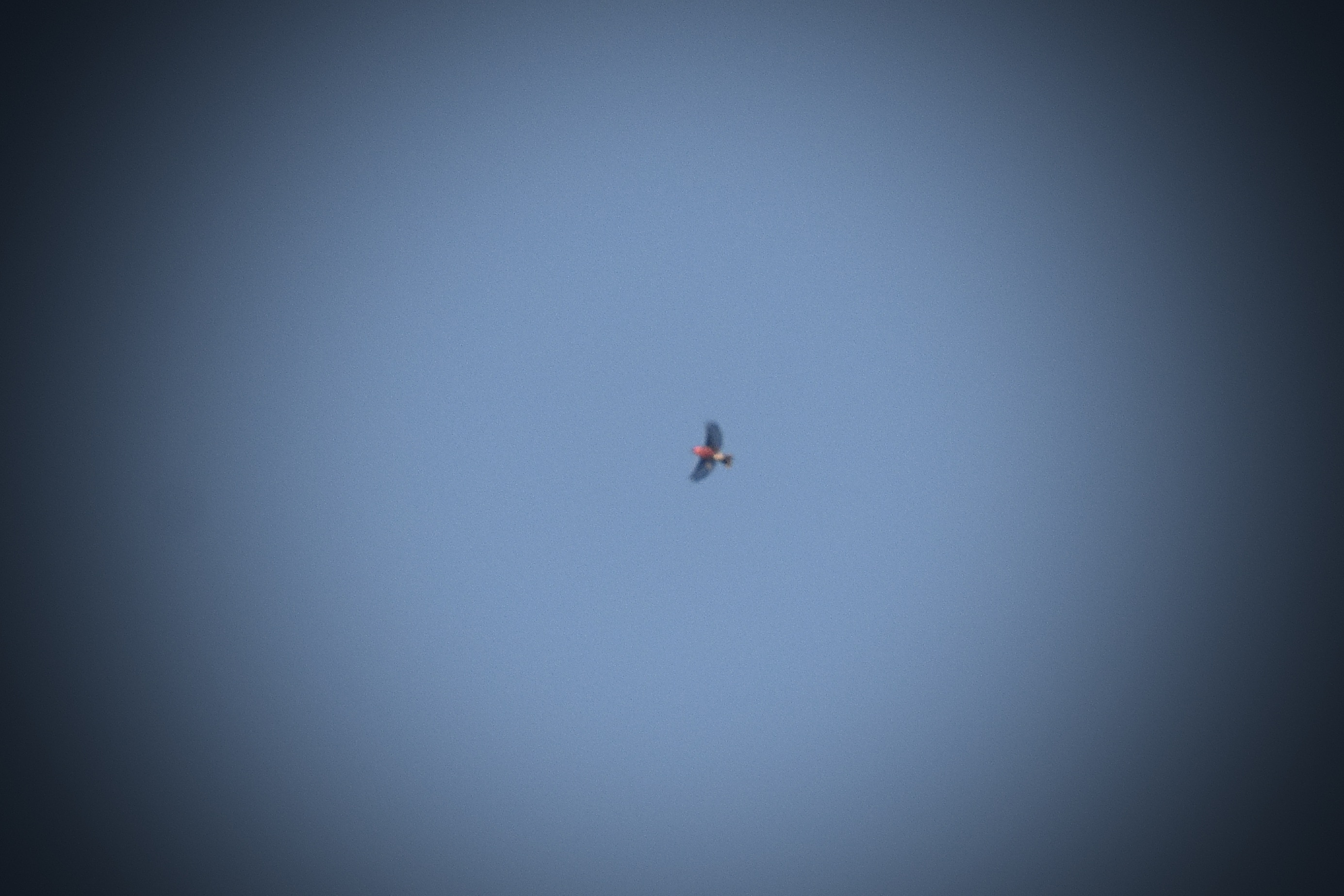
Photo of an ‘apapane in flight by Eric Anderson.

Tempted

The tempter came and said to him, “If you are the Son of God, command these stones to become loaves of bread.” – Matthew 4:3

Temptation I recognize, Jesus
(except when I don’t).
My media diet is full to the brim
of temptation, allure:
“Buy this! Buy that! And life
will be better for sure!”

At times I am sure that
temptation disguises itself as need:
a tool or a book or a thing
enlivening live streams or
enhancing worship or
giving me something to think on anew.

Might temptation be present in
obvious choices, the things that we get
because Mom always got them?
The symbols we use, uniforms donned.
As I bow my head for a Sunday stole,
do I hear a reproach in its wavering fringe?

And then there’s temptation
I simply don’t recognize, and here I must ask:
What’s wrong with transforming the stones
into bread? Your need was as real as
the need of five thousand
or those who lived on the manna of Sinai.

Your retort to the Tempter – what does it mean?
We live by the words of the mouth of God?
Who would know that better than the Incarnate Word?
And yet you consumed the fruit of the land,
the bread from the ground, its flour ground
(as you knew) between stones.

As a test, I can pass this one, Jesus.
I can. There’s no sign the power
of stone-flour bread is mine to command.
But I wonder, Messiah. You spotted this test.
You chose your best course. You passed the exam.
But would anyone else? Could anyone else?

The Tempter was someone you knew to resist.
I don’t always know. Sometimes, but not always.
The action was one that would lead you astray.
The paths that I follow all seem to be straight… to start.
So I beg you to help me to choose the true bread,
for I don’t always recognize the voice of God.

A poem/prayer based on Matthew 4:1-11, the Revised Common Lectionary Gospel Reading for Year A, First Sunday in Lent.

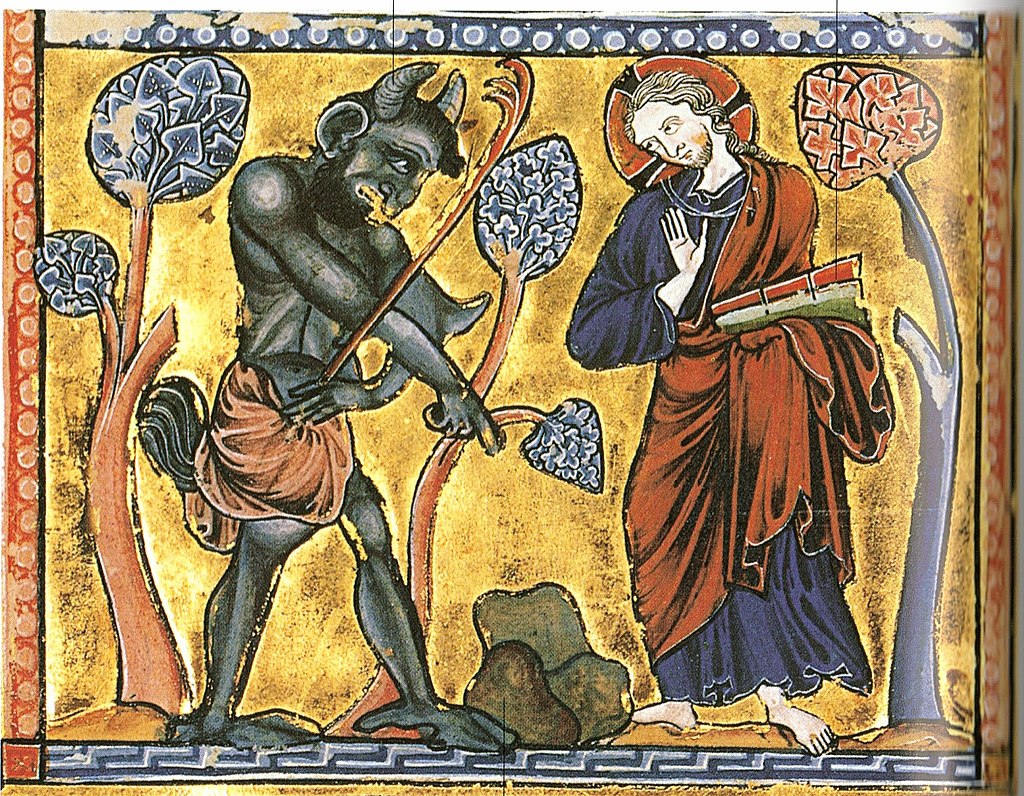
The image is an illustration in a Psalter ca. 1222 by an unknown artist – Self-scanned Rosa Giorgi: Bildlexikon der Kunst, Bd. 6.: Engel, Dämonen und phantastische Wesen, 384 S., Berlin: Parthas-Verlag 2003, ISBN 3936324042 / ISBN 9783936324044, S. 130, Public Domain, https://commons.wikimedia.org/w/index.php?curid=114178710.

Story: The River Who Wanted to Be a Mountain

February 19, 2023

Exodus 24:12-18
Matthew 17:1-9

The river was a pretty good river. It had some charming waterfalls and some broad pools. It had earth banks solid rock banks and stony banks and down near where it entered the ocean, it had sandy banks. It made chuckling sounds over small rocks, roaring sounds as it fell, and seemed to create its own silence in its wide, slow sections. Anyone would say it was a pretty good river. – anyone, perhaps, except the river itself. You see, the river wanted to be a mountain.

It looked up to the mountain and envied its craggy sides and its lofty peak. It envied the clouds that wreathed its summit sometimes and the snowy crown they left behind. It envied the sheer mass of the mountain, so great that it pressed down the sea floor from which it had grown. It envied its grandeur. It envied its majesty.

The river wanted to be a mountain.

“Oh, I wish I could be a mountain,” it said in the musical rippling of the water over stones.

To the river’s surprise, the mountain heard, and to the river’s greater surprise, the mountain replied. “Why do you want to be a mountain?” it hummed with its deep, rumbling voice.

“I’d like to be as tall as you,” said the river. “I’d like to touch the sky. I’d like to see all the earth around me. I’d like people to look up to me with awe.”

“You’re nearly as tall as me,” pointed out the mountain. “Water that falls on my peak comes down to you – you and other rivers on my sides. Water you carry to the sea rises up to touch the sky. Between the oceans and the clouds, your waters cover all the earth. And you know that people look at your falls and pools with joy.”

“Yes, but I’ve heard stories,” said the river, “about times when God had special things to say, and those things were said up on the mountains. God spoke to Moses on a mountain, and Jesus taught on a mountain.”

“That’s true,” said the mountain. “I’ve heard those stories, too. And I’ve heard another story. Did you forget that one?”

“Which one?” asked the river.

“I’ve heard that before Jesus taught on a mountain, he was baptized. In a river.”

The river was silent, because that was a familiar story, too, and in its envy, it had forgotten it.

“I guess it’s not so bad to be a river,” said the river.

“I’m glad to hear it,” said the mountain. “Can I send the water that falls on me your way?”

“You can,” said the river. “And I’ll send it on to the ocean.”

The mountain stands, and the river runs, and both have their place in the life of the world, and in the stories of the Bible and our faith.

by Eric Anderson

Watch the Recorded Story

The story in this recording is told from memory of the text above. Sometimes the memory isn’t perfect, and by “sometimes” I mean “always.”

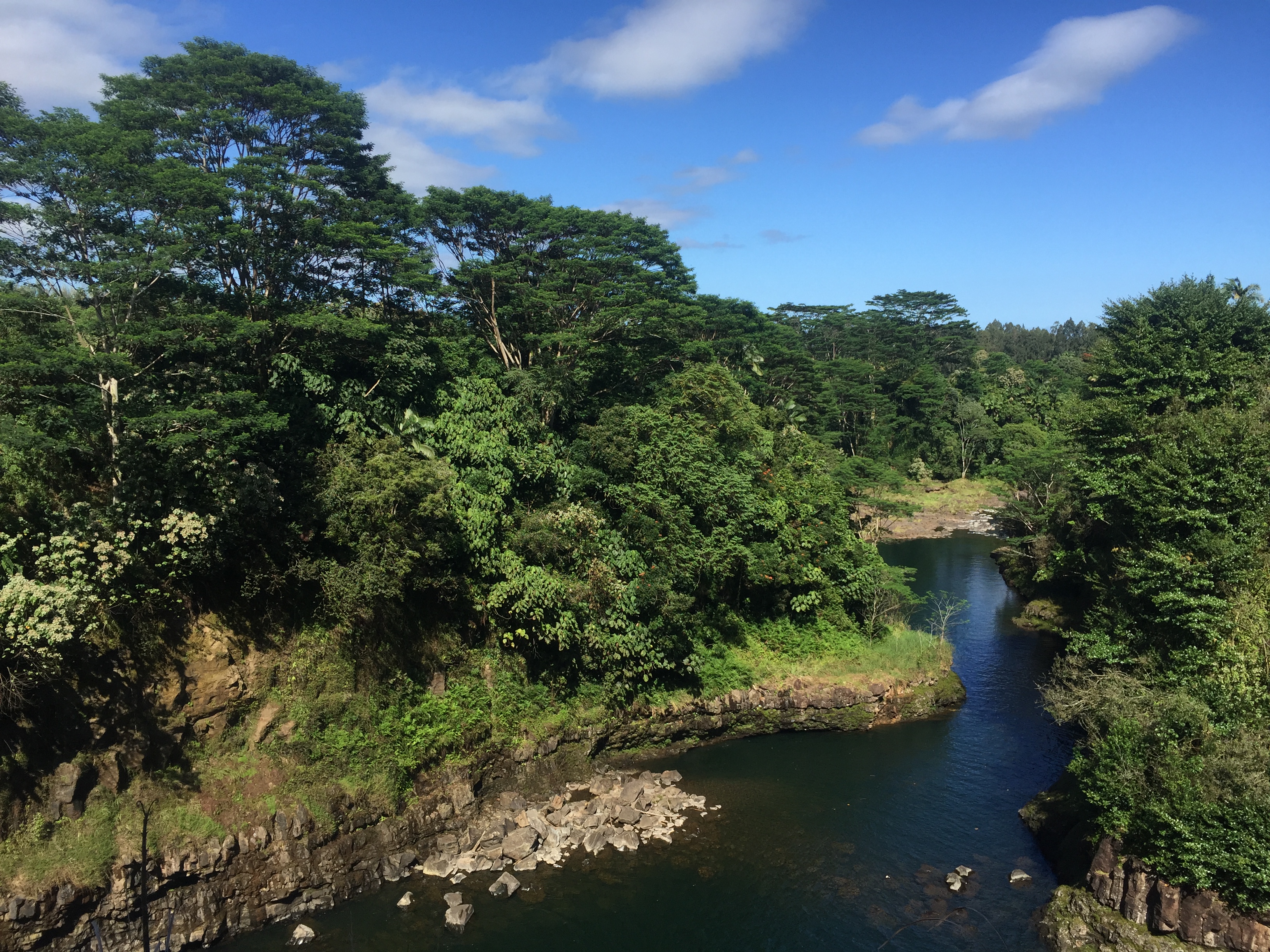
Photo by Eric Anderson.

Half Way Down

“As they were coming down the mountain, Jesus ordered them, ‘Tell no one about the vision until after the Son of Man has been raised from the dead.'” – Matthew 17:9a

Who would I tell, Jesus? What would I tell them?
“He glowed like a lamp in the sun, but brighter!”
“Moses was talking to him; so was Elijah!”
“A voice told me to listen from a cloud!”

They’d shake their heads to hear the first,
to hear the second, to hear the third.
The last and final sentence, though, they’d hear and smile:
“And when, pray tell, will you start listening?”

That question’s fair enough, I know.
I blurted out those words of invitation
rather than a question, like, “Should we
build booths for you, as you are here?”

So, Jesus, no, I’ve learned a little bit.
I’ll keep my silence ’till you give the word.
And listen. I will listen, sure as day.
And… maybe… wonder what you mean by “risen from the dead.”

A poem/prayer based on Matthew 17:1-9, the Revised Common Lectionary Gospel Reading for Year A, Transfiguration Sunday.

The image is Transfiguration by Latimore, Kelly, from Art in the Christian Tradition, a project of the Vanderbilt Divinity Library, Nashville, TN. https://diglib.library.vanderbilt.edu/act-imagelink.pl?RC=57114 [retrieved February 14, 2023]. Original source: Kelly Latimore Icons, https://kellylatimoreicons.com/.