It’s been a while since I told a story about this kind of fish. It’s called a hinalea, a cleaner wrasse – in fact, a Hawaiian cleaner wrasse – and they’re small fish that live along the reefs in somewhat deeper water.
As small fish, you’d expect they’d be hunted by larger fish for breakfast, lunch, and dinner. And they are, in fact, hunted – but not as food. Despite the fact that we’re so much bigger than a mosquito, they still come and land on us and try to eat a little bit of us, right? Similar things happen to fish, and unlike mosquitoes, a lot of these pesky creatures don’t let go. After a while, a fish can have quite a lot of unwelcome passengers, all of them trying to take a nibble on them. It’s not fun.
Cleaner wrasse eat those tiny pesky irritating creatures, gently nibbling them away from the skin and scales of the larger fish. They set up spots along the reef which people call “cleaning stations,” and where the larger fish will gather for a cleaner wrasse or three to remove those little pests. It’s a nice arrangement. The large fish go away greatly relieved, and the hinalea get, well, breakfast, lunch, and dinner.
One particular school of hinalea had one of the busiest cleaning stations on the reef. The school leaders – and I know you want me to call them teachers, but a wrasse school isn’t a school, it’s a business, so the best term for school leaders is bosses – the school leaders had announced that they needed all the hinalea there at the cleaning station. No cleaning fish anywhere else.
They couldn’t clean all the time, of course. Nobody can eat all the time, despite the things you’ll sometimes hear about human teenagers. The cleaner wrasse would take a break for a while, but the only place they were allowed to clean was at the station.
One hinalea was on his break, lazily swimming along the reef and not much worried about anything, when a larger fish came along. It was an ‘uhu, a parrotfish, and it was in terrible shape. It had picked up so many pesky creatures that it was really painful. She was wandering aimlessly along the reef, unable to figure out which way she was going and where she could find a cleaning station. She spotted the lone hinalea with its bright blue and yellow and purple scales, and settled next to him.
She didn’t need to say anything. She needed help. The hinalea went to work. All alone outside the cleaning station and as covered as she was, this would take some time.
Another hinalea, one of the bosses on break, wandered over and stopped, shocked to see what he was doing. “This isn’t the cleaning station!” he said. “Stop that now!”
Our hinalea said nothing – his mouth was full. In fury, the other hinalea swam at him and chased him away from the ‘uhu, chased him all the way back to the cleaning station.
“This fish cleaned away from the cleaning station,” announced the boss. “What shall we do with him?”
The other bosses gathered menacingly. This didn’t look good at all. But just then the ‘uhu appeared and swam to the little wrasse in the center of the angry fish. “Thank you so much,” she said.
She turned to the bosses and said, “Do you know what this little one did? I had so many pests on me that I couldn’t find the cleaning station. He picked off enough of them that I could find you. I can’t tell you what would have happened if he hadn’t. I’m pretty sure you would have lost a customer.”
She looked at the hinalea again and said, “As good a job as you did, you got interrupted. Do you suppose you could finish?” And so he did.
Sometimes bosses in the world are foolish, and sometimes they are wise. This group of hinalea bosses chose wisdom that day. It remained important that everyone concentrate on the cleaning station – a lot of fish waited there – but if a hinalea on break could help get a fish to the station? That was good, and right, and important, too.
by Eric Anderson
Watch the Recorded Story
The story above was told live from memory of this text.
“Now he was teaching in one of the synagogues on the sabbath. And just then there appeared a woman with a spirit that had crippled her for eighteen years.” – Luke 13:10-11
Wait now, just wait. I know it hurts – I feel your pain. But now is not the time. The time will come when… it comes. Until then, wait. Just wait.
Wait now, just wait. I know you’re burdened – I carry it with you – But things are just not ready. You’ll have to carry it until the time is ripe. Until then, wait. Just wait.
Wait now, just wait. I know oppression harms you – I’m there with you. But hearts have not been opened. Hang on for just a little while. Until then, wait. Just wait.
“But the Lord answered him and said… ‘And ought not this woman, a daughter of Abraham whom Satan bound for eighteen long years, be set free from this bondage on the sabbath day?'” – Luke 13:15a, 16
A poem/prayer based on Luke 13:10-17, the Revised Common Lectionary Gospel Reading for Year C, Proper 16 (21).
It might surprise you to hear that young nene go to school. Many of us wish that their classes included one in staying away from roads that have cars moving on them, but apparently they don’t.
As you’d expect, though, they teach a lot about two of the big components of nene life. Eating and flying. They do learn about eating and flying from their parents, of course, but there’s definitely more to learn about both topics for a growing nene.
A little flock of young nene had gathered with their teacher and had just finished the eating section of the day. Eating lessons for a nene are both complicated and simple. They’re complicated because nene like to eat a lot of different things. If it’s green and its leaves are grass-shaped, they probably eat it. So there’s a lot to explore in an eating class.
What’s simple about it, of course, is that if it’s green and the leaves are grass-shaped, they’ll try to eat it.
Flying, however, is definitely an advanced topic. Nene have smaller wings for the size of their body than you’ll find on other birds. It requires effort to get that much bird off the ground. When there’s a few of them in the air, they fly carefully spaced in formation. That takes some learning. And, of course, they will pull a few special tricks from time to time, like making a barrel roll in midair.
The class this day had got pretty excited during the eating session and the young students were eagerly debating the merits of the various grasses they’d tried. Their teacher was talking with one of the young goslings who wanted some help with take-offs. As she spoke with him, the other nene got louder, and louder, and louder.
“Class, settle down,” said the teacher (I’m afraid teachers everywhere of every creature say that phrase a lot). “I’ll be right with you, and if you listen you can learn something about take-offs, too.”
They were quiet for a few moments, but rather like human students, the chatter started up again, and grew rapidly until the teacher couldn’t hear herself.
“Class, settle down!” she called.
They were quiet. For… a little bit. And despite the very helpful things she was saying about wing position on takeoff, the quickly raised the volume from a murmur to a racket.
The teacher honked in complete exasperation and shouted, “Class dismissed!” Then she flew away.
The students were shocked. This had never happened before. They looked at one another – and for once, they were silent. The one who’d been getting take-off instructions looked at them unhappily.
“Come on,” he said after a few minutes. “We need to go find her.”
They found her in a clump of ‘ohelo, taking a berry, then honking in frustration, then taking a berry. They waited until she’d slowed down on berries and on honking.
“We’re sorry,” they said.
“What are you sorry for?” she asked.
That was a question they hadn’t expected. What, after all, had they done? They weren’t sure they knew, except for the one who’d been getting take-off help.
“We’re sorry we didn’t pay attention when you were teaching us the things we want and need to learn,” he said.
“Are all of you sorry for that?” she asked.
Now that somebody had said it, they were.
You see, that’s when nene teachers get cranky: when they’re sharing the things young nene need and want to know, and the students ignore them. Fortunately, there are things that help. There’s ‘ohelo berries, of course, and a soothing turn around in the sky. Best of all, there’s the students who think to say, “I’m sorry,” and come back ready to learn.
by Eric Anderson
Watch the Recorded Story
The story is told from an imperfect memory of this manuscript. To responsive children. The story as told is not identical to the story as written, oh, no, not for a moment it isn’t.
“I came to bring fire to the earth, and how I wish it were already kindled! I have a baptism with which to be baptized, and what stress I am under until it is completed!” – Luke 12:49-50
I do not see the flames alight and sweeping through the trees, charcoaling the grasses, clouding out the sun.
I hear their crackling roar in your frustrated voice, creaking with impatience, choking on anticipated smoke.
I do not see the water beckoning you forward, at once inviting and malignant, that will close above your crown.
I see the falling water, Jesus, streaking in the ever-present dust its path from eye to lips: the tracing of your tears.
A poem/prayer based on Luke 12:49-56, the Revised Common Lectionary Gospel Reading for Year C, Proper 15 (20).
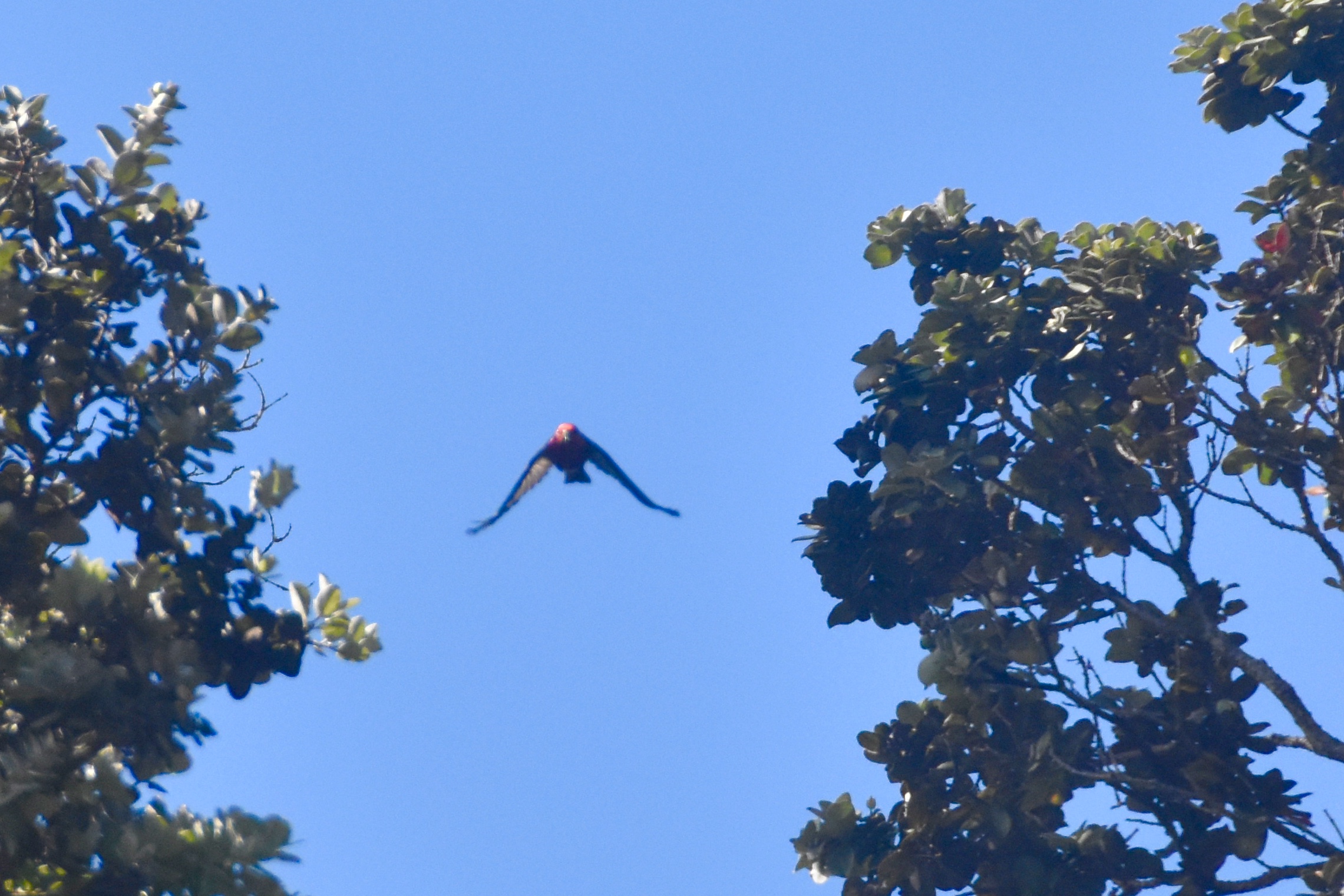
The oma’o is a fairly small bird, living on the lower slopes of the volcanoes from Hamakua to Ka’u. When you’re an oma’o chick, you’re even smaller. He hatched and grew up in a hole in a koa tree, and about the only thing he could even imagine as he looked out from the hole was:
It’s a great big world, and I’m a very small bird.
He was, of course, a very small bird, but he grew to become, well, a larger but still very small bird. The world outside was still a lot bigger than he was. He watched his parents fly back and forth to and from the nest, and wondered how they did it. Their wings seemed awfully small to carry even their small bodies. Their feet seemed awfully fragile to grip a twig. How was someone like him to have any place in a huge world like this?
Young oma’o do some experiments that lead to flying. They move their wings around and start to preen them, to settle their feathers with their beaks. They start to hop and stretch their legs in the nest – but they don’t leave the nest. In fact, after they leave the nest, they don’t come back to it. They’ll stay where their parents can find them – they still feed them for a while – but they don’t go back to the nest.
This young oma’o, however, wasn’t sure he wanted to leave the nest. Big world. Small bird. Small wings, big air. It was a night that the winds blew hard that he came to a decision.
“No,” he told his father. “I’m staying here.”
“Very smart, son,” said his father. “It’s a nasty night. The nest is a good place for now, and it’s not a great time to take your first flight.”
“No,” said the youngster. “I mean I’m just staying here. I’m not going to leave.”
The father didn’t know what to say, so he didn’t say anything. Nor did mother when the youngster told her in the morning.
“What are you going to do just staying in the nest?” asked mother.
“What I’m doing now,” he said.
“Wouldn’t you like to fly?” asked father.
“I don’t think so,” said the child.
It was mother who settled down with him and got him to say what was going on. The world was too big. The winds were too strong. His wings were too fragile. He was too small.
Then he asked, “How do you do it, Mom?”
She thought about it. “It is a big world,” she said. “I’m a small bird. My little wings aren’t much to carry me through strong winds. But I’ve got a couple of things that carry me through it all.”
“What?”
“Well, I haven’t got one just wing. I’ve got two. With only one, I don’t think I’d get far. With two, I can get anywhere I want.”
“But how did you make that first leap of faith?” he asked.
“I just flapped my wings and hopped, and as I hopped I hoped and prayed. Suddenly my wings caught the air and I was flying.”
Without even realizing it, the young fledgling was hopping and flapping. “So a wing and a prayer?” he asked.
“Two wings and a prayer,” said his mother, “and I took my first flight – just like you’re doing now.”
Sure enough, his flapping wings had caught the air and he’d taken off on his first short flight.
“Just like that,” he marveled, “on two wings and a prayer.”
by Eric Anderson
Watch the Recorded Story
The story was told from memory of this manuscript text – which means that in the recording, it’s told differently.
“Now faith is the assurance of things hoped for, the conviction of things not seen.” – Hebrews 11:1
Oh, for a mechanical God, a God who spins when I pull down the lever, a God who chimes when I haul on the rope, a God whose actions I’d predict infallibly each day.
Oh, for a magical God, a God invoked by sound and tone, a God directed by desire, a God to do my will infallibly each day.
Oh, for a predictable God, a God whose rulings I affirm, a God whose justice I approve, a God whose mercy I… receive infallibly each day.
Ah, but an uncontrollable God, a God creating in profusion, a God with greater grace than mine, this God I humbly worship… quite fallibly… each day.
A poem/prayer based on Hebrews 11:1-3, 8-16, the Revised Common Lectionary Gospel Reading for Year C, Proper 14 (19).
Drew liked to tell the story of how we met. My daughter had signed up for a winter event at Silver Lake Conference Center, and I had asked if I could volunteer with the other age group that weekend. Drew and Debby led the group I wanted to work with.
Although it’s always useful to have adult counselors at these events, Drew wasn’t at all sure he wanted to include this unknown “helicopter parent” who might both distract the other group and leave him without a fully engaged counselor. I assume he got enough reassurance from the camp directors because he and Debby welcomed me with no signs of his reluctance.
I confess that I brought my own hesitations. Drew set off all sorts of alarm bells going back to my teenage years. He was tall with a booming voice. He was an athlete. His hair was closely cropped. He led the event with an air of confident authority. He reminded me of too many people I’d had painful relationships with many years before.
And… he was tall. He had a booming voice. He was an athlete, winning a bronze medal in his age group at the US National Fencing Championships in 2016. He did change the length of his hair, but it was never very long. He did carry himself with confident authority.
That weekend also demonstrated the incredible depth of his heart and soul. Drew had trained to be a public school teacher because of his passion for teaching and inspiring young people. He left the classroom because the administrative overhead frustrated him more than he would accept (my father, who worked many years as a public school administrator and teacher, would have sympathized). He poured that commitment to teaching into coaching. He founded a fencing school in Willimantic, Sword in the Scroll, which offered both modern fencing and German broadsword.
When we met, one of the other counselors for the weekend, a college-age student, was nursing some bruises from a mistake in her guard. Drew the coach was both sympathetic, making certain that she wasn’t doing things that would delay her recovery, and also evaluative, helping her understand what she’d done so that she could do it better next time.
It was a good weekend.
I didn’t yet know I’d made a friend.
Some time later the Silver Lake directors asked me to consider becoming a dean for a week-long summer conference. “We’ll set you up with experienced deans,” they said. So in summer 2008 I joined Drew and Debby Page as the third wheel dean for “I Learned it All in Volleyball.” Volleyball, incidentally, is an enthusiasm Drew and I shared. Among the trio, Drew was known as the “alpha dean,” Debby as the “beta dean,” and I was the “omega dean.” It worked so well that we did it again the next summer (and my son Brendan came along as a counselor).
In the meantime, Drew and I had started to spend a lot more time together. At the end of 2008, we offered him the position of Media Assistant for the Connecticut Conference UCC. It was not an easy choice. We had some really solid candidates who offered very different sets of talents and skills. The position was new and none of us really knew what it would become. In the end we settled on Drew because he was not only skilled, he was constantly adding to his skills. He would do so throughout his work with the Connecticut Conference and the Southern New England Conference over the next 13 years.
Drew joined me in a large but rather noisy and visually chaotic office on the “Garden Level” (basement) of United Church Center in Hartford. Noisy? Drew’s desk sat next to three servers and other network appliances whose fan noise varied but never ceased. Visually chaotic? Shelves around the room contained computer equipment, reference manuals, and stacks of storage media. I had a habit of retaining the packing boxes of computers we’d recently purchased in case a defective unit needed to go back. And I had an, um, elastic notion of “recently purchased.”
Drew settled in to maintain mailing lists, postal and electronic. He assisted with feeding various databases. He was a solid copy editor, cleaning up my more awkward constructions (and I’d rather like him to read this piece right now). He took on writing projects for our printed and online publications. His first byline, as far as I can tell, appeared in spring 2009. He stepped behind a video camera at Conference events, and like his boss (me), carried a still camera on his shoulder.
He’d done some of these pieces in other parts of his life before, but he learned new things incredibly fast, as well as combining these skills in ways that really served the ministry we were doing. Drew’s ideas rose from a deep understanding of what we were trying to accomplish, what benefit we were trying to bring to the people of the conference. We didn’t try everything he thought of. Not everything we tried worked. A couple things that I thought worked well took more time than we had for them – I really regret the video reporting we couldn’t do.
We gave Drew more hours. Drew took those hours and turned them into precious gifts.
We shared an office. I remember one spring when we had a very heavy workload. We were preparing for a spring meeting of the Conference. We were also filming and editing 32 brief videos in which Silver Lake deans invited young people to their conferences. Each one lasted a minutes, but – there were 32 of them!
The two of us recorded them together during a gathering of the deans. He’d film one group while I filmed another. When we were back to the office, Drew sat down at his computer and forged through those recordings, reviewing each take (there was always more than one), adding transitions, fixing the audio as best he could, and putting in the titles. It was hours of work – and he did it so well that Silver Lake has continued to do much the same in the eight years since.
Sharing an office isn’t just about work. You learn things about office mates that you don’t learn about the folks who work down the hall. When Drew was preparing for competition at the national level (this was before 2016), he changed his diet and work habits – by which I mean, he made sure to move around more and avoid stiffening up at the desk. When he suffered increasing shoulder pain from an old injury – and when that injury was aggravated – I was one of his companions in the journey to heal.
And then we started going out to lunch.
I have… irregular meal habits. I frequently skip lunch entirely. Drew, a much more careful person around health and diet, did not. It might be light, but he made sure his body was being properly sustained.
But then once or twice a week we’d go out to lunch along with Emily (then Hale) McKenna (who may have got this started in the first place). There were several places we enjoyed in that immediate West End neighborhood. We’d take the opportunity of workers everywhere to gripe about our workloads (I was formally Drew’s boss, remember), but mostly we talked about the important things outside of the working life of the church. We talked about music and kids and dreams. We told stories about our pasts and imagined things for our future.
In the office we were partners and collaborators. At the table we were friends.
I can’t remember more than a fraction of the stories. I can’t remember more than a portion of the dreams. What I remember was the assurance of friendship, or companionship, of faith in one another as well as in God.
Friends at a table – Drew is just behind me.
When I left the Connecticut Conference and moved to Hawai’i, Drew told me that he’d committed to making only three phone calls to ask me about a problem. Those calls, by the way, were more than fair. I’d left a working system, but I’d left a system that, for the most part, I’d built. There were a lot of things that, despite my best efforts to document them as I was leaving, I was probably the only one who knew. I expected that Drew would have to make more than three calls despite his best efforts and intentions.
He only made two.
In February 2020 Drew received a diagnosis of colon cancer. He went through radiation and surgery, writing about them quite frankly in his blog, Drew’s 2 Cents – and he did it during a global pandemic. He had a reassuring season, but in January of this year learned that the cancer had spread to lungs and lymph nodes. Though there were treatment options, none would have much impact on the course of the disease, and all would reduce his ability to enjoy the life he had. He chose to enjoy that life.
“In otherwise,” he wrote, “dream of the things you want to do, enjoy the life right in front of you, and try like hell to be good to other people. If you have the skill, knowledge, or talent to impact other’s lives, do it. If you have the opportunity to witness something amazing, don’t hesitate. And don’t underestimate what can amaze.”
Last week I wrote a song for Drew, performing it during my weekly live stream. Its formal title is “To the Banks of the River Jordan,” but truthfully it’s Drew’s Song to me. About four hours after I sang it, Drew went from our care to God’s.
When I heard Drew had died, my prayers were not suitable for human ears. God may be excused for not listening for a while. They weren’t coherent. I was not blaming anyone, not God or a person or even that demon “Cancer.” I was just blistering the metaphorical air with my hurt.
It didn’t take too long for me to be mad at the world. “Why aren’t you stopping?” I shouted (silently). “My friend has died! Stop! Just STOP!”
Neither the world, nor I (to be honest), stopped. When has it? When, to be honest, have I?
Drew was far more than my experience of him. We were co-workers and friends. Drew was also a husband. It was a joy to witness his relationship with Debby. He was a father, and over the years the only thing that grew faster than Duncan and Dani was his love for them. He was a teacher and coach, and I had only a glimpse of that. He was a musician, and oddly enough the two of us didn’t make much music together, though we played the same gig once.
In the end, what can I say but this: He was my friend, and I have rarely made a better choice than to enter this friendship. Now he is gone, and I am deeply sad. The memories remain in their precious fragility, but more than that the love endures, and will endure beyond the end of time.
To you and I, an ‘amakihi nest doesn’t look that big. It’s sort of an irregular ball shape – it doesn’t look exactly like an egg, but you might possibly think, “Oh. It does look a little bit like an ‘amakihi egg, only larger.”
It might be large, but it’s still not large for us. Most ‘amakihi nests are a little bit larger than a softball. Made of grasses and twigs, they’ve got a bit of a cup shaped top to hold the two or three eggs.
A mother-to-be was pretty anxious about getting her nest ready for the eggs that she’d be laying. Her husband, sad to say, didn’t help much. Or at all. That’s not uncommon among the ‘amakihi of this island. He would bring materials and he would stay nearby to encourage her, but she did the selection and the weaving of all the grasses and twigs and fern leaves. It was her first nest, and she was absolutely determined that there would be no problems for her eggs. It was going to be safe and warm and dry.
So she started with the basic structure, and it widened out as the nest grew higher. When she got near the top, she began to form the rim around the little bowl shape where the eggs would lay. That’s when she got… worried about things.
“What if the eggs roll out?” she asked her husband when the nest seemed finished.
He looked at it carefully and said, “I don’t think it would. It looks like the nest I was hatched in.”
“I think they’d roll out,” she said.
“Do you want to make the sides higher?” he said.
“I do,” she said, and she set about it. This in turn made the nest start to expand outward because the sides had to be supported underneath. And they kept going up.
“I think that looks good,” her husband ventured one day. “I don’t think they’ll roll out of that.”
“But what if the hatchlings fall out?” she asked. “They can climb, right?”
The husband wasn’t sure.
“Higher,” she said, and the nest kept getting bigger.
The day came when she had to stop building because she had eggs to lay and it was time. She looked at them proudly resting at the bottom of the cup in the nest. “There,” she said. “You’re safe and I’ll keep you warm.”
Her husband looked down at her. He seemed far away. “Um. How is this going to work?” he asked.
“How is what going to work?”
“How are we going to feed the chicks?”
Her nest had become an oversized softball with a narrow hole in the top that led down into it – quite a long way for a small bird like an ‘amakihi. It was actually so far that if he strained his neck down and she strained her neck up they couldn’t actually touch.
“How are you going to get out to eat?” he asked.
The sides were going to be an effort to climb. She’d struggled, in fact, to get to the bottom to lay her eggs.
“I think,” she said slowly, “that we’re going to have make some changes.” She looked at the eggs below her. “That is, can you make the changes?”
“Just tell me what to do,” he said.
“Let’s start by pulling away the top – at least until I can see out,” she said. And that’s what they did – until the nest that was built for ultimate safety was actually fit to use.
by Eric Anderson
Watch the Recorded Story
In the recording above, the story is told from memory of this text. It is rather different.
“Someone in the crowd said to him, ‘Teacher, tell my brother to divide the family inheritance with me.’ But he said to him, ‘Friend, who set me to be a judge or arbitrator over you?'” – Luke 12:13-14
Greedy? Never! Jesus, you misunderstand! Of course I come to you for aid in seeking justice for myself (and for my sisters, too, of course, which goes without my even mentioning their needs to you). You are a Teacher, you a specialist in Law, in virtue, and in righteousness. Who better to give me advice, or (better) act for me in dealing with my brother, or declaring in my favor (that would be the best).
But greedy? No! Oh, Jesus, you are just so wrong. It’s just the justice of the thing. I did as much (and more, much more) than he, my older brother, did. We both were active on the land, but he, it must be said, just doesn’t have the feel for farming, doesn’t have the skill to know which crops to plant and plants to tend. Left solely in his hands, our patrimony withers on the vine. (Why yes, there’s grapes upon the land. How did you know?)
And – quietly into your ear, O Teacher of the Law, he hasn’t really been the best of men. He stays up late. Well, I do, too, but I still rise before the dawn and he comes stumbling out just as the sunbeams gleam. It’s not a major difference, sure, but which of us should have the double portion, would you say? The one born first, or me, the one who’s first to greet the day?
So Jesus, I don’t need a lecture on the sin of greed, nor echoes of another ancient Teacher (“the things you have prepared, whose will they be?”) when I’m arguing quite clearly and with concrete proofs my brother, though he’s mostly fine, is not equipped to fairly manage this estate, and I, in humble duty, must step forward, and in justice, ask you to decide for me.
What are you saying now?
Didn’t I tell you I do not need to hear a story about greed?
A poem/prayer based on Luke 12:13-21, the Revised Common Lectionary Gospel Reading for Year C, Proper 13 (18).
First one leads, then one follows One aids, and one seeks aid. In the story of friendship You and I have made. But you’ve taken the lead this season And I cannot keep pace To the banks of the River Jordan, To your crossing place.
[Chorus 1]
There’s a time for work and progress, There’s a time for rest and play, But this time to say farewell to you: I’d have asked for a later day.
[Verse 2]
We shared in joys and sorrows. We put our hands to the plow. There were times of heartfelt sharing: May they comfort us now. As you walk to the bank of Jordan, As you near your crossing time, My tears flow with reason, My grief has so many rhymes.
[Chorus 2]
There’s a time to plant and nourish, There’s a time to harvest and store, But I’m lost in this time of farewell. I’d have asked for a little time more.
[Verse 3]
Bright days and thunder sounding, Our minds at work to shape words Telling others’ stories as sweetly As ever a story was heard. As you make your crossing of Jordan, Don’t linger, my friend, for me. You can lay aside life’s burden. In the crossing, my friend, you’re free.
You can lay aside life’s burden. In the crossing, be free.
[Chorus 3]
There’s a time to live and to flourish, There’s a time to shed life’s shell. Though I could have asked for later, my friend: Aloha o’e – fare well.