“Now the birth of Jesus the Messiah took place in this way. When his mother Mary had been engaged to Joseph, but before they lived together, she was found to be with child from the Holy Spirit.” – Matthew 1:18
What should I, could I say? His mind had closed. His ears had stopped. No words I’d say would sway him. What could I, should I say?
I tried; you know I tried. I knew the difficulty of belief, e’en with the confirmation of by body – What could I, should I say?
He stomped away. I knew that, unbelieved, I’d be abandoned – quietly but sure. What could I, should I say?
The very morrow he returned much chastened by a dream. It’s nice to be believed, I said. What could I, should I say?
But Joseph, damn your faith in dreams of angels, but refusal to believe the one who loves you. What could I, should I say?
And Matthew, you whose pen could not record a single word of mine, I wish you’d learned from Luke. What could I, should I say?
So silenced, I rely upon the child I bore to speak the words I spoke to him, and which he magnified. What could I, should I say?
He spoke of liberation and he spoke of resurrection and he spoke of God’s triumphant day. So can I, must I say.
Author’s note: Matthew did not quote Joseph in his Gospel, either – but Joseph takes all the initiative and makes all the decisions which carry the Holy Family from Bethlehem to Egypt to Nazareth.
A poem/prayer based on Matthew 1:18-25, the Revised Common Lectionary Gospel Reading for Year A, Fourth Sunday of Advent.
His feathers were fully grown and laid upon his wings and back in shades of greyish brown, with bright white and black on his chest and wings. His wings stretched nearly three feet across, elegantly shaped and tapering to each pointed wingtip. He was kind of awkward on the ground and it took some work to get airborne, but once he caught the air beneath his wings he could stay airborne for hours. He was an ‘ua’u, or Hawaiian petrel, and he would spend three quarters of the year over the sea.
He was, in short, all grown up.
That left him, I must say, just a little cross. Flying over the ocean at night, wings beating and eyes tracking the water below for the little glow of fish or squid near the surface, he wondered what more there was to things. It was all very well to be a strong flier and a good looking bird and an effective fisher – flying fish, beware! – but now that everything was done, what was there to do that was new?
One day he found himself flying nearly wingtip to wingtip with his grandmother. It was pure chance – ‘ua’u fly solo or in pairs during their nine or so months at sea – and the two fished in silence for a while. After catching a particularly tasty flying fish, however, the grandson turned to the grandmother and asked, “What do I do now that I’ve done everything?”
“What makes you think you’ve done everything?” said Tutu, rather surprised.
“Well, look at me,” he said, and turned a circle that showed off his feathers and flying skills. “I’m an expert at catching fish,” he said, “and I know all the calls and sounds of an ‘ua’u. What more is there?”
Tutu knew that there was something more, but the ‘ua’u don’t start having chicks until they’re some years older, so she didn’t mention that. She was puzzled, though, that her grandson thought he’d done everything there was for an ‘ua’u to do even before having a family.
“Look down,” she said. “What do you see there?”
He looked down and there was a ruffling beneath the sea surface. It was a school of squid – but strangely, he’d only seen such a thing once or twice and had never fished them.
“Follow me,” said Tutu, and she gave a strange twist of her wings and swooped down over the ocean surface. He had to follow more gently, because he’d never seen that flight move before. The two swept over the school of squid and in a moment they were both feeding.
“Was that different?” asked Tutu, and he had to admit it was. “And why didn’t you follow me down the way I flew?” she asked, and he had to tell her he’d never seen what she’d done before.
“I guess you haven’t done it all yet, have you?” asked Tutu.
“But once I’ve eaten everything in the ocean,” he said, “and learned everything there is to know about flying, what is there then?”
“It’s not likely that you’ll taste everything that swims,” she said, “and there is always something more to learn about flying – but even when you get close to that, there will be other ‘ua’u around who will want to learn what you know. Sharing those things makes them new again.”
“Your life is never fulfilled,” she told them. “It may seem much the same from day to day, but even then there are new things, new challenges, because tomorrow is not just like today. Each day you are fulfilling your life, and each tomorrow you are fulfilling it a little more.”
by Eric Anderson
Watch the Recorded Story
In the video, I’m telling the story from memory of this text. And making things up as I go along as well.
When John heard in prison what the Messiah was doing, he sent word by his disciples and said to him, “Are you the one who is to come, or are we to wait for another?” – Matthew 11:2-3
The clarity that comes with voices in the clouds soon fades. The vibrant colors of the golden sun, the azure river, and the argent billows in the air transmute to foggy grey as time saps confidence. So ask the question, John, as well you may: “Are you the One? Or must we wait to see One you proclaim as I once proclaimed you?”
With you I bend my ear to the reply: Look well, stern messenger of God. The ones who could not see now see. The ones who could not hear now hear. The ones who, ill, had lost community and home have been restored. The poor are cheered to hear good news proclaimed.
And so we see, and so we hear, dear John the Baptist (caught in Herod’s snares), that one has come to claim anointing by the One, and not to seize a throne, or start a war, or set himself apart from us. He’s come to heal. He’s come to preach. He’s come to bring us freedom from the cradle to beyond the grave – a life for you, dear John, and me.
A poem/prayer based on Matthew 11:2-11, the Revised Common Lectionary Gospel Reading for Year A, Third Sunday of Advent.
That year the goslings had a choice between two flight instructors here on Hawai’i Island.
I know I’ve talked about nene school before. It basically covers two topics: how to fly and how to find good things to eat. As I said, there were two flying teachers that year, and the goslings were able to choose which class to attend. One teacher was an older male nene, and he had charisma. He strutted around and hooted and honked, and you just knew that if you didn’t do just what he told you, he’d be honking right there in your beak.
The other teacher was smaller and quieter. She was well known as one of the best fliers of all the flocks on the island, but she never made much of it. You could hear her fellow teacher’s voice for miles. You hardly ever heard her say anything.
One young nene was, to be honest, pretty intimidated by both these teachers. He was pretty intimidated by flying in general. He didn’t really want to be judged by a nene considered one of the best fliers of the island, but he also didn’t want to be yelled at a lot by a big, noisy teacher. Most of his classmates, though, were impressed by all the honking and the strutting and the bravado – and maybe they were afraid that if they didn’t go to his class, they’d look like they were afraid.
When the day came to choose teachers, most of the goslings went with the big noisy male teacher, and a smaller group chose the smaller female teacher, including the young nene who was scared of them both.
It didn’t take long before he wondered if he’d made the right choice. His teacher never raised her voice, but she never missed anything, either. She could spot a single feather out of position and she always made her student fix it. Her classes started early and they ran late. Across the slopes her students could hear the agitated honks of the male teacher for a while, but then his voice would fade. They’d hear the voices of those other students, now released from their class, playing and foraging for snacks, while they were making tightly controlled – and closely inspected – circles in the sky.
“I need this to be easier,” said the young nene one morning, and instead of going to his class he made his way to the other class. Nobody minded. He joined the small crowd and watched the teacher honk at the students until they all stretched out their wings and took off. With his agitated honking behind them, they tried to form a flying V, but none of them had really mastered keeping a straight, level, and steady course. They veered from side to side, everybody except the young nene who’d just joined their class that day. He knew how to fly straight and level. He wouldn’t fly faster than the goose ahead. But he found himself dodging gosling after gosling as they zoomed back and forth across the formation.
The teacher’s honks were plenty loud, but he was saying things like, “Don’t do that! No! The other way! The other way!” Since none of the flyers knew what “that” was, or who was doing “that,” and which way might be this way and what way might be the other way, well. It didn’t help.
The teacher honked himself to hoarseness and dismissed the class early, flying off to find some ‘ohelo. The young nene watched him go, and flew over to where the smaller class was still meeting, with the sharp-eyed female teacher.
“You’re back?” was all she said.
“I’m back,” he said. “I’ve found it’s easier to learn to fly by working hard.”
by Eric Anderson
Watch the Recorded Story
The story was told from memory of this manuscript – by someone with an imperfect memory.
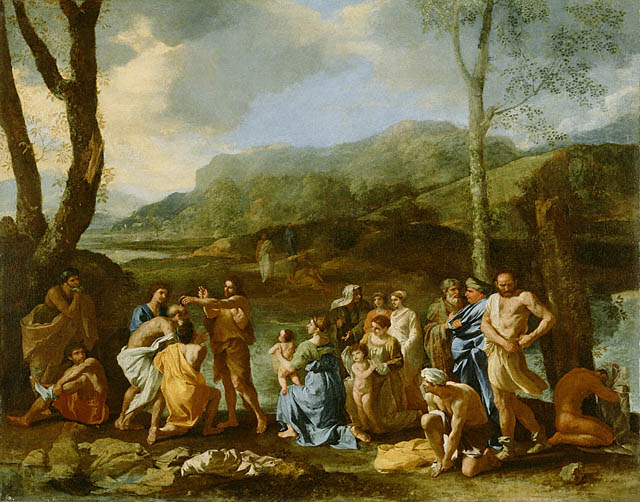
“…they were baptized by [John] in the river Jordan, confessing their sins.” – Matthew 3:6
Ah, baptist at the riverbank, I come to seek the power of the cleansing touch of water and of Spirit and of fire. Anneal my harrowed soul. Your words have burned their way into my heart and mind and I do not forget. Who warned me, John? Well, you. You with your party-breaking summons to the realization – hardly new but strong in its familiarity – that I have not kept steadily the prophet’s road, which is not straight, not even close, but winds through thickets and through thorns like serpent’s teeth.
I wanted, baptist, to step quietly into the muddy waters, duck my head in quick and studied piety, then stand and melt into my ordinary life once more as surely as the water dried upon my skin. The water I might thus ignore, but not your harshly calling voice. I shiver and I listen and I plan: to learn and follow, learn and follow, learn and follow Christ more faithfully today.
A poem/prayer based on Matthew 3:1-12, the Revised Common Lectionary Gospel Reading for Year A, Second Sunday of Advent.
As you know, one of the really important questions in the life of any animal – bird, fish, reptile, or mammal – is:
“When is breakfast?”
For most animals the next question is likely to be “where is breakfast?” Whether you’re a hunting animal that has to find something with meat on it, or whether you’re a plant-eating animal, the fact is that you probably haven’t gone to sleep where breakfast can be found. Even the nectar-eating birds of the ohi’a forest have to find a tree in blossom in the morning.
Still, the first question is: “When is breakfast?”
The kolea has to learn two answers to this question. As you know, kolea emerge from eggs laid in Alaska. So the first thing a kolea chick has to learn when it’s heading out on its own is when the worms come out.
In fact, kolea don’t ask the question, “When is breakfast?” because the answer is always, “When the worms come out.” So they skip to the next question, which is, as you’d guess, “When do the worms come out?”
“When do the worms come out?” a young kolea asked his mother.
She didn’t have a great answer, because she wasn’t a great thinker among the kolea. She knew a lot of things, but she didn’t put them into words. You could count on her to be right there when the worms poked their heads out of the ground, but she couldn’t tell you what she’d noticed to make her go there. If she’d been a human being she’d have been one of those amazing cooks who, if you ask, “how much butter did you put in that cake?” would reply, “About the right amount,” and not really know. And the cake would be delicious.
That’s why she said, “The worms come out when they do,” which wasn’t helpful, but she did the best she could.
He managed to find worms by following his mother around, and since she didn’t mind that worked pretty well. But then came the time to go to Hawai’i for the first time. He wouldn’t have her nearby there – or rather, here.
“When do the worms come out?” he asked.
“When they do,” she answered, and that was the best he got.
Here in Hawai’i, he settled into the new job of living on his own. Worms were hard to come by, but there were plenty of grubs and spiders and so on. He did fine. He missed worms, though.
“When do the worms come out?” he asked himself out loud.
“As dawn approaches,” said a voice from nearby.
It was a myna, which took him by surprise. Mynas usually talk to each other – or rather, they argue with each other a lot. “What was that?” he asked.
“The worms come out as dawn approaches,” said the myna, which then turned away from him to enter a furious argument with another myna about… well, something. Anything. Who knows?
The kolea thought about the things his mother had done. She’d begun moving about as the sky grew brighter in the east, and flown to grassy places that worms liked. She chose cool places with some heavy dew on them or a fine rainy morning. In the cool wetness, worms were plentiful. When the ground dried and the sun warmed everything, the worms disappeared underground again.
“As the dawn approaches,” murmured the kolea.
There are plenty of things that require more examination and thought to understand than when to find a worm. Most things have something that gives you a notion that things are changing, that something is coming. For many things in life, there’s some sort of sign: like the approaching dawn.
by Eric Anderson
Watch the Recorded Story
The story was told from memory of this prepared text. And… it’s not the same.
Last week’s story was about a kolea who came back from a summer in Alaska to find Pohoiki completely changed by lava. It was a hard thing to accept that this is how an island grows. He saw a landscape that had been green and growing transformed into one that was rocky and barren.
He might have taken more comfort if he’d talked with a tree – though I’m not sure whether even a kolea really knows how to listen to a tree.
The trees whisper on the wind. They let their soft voices swirl about on the breeze like a sigh. A lot of what they say is simply, “Do you remember?” and “Yes, we remember,” and the memories float through the forest.
Higher up Kilauea, surrounding the crater we call Kilauea Iki, there are a lot of trees and they have been watching that crater for a long time. “Do you remember?” they sigh, and yes: they remember. They remember when it sloped down into a notch. Trees and bushes sprouted along the sides and the bottom. They remember when lava fountained over a thousand feet into the air and poured down into valley. They remember watching the lava pooling and the lava pool rising. They remember that when the lava stopped fountaining and flowing, the valley floor was four hundred feet higher than it had been. They remember watching parts of the flat surface crack and tilt as the liquid rock cooled to solid.
“Do you remember?” they sigh. Yes, they remember.
They remember when it was just black rock, steaming in the rain, baking in the sun.
They remember when ohi’a seeds fell upon that hot rock and did nothing. They remember watching seeds landing on the rock in a small crack and doing their level best to sprout and grow, but even the pushing of their roots could only find a couple grains of sand. They remember when the first ohi’a landed in a spot where cracking and rain had created enough – just enough – small bits that a root could take hold and begin collecting rainwater. They remember when the first of the little ohi’a plants – so small, those plants – they remember when the first of them had enough soil and water and sunshine and strength to form flowers and set its own seeds to scatter.
“Do you remember?” they sigh. Yes, they remember, and that includes the small trees, some no more than inches high, that you’ll find one here, one there, on the floor of Kilauea Iki.
The kolea, I’m afraid, didn’t think to ask the trees, and he was in the wrong place to ask them down at Pohoiki if he’d thought of it, and he may not have understood what they said to him if he’d asked.
But the trees along the steep sides of Kilauea Iki remember, and they sigh their memories just the same way they scatter their seeds: cast out upon the blowing wind.
“Do you remember?” they ask, and they answer, “Yes, we remember.”
On the flat black surface of the Kilauea Iki crater, roots crack the rock into soil, shoots stand ever higher above the stony surface, ohi’a blossoms flutter crimson in the wind, and they share their seeds and their memories upon the blowing wind.
by Eric Anderson
Watch the Recorded Story
The story above was told from memory of this prepared manuscript. In my opinion, I told it better than I wrote it this time.
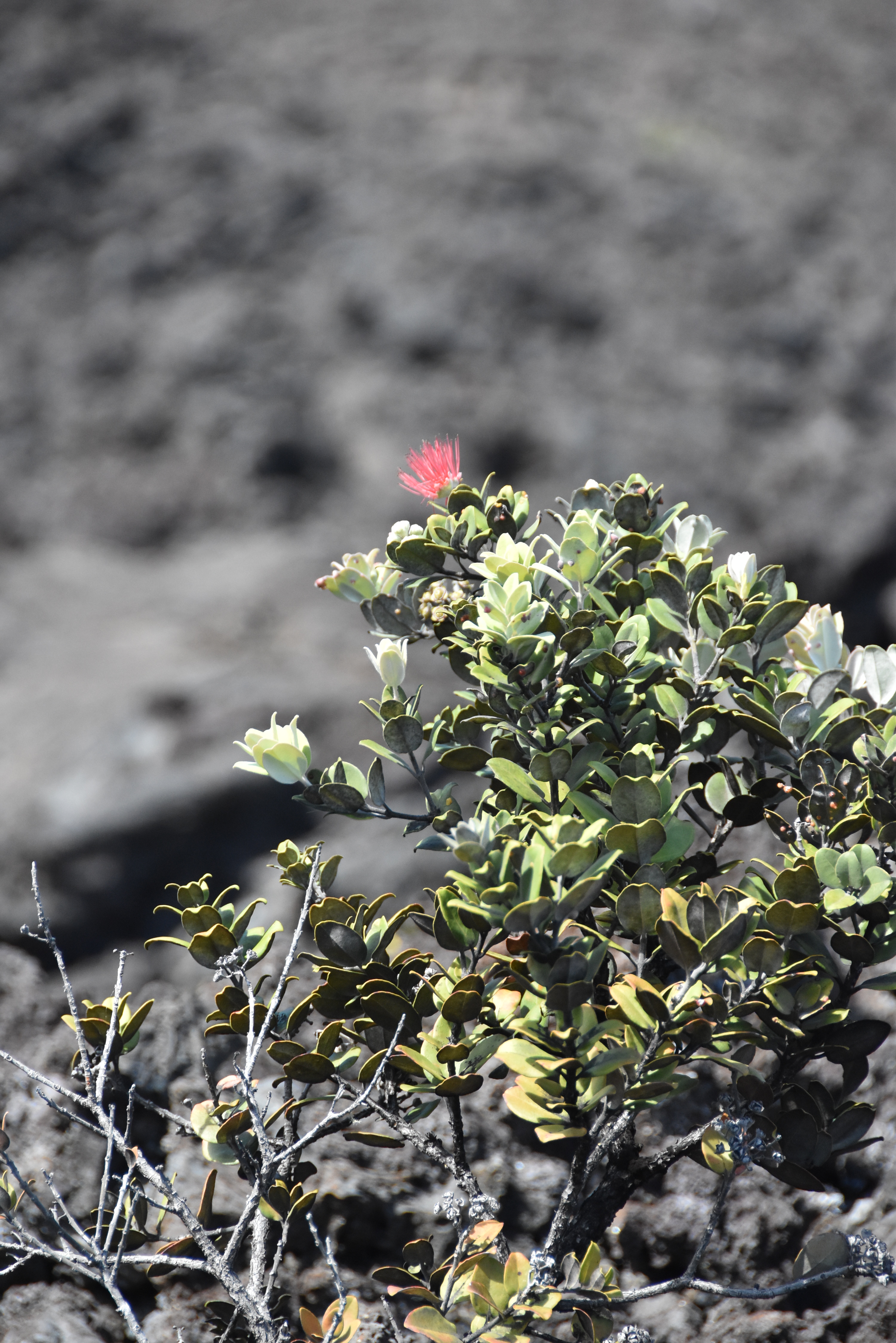
Photo of an ohi’a blossom in the Kilauea Iki crater by Eric Anderson, 2016. The Kilauea Iki eruption took place in 1959.
When some were speaking about the temple, how it was adorned with beautiful stones and gifts dedicated to God, [Jesus] said, ‘As for these things that you see, the days will come when not one stone will be left upon another; all will be thrown down.'” – Luke 21:5-6
The flagstones and terraces, walls and pillars, the walkways and courtyards, collonades and shrines. Oh, look where the peak of the roof glows at sunset! Oh, look how the glory of God has been housed.
The stones seem so durable, set and enduring, but Jesus in sadness announces their fall. Eternity’s structures are not built with masonry. Instead, they are built on the soul.
It has been many days since I stood by the ocean and watched while this island expanded its shores. Incarnadine tendrils, dulling to sable, forming a delta of newly poured stone.
And that delta has vanished. It broke and it crumbled. The rocks of the ages could be counted in days. Since then new eruptions have fashioned the coastline anew and anew and anew.
Stone poured upon stone, broken to sand. Stone stacked upon stone – by human hands. They come and they go, they bloom and they fade – But oh, what glory that these things should be.
Fragile stones, enduring for centuries, collapsing in days, wrecked by malice, swept away by the sea. Fragile stones that stand for a moment: But oh, what glory that these things should be.
A poem/prayer based on Luke 21:5-19, the Revised Common Lectionary Gospel Reading for Year C, Proper 28 (33).
Photo of the 2016 ocean entry in Kamokuna by Eric Anderson.
This story took place a few years ago here on Hawai’i Island. I suppose it could have happened at various times here on Hawai’i Island – I would guess something similar has happened a good number of times here on Hawai’i Island.
A kolea flew back to Hawai’i after spending the summer in Alaska. This wasn’t the first time he’d done it. Like most kolea, he had a destination in mind. For four seasons he’d come to the same beachfront in Puna. For four seasons he’d had a good spot to hunt for crabs in tide pools and then for bugs and worms just inshore. There were people who came and went, but you may have noticed that people come and go in a lot of places and he came to ignore them. So when he spotted the mountains of this island he made his way toward Puna.
Toward Pohoiki.
When he reached it, he hardly recognized it. As I said, this was a few years ago, and in the time that he’d been in Alaska the 2018 eruption had sent lava flowing across lower Puna from Leilani to Kapoho. The edge of the flow stopped at Pohoiki. Mounds of a’a had turned his favorite section of the beach from a gentle slope to a seven or eight foot high wall at the water’s edge. It was still cooling underneath; he could feel the heat when he came near to try landing.
The lava flow had left some things just the same. There were still human parking lots and structures, there were trees. There were broad stretches of flat ground that he knew he could still find food in. But there was also a brand new stretch of beach made of black sand and rocks that clattered and hissed when the waves drew back to the sea.
He landed and watched the water for a while, where it crashed against the new rock and where it piled up more sand gradually on the beach.
“What happened?” he said to himself.
He may not have meant anyone else to hear, but a saffron finch replied. “Lava came,” she said.
“It’s not the same,” he said.
“No, not much,” she agreed. “It’s even changing each day. That black beach keeps getting bigger.”
“Everything’s dead and gone,” he moaned, “buried under that warm rock or getting covered with that black sand.”
The saffron finch looked at him, puzzled. “What are you talking about? There’s still grass. There’s still trees. There’s still bugs and worms to eat. Life goes on.”
“How can it, when it’s so different?”
The saffron finch thought. “Do you remember hatching?” she asked.
“Not really,” he said.
“Well, are you the same as you were then?”
“Definitely not,” he said. “I had to grow a lot and get these feathers before I could ever fly here.”
“So you grew,” said the saffron finch, “and in some ways you still grow.”
“Of course,” said the kolea.
“This island also grows,” said the saffron finch. “I don’t suppose it’s quite alive the way you and I are alive, but it grows. Where it grows, it creates space for plants to grow, and bugs to grow, and eventually for you and I to grow.”
“But it’s different and I liked the old way better,” said the kolea.
“You and I grow and others may not like it,” said the saffron finch, “but we grow in our own way. You might as well let this island grow in its own way, too.
“Because it will grow in its own way no matter what you say.”
by Eric Anderson
Watch the Recorded Story
The recorded story above was told live during worship from memory of this text. Between memory and improvisation, they are not identical.
Photo of lava rock and black beach sand at Pohoiki (2018) by Eric Anderson.