Transfiguration Sonnet

Upon the mountain’s height the stones reflect
the sudden glow, not gleaming from the skies
as ordinary light. They are bedecked
with sudden radiance that mystifies.

Now where there were four figures there are six,
and two did not come up the earthen trail.
Three faces wear astonishment transfixed
to see the ancient prophets so unveiled.

The ever-daring one proposes booths
until a booming voice imposes hush,
for listening is like to admit truths
far more than motion taken in a rush.

But were I there, I fear my faltering frame
would hardly dare pronounce Messiah’s name.

A poem/prayer based on Mark 9:2-9, the Revised Common Lectionary Gospel Reading for Year B, Transfiguration Sunday.

Studies of the Heads of two Apostles (St. Peter and St. John) and of their Hands by Raphael (1483–1520), at the University of Oxford’s Ashmolean Museum. Black chalk touched with white on greyish paper. http://www.wikipaintings.org/en/raphael/studies-for-the-transfiguration, Public Domain, https://commons.wikimedia.org/w/index.php?curid=23549943.

Gathered Around the Door

And the whole city was gathered around the door. – Mark 1:33

The city is outside my door, Jesus,
but they are not calling to come in.

They have not come en masse to seek a healer
or a prophet who could liberate their souls.

Oh, one or two, perhaps. From time to time.
If they found solace, they have kept the secret well.

There is enough, in truth, to drive a lesser one
like me to seek the solitude you sought

When morning had not wakened those
whose needs had not been satisfied.

I’m not sure how I’d handle all those people
seeking what I know to be beyond my power

And so confess with sadness that I’m glad
I lack the power, and the crowds stay home.

A poem/prayer based on Mark 1:29-39, the Revised Common Lectionary Gospel Reading for Year B, Fifth Sunday after the Epiphany.

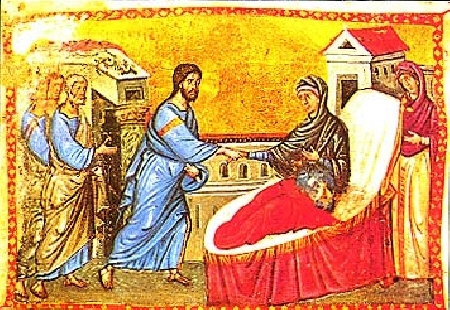
The image is Healing Peter’s Mother-in-law, from a 13th century manuscript from the Athos monasteries by an unknown author – http://shop.liturgie.de/, Public Domain, https://commons.wikimedia.org/w/index.php?curid=5187185.

What Have You to Do with Us?

In my weary moments, I wonder:
What have you to do with us,
Jesus of Nazareth?

Your followers (including me)
have found some other path
than yours. You, after all, relieved
the pains of those you met, while we
who claim your name impose such pain
to “save” our comfort or our power or
this sad deluded shout of “righteousness!”
We shame the poor; we spread disease;
we wrap ourselves in violence.
Were I you, Jesus, I would think
to shed this ill-named Christianity,
to wash it away, perhaps,
and start anew.

In my lonely moments, I wonder:
What have you to do with us,
Jesus of Nazareth?

Oh, sometimes I can feel your breath
upon my shoulder, sometimes feel
your hand upon my arm, yes
sometimes feel you pulling me into
a new direction. But.
Sometimes when evening falls or sunrise lifts
I sense no company, no strong
companion, and I long to know
once more the certainty my memory’s
fragility retains so fitfully
of your once-lucent clarity.

In my awestruck moments, I wonder:
What have you to do with us,
Jesus of Nazareth?

You could dance among the stars;
perhaps you do. I would, I think,
if I were you. You could speak and all
the evils of this world would be resolved.
Yes, bring the braided cords and clear
the temple – well, unless you’d have to lay
your sternness upon me. I’d settle then
for mercy, thank you very much.
No, with the ancient poet I repeat:
What are human beings that you
hold us in your mind; what are
mortals that you care for us?

In truth, I have no ready answer
for my weariness, my loneliness,
or even for my awe.
I can only be grateful, Jesus,
that you have been with us – and are.

A poem/prayer based on Mark 1:21-28, the Revised Common Lectionary Gospel Reading for Year B, Fourth Sunday after the Epiphany.

The image is Christ heals the possessed by engraver Jan Luyken. In the Bowyer Bible in Bolton Museum, England. Print 4234. From “An Illustrated Commentary on the Gospel of Mark” by Phillip Medhurst. Section D. Jesus confronts uncleanness. Mark 1:21-45, 2:1-12, 5:1-20, 25-34, 7:24-30. Image courtesy Phillip Vere – http://wfurl.com/a6ea272 (.pdf) “An illustrated commentary on the Gospel of Mark”. By Phillip Medhurst. .pdf file, FAL, https://commons.wikimedia.org/w/index.php?curid=9393722.

In the Silence

“And immediately they left their nets and followed him.” – Mark 1:18

Here you come again, O Jesus,
striding on the (rocky? sandy? weedy?) shore
to where I’m busy – busy, Christ, I tell you! –
with the labor of your call.

And you – oh, you – you have another call,
I’m sure, to summon me away
from this old fishing style to some new one,
from catching those… well, catching… what?

For if I am a fisher, then I fish the ponds
of fish you’ve caught before, and rarely reach
the waves upon the beach, and never stretch
beneath the ocean billowing.

Instead, I try to show the long-caught fish
just what it is to be a fish of yours,
to be a fishing fish, a loving fish,
a sharing-of-your-loving fishing fish.

As dear Mark left unspoken your
persuasive words to Simon, Andrew, James and John,
I wait within the silence yet to hear
your summons to be…?

A poem/prayer based on Mark 1:14-20, the Revised Common Lectionary Gospel Reading for Year B, Third Sunday after the Epiphany.

The image is a painting of the call of Simon and Andrew in the La Barca de la Fé, Templo Parroquial de San Andrés Buenavista, Tlaxco, Tlaxcala, México. Photo by Enrique López-Tamayo Biosca – https://www.flickr.com/photos/eltb/8399897831/sizes/o/in/photostream/, CC BY 2.0, https://commons.wikimedia.org/w/index.php?curid=24055602.

Fig Tree

“Nathanael asked him, ‘Where did you get to know me?’ Jesus answered, ‘I saw you under the fig tree before Philip called you.'” – John 1:48

It was long ago, my Savior, that you called me
out from under my fig tree.
Neither then nor now do I pretend to understand
just what you saw.

I strive, Redeemer, to become a person without guile –
sometimes successfully.
I’ve found your awkward knowing words and silences
correct me more than praise.

Still, knowing what you know, you sent the call
to summon me from shelter, and
I came to come and see, and seeing, echoed those old words:
You are the Son of God.

A poem/prayer based on John 1:43-51, the Revised Common Lectionary Gospel Reading for Year B, Second Sunday after the Epiphany.

The image is Bartholomew the Apostle by El Greco – lAHToi0sj3MVQw at Google Cultural Institute, zoom level maximum, Public Domain, https://commons.wikimedia.org/w/index.php?curid=29844192. Nathanael, named only in John’s Gospel, has traditionally been identified with Bartholomew, one of the Twelve in Matthew, Mark, and Luke.

Repentance

John the baptizer appeared in the wilderness, proclaiming a baptism of repentance for the forgiveness of sins.” – Mark 1:4

I am more accustomed to proclaiming
a baptism of forgiveness, Jesus, a baptism
of the Holy Spirit, a baptism of renewal.

I am more accustomed to confining
the language of repentance to my own
inadequacies, imperfections.

But as the pictures flicker on the screens,
and as the lies continue multiplying, then
I know I must repent a frightened silence, and

I summon up the words of John. Repent, you brood
of vipers, shed delusion, accept truth, and turn
from violent desecration of the nation

that you claim to love.

A poem/prayer based on Mark 1:4-11, the Revised Common Lectionary Alternate Psalm Reading for Year B, First Sunday after the Epiphany, the Baptism of Christ.

The image is Preaching of John the Baptist by Rembrandt – Gemäldegalerie, Berlin, Public Domain, https://commons.wikimedia.org/w/index.php?curid=41608726.

An Open Letter to the Speaker of the House of Representatives: January 7, 2021

Dear Madame Speaker,

I urgently request that the House vote upon articles of impeachment of President Donald J. Trump. He incited a riot against Congress. No public official should ever incite a riot. They should never incite a riot against another branch of the federal government. They should never be the head of another of the branches of government when they incite such a riot.

This is the very definition of a high crime.

This man must be held accountable, and he must never have the opportunity to betray the public’s trust again.

Thank you.

Eric Anderson

I sent a nearly identical letter to Senate Majority Leader McConnell.

2020: What We Should Have Learned

I have said once or twice that the past year and its problems are many things – stressful, harmful, dreadful, painful – but they have not been unprecedented. Every corner of the world has experienced a pandemic in its history. Why else is one of the Four Horsemen of the Apocalypse identified as Pestilence, even though that is one of the attributes of the Fourth Horseman, Death, in Revelation 6:7?

Hawai’i in the 19th century endured so many waves of disease that leaders despaired of the survival of their people. We have frequently compared the COVID-19 pandemic of 2020 to the influenza pandemic of 1918. Just a few years earlier, however, the United States had suffered an outbreak of actual bubonic plague in San Francisco. The five years of 1900 – 1904 included the political obstruction, outright racism, and unnecessary death we have known in 2020. There is a great video about the San Francisco plague.

Likewise we have known domestic turmoil, political polarization, and racial protest before. I wince every time these things are called “unprecedented” in a nation that fought a civil war, one which took the lives of more combatants than have died in all the other wars we have fought before or since: combined.

These are not unprecedented times. We call them such because we did not learn from the times before.

What should we learn from 2020?

Presence is Crucial and Irreplaceable

2020 brought great hardship: rising and falling and re-rising tides of illness, fear, poverty, death, and grief. Human beings aid one another in their need in a variety of ways. Nearly all of them begin with the simple gift of presence.

Is someone ill? Family and medical professional caretakers begin their treatment with presence. Is someone afraid? Comfort begins with presence. Does someone need food or shelter or housing? The first step is someone being present to their need. Is someone dying? We offer them presence. Does someone mourn? We make ourselves present.

Presence has been a risk factor in a pandemic. Actions we intended to bless have furthered the course of the curse.

Knowing this, we have drawn away from one another at great cost. Mental health statistics of anxiety disorders have climbed through the year. Holidays have brought a layer of sadness – even more than usual – to their invitations to celebration. For me, the great and terrible marker has been the aching gap of funerals. We grieve alone, but we comfort one another together. Ten people spaced apart in a big room, visibly holding themselves away from embraces, are starved for comfort.

We have tried to use technologies to fill the gaps with some success. There is relief to seeing the smiling unmasked faces on the computer screen or hearing the voices over the telephone. It makes things brighter. It is not, however, the same experience as physical presence. It has its strengths, but it is not the same.

Some day, I hope, we can be present to one another safely. What I hope we learn is to value that time in accordance with its actual surpassing worth.

Expertise and Competence Matter

There is a difference between intelligence and knowledge. Many people are smart. They can create things. They can calculate things. They can learn things. They can understand things.

Their ability to understand things – and create and calculate – depends a great deal on what they have actually learned. Without a base of knowledge, their understandings, calculations, and creations simply collapse in the face of cold, hard reality.

Examples of intelligence presuming expertise in the absence of knowledge and training are rife in 2020. In the United States, individuals contradicting experts had far too much sway, far too much authority, far too much power. The result has been that this nation has led the world in infection rates, hospitalizations, and deaths. We chose our unstudied ignorance over the knowledge of those who had studied. In a few cases those who did so paid the ultimate price. In more cases, other people paid the ultimate price.

Experts do not know everything, particularly when a situation like an emerging virus… emerges. Early statements from the Centers for Disease Control and the World Health Organization advised caution because of what they did not know. The researchers and scientists worked to learn about the new pathogen. Their success can be seen with the incredibly swift production of safe and effective vaccines. The point is that they did not quite start “from scratch.” They started with a knowledge of similar viruses, of tools to assess its characteristics, and for that matter with centuries of experience now that vaccines can work.

I’m a pretty smart guy. I’m probably bright enough that I could have done it… after spending years to learn the science of virology. I am no end grateful that others had already done that.

Can we learn to take expertise, training, and knowledge more seriously?

John Calvin… May Have Been Right

My theological tradition’s branch grows from the genius of John Calvin. He was a French Protestant who, in Geneva, Switzerland, developed the ideas which became the Reformed strain of Protestantism. Christianity in general holds to a doctrine of the inherent sinfulness of human beings. Calvin’s phrase expressed a somewhat bleaker view. He called it “total depravity.” “Because of the bondage of sin by which the will is held bound, it cannot move toward good, much less apply itself thereto; for a movement of this sort is the beginning of conversion to God, which in Scripture is ascribed entirely to God’s grace… Therefore simply to will is of man; to will ill, of a corrupt nature; to will well, of grace.” (Institutes of the Christian Religion 2.3.5)

Well. That’s depressing.

It has also been widely illustrated by human action in 2020.

Darker skin color has been strongly associated with COVID-19 illness and death in 2020, mirroring the experiences people of color have had with the criminal system, employment system, housing system, and government system. Official violence has continued to receive unmerited protection and even explicit encouragement from some elected leaders. Political leaders ordered an assault on Black Lives Matter demonstrators outside the White House, one carried out with well-documented brutality. They cleared a lane to a church from which their tear gas (tear gas is forbidden in war by international treaty) had driven ordained and lay staff from a medical station – a healing ministry – so that one politician could hold a Bible for the cameras.

Sexist and racist speech has re-emerged as “acceptable,” with those employing them using the tattered excuse that “they didn’t mean to offend,” as if motive really changed the impact of their words and deeds. As the year ended, a suicide bomber detonated a recreational vehicle filled with explosive in downtown Nashville, Tennessee. Some days went by before there could be agreement that it would be labeled a “terrorist” act. Could it be because he had been male and white?

Well. That’s depressing.

I have spent most of my ministry career working theologically at the more generous end of the doctrine of Original Sin. I have tended to de-emphasize the Pauline and Augustinian obsession with sexuality (though I note that people hurt one another terribly through their sexuality); I have tended to assume good motives for people (despite the clear harm they inflict); I have tended to a theory that circumstance, not nature, underlies the impossibility of perfection (despite the evidence that evil acts tend to be done out of all sorts of circumstances). Now I have to re-think this. It’s not that people behave worse than I thought. I’ve studied enough history to know differently. It’s that people persist in their evil, that they justify their evil, that they embrace it in the face of ethical teaching, new information, the guidance of their religion, and even their own pious statements to the contrary.

It’s one thing to read of these things. It’s another to see them and hear them day after day.

Total depravity indeed.

I have no interest in turning to a theology in which there is no worth to the human soul – among other things, it is clear that God puts great value in human beings. Calvin knew this, too. “Yet God would not have us forget our original nobility, which he had bestowed upon our father Adam, and which ought truly to arouse in us a zeal for righteousness and goodness… so that sick of our miserable lot we groan, and in groaning we sigh for that lost worthiness. But when we say that man ought to see nothing in himself to cause elation, we mean that he has nothing to rely on to make him proud.” (Institutes 2.1.3)

I hope we learn more humility about ourselves and our rectitude from 2020. I hope we discard the easy dualism that divides the world into Good People (that begins with Me) and Bad People. I hope we can consider not just that I Might Be Wrong but that They Might Be Right. I hope we can learn that others have paid a price for our comfort that we never asked but have been loathe to relieve.

May we learn humility.

The Failure of Christianity

There are so many ways to take that phrase. Do I mean that Christianity has failed to assert its power against the coercion of the State? Do I mean that Christianity has failed to pray away the pandemic? Do I mean that Christianity has failed to retain the loyalty (and attendance) of its members? Do I mean that Christianity has failed to convert the world to Christ?

No. I mean that Christianity has failed to live up to the standards of its Founder or of its God.

Christians this year have spent too much time and energy in maintaining political and social power. The Christian voices summoning up care and compassion have been soft by comparison. Christian voices have issued calls for violence in the assertion of privilege. Christian tongues have invoked racial bias, sexist dogma, and homophobic prejudice. Christian guidance has encouraged deadly folly in the name of Jesus. Christian leadership has ignored the vulnerability of many for the benefit of a few.

As the year ended, for heaven’s sake, the Wall Street Journal published two opinion pieces. One argued in explicitly sexist terms that a woman’s own achievements should be disregarded in favor of the title conferred by her husband’s office. Translation: Courtesy and respect for education and accomplishment bow to sexism and “I’ll call you anything I care to” privileged rudeness. Another asserted the virtue of Ebenezer Scrooge (yes, the one from “A Christmas Carol”), praising his thrift and diligence as the foundation of the feast. Translation: Greed is good.

Neither article survives ethical review with a Christian moral lens. Both were written in a culture that proclaims its Christianity. Christianity failed to guide either one.

Christianity seems to have left Christlike-ness behind.

As 2021 begins, I hope we learn to discover Christlike-ness. I hope we can learn, despite total depravity, to encourage one another in doing better today than we did yesterday. I hope we can learn, in short, to repent, to reform, and to renew ourselves and our faith.

I hope we learn.

2020. Well. That’s Quite Enough of That.

It started so well…

My only significant trip of the year started in 2019. I joined the Society of Christmas Day Travelers (Um. Is there an official organization called such? If there is, I didn’t formally join it) and flew east to spend time with friends and family in New Haven, Connecticut; Boston, Massachusetts; Norwalk, Connecticut; Westfield, Massachusetts; and New York, New York. It was lovely and, because I’d allocated two full weeks to the trip, not exhausting.

I returned to pick up the regular busyness of pastoring. In fact, I met with a family about a funeral for a dear church member on my first day in the office. We welcomed new members into the church. I planned a study of the Wisdom literature of the Old Testament for Lent. I attended the Church Leaders Event on O’ahu in February, the last time I would board an airplane in the year. That doesn’t sound like much of a milestone, but I had anticipated a number of trips to Honolulu in 2020 as part of my work with the Hawai’i Island Association Committee on Ministry. Only one took place.

Shrove Tuesday on February 25 saw me elected as President of Interfaith Communities in Action. On Ash Wednesday I welcomed the Rev. Jonathan Lee, a long-time friend who works for the Pension Boards, United Church of Christ, and we made plans for another visit that included him preaching at Church of the Holy Cross late in Lent. February ended (on the 29th; did you remember it was a Leap Year?) with an anniversary celebration for a wonderful couple in the church.

As March began, however, the spread of COVID-19 in the United States at large began to affect Hawai’i. The first diagnosis was confirmed on March 6th, someone who had contracted it aboard a cruise ship. The first case on Hawai’i Island was diagnosed ten days later. I shared my state of mind at the time in the essay, “Lessons from a Slow Motion Disaster.” I took my last daily walk with friends in Lili’uokalani Gardens on March 20th. On Sunday, March 22nd, we held our first online-only experience of worship. We hoped we might safely resume gatherings two weeks later. We did not.

Like pastors everywhere in 2020, I had no experience in leading or comforting a congregation during a pandemic. My work with the Connecticut Conference UCC gave me a foundation in Internet publication and video production most of my colleagues do not have. Even with that background, it all felt like an ongoing improvisation. To some extent it still does. I recorded those struggles in “An Ordained Geek Becomes a Televangelist” Parts One, Two, and Three. There should probably be a Part Four sometime…

Being me, I also turned to music. One of the questions asked early and answered early was about the risks of group singing. They turned out to be unacceptably high. How, then, to continue to enjoy vocal music? I launched “A Song from Church of the Holy Cross” on March 25th. I’d hoped to write an original song each week of the pandemic. That ambition didn’t survive the second week, but I did succeed in writing some new pieces throughout the year. I also transformed the twice-monthly Community Sings into hour-long live streamed Community Concerts. My Music playlist on YouTube includes both the single songs and the concerts.

I’m too old a hand at communication, however, to believe that current technology would work for everyone. In addition to live streams, the continuation of What I’m Thinking (which reached episode 200 this year), and the church’s electronic newsletter The Weekly Chime, we changed the print newsletter The Messenger to weekly and I began sending hand-written notes to those we believed did not have Internet access about once a month. My writing this year included all those additional essays for The Messenger as well as the #LectionPrayers here at Ordained Geek.

Church went on.

Jonathan Lee returned to preach electronically rather than in person, delivering the Palm Sunday sermon from his living room in Connecticut on April 5th. Unlike some of my colleagues, I did not experience a rush of additional video conference meetings among congregational leadership. In fact, we held far fewer meetings and managed to continue the work of the church pretty well. I really commend the members and the leaders for demonstrating that level of confidence in one another. There have been and continue to be strains and struggles – Church of the Holy Cross lost the bulk of its facility use income in 2020 – but we have continued to care for one another even as we have tried to figure out how to do that safely.

I have presided at three funerals since the pandemic struck. Other families have chosen to defer services until a public gathering is safe. This is one of the places where the isolation has taken a severe toll. It hurts to see grieving people keeping six feet away from other grieving people. It hurts to not see the supportive faces of those come to honor the departed. It hurts, and this is a pain that will not fade quickly.

The economic impact on Hawai’i has been considerable. Though our island relies less on tourism than O’ahu or Maui, service workers have been furloughed or laid off as hotel incomes fell away. In the interfaith community, we greatly fear the end of the state’s moratorium on evictions. Without substantial aid, jobless working families will not be able to pay rent. Landlords who have their own bills to pay will evict them, and then have trouble finding new tenants with cash in hand. I cannot stress how important it is to prevent this. It is always easier to keep someone housed than to find housing for them once they have become homeless.

As summer arrived, case counts fell in Hawai’i. Church of the Holy Cross replaced the pews with folding chairs to maintain distance between households and resumed gathering for worship on July 5th, though we continued to stream the service as well. Six weeks later, rising diagnosis rates prompted us to return to online-only worship. We have done this ever since, and have made no attempt to guess at how soon we might welcome a congregation again.

A couple of other organizations asked for my services this year. During the summer, I accepted an invitation to join the board of the Kuikahi Mediation Center. Among my contributions was vocals and instrumentals for a jingle in the fall (oh, and some video production as well). I was also nominated to become Chair of the Conference Council for the Hawai’i Conference United Church of Christ. The members elected me in October at the delayed ‘Aha Pae’aina and I took office then. I stepped down from the Hawai’i Island Association Committee on Ministry as the month ended.

In September, I joined an incredibly talented panel of ministers speaking about “The Sermons That Keep Preaching,” during which I confessed that I had, in fact, written nearly the same sermon about two years apart. For the October ‘Aha Pae’aina, I interviewed some of my Micronesian colleagues on camera to be included in a live streamed workshop. In November, I assembled the contributions of religious communities around East Hawai’i for the Interfaith Communities in Action Thanksgiving Celebration. The song from Church of the Holy Cross was my own composition, “Hard Season.” For December, I accompanied soprano Joanne Pocsidio on guitar for the University of Hawai’i at Hilo’s Kalikimaka 2020 video.

The strange truth is that during this past year, I have been in front of a camera at least three times in most weeks, and four times in just under half of them. Televangelist indeed.

Morwen in 2007

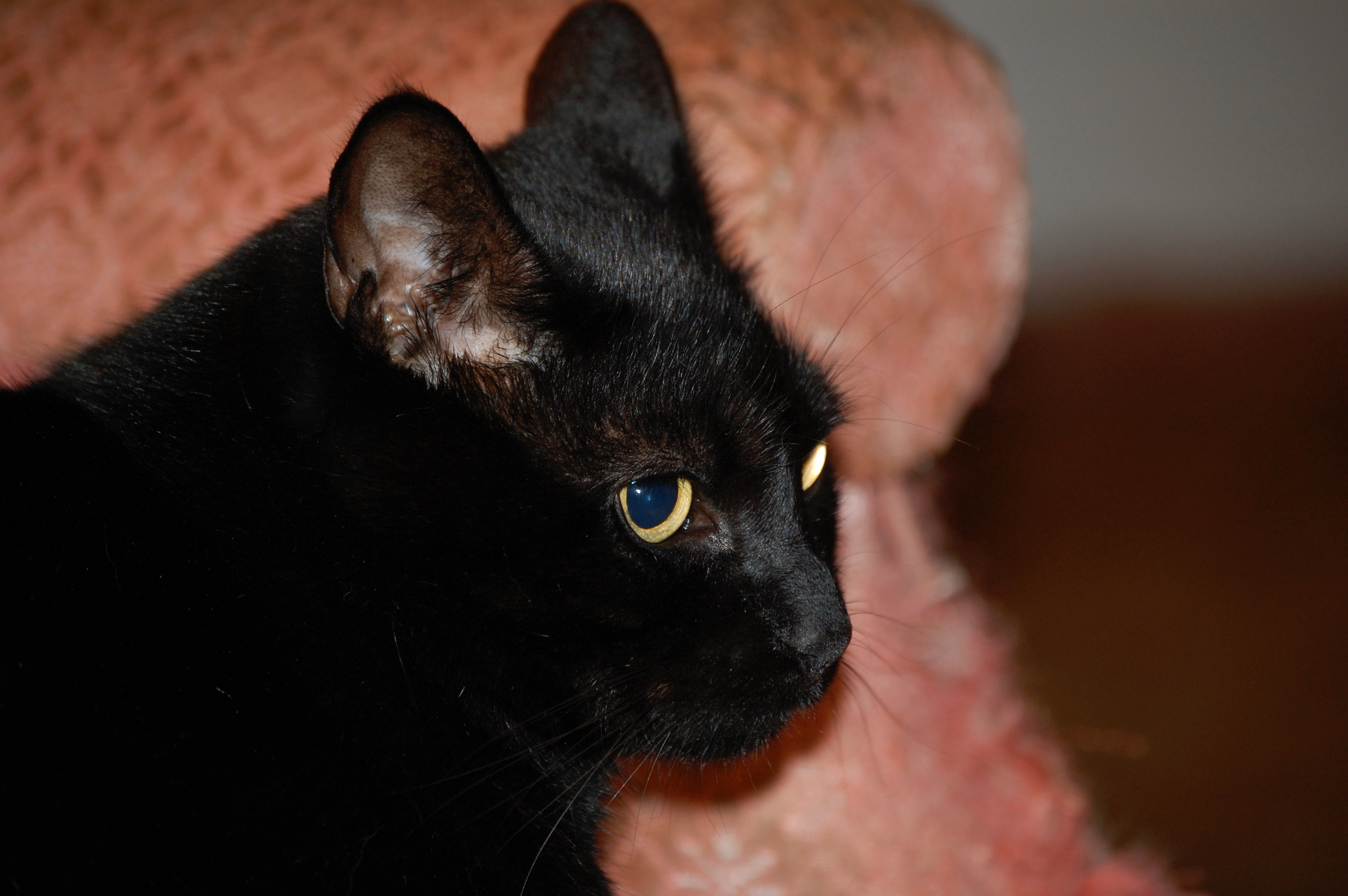
As all this was happening, my son Brendan gained acceptance to a Master’s degree program at the University of Bangor in Bangor, Wales (yes, on the island of Great Britain). After COVID-related (and bureaucracy-related) delays he flew to the United Kingdom in October. Rebekah continued her seminary education at Union Theological Seminary in New York City, though with classes online and growing case counts she left the city for some months. Sadly for her and for all of us, her cat Morwen died as 2020 ended, putting another capstone of grief on a year with too much for everyone.

2020 Photo Summary - 1 of 141

It is now 2021. We have – those reading this – survived 2020. Others did not. Some died of “the usual” causes: age, illness, violence (Usual? Yes, tragically usual), neglect, accident, suicide. Others died of COVID-19: 45 on Hawai’i Island, 286 in the state of Hawai’i, 346,000 in the United States, 1.82 million worldwide. Vaccines are in production, but they can not be manufactured and administered at the rate anyone would prefer. 2020 will linger into 2021.

Another essay is in the back of my mind – lessons to take away from 2020. Let’s see if that one takes shape this weekend before I return to ministry in a pandemic as my vacation ends on January 5th.

Whether it does or not, may we have health of body, mind, and spirit in this new year. Love to you all!