I Don’t Want to Hear About Fig Trees

Then he told them a parable: “Look at the fig tree and all the trees; as soon as they sprout leaves you can see for yourselves and know that summer is already near. So also, when you see these things taking place, you know that the kingdom of God is near.” – Luke 21:29-31

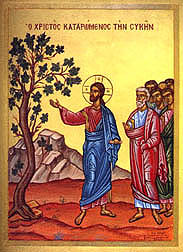
I don’t give a fig for fig trees, Jesus.
Tell me clearly what the future brings.

I know that changes in the wind forecast
the rain, or sun, or clouds, or stormy blast
that drowns or feeds or shields the fields,
or lays them down in wind-swept rows.

I know that rumblings deep within the ground
presage emergence of the fiery rock
that ravages the things we’ve built
and does what we cannot: make land.

And, yes, I know that human beings have a way
of signaling the things they’ll do.
I mean, sometimes they say it loud and clear
and we, somehow, will not believe.

I even know that when I dare not say myself
the compass point to which I’ll set my course,
I’m pretty sure which ways I will not go,
and that’s a good prediction where I will.

So it’s not ignorance of figs and leaves
or strength of wind or human whim:
it’s weariness, my LORD. The fig may speak;
my spirit is too tired to hear its voice.

A poem/prayer based on Luke 21:25-36, the Revised Common Lectionary Gospel Reading for Year C, First Sunday of Advent.

The image is a Byzantine icon of Jesus as in Mark 11:12–14 – http://revcrystalk.files.wordpress.com/2009/04/miraclesofthelordpa31.jpg, Public Domain, https://commons.wikimedia.org/w/index.php?curid=19042975.

Another World

“If my kingdom were from this world, my followers would be fighting…” – John 18:36b

O Lord, a disingenuous remark, perhaps?
There was some fighting in the garden when
you were arrested, yes? When Malchus lost
an ear, which you restored with just a touch.

It’s funny how nobody mentioned that
before the Roman governor. It’s like
the movie. “They cut off my ear!” “Your ear?
Your ear is fine.” “Well. It got better.”

In the best taste? Well, no, perhaps. You told
your old friend Peter to re-sheathe his sword,
then he and they decamped while you
were taken to the priests and then to Pilate.

Now, Pilate knew quite well just what to do
with you, Messiah. Crush the serpent’s head;
the rest will follow it to death. What need
a trial for pretenders to Israel’s throne?

What need? The need for truth, of course,
the truth that you defined Messiah unlike those
before, or those to come. You refused
to found your throne upon a frame of shattered bones.

Instead, you said, your reign’s foundation would
be truth itself, and truth its sign, and truth its aim.
To which the governor would scoff, attention gone,
the bitter question, “What is truth?”

Another world you rule indeed, Messiah King,
where those in power seek to rule in truth.
In this our world – and Pilate’s too – the truth
is clay to be reshaped as fits the day’s desire.

May we, unlike the governor who left the room,
his question echoing unanswered, give
the time and concentration to discern the truth.
Truth’s Author waits for us to ask – and learn.

A poem/prayer based on John 18:33-37, the Revised Common Lectionary Gospel Reading for Year B, Proper 29 (34), Reign of Christ Sunday.

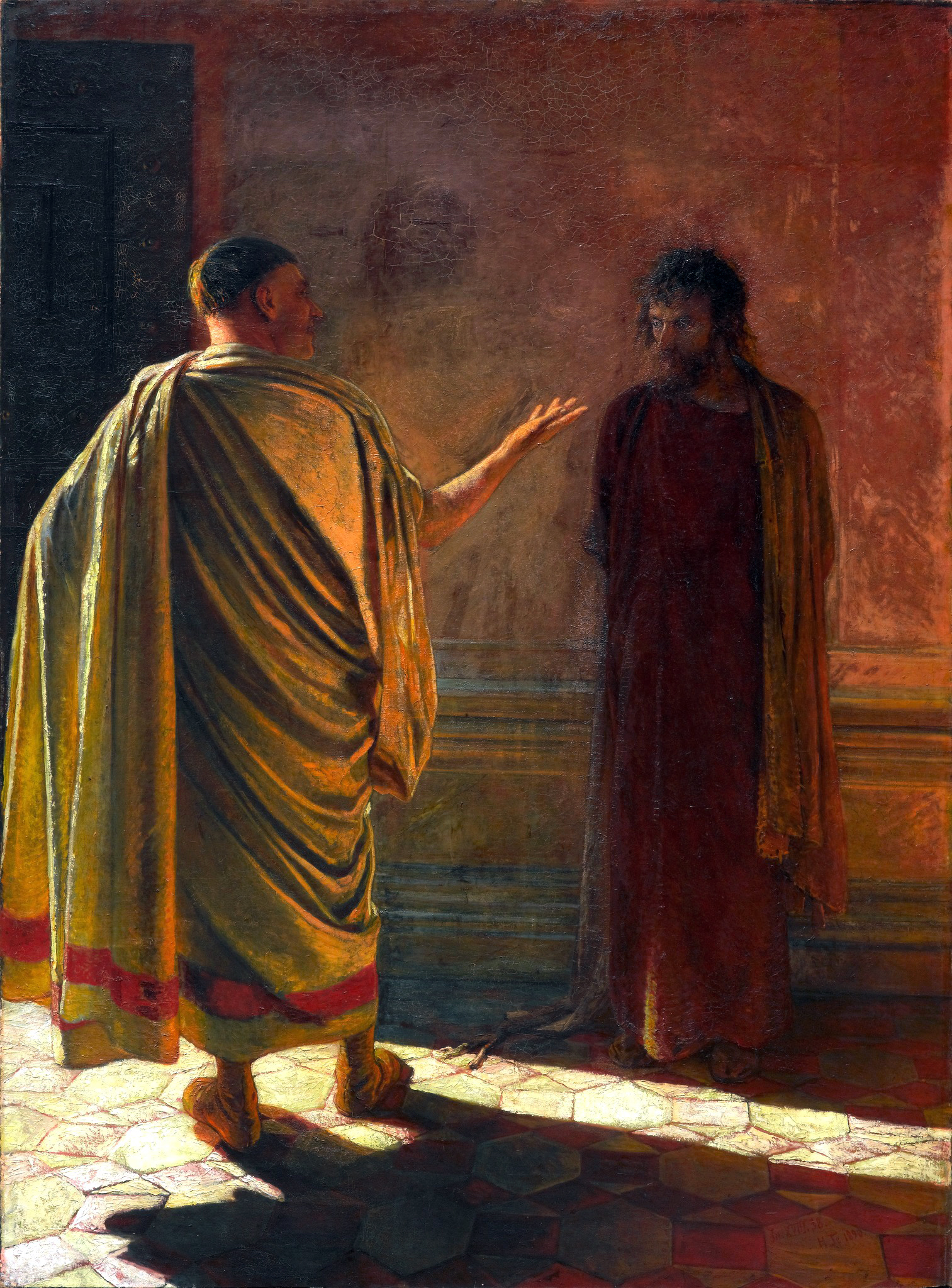
The image is What is Truth? Christ before Pilate by Nikolai Ge (1890) – http://www.picture.art-catalog.ru/picture.php?id_picture=7515, Public Domain, https://commons.wikimedia.org/w/index.php?curid=426635.

Distant Thunder

“The LORD! His adversaries shall be shattered; the Most High will thunder in heaven.” – 1 Samuel 2:10a

Ah, Hannah, generous of you, to spread your thanks
as broadly as a many-bristled brush, and not
to concentrate upon the detail of
your own distinctive celebration.

How dare we be so proud? We know
that God has lifted up, and God has tumbled down
the weary and the prosperous not once,
but time and time again across the span of time?

Indeed, these days have found us humbled once
again, at least we should be humbled now,
discard vainglory’s claim to safety through
the wonders of technology,

For all the care we take to trace disease,
and all success to find the means
to vaccinate the people, still
the folly of humanity prevails.

Ah, Hannah! Pray for us, that this reversal might
not bring us down to grovel in our pride,
to weep at further graves, lament our lost
communities and loved ones gone.

Yes, Hannah, pray for us, that this reversal might
lay down our pride, so we can stand
and raise each other up, to weep in joy
that we discarded folly’s ways in time.

O help us hear, upon the flowing wind,
the distant rumbles of salvation’s thunder, hope
that peoples near and far may know God’s grace,
and with their voices echo Hannah’s song.

A poem/prayer based on 1 Samuel 2:1-10, the Revised Common Lectionary Psalter Reading for Year B, Proper 28 (33).

The image is Anne, femme d’Elqana et mère de Samuel, priant (Hannah, Wife of Elkanah and Mother of Samuel, Praying) by Unknown author (10th century), found in the Psalter of Paris – Bibliothèque nationale de France (BNF). Cote : Grec 139, Folio 428v., Public Domain, https://commons.wikimedia.org/w/index.php?curid=14041273.

Devoured

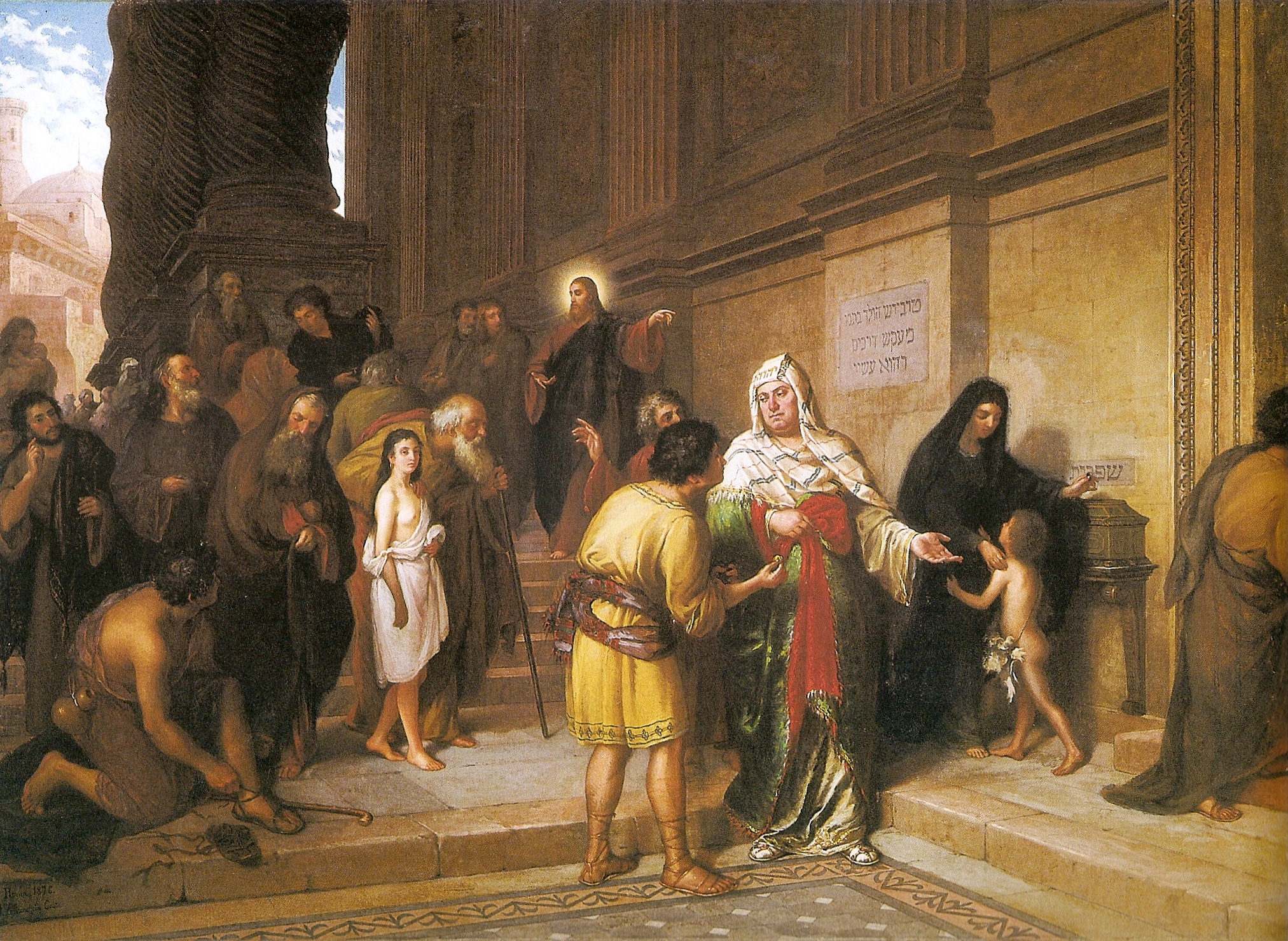
Note that both Jesus and the widow are in the background of the painting. The foreground features a religious official who resembles those Jesus described as liking to walk around in long robes and be greeted with respect.

“They devour widows’ houses…” – Mark 12:40a

“…But she out of her poverty has put in everything she had, all she had to live on.” – Mark 12:44b

So what was your expression, Jesus,
when you called your friends to see
the widow whose last coins had rattled down
into the treasury collection?

Did you watch with soft, approving eyes,
to see such faith, such generosity,
such confidence of God’s aloha
to relieve the crisis now at hand?

Or did your brow bear furrows
of concern, of worry, for her poverty
had now reached destitution, and
her final meal had clinked into the box?

Or did you grind your teeth to witness on
the Temple grounds the very thing
of which you’d warned? For here
a widow’s house had been consumed.

Oh, Jesus! Have you any teeth remaining in
your jaws? Or do you lubricate
their grinding with your tears? For still
the widows bring their homes… and we devour.

A poem/prayer based on Mark 12:38-44, the Revised Common Lectionary Gospel Reading for Year B, Proper 27 (32).

The image is O óbolo da viúva (The Widow’s Mite) by João Zeferino da Costa (1876) – Scan: MNBA/Banco Santos catalogue, São Paulo, 2002., Public Domain, https://commons.wikimedia.org/w/index.php?curid=15742896.

Nobody Asked

“One of the scribes came near and heard them disputing with one another, and seeing that he answered them well, he asked him, ‘Which commandment is the first of all?'” – Mark 12:28

You thought it was a worthy question, Jesus,
so worthy that you did what you so often
did not do: you answered it. With quotes.
“Deuteronomy six, verses four and five,” you said.
“The second is much like it, but you’ll have to turn
the pages to Leviticus nineteen, the eighteenth verse.”

Well, no, you didn’t tell him that,
and force him to refresh his memory for numbers
rather than the force of God’s commands:
“The first is ‘Hear, O Israel, the LORD is one,
so love the LORD with heart and soul and mind and strength.
The second is to love your neighbor as yourself.”

An honest earnest question and an honest earnest answer,
so you and he agreed. “Yes Teacher, you have truly said
that God is One, there is no other, to love the LORD
so well, to love one’s neighbor as oneself, is better
than the offerings and sacrifices of this Temple.
And so you told him he was near the Realm of God.

“After that no one dared to ask him any question…” but
I wish they had. For if to know that loving God and
loving neighbor is to stand upon the verge
of God’s expanding realm, the question still remains:
How do we cross the border from its edge
and find ourselves as citizens of God?

I see that steady, steely gaze, of course.
You have no need to answer what you’ve answered
time and time and time again. To know
we are to love our God, to know we are to love
our neighbor, these bring us to the gate.
To make the crossing, we must bring the love.

A poem/prayer based on Mark 12:28-34, the Revised Common Lectionary Gospel Reading for Year B, Proper 26 (31).

The image is Caritas by William Wilson, 1905-1972. From Art in the Christian Tradition, a project of the Vanderbilt Divinity Library, Nashville, TN. https://diglib.library.vanderbilt.edu/act-imagelink.pl?RC=57837 [retrieved October 27, 2021]. Original source: https://www.flickr.com/photos/paullew/8539356086/.

Lightened

“Jesus stood still and said, ‘Call him here.’ And they called the blind man, saying to him, ‘Take heart; get up, he is calling you.’ So throwing off his cloak, he sprang up and came to Jesus.” – Mark 10:49-50

He heard the Nazarene was near.
He called the name,
He shouted “Jesus, Son of David!
Come and bring me mercy!”

He saw more clearly than the ones
Who sought to quell his voice.

They sternly ordered him,
But quiet would not serve the time.
“Son of David, come!
Come and bring me mercy!”

He saw more clearly than the ones
Who shortly would declare, “Hosanna!”

They would acclaim a conquering prince.
He shouted for a healer’s power.
They would prefer their preconceptions
To the Way the Christ would tread.

He saw more clearly than the ones
Who sought to sit at left and right.

“The Teacher calls,” the word had spread,
And hearing, he erupted from the ground,
Now lighter in his movements as
His cloak was left a-flutter in the dust.

He saw more clearly than the ones
Who’d take two tunics on the Jesus road.

So Jesus, tell me true,
Because I find myself confused.
Why when he asked to see again,
You said, “Your faith has made you well”?

You might have said, in deepest truth,
“My friend, you see. You do.”

A poem/prayer based on Mark 10:46-52, the Revised Common Lectionary Gospel Reading for Year B, Proper 25 (30).

The image is Christ Giving Sight to Bartimaeus by William Blake – XQENbMVCvBS7kw at Google Cultural Institute maximum zoom level, Public Domain, https://commons.wikimedia.org/w/index.php?curid=22207218.

Rise and Fall

“[Jesus] said to them, ‘Whoever divorces his wife and marries another commits adultery against her…'” – Mark 10:11

“But when Jesus saw this, he was indignant and said to them, ‘Let the little children come to me; do not stop them; for it is to such as these that the kingdom of God belongs.'” – Mark 10:14

Rise and fall, rise and fall.
One minute you set the goal posts high,
to give relationships the dedicated work
we give to our most cherished crafts.

Perhaps you were remembering the potter
Jeremiah watched five centuries before,
who made those errors but reshaped
and did not throw away the clay.

But harsh, Jesus, harsh, to raise the spectre
of a Ten Commandment sin when other sins
like violence defile the marriage bond,
when some receive no options but assent.

Rise and fall, rise and fall.
Another minute and you are indignant
once again, but not with divorcees but friends,
who would “protect” you from the crush of children.

Lower now the barriers, you say,
and let the children come to me,
the heirs, possessors, owners of
the reign of God.

And so they come, the carefully washed
when leaving home, now layered with
a liberal crust of dust, and hardly struck
with the importance of the blessing they’ll receive.

Rise and fall. Rise and fall.
You set our aspirations high, O Lord,
for spouses, friends, and strangers, then
you let them fall, and give the realm of God to us.

A poem/prayer based on Mark 10:2-16, the Revised Common Lectionary Gospel Reading for Year B, Proper 22 (27).

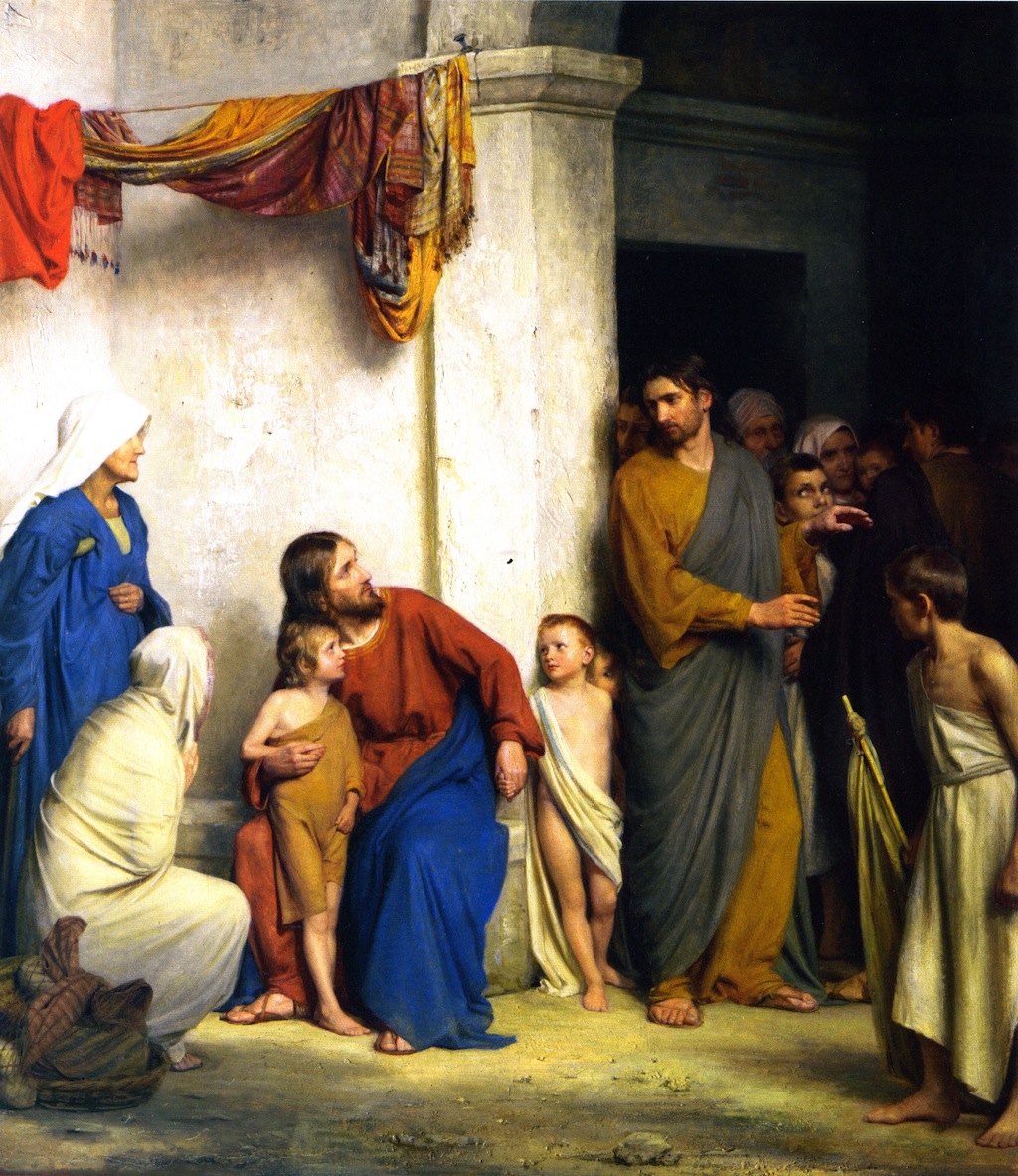
The image is Jesus Christ with the Children by Carl Bloch (1800s) – Photo by the Athenaeum, Public Domain, https://commons.wikimedia.org/w/index.php?curid=25991809

Nice

“Then the LORD came down in the cloud and spoke to him, and took some of the spirit that was on him and put it on the seventy elders; and when the spirit rested upon them, they prophesied. But they did not do so again. Two men remained in the camp, one named Eldad, and the other named Medad, and the spirit rested on them; they were among those registered, but they had not gone out to the tent, and so they prophesied in the camp.” – Numbers 11:25-26

“John said to him, ‘Teacher, we saw someone casting out demons in your name, and we tried to stop him, because he was not following us.’ But Jesus said, ‘Do not stop him; for no one who does a deed of power in my name will be able soon afterward to speak evil of me. Whoever is not against us is for us.'” – Mark 9:38-40

Within the tent, You spoke to Moses, and
the sixty-eight inside proclaimed
Your word, and likewise two
who couldn’t follow clear instructions. Nice.

Outside the house, You gave the healing strength
to one who followed Jesus without following
the others. John, like Joshua before,
protested. Jesus bade him silence. Nice.

Who, after all, could smother all
the movements of Your Spirit? We
can try it all we like, but still the breath
of God moves as it will despite us. Nice.

But then, it works (or not) the opposite,
for when I’d see Your Spirit wafting wide,
“the word of God was rare those days,”
and just a few declare Your power. Nice.

And so I hear the weariness of Moses, said
to Joshua, “Would that God’s people all
were prophets!” Then the labor of disciples could
be shared, and I might rest a while. Nice.

Oh, Eldad, Medad, unnamed exorcist
of Galilee, may that same Spirit that
empowered you empower more, ’till all
rejoice in holiness and healing. Wouldn’t it be nice?

A poem/prayer based on Numbers 11:4-6, 10-16, 24-29 and Mark 9:38-50, the Revised Common Lectionary First Reading (Alternate) and Gospel Reading for Year B, Proper 21 (26).

The image is Moses elects the Council of Seventy Elders by Jacob de Wit (1737) – AQGtI5P6nkpYyw at Google Cultural Institute maximum zoom level, Public Domain, https://commons.wikimedia.org/w/index.php?curid=21988106.

The Circularity of Arrogance

“[Jesus] sat down, called the twelve, and said to them, ‘Whoever wants to be first must be last of all and servant of all.'”
– Mark 9:35

No, I don’t really want to talk about the things
we talked about, not when you’d likely
have preferred we talked about the things
you said, the things we didn’t want to talk
about at all. No, not at all.

I really do not want to tell you, nor
admit, that we were one in mind
to not discuss what you had said,
and in the unity of our denial broke
into an argument of who is chief.

Um. After you, of course.

So really, we’ll just stand in silence, let
our shuffling feet reveal what you
already know without our saying anything
(and have I said just how annoying that
we know you know what we’d prefer you did not know?).

Our lips compress as you confirm you know
(we knew you knew) and tell us greatness is
the thing you said that we’d preferred
to leave unsaid: the first is last, the last is first,
and yes, we know, but honestly…

You know this doesn’t ever work – you know.
You know there’s prideful service just as much
as prideful leadership. You know
that some proclaim their martyrdom of self
as virtue though they only serve themselves.

So even were we to have spoken of
the greatest servant soul among us
(after you), we still would have been puffing up,
not building up. Do you not see
the circularity of arrogance?

I see despair has crept across your face,
the desperation as you take the hand of… wait.
You mean it’s just that simple? Serve the child?
Serve the growing child? Serve the child that’s grown?
Serve the child – and so we serve our God?

A poem/prayer based on Mark 9:30-37, the Revised Common Lectionary Gospel Reading for Year B, Proper 20 (25).

The image is Jesus and the Children, a Carolingian fresco on the north wall of the nave of the Monastery Church of St. John in Müstair, Switzerland, ca. 825. Image file from James Steakley; artwork: unknown – Jean Hubert et al., Europe in the Dark Ages (London: Thames & Hudson, 1969), p. 152, Public Domain, https://commons.wikimedia.org/w/index.php?curid=6941409.

Unreturned Compassion

I originally wrote this essay in 2010 as a Facebook “Note.” Since that portion of the service has steadily faded away, this seems an appropriate moment to republish the piece here at Ordained Geek.

In an opinion piece carried by the The Hour in Norwalk, my good friend the Rev. Paul Bryant-Smith, pastor of the First Congregational Church UCC in that city, makes the case that ‘It is our responsibility to defend our Muslim neighbors from slander.’ I commend the essay to you, and I have very little to add to it, except to note that the chorus of those American Christian leaders affirming interfaith relations of kindness and integrity is far larger than those opposing it.

As is frequently the case in these days of instant comment on the Internet, though, one of the latter voices appears right below Rev. Bryant-Smith’s. It’s discouraging, and it features, near the end, this dispiriting flourish: ‘So please, for this weekend of mourning and remembrance, save your one-sided message of unreturned compassion for your pulpit.’

That’s the crux of the matter. Unreturned compassion.

The argument goes like this: ‘They (pick a They, any They) did something bad to us/said something bad about us/think badly of us. That’s Bad.’

So far I agree.

‘Because They did this bad thing, They are Bad.’

Perhaps. All too frequently, one person stands as surrogate for another’s bad acts, with whom they can be identified because of (frequently superficial) shared characteristics. Guilt by association usually looks much different to the one being condemned than it does to the one doing the condemning.

But for the moment, let’s assume that the people named are no surrogates; They bear some actual responsibility. Are They therefore Bad People?

The Gospel word, the Good News, says both yes and no. Remember those whose blood Pilate mixed with their sacrifices, says Jesus (Luke 13:2). Were they worse sinners than anyone else? ‘No, I tell you; but unless you repent, you will all perish as they did.’

Sin and sinning aren’t escapable things in classic Christian theology. We do the best we can, but we can’t be perfect. With absolute purity unattainable, we rely on the grace of God.

So are they Bad People? Yes. And so are you and I, in our own ways.

But now we really come to the heart of it. What are we to do with Bad People, with Them, and with You and with Me?

‘Love your enemies, do good to those who hate you, bless those who curse you, pray for those who abuse you’ (Luke 6:27-28).

Unreturned compassion. That’s the crux. That’s the center. That’s the Cross.

That’s where we have hope for a society that is greater than what we have. That’s where we will find (or at least glimpse) a blessed community. If we save it only for the pulpit, we’ll never have the glimpse.

Unreturned compassion. That’s the crux. That’s the center. That’s the Cross.