The Overburdened Albatross

Laysan_Albatross_RWD2There are creatures in the world who love to collect things. Lots of things.

There’s the bowerbird of Australia and New Guinea, who assembles a collection of brightly colored objects (from shells to flowers) to impress a potential mate. There’s the pack rat of the Americas, who will use anything and everything to construct a nest.

And then there’s people. We might be the greatest collectors of all. We are amazing.

If there’s one creature who shouldn’t, and doesn’t, collect a lot of things, it’s the albatross. They spend most of their time far out at sea, gliding on the trade winds over the ocean, landing on the water’s surface from time to time to snatch a meal. Sometimes it’s fish, sometimes it’s squid. They like squid.

You don’t think squid sounds very tasty? Some people like it better if you call it calamari.

Did that help?

Whether you like squid or calamari (or neither), it’s a difficult life for a collector. Nevertheless, there was once a young albatross who set out to do precisely that. I have no idea why.

He started with pebbles he found along the shoreline near the nest where he’d been hatched and grown to become a young adult. I guess he found the colors or the shapes interesting, and they made a nice addition to the nest. Then he added different kinds of grasses that he found. When the old ones blew away, he brought new ones.

Soon there were sea shells piled around his nesting spot, and inevitably the trash that humans leave behind. Some albatrosses get very sick by eating these things, but he just picked them up and put them down again. There were bits of plastic, and shreds of cloth, and his grandest prize of all: the better part of a beach blanket that had floated away from somebody one day.

That wasn’t any of yours, was it? Oh, good.

As his collection got bigger, his circle of friends got smaller. Not because they objected to his hobby, no: but because the season was passing, and they started leaving the nesting site. They were riding the winds out over the Pacific Ocean, with an occasional descent to the surface to catch calamari.

Or squid, if you prefer.

But this young albatross didn’t want to leave his collection. Oh, he tried to take it with him. He wanted to soar over the ocean, too. But when he tried to carry everything on his back, between his wings, he couldn’t manage to take off. When the load was light enough to fly, everything tumbled off. He tried gripping things in his beak, but he quickly realized that he couldn’t eat that way. It’s hard to hold things in a webbed foot, and when he wanted to use two feet to carry things, well, he found that it didn’t work.

And it was also painful.

Finally, it was hunger that made him see the true worth of his piles of pebbles and shells and even the magnificent beach towel. However lovely they might appear to his eyes, they didn’t feed him. No, they didn’t feed him.

Not the way that the skies of the Pacific fed him. Not the way that the waters of the Pacific fed him. And certainly not the way that the squid (or the calamari) of the Pacific fed him.

So he stepped carefully away from his collection, gave it one last look, spread his broad wings, leaped into the air: and flew.

Photo credit: By DickDaniels (http://carolinabirds.org/) – Own work, CC BY-SA 3.0, https://commons.wikimedia.org/w/index.php?curid=18611723

The Hungry ‘Apapane Brothers

Two apapaneThis morning’s story is about a particular kind of bird. Now, I have a reputation for telling stories about this one particular kind of bird, so I’ll just put the question out there: Would anyone like to guess what kind of bird this story is about?

The i’iwi? That’s a good guess – really close, in fact – but no.

Wait, I think I just heard it…

Yes, it’s the ‘apapane. (The room settles into comfortable expectancy.) Although actually, it’s not.

It’s about two ‘apapane!

They were brothers. They’d hatched from eggs in the same nest, about an hour apart from each other.

Why yes, just the way you two are brothers. Only I don’t think you two were hatched? Were you? Am I wrong? No. OK. I thought not.

I also suspect that you weren’t born an hour apart. Right. Mom says not. Three years apart? OK.

Well, these two ‘apapane were hatched just an hour apart.

They grew up together, and learned to fly together, and had the same friends, and they wore the same wonderful feather cloaks of rusty red and white and black.

Not surprisingly, since ‘apapane tend to like the same things, they had the same taste in food. That’s also where the trouble came in.

You see, when they’d see an ‘ohi’a tree in blossom, they’d both swoop down to drink the nectar from its flowers. That’s fine. That’s what ‘apapane do.

But these two, well, not only would the swoop down to the same tree, they’d land on the same branch. Not just the same branch, but the same cluster of flowers. And when they went to dip their beaks, they’d aim for the same single blossom. At the same time. So they’d bang their foreheads together.

Then they’d sit there on the same cluster along the same branch in the same tree and scream, “MINE MINE MINE MINE MINE!”

Each time they’d scream, “MINE!” they’d jab their beaks at each other, and the screeching echoed around the forest.

Their friends soon learned to get out of the way when this started. For a while, they tried pulling them apart, but they weren’t so much driven away as ignored. They’d scream “MINE!” no matter what they did.

Their parents tried to intervene, and got no farther. In desperation, they went to the older ‘apapane for advice. Some had some, and they tried it, but nothing worked. Finally, one wise ‘apapane, who had seen many things in her time, said, “Let them alone. They will discover one day that the ‘ohi’a do not belong to them.”

And so the forest continued to resound with the screaming: “MINE MINE MINE MINE MINE!”

There came the day when the two brothers flew to the same tree, landed on the same branch, hopped to the same cluster, and bonked their heads together over the same blossom. The screaming got started and wouldn’t stop. The other ‘apapane flew to other trees to escape the noise, but the two brothers didn’t notice. They didn’t notice as the sun dipped below the treetops. They didn’t even notice that the ‘ohi’a blossoms themselves were fading away, dropping from beneath them and going to seed. They screamed and they screamed and they screamed.

Not even an ‘apapane’s lungs can keep that up forever. Gasping for breath, they looked at each other, and then looked down at the blossoms that had faded away beneath them. It was a cluster of seeds. And finally they knew.

The ‘ohi’a lehua did not belong to either one of them. The blossoms did not belong to any ‘apapane. The flowers belonged to the ‘ohi’a trees, who shared them with the ‘apapane, and the i’iwi, and the ‘elepaio.

I hope you’ll remember that we do not own the living things of this world of ours, not the ‘ohi’a, nor the birds of the air, or the fish of the seas, or any of the people. God has shared them with us. Let us remember to always share God’s creation with the other living things of this Earth.

There are two ‘apapane in the digitally enhanced image above. Photo by Eric Anderson.

After the Funeral

IMG_0008The sun was setting well behind my back
(And well behind the mountain)
As I stood for just a moment
And looked up upon the sky
As mourners made their way
From sanctuary’s words of comfort
To the kitchen’s comfort foods.

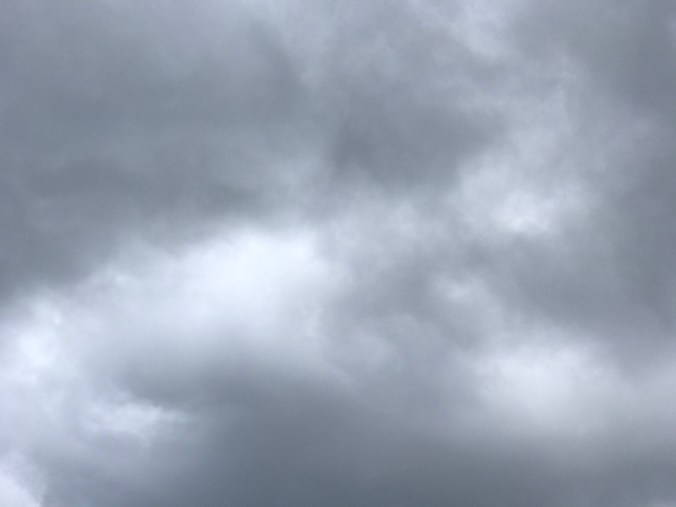
And there, upon the gray-clad cloud,
A crystal band a-glow.

Too small, this sight, to capture with
The sensors of the pocket camera.
I doubt too many noticed it at all.
It lacked the hues of saffron or of crimson:
Just a top-lit arc of argent, glowing
With reflected sunlight, in a corner
Of the sky.

I thought: It is no wonder
We imagine heaven in the clouds.

Wherever it might be you gather souls, O God,
Wherever you have welcomed this dear man,
And others dear, women and men and everyone,
May it be as glorious, or even more,
As this fair gleaming, beaming from the cloud.
And thank you for this brief reflection
Of a glory promising your grace.

Thank you, God, for light on clouds.
Thank you, God, for light in hearts. Amen.

In memory of Kenneth Susumu Tanouye, after whose funeral I saw this light upon the clouds, and with love for all those who have gone from our care to God’s.

The photo does not particularly resemble the light reflected in this poem. It’s more dramatic — which is a virtue of its own, and so it won its place here.

Birthday!

mosaic-409427_1920They didn’t know it was a birthday.

I’m sure they were aware that nearly every day is somebody’s birthday. Maybe they thought about that. Maybe they didn’t. If they did, they probably moved right along, realizing that they didn’t know the person (persons?) whose birthday it was.

And in any case, the birth they didn’t know to celebrate hadn’t happened yet.

“They” were Jesus’ friends and followers, getting together in a house in Jerusalem. It had been fifty days since that terrible and yet miraculous Passover, the Passover during which Jesus had been arrested, tried, convicted, crucified, and killed. It had been forty-seven days since that starting and miraculous Sunday when they found that the Crucified One had become the Risen One, that Jesus walked the Earth once more with a new life and a new power.

The birth, however, hadn’t happened yet, so they didn’t know (fifty days after Passover) that it was a birthday.

They were together to share stories, and take comfort in each other, and to pray.

Suddenly, there came the sound of a great wind, howling through the streets of the city, roaring through old Jerusalem.

Startled, they looked up, and to their astonishment what they saw was as surprising as what they heard. Something like tongues of fire danced about above their heads, just like the candle flames on a birthday cake.

Birthday candles. Like on a birthday cake. The birth was happening.

(OK, I know that they didn’t do birthday cakes with candles in the first century.)

Like a child filled with sugary cake and icing, they couldn’t stay still. They spilled out of the house into the city streets, to find others outside as well. They’d heard the wild rushing wind and come to see what was going on.

Jesus’ friends started telling them. They told them about the wind of the Holy Spirit, but they told them even more: about Jesus and his kindness. About Jesus’ teachings and compassion. They told them about his bravery in the face of death. They told about his resurrection to new life, and they told them how it showed how much God loved them.

How much God loves everyone.

How much God loves us.

It didn’t seem to matter what language the other people spoke, at least not on that day. Jesus’ friends, in that moment, could speak to everyone and be understood.

And so the Church was born.

Photo found on Pixabay offered as public domain.

The Folded Peacock

PeacockThis week’s story is about a bird who is not native to these islands, but I’m pretty sure you know about them. Some do live here. This story is about a peacock.

Have you seen one?

Great!

I need to mention that since the beginning of Creation all the way up to the present day, there has never been such a thing as a humble peacock. Not one.

I guess they’ve got good reason. Their chests and necks are covered with feathers so blue that the sky looks down in awe. They wear a crest on their heads with is daring and delicate. And when they spread their tails in a great fan of feathers, those eye shapes glow as if with their own light.

It’s hard to say anything other than that they’re magnificent.

The peacock I want to tell you about was widely acknowledged to have the finest tail fan of his generation. The blues and greens were deeper, and they glistened brightly. There were silvers and golds in the eye patterns that were unique, and somehow the fan felt fuller, with less transparent gaps, than any of his fellows.

Among a species of magnificence, he was at the top.

He became concerned over the years, however, as he saw signs of wear begin to appear on the tails of other peacocks. He’d married a very nice peahen, and they’d raised a number of chicks during that time. But he noticed that time was not being kind to the tails of other peacocks.

Some were less careful, perhaps, to keep their tail feathers out of the dust or even muddy areas, and the dirt would dull their glistening feathers. A quick rinse would take care of most of that, but then there were other problems. The dirt would also pull at the feathers themselves, tearing away the little bits that made the fan connected.

The eye patterns would lose their shape sometimes when brambles or branches pulled the barbs of the feather apart, and sometimes pulled them away, leaving gaps.

The worst seemed to happen as a peacock opened his tail into that great fan. Hooks on the barbs would catch in the wrong place, hauling the feather out of shape. Feathers would cross each other, causing more damage.

Worst of all, the peacock considered, was when a bird lost a tail feather or two, and fanned his tail anyway. He didn’t approve of leaving those holes.

So he stopped displaying his tail.

It wasn’t enough, he thought, to carefully carry his tail above the dust and dirt, or open it gently to the eyes of others. An open tail came with the risk of wind guests, and sudden rain, and a score of other dangers. He kept his tail tightly closed.

A new generation of peacocks grew up with the stories: “This bird over here has the most amazing tail fan I’ve ever seen.” The tale-tellers would describe the appearance as they remembered it.

Their hearers, I regret to say, didn’t entirely believe them, and certainly didn’t understand that their glowing descriptions didn’t do justice to the stunning reality. The tail became a legend that could not be demonstrated, a glory that was cloaked in words.

None of you are peacocks, but you do have wonders about you: perhaps you sing, or build things, or paint things. Perhaps you are good at kind words; perhaps you have a wide, friendly smile. Those things are meant to be shared, not hidden away.

I hope that you’ll have the courage to risk your talents to the world: Risk singing, or painting, or helping, or smiling, or whatever you have to share.

Have courage. Share it. And let this peacock be the last creature to be afraid to share his gifts.

Photo Credit: By Alex Pronove (alexcooper1) – Own work, CC BY 2.5, https://commons.wikimedia.org/w/index.php?curid=452220

Running

Running beach Don GrahamI don’t know how she reached the age of seven years old without learning to run, but she hadn’t.

I guess she hadn’t seen the point. There weren’t any reasons that she couldn’t run — she’d never even been told “No running in the house!” by her parents (probably because she didn’t) — she just didn’t run. She could walk, slowly or quickly, as the moment required, but she didn’t run.

Now came the day that she wanted to. So she set out to learn.

Running isn’t like walking (you heard it here first, folks!). In walking, there’s always one foot on the ground. When you’re running, there are times when you sail through the air.

She’d watched her friends and family, and even slowed down movies, so she knew this. So she started with hopping.

First she hopped back and forth with both feet together. Then she tried hopping on one foot. Then she hopped from one foot to the other: back and forth, back and forth, back and forth.

She tried making longer hops forward.

Then she tried making one one-legged hop forward, followed by another, followed by another.

She fell down on hop number four.

That might have been discouraging, but she only sat up and congratulated herself for picking a soft field to practice in.

She tried different approaches. Sometimes she hopped a little more sideways (kind of like a crab) and sometimes she tried crossing her feet back and forth in front of her (she gave up that one pretty quickly). When her feet got tangled up, she’d try the same thing again, and if it tripped her the second or third time, she tried something else.

She kept at it, remembering to experiment through the process, and keep her mind on the goal.

By the end of the day, she was running around the field with a grin as wide as the sea. She wasn’t fast, it was true, but she was authentically running, and she knew she’d get faster with each new day.

Her friends, it must be said, were very impressed, both with the running, and with the smile. Together, they charged off into each new day.

Photo by Don Graham. Used by permission under Creative Commons license.

Imagining Cleopas and Companion

The_Road_to_Emmaus_-_Google_Art_ProjectI wrote this little dialogue for the sermon “Hidden Messiah, Visible Messiah,” preached on April 30, 2017, at Church of the Holy Cross UCC in Hilo, Hawai’i. It, um, “fills in” part of the story omitted from Luke 24:13-35. I’ve always enjoyed inventing these conversations. So here it is in a stand-alone format.

One: “That was Jesus.”

Two: “Yes. That was Jesus.”

One: “So he’s really resurrected?”

Two: “Apparently so.”

One: “Just like Mary Magdalene, and Mary, and Joanna said.”

Two: “Just like they said.”

One: “Wow.”

Two: “Wow.”

The two disciples were silent for a moment.

Two: “And how far did we just walk with him?”

One: “About six miles or so.”

Two: “And we didn’t recognize him until just a moment ago.”

One: “That’s right. We didn’t.”

Another silence falls.

One: “Do you want to go back to Jerusalem and tell this story to all our friends?”

Two: “No. Do you?”

One: “Not for a moment.”

More silence.

One: “We have to, though, don’t we?”

Two: “Yes, we do. Let’s get going.”

One: “They’re going to hold this over our heads for two thousand years aren’t they?”

Two: “Could be. But if you’re lucky, Cleopas, they won’t remember your name.”

Hidden Things

Pacific_Golden_Plover_hawaii_RWDAs I invited the young people to come forward, I gathered my notes and brought them down front with me. 

I don’t usually bring notes with me for these stories, but I’ve managed to get the name of this bird wrong five times this morning, and I want to get it right. Because this story is about a kolea.

There are a lot of kolea about this island these days. In English, they’re called the [look at notes] the Pacific Golden Plover (the Hawaiian name is easier, isn’t it?). They’re all born in Alaska, which is a long way from here, and they have the good sense to fly here to Hawai’i to spend the winter. That’s where they are now, but they’re all getting ready to go back to Alaska. There they’ll look to find mates, and build nests, and lay eggs, and hatch chicks, and raise the young birds.

And then they’ll fly three or four days, flying without landing, to come back to this island again.

Well, this one young kolea had only made one of those long flights: the time she flew here after her birth in Alaska. That had been a grueling four days, but she made it, and she had enjoyed her stay here on Hawai’i. The time is coming for her to make the trip to Alaska for the first time.

Which means that she eats pretty much anything she can find, so she’ll have the strength. But she’s also wondering what will happen back in Alaska.

Will she find someone to build a nest with, and raise a family with? Will she find love? And how will she know?

The older birds have been telling her not to worry. Male kolea fly and dive about to show their territory. There are calls and hops and ways to hold their wings.

One older female took her to a grassy place, maybe a little bit like our lanai, and said, “Look there. Is there anything to eat in that grassy place?”

The kolea looked, and quickly counted eight bugs and two slugs.

Yes, kolea like slugs. I’m glad something does. I’m really glad that something isn’t me!

“Yes,” she said, “I count eight bugs and two slugs.”

Why are you making that face? Oh. You don’t like thinking about eating slugs. Well, I don’t either. We’ll think about something else, then.

The older kolea said, “Look again. Now tell me, how many of those do you actually see?’

“Well,” said the younger one. “Just two, actually.”

“How do you know the other ones are there?”

“I can see that they must be there. It’s how the grass moves, or doesn’t move when the wind is blowing.”

“That’s right,” said the older bird. “We learn about what is hidden by how it changes what we see.

“So don’t worry. There will be a bird who loves you. And he’ll show it. You’ll know how he feels by how he acts toward you. You’ll see more than enough signs to know.”

I’m sure she will.

And it’s true of us, too. We learn about what is hidden by the way it influences what we can see. So we can see that others love us by how they act toward us, how they care for us, how they listen to us and talk to us.

So that when somebody loves and care about you, you will know.

Photo is by Dick Daniels (http://carolinabirds.org/) – Own work, CC BY-SA 3.0, https://commons.wikimedia.org/w/index.php?curid=18649090. Used by permission.

To the Attorney General of the United States

IMG_2103Dear Mr. Attorney General,

According to your statement in an interview, you do not feel that a judge on “an island in the Pacific” should be able to review a federal executive order.

Apparently, Mr. Sessions, you haven’t heard that federal judges do, in fact, have the power to review executive and congressional action and evaluate them for constitutionality and adherence to other relevant federal law. Or, I suppose, you haven’t heard that the judge in question is, in fact, a federal judge.

I’ll assume that you know that this island in the Pacific is a full member of the United States of America.

Well, Mr. Sessions, this is one of several islands in the Pacific, it’s true. Islands, it seems, where we can read an executive order and spot its inhumanity, its injustice, and its betrayal of American values. Islands, it seems, where we understand the processes of American jurisprudence. Islands, it seems, where we will stand for the best of America when others will not.

Mr. Sessions, you are an officer of the court. You owe a federal judge an apology. Mr. Sessions, you are a cabinet member of this administration. You owe an entire state (some of whose citizens voted for your principal) an apology. Mr. Sessions, you are a human being. You need to examine your heart, abandon these policies of racial and religious discrimination, and start over.

Mr. Sessions, you need to repent.

Sincerely yours,

Eric S. Anderson, Pastor
Church of the Holy Cross United Church of Christ
Hilo, Hawai’i

Slippers and Resurrection

Flip-flop by Zeev BarkanThis story is about that same little girl who always seemed to have two things on her mind. You might remember her from the times that she was trying to fly kites and understand love and so forth.

Well, she awoke one morning and put together her two-item agenda for the day. And the first thing she wanted to do was learn how to run and keep her rubber slippers on her feet.

You see, that was just something she’d never been able to do. At some point when running along, whether the ground was grassy or graveled or paved or something else, suddenly she’d be running with only one rubber slipper on one foot. The other would be somewhere else in the field, or the driveway, or wherever. It never failed — and she was determined to make that change.

The second thing she wanted to do that day was understand how Jesus had risen from the dead. It was around Easter time, after all, and she’d heard a lot about that.

Let it not be said that she was afraid of asking difficult questions!

So she and her friends went out to a nice grassy field, and they started running. They went hither and yon and up and down and back and forth and this way and that, and pretty much every time, there was at least one rubber slipper left behind.

Sometimes two. Or frequently two.

They tried different things. They tried putting their legs straight down, which didn’t help their speed or, as it turned out, prevent the other slipper from falling off. They tried clenching their toes in all sorts of different ways, but somehow they couldn’t maintain the grip all through their strides. They tried running with knees up and knees back; they tried running backwards and sideways; they tried swapping them from one foot to the other (because, after all, why not?).

None of it worked, or if it did, it slowed them down so much they might as well have been walking. At some point, a slipper would sail away as if it had something else it would rather do.

It was all quite disappointing.

So she went to find her grandparents, who usually had pretty good answers to difficult questions like this. They were together, so she hopped up before them and asked, “How do I keep my slippers on when I run?”

(It took the grandparents a little time to understand the question, which had taken them by surprise.)

Then they looked at each other for a second or two, before they looked back at their granddaughter and confessed, “We don’t know. If there is a way to keep them on when you’re running, we never found it.”

“In fact,” they added, “We always thought that’s why you call them slippers. Because they slip off, you know.”

The news came as a disappointment, but also as something of a relief. After all, it meant that she and her friend weren’t hopelessly clueless about life.

But speaking of the unknown, she put her second question to them: “How did Jesus rise from the dead?”

Her grandparents looked at one another again, and then back at their granddaughter.

“We don’t know that, either,” they gently said. “It’s a more amazing thing than keeping a rubber slipper on. But we think it has to do with how much God loves, and how strong God’s love is. It’s strong enough to bring Jesus to us. It’s strong enough to bring Jesus’ message to us. And it’s strong enough to bring Jesus back to us.”

She thought about that for a moment, and gave her grandfather a big hug. “Love like that?” she asked.

“Like that, only even bigger,” he told her.

She gave her grandmother and even bigger hug, and asked, “Love like that?”

Her grandmother laughed for sheer joy and said, “Exactly like that: Only even bigger, and grander, and stronger.

“Yes, grandchild: Exactly like that.”

Two notes: First, this story led into the dedication of rubber slippers collected by the church to be given to local school health aides. They will be available for children whose rubber slippers break or disappear during their active days, and for those who appear at school without them.

Second, I was told after the service by a proud (and wondering) grandmother that her grandchildren run around all day in rubber slippers without them ever falling off. So I guess there is a secret to it — but I sure never learned what it is!

The photo is by Ze’ev Barkan, used by permission under Creative Commons license.