For Khan Sheikhoun

Aircraft circled in the sky, then turned.
The cylinders beneath their wings detached
And with the grace imparted by geometry
They traced their arc into the town.

What was the sound as they erupted?
Did explosions echo from the walls
Already fractured, crazed with crevices
From bombs and bullets previously struck?

Or was it silent, as the creeping poison
Exited the canisters and, carried on the very breath
Of air, passed softly through the lips
Of people, passed into their blood.

And then, and then, and then the cries
Of anguish, and of agony,
Of pain that wracks the body and
Of pain that wracks the soul.

And the world paused,

Afraid, perhaps, to breathe.

Then:

Unguided aircraft in the sky made descent
And in a mad cacophony of death
Erupted on the runways, in the hangars,
Tearing concrete, metal, wood, and flesh.

For the children of Khan Sheikhoun,
For the parents who will share their graves,
For the well-loved and the disregarded
Whose days ended in the poisoned air:

Justice.

So says the superpower.

But:

Tell me, children (and adults) of Khan Sheikhoun,
Has your life (too brief) been honored
With the blood that stained the taxi-ways
Of this airfield of your killers? Has it?

Tell me, children, do you know
If these explosions, this destruction
Will prevent another scene of horror?
For we have supped full of horrors…

Tell me, children, as I strain to hear:
What is your wish, as you breathe free
The scented air of God’s new life,
What is your wish? Your longing prayer?

More blood?

No?

Oh.

Weep, world, to know the will
Of these departed children:
“To live in peace and joy: No more.
To live in peace and joy: No less.”

Forgive us, children. We have failed.
We did not bring your long-for peace to you.
We have not brought your longed-for peace
To anyone. We have brought death and war.

Pause, world:

Fear to breathe

Until the planet’s children
Live in peace and joy.

No more.
No less.

On Tuesday, April 4th, a chemical attack on the village of Khan Sheikhoun in Syria killed over eighty people. Western leaders identified the Syrian government as responsible, and on Thursday, April 6th, United States forces attacked the Shayrat military airfield with cruise missiles, describing it as the source of the chemical bombing. 

The very next day, Syrian warplanes took off from the same base and carried out conventional air strikes. The war continued.

Syria 2001 what became of them by Willy Verhulst

2001 photo by Willy Verhulst, who asks, “What became of them?”

The Pueo Who Wouldn’t Cry

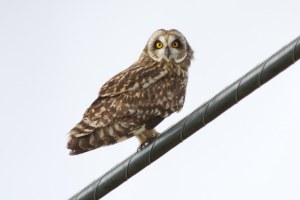
Asio_flammeus_-Hawaii-8_(2)A pueo sat in a tree, looking out over the world around him.

Which, I must confess, looked to him mostly like just leaves, since his branch was pretty sheltered. Still, there he was, looking out at things, and enjoying the day.

Down below his tree, he heard the voices of two people as they walked through the forest. I’m afraid, however, that they were saying some pretty foolish things.

One declared, “I never, ever cry. If you’re in tears, you’re weak.”

The other replied, “Right. I don’t cry either. Why, crying makes you look like a baby.”

The pueo thought about this long after they were gone. He, after all, didn’t want to look weak in front of the other owls. And he didn’t want anybody to mistake him for a baby. Er, a chick.

Now, like other owls, the pueo has tear ducts, but it’s just to keep their eyes from getting dry. When they’re upset, they don’t cry. They might flap their wings about, or ruffle their feathers (at this point I made a completely unsuccessful attempt to rustle my own feathers). They might make a sound (Hoo!) or they might stamp their feet. But they don’t cry.

Nevertheless this pueo decided that he, too, would not cry, like those human beings he’d overheard.

He decided that the problem was going to be blinking. That’s when the tear ducts would open, and his eyes would get moist. How to stop from blinking, though?

He could keep his eyes closed – that would do it – but that would make it awfully hard to find food. No, Mission Eyes Closed was a bad plan.

He could, however, keep his eyes open. So with eyes held wide (lest they blink by accident), he took up an unblinking gaze at the world.

If he’d had a toothpick to put underneath his eyelids, he would have tried it.

He’d been doing this for a while when an ‘io swooped in and perched on a nearby branch. He couldn’t help but notice the pueo staring wide-eyed out into space. Er, leaves.

“What on earth are you doing?” he asked.

The pueo explained about overhearing the people talking about crying, and how he had decided never to cry, and to prevent it he’d hold his eyes open. The ‘io was skeptical.

If he’d been a television personality, he’d probably have asked, “How’s that working for you?” but he was a Hawaiian hawk, so he asked, “How’s it going?”

The pueo admitted that his eyes were feeling drier and drier and it was getting really uncomfortable.

The ‘io sniffed, and flapped his wings about in preparation to take flight again. “I thought owls were supposed to be wise,” he told the pueo. “It seems rather foolish to me.”

And off he soared.

Owls don’t have any teeth, either, or the pueo might have chewed this thought over for a time. He had to think about it instead. In the end, he decided that he’d have to risk the tears. In fact, not crying didn’t sound like great advice for the two humans either.

He chose to be wise.

If I could offer you some advice today, I’d suggest that you be wise, too. Tears keep our eyes moist, but they also keep our souls moist. They help us clear away what’s troubling us inside, and get us ready for the next thing, bad or good.

So let the tears come, and be wise, like the pueo (eventually) was.

Photo Credit: By HarmonyonPlanetEarth – Pueo (Hawaiian Owl)|Saddle Rd | 2013-12-17at18-07-587Uploaded by snowmanradio, CC BY 2.0, https://commons.wikimedia.org/w/index.php?curid=30241891

Jesus Wept

Child and Tear croppedAuthor’s note: This poem was written as part of a sermon called “When Jesus Wept” preached on April 2, 2017, at Church of the Holy Cross UCC in Hilo, Hawai’i.

Tears, come, and make your muddy traces
In the dust that yet adheres upon the visage
Of the Savior. Tears, come, as dust-caked voice
With muted tones inquires where he’s laid.
Tears, come, to join those springing from the eyes
Of friends most dear and of their comforters.
Tears, come, to stain the face of God.

Tears, come, because they do not understand.
Tears, come, because they fear when they need not.
Tears, come, because a few among them,
In just a little time,
May howl for your death.
Tears, come, because the road was long,
The body weary, spirit drained,
And who on Earth could hold themselves from weeping
In this sad community of tears?

Tears, come, because these are the depths of grief.
Tears, come, because the one you loved is gone.
Tears, come, because the resurrection has not happened yet,
Not the resurrection of the final day,
Nor the resurrection of today.

Tears, come, because we go to stand outside a tomb.
Tears, come, because we comprehend the paths of time.
Tears, come, because the grave of Lazarus,
Though opened, opens yet another tomb,
And they will carry you where you wish not to go.

Tears, come to testify to love.
Tears, come in solidarity with grief.
Tears, come to gather power for
A glorious resurrection.
Tears, come to anoint thee
For betrayal, for the trial,
For the torture, for the death,
For the tomb ahead.

Tears, come to Jesus’ eyes
And bathe his weary cheeks
With love, with grace, with awe.

Photo credit: The image is cropped from a photo by Giorgio Montersino, used by permission under Creative Commons license.

A Proper Dinner

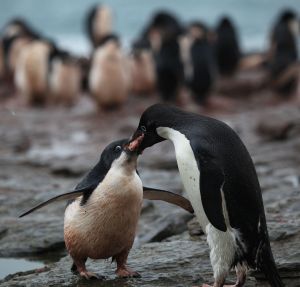
Adélie_Penguin_regurgitates_krill_for_its_chick_(5917753158)Usually, I try to tell stories about creatures that live here on these islands (or in the seas around them), but not today. This story is about birds who live far away, on the shores of Antarctica, where it is distinctly colder than it is here.

It’s about penguins.

You’ve heard of penguins, I’m sure. They swim rather than fly, and they’re always well dressed. What other creature wears a tuxedo twenty-four hours a day?

Well, this penguin was a young one, and he knew what a “Proper Dinner” consisted of.

He knew that a Proper Dinner was important. After all, he was always dressed for it.

So. Here’s how a Proper Dinner goes. Mom or Dad appears at the nest after hunting for fish out in the water. And you, as the young one, you stand straight up and tall. You throw your head back and open your mouth, and Mom or Dad sticks their beak in your mouth and…

How do I put this?

Well, let’s just say that food that was in their stomach goes into yours.

If that sounds gross to you, it does to me, too. Which makes us people, not penguins.

In any case, that was a Proper Dinner for this young penguin, and after all, he was always dressed for it.

One day, though, when Mom appeared, she was carrying an actual fish in her beak. And when Sister put back her head and opened her mouth, mother put the fish in.

Sister swallowed it right down with every sign that she enjoyed it, but Brother knew that it wasn’t a Proper Dinner.

Sure enough, Dad appeared shortly afterward, and like Mom, he had a fish in his beak. Brother looked at it, and it wasn’t a Proper Dinner.

So he didn’t stand up straight. And he didn’t put his head back. And he didn’t open his mouth.

If he could have, he would have folded his wings across his chest, but he couldn’t, because penguin wings don’t do that.

Sister got the fish. And Brother had to wait until Dad went away, caught some more fish, and returned to feed Brother what he’d already eaten, so that he’d have a Proper Dinner.

This went on for two days, which is an endless amount of time when you’re a young penguin. Mom and Dad brought fish, and Brother wouldn’t eat them, and he’d wait, hungry, until they returned with a Proper Dinner.

Finally, Mom and Dad had had enough. They wouldn’t do this any more.

Has that ever happened to you? That Mom and Dad wouldn’t do something for you any more?

You, too, eh?

So they stood there and eyed him with the fish dangling from their beaks. And he stared back with a gaze that slowly fell away in the face of their united disapproval. He slowly raised his beak, and opened his mouth. A little. Then a little more. Until Mom tucked the fish onto his tongue.

He swallowed.

To his utter astonishment, he liked it.

“Well,” he decided. “I guess there’s more than one way to have a Proper Dinner.”

“And after all, I’m dressed for it, whatever comes.”

Photo credit: By Liam Quinn from Canada – Adélie Penguin regurgitates krill for its chick, CC BY-SA 2.0, https://commons.wikimedia.org/w/index.php?curid=24444946

Moi Questions

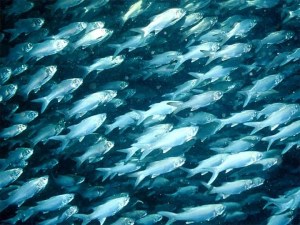
Sixfinger_threadfin_school

A school of moi.

Today I’m going to tell you a fish story.

I mean, literally. I’m going to tell you a story about a fish.

This fish was a moi, which are well known here in Hawai’i for being a fish that only the ali’i, the royalty, the most powerful people in the islands could eat in the ancient days. That’s not how the moi think of themselves, though. Who really think of themselves in terms of who is going to eat them?

There was one young moi who was always asking questions. I mean, always. He’d ask one question, and get an answer, and then he’d ask another.

“What’s that bright light up above the surface of the water?”

“Why are the corals different colors?”

“What’s that coming toward us, with all the holes? Should I avoid it?”

(Well, yes. It was a fishing net.)

“What’s that shiny thing on the end of the grass-like thing? Should I eat it?”

(It’s probably best not to eat the fishhook.)

Probably the most common question, though, was one he asked over and over and over:

“Is that good to eat?”

“Is that good to eat?”

“Is that good to eat?”

Let’s face it, that’s an important question when you’re a moi.

With all his questions came something else: He got to know the answers. Other moi started to ask him questions, because they thought he’d probably asked it already and knew the answer. Much of the time, he did.

When he didn’t, you know he’d turn around and ask that question of some other fish.

He always had moi and moi questions.

A decided groan greeted that last remark.

Moi swim in great schools, and if you’ve ever seen a school of fish, you realize that when the school turns, then a new leader emerges. The one who had been at the front is now at the side, and someone at the side is the new leader of the school.

All the other moi learned to feel very good about having this curious moi as their leader. When he was in front, they didn’t swim into fishing nets. When he was in front, he didn’t have them chase after fishhooks.

So his questions made him a valued leader among the moi.

That’s true of you, too. If you ask questions, if you seek after what you don’t know, if you keep learning, well, like our curious moi, you can be a success in school.

More groans.

Seriously. It will help you in school. But it will also help you make a better life. Ask questions, even when your parents, or your teachers, or even I start to look like you’ve asked a lot of them. It’s OK.

Because you’ll be learning, and thriving, and growing.

Inviting Questions

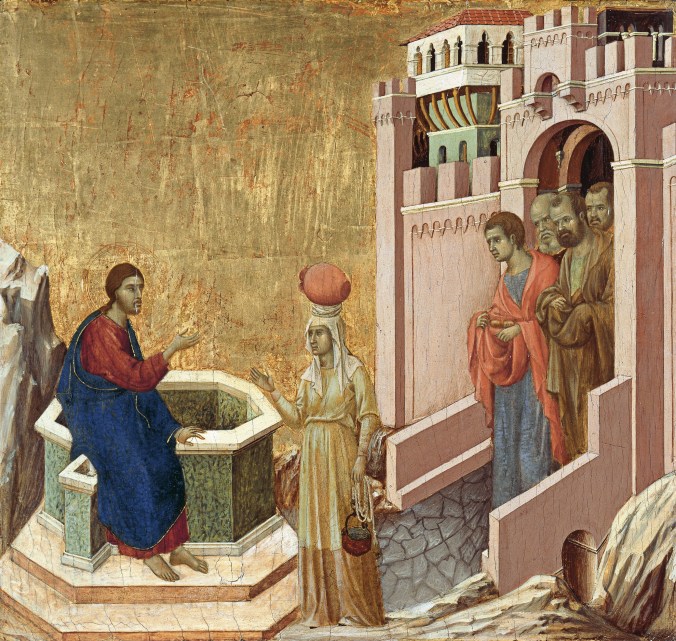
Duccio_di_Buoninsegna_-_Christ_and_the_Samaritan_Woman_-_Google_Art_Project

What would you ask of us, O Jesus, by
Our well of Jacob? How would you secure
Our trust, invite our glance to catch your eye,
Persuade us of your power by flesh obscure?

We keep the treasures of our souls at depths
Much like a well’s, and hide them even from
Ourselves. The treasures! Though our halting steps
You know from rising dawn to setting sun.

What may we ask of you, O Jesus, by
Our well of Jacob? What great secrets tease
From you, who’d see our downcast spirits fly
From mountain to the ever-rolling seas.

With questions let us comprehend your grace
That others may in you find, too, their place.

This poem was written for a sermon of the same title to be preached on March 19, 2017. As it happens, it didn’t make it into the sermon after all.

The image is “Christ and the Samaritan Woman” by Duccio di Buoninsegna, painted ca. 1311.

The Untidy ‘Elepaio

Hawaii_Elepaio_(Chasiempis_sandwichensis)_(26372854912)Most ‘elepaio, it seems, take a good deal of pride in their nests.

The ‘elepaio is a small songbird who lives out in the koa and ohi’a forests. It’s colored tan and gray, and it’s a curious bird who might just fly over to get a good look at you as you’re walking in the woods.

That has nothing to do with the story, by the way; it’s just so you might recognize one if you see one.

‘Elepaio mothers take a great deal of effort to build their nests in the tree branches. They weave their cup-shaped nests from grasses and bark and even spider silk, and they trim everything up so that it looks neat and tidy.

There was one mother bird, however, whose nests, while not actually being a shocking mess, nevertheless always looked… unfinished. Grass ends would stick up from the edges instead of being carefully tucked away. Bits of spider silk waved in the breeze. And in some places you could actually see the underlying structure of the nest.

The other ‘elepaio thought she was a pretty careless, untidy bird.

One of the younger ones, however, noticed something after a few windy days had gone by, and they’d endured some rain showers. When those things happened, everybody had to repair their nests. Rain and wind force you to do that sort of thing.

Most of the ‘elepaio had to undo a good deal of work in order to get to the thing that needed to be replaced or fixed. They’d untuck grasses and pull out bits of bark until the problem was visible.

The untidy ‘elepaio, however, always seemed to get her nest repaired before anybody else. The problem areas were easier for her to reach. She did less removing and more replacing.

So the young bird flew over to ask for her secret.

“It’s nothing special,” she said. “I just leave gaps in the nest where there will probably be a need. There’s always something. I’m just a little more ready for it.”

She left her gaps where the new needs might arrive.

I don’t always explain my stories, but today I will. Because this story is not about being messy and not picking up your things and putting them away. I could get in a lot of trouble with your parents if that’s what you decide, and for that matter, if you don’t pick up those plastic building blocks at night you’ll step on one when you get out of bed in the morning, and then nobody will be happy.

It’s also not an excuse for not finishing your homework. You should finish your homework. That will make your parents, and your teacher, and eventually you, much happier.

No, this story is about not seeing ourselves as finished. None of us are ever “finished,” we learn new things all our lives. This story is about making sure that you always leave a place in your life to learn something new, and grow some more, and become a you who’s more you than you were before.

Leave some places in you where the world, and where God, can help you learn and grow.

Amen.

The photo is by Dominic Sherony – Hawaii Elepaio (Chasiempis sandwichensis), CC BY-SA 2.0, https://commons.wikimedia.org/w/index.php?curid=52150176

Interfaith Encounters

14_Mark_s_Gospel_D._Jesus_confronts_uncleanness_image_4_of_7._the_Syro-Phoenician_woman._Jan_LuykenThis meditation was delivered at the closing worship service of the Hawai’i Conference Clergy Retreat on Wednesday, March 8, in Kailua-Kona, Hawai’i Island, Hawai’i.

Scriptures:
Matthew 15:21-28
Acts 17:22-23

A few weeks ago, the Rev. Linda Petrucelli called me to say that Hawai’i Island Association, as hosts of this Hawai’i Conference Clergy Retreat, had responsibility for the worship and some of the program, and would I be part of the planning team. I said yes, and we went on to talk over the schedule.

We started with the opening worship, and she asked me if I’d deliver the message. I said, “No, I don’t think I should. I’ll have just given a keynote at the Church Leaders Event the week before, and I think that’s as much as anyone needs or wants to hear from me.” She thought that sounded reasonable, so we went on through the rest of the time.

When we got to the closing service, she asked if I’d deliver the message. And here’s where a key personality quirk of mine kicked in.

Is this a safe place to share this?

I can say, “No,” when somebody asks me to do something.

But only once.

And here I am.

I grew up in a Christian town. A mostly white Christian town. It was a mostly Roman Catholic Christian town, but I didn’t know that. I also didn’t know that the Catholicism of the Irish heritage at Saint Bernard’s Church was different from that of the Polish heritage at Saint Joseph’s Church.

So here I am to share my ignorance.

Each of these these two Scriptures describes an interfaith encounter. The first one didn’t go so well, did it?

“Kind and gentle” Jesus displays neither kindness nor gentleness here. He calls the Syro-Phoenicians (or as Matthew calls the woman here, Canaanites) “dogs.” That’s harsh. In fact, that way beyond harsh. They’re animals. Domesticated beasts – but their domestication is fragile, isn’t it? There’s a fearsome wolf within.

She comes back at Jesus with a challenge: “Even the dogs eat the crumbs which fall from their master’s table.” And her challenge brings her child healing.

In contrast, we have Paul’s address to the crowd in Athens – which isn’t Christian Athens, or Jewish Athens. It’s the Athens of Zeus and Hera, of Apollo and Artemis. Specifically, it’s the Athens of Pallas Athena (whose symbol, appropriately for our speaker, was a pueo – an owl).

And Paul, who displayed his forthright tactlessness so eloquently in Second Corinthians, here reaches out very tactfully indeed to a local touchstone: the altar to an “unknown god.”

These are very different interfaith encounters.

There was a reason why I could be ignorant of the other faiths around me (and I was profoundly ignorant). Imagine my surprise to learn, over the years, that some of my school friends were Jewish. One, in fact, was the son of the local rabbi, and I didn’t know that until I’d known him for at least a couple of years.

The reason was power. It was privilege. My church – not the synagogue, and not the Irish Catholic, or the Polish Catholic Church, but my church – represented the dominant culture of the town. Its imposing granite blocks had been mostly paid for by the family whose mansion stood literally across the street. That family owned the woolen mills in town, which had employed the grandparents of my Roman Catholic and Jewish friends. I had no idea.

Ignorance of a privilege of the privileged.

That’s a critical distinction between these two interfaith exchanges: the distinction of power and privilege. Who has it, and who does not. Most of his life, Jesus would have been considered relatively power-less. He was not born to wealth, or the nobility of Israel. He was not acknowledged as a member of the ruling royal family. He certainly wasn’t a citizen of the empire that occupied his nation.

But in this circumstance, he had a power that the Syro-Phoenician woman lacked, and which she desperately needed. He had power he refused to use. And she shocked him out of his privilege. She held a mirror up to him so he could see it. Seeing it, he changed his way.

In contrast, Paul came to Athens without power. He had to persuade; he could not enforce. So he brought a humility to this encounter with these other faiths, and dared to celebrate the altar to an unknown god.

By college, I’d been through the loss and rediscovery of my Christian faith, and had come to believe that I was, in fact, called by God to Christian pastoral ministry. And it still boggles my mind.

Among my friends was a young Jewish woman (she was a year younger than I, which was enough to make her “young” in my eyes at the time) who had come to love a young Methodist.

His family did not approve. It broke their hearts.

So she asked me one day how I could become part of an organization that did such things, that caused such unhappiness. And I replied, “So that these things will never happen again.”

I was plenty arrogant to believe that I could accomplish it.

I was absolutely right to commit to it.

We come from different places in our histories and our cultures. We bring different theologies of grace and redemption. We live in different places on that damnable hierarchy of privilege and power.

But I think the testament of the altar to an “unknown god” has something for most of us. Can we bring an honest humility to interfaith conversation, encounter, and relationship? Can we set aside the privileges of power, and even of just “being right?”

Can we be honest enough to realize that, human beings that we are, we worship an unknown God, that there is more light in the light than we can know? Can we celebrate all the aloha God has shown throughout the world?

Let me be clear: There are gods not worth worshiping.

The god of racism. The god of self-aggrandizement. The god of sexism.

The god of greed. The god of love of raw power – these are the gods of American capitalism.

But these are not the gods of interfaith encounter. There we may be humble and learn.

My brother Buddhist has much to teach me about compassion.

My sister who looks to Pele – sorry, Tutu Pele – has much to teach me about how the whole world is sacred.

My non-binary sibling who prays daily toward Mecca has much to teach me about faithfulness, discipline, and courage in a community that is hostile to their faith.

In my privilege, I could stay ignorant.

But what a blessing if I take on humility and learn.

Dolphin Tempted

dolphins-by-robert-youngThis story may sound like one you’ve heard before. Perhaps it will be a little familiar, even though it’s not set on land like the original. This one takes place in the ocean.

Once there was a shark who decided to try to tempt a dolphin away from its pod.

(Do you know what a pod is? You do? Yes, that’s exactly right: a pod is a group or family of dolphins. Well done!)

So the shark found a pod, with one young dolphin swimming along near the side and toward the back. The water was rather murky, so the shark was able to get pretty close without being clearly visible as a shark.

I don’t really want to tell you what the shark had in mind. What? No, I’m afraid it wasn’t friendship. You’re thinking of the movie, Finding Nemo. No, this shark was not following the twelve steps toward seeing fish as friends, not food. Or, in this case, dolphins.

So, okay, the shark had his mind on lunch.

Well, from out there in the murk, he said to the young dolphin, “Hey, come over to the other side of this reef. I found this amazing place to catch fish. You’ll eat until you can’t eat any more.”

The young dolphin was pretty hungry himself, so this sounded pretty good, but his pod leader hadn’t said anything about going to the other side of the reef. “No,” he said eventually, “I think I’d better not. You might tell the pod leader about it, though.”

That was the last thing the shark wanted to do, so he tried something different.

“The pod leader would want you to learn leadership yourself,” he said. “Not to worry, of course. Other dolphins will come along to keep you safe if there should be any danger nearby.”

Though not enough, he thought, to make a difference when the dinner bell chimes.

That sounded even better to the young dolphin, who certainly aspired to become a pod leader. Maybe this would be a good time to experiment, and to take a risk.

“Well, no, I don’t think so,” he finally said. “I wouldn’t want to make the other members of the pod choose between me and our pod leader. No. Definitely not.”

Oh, come on, thought the shark. So close and yet so far…

“If you come now,” the shark murmured, “I’ll make you into a pod leader. You’ll be the pod leader. Just follow me.”

Oh, that sounded awfully good to the young dolphin. To be a pod leader, and not wait! Wow.

Wouldn’t you like to be a pod leader?

Yes? No?

Well, about half and half.

Our dolphin, though, he did want to be a pod leader someday. But he decided that he’d trust in his own pod leader’s wisdom about when that time would come, and not the sweet words of this rather murky figure.

“No,” he said firmly. “I’ll follow my pod leader until it’s time to lead myself.”

It was at about that time that the pod leader up at the front realized that there was a figure in the shadows behind them that didn’t belong. He darted back through the swimmers, joined by other dolphins as he went, and together they chased the shark far away from the pod, clear to the other side of the reef, where the fishing truthfully wasn’t any better than where they were.

So, did that story sound at all familiar?

A little?

The title of that other story?

Why, it’s “The Temptation of Jesus.”

Photo by Robert Young. Used by permission under Creative Commons license.

When the Tempter Quotes Scripture

tentaciones_de_cristo_botticelliThis poem was written as part of a sermon (of the same title) delivered at Church of the Holy Cross UCC in Hilo, Hawai’i, on March 5, 2017.

Did a quaking pulse accompany
You to the Temple’s zenith, Jesus?
With the Tempter?
Did your sandals slip or grip the cedar of the ridge?
Did your mortal soul take hold, just for a moment,
To protest:
“Tempter, you have lifted me too high”?

Ah, now you hear the words of sweet assurance:
“On their hands the messengers of God
Will bear you up,
No bruise will mar your angel-guarded feet
As gently they regain the comfort
Of the ground.”

Across the ages, words of Psalmist’s faith.
And did they challenge You to step, to leap,
To dive toward ground?
For just a moment, did you fail to see
The test it posed to God, and see instead a test
Of your own faith?

We know your story’s ending, Jesus,
How you deflected Tempter’s texts
And Tempter’s taunts
How you refused to put God to the test,
How you refused the bread and realms which were
In truth, your own.

We know this story’s end was the beginning,
Taking your unbruised feet to Galilee,
Samaria,
Jerusalem and Bethany and to the courts of Pilate
Where those feet were bruised and pierced by nails
For love
Of
Us.