Christmas Prayer 2016

img_1767When Christmas falls on Sunday, it’s not just any service. It’s not just any Sunday service, and it’s also not just any Christmas service. Though every worship experience should connect with the heart and soul, Christmas truly demands it, and it also demands that we step outside the “usual” – since God did precisely that by coming to Earth in Jesus.

Thus this song, which was the pastoral prayer this morning. Mele Kalikimaka – Merry Christmas!

[Chorus]
Come to us, Christ Child
With the wailings of a newborn
Interrupt our sleep with an infant’s shrill demands.
Let us clothe your flailing arms with hope for all tomorrows.
Let us feed your hungers for deep peace around the world.
Let our arms enfold with the tender love of mother.
Let us sing a lullaby of joy
As our Christmas prayer:
As our Christmas prayer.

Your family fled from Herod
So we pray for refugees
May the ones oppressed by rage and fear
Soon shout that they are free.
You were given gifts by magi
So we pray we might be wise.
When we turn away from suffering
Redirect our eyes.

[Chorus]

As you grew from child to teacher
So we pray for all to learn
The depth of your compassion
And the love for which we yearn.
From your first hours in the manger
To your triumph over the grave,
Give us hope and confidence
You were born on Earth to save!

[Chorus]

Let us sing a lullaby of joy
As our Christmas prayer,
As our Christmas prayer

Christmas Eve 2016

ikona_matki_bozej_znak_cerkiew_greckokatolicka_warszawa

Photo of a mosaic in the Greek Catholic Church and monastery of the Basilian Friars in Warsaw by Loraine – Own work, GFDL, https://commons.wikimedia.org/w/index.php?curid=9656226

We have heard the stories. We have sung the songs. We have lit the candles. We have shared Christmas greetings. We have shared Christmas treats.

Now comes the silence which comes so rarely in this busy technological world. Gradually, the excited children will succumb to the fatigue excitement brings. The wide-eyed stares of anticipation will relax into dreams, whether there is snow outside to cushion the anticipated sleigh or not. Ears tuned to the clatter of reindeer will be disappointed, once again, to find that the miracle happened while they slumbered and could not warn their owners that the moment had arrived.

Two thousand years ago, there must have been such a moment. I doubt it lasted long, babies being babies, but there must have been a moment when the exhausted newly-christened mother dreamed, and when the wondering father slumbered, and when the infant made only the soft snuffling sounds that reassure anxious parents that their child breathes.

In that moment, God could appreciate the miracle new-wrought in Bethlehem, and make whatever cosmic sound we imitate with a contented sigh. The miracle new-wrought, alive, and growing.

Have a blessed Christmas.

Magic Words

2mhane

Painting by Jacob Hane

‘Twas the week before Christmas
And all through the house,
The children were screaming –
And they’d frightened the mouse.

Well, I’m afraid that’s as far as my memory will let me get with rhyming. So I’ll have to tell you the rest as a story. OK?

Sometimes, when children are screaming, it’s good screaming. Sometimes you’re just so happy or full of energy or overflowing with good feelings that they come out at full voice. And if everybody else is doing the same thing, well, it just gets louder and louder, doesn’t it?

Unfortunately, on this day, in this house, the screams weren’t happy screams. The kids were screaming with anger.

They’d reached the point – you’ve been there, right? – where they’d forgotten what they were mad about. It was all just yelling and name-calling and sorrow and rage now. Lots and lots of screaming.

One of the children went in search of the mother, who had sought a place at the far side of the house in the (forlorn) hope of escaping the screaming din. The child, with some difficulty because of the way tears and indignation combine to disrupt a coherent story, demanded that the mother come and stop all the rest of the children from being jerks.

“Well,” said the mother, “why don’t you just use the magic word?”

The child had some experience of this, however, and would not be put off by this ploy. With folded arms, a tossed head, and (I’m afraid) rolling eyes, the child informed the mother that “Please” had already been tried and the other children were still jerks.

“All right,” said the mother. “Why don’t you try this one?”

Leaning over, she whispered softly and briefly in the child’s ear. The child’s face went through the contortions of surprise and puzzlement, but recognizing that this step had to be taken before anything else happened, the child made the trip back to the other side of the house and the screaming room.

The screaming, I have to admit, continued.

But a few minutes later, one of the other children appeared before the mother with the same complaint. Once again, she whispered a few words into the ear, and the child exited her room, with a face filled with surprise and doubt.

The screaming continued, but with somewhat less volume.

One by one, all the children made their way to see the mother, and one by one returned with the same whispered instructions. Finally the last and littlest one seized her hand and would not let go until she, too, made her way to the surprisingly quiet screaming room.

The children were no longer screaming. They were repeating their magic words, sometimes one after another, sometimes overlapping each other, sometimes all at the same time. Their faces held the surprise that had overwhelmed them some time ago when the screaming faded away.

They were all saying, “I love you.”

I can’t promise that those words will magically end any of the screaming matches you find yourselves in. I can definitely tell you that it’s worth trying: It’s worth trying to say them, and it’s definitely worth trying to live up to them.

As for the mother, she smiled.

This story takes its inspiration from one told in my hearing some years ago by the Rev. Dr. Ronald Brown, senior pastor of First Congregational Church UCC in Southington, Connecticut. I haven’t found that story available online, but you’ll find Ron’s wit, wonder, and wisdom on his blog.

The Box

53e50304-51fa-4840-be1a-af2a2887612c

Boxes

This story is about a family that was having a difficult December.

Mostly, they were doing OK. Everyone was healthy, and their home was a happy one. But some bills had to be paid just as the month began, and their savings dipped. There was still plenty to offer their daughter plenty of presents, though, and to have a festive meal.

They came home one day, however, to find that the kitchen refrigerator had stopped humming. Their first clue, I’m sorry to say, came when they opened the door and two things happened: (1) the light didn’t come on and (2) a really sour smell came out. All the food in the refrigerator had spoiled when it stopped working.

They called a repair person, but that worthy individual just shook his head and said, “That’s it for this one.” The family had to buy a new refrigerator just before Christmas.

That brought their savings down quite a lot, and replacing the spoiled food made a big dent in what was left. The parents knew there wouldn’t be many Christmas presents for their daughter that year, and a sadness crept into their holiday smiles.

On Christmas morning, however, their daughter showed no disappointment when fresh fruit rather than toys filled her stocking. She peeled her orange and promptly stuck one of its sections into her mouth whole. When she peeled back her lips in an impish grin, the fruit section smiled orange for her.

Beneath the tree, the small stack of boxes mostly contained clothes – she was growing, of course, and truly needed the new outfits. She showed now disappointment at the lack of toys, though. She glowed with pride that she was probably the only girl in her class who would have Spider-man pajamas.

As the last box passed from wrapped to unwrapped, the parents glanced at each other sadly at how little she had to play with from her Christmas morning. Their daughter, however, didn’t hesitate at all. She made a beeline for the kitchen, where the cardboard box for the refrigerator still stood beside its former contents.

“Can I play with this?” she asked.

Over the next few hours, it became a house, then a castle, then a cabin on a mountain, then a mountain itself, then a boat, then a treehouse, and finally something that she called a “creaturecrater” and refused to explain to her parents, solemnly informing them (with a giggle in her voice) that it was a secret.

For the next week, and all through the holiday break, she was the most popular child on the street, as all her friends filed through to play in the house, or on the mountain, or in the boat, or amidst the “creaturecrater.”

But this story isn’t about her, nor is it about her amazing big box. And it’s not about how she made a lot of fun for herself out of something ordinary, or about making the best of things. All those happened, but that’s not what this story is about.

This story is about the smiles on her parents’ faces as they held hands on the sofa and watched her play with the box. This story is about their fears that they could not give their daughter joy at Christmas – and how, instead, she gave theirs back to them.

I think we all can help those we love find joy at Christmas. Do you?

You do, too?

Then let’s do it.

Worst and Best

OLYMPUS DIGITAL CAMERAToday marks the 75th anniversary of the Japanese air and sea attack on the United States at its bases around Pearl Harbor. The day continues to fulfill President Franklin D. Roosevelt’s prophecy that it will “live in infamy” to Americans, and indeed to others around the world. Over 2,400 Americans died in the one-sided two hour battle, the first of some 419,000 who would perish before the war ended four years later.

Hundreds of survivors attended today’s observance at Pearl Harbor, according to news accounts. They honored the friends they lost seventy-five years ago for the dedication and valor they showed on the last day of their lives. War calls upon human beings to offer all they have to give – their talents, their freedom, and their very lives – on behalf of others. They offer it all for their nation, they offer it all for their families, and they offer it all for those beside them.

There is a greatness in that. It calls for the best.

Here in Hawai’i, however, I find it easier to see the price of that greatness. The commitment and the dedication and the valor (which can be found on both sides of the battle) preserve a nation, but also imperil its values. Martial law was imposed on the Territory of Hawai’i within hours, and would not be lifted until 1944. American citizens were detained and imprisoned without criminal charge or conviction. Military courts suspended the writ of habeaus corpus. In fear for their liberty, people buried or burned possessions that linked them to Japan: records, photographs, mementos.

The infamy of Pearl Harbor has company, lots of company: The Bataan Death March. The horrors of Germany’s invasion of the Soviet Union. The firebombing of London. The abduction and rape of thousands of women by Japanese soldiers. The murders of millions of military prisoners, gay men, Romani, and Jews in German death camps.

Lest we assume a virtue that is unwarranted, however, the infamy of Pearl Harbor has plenty of Allied company: The savage campaign on the Eastern Front. The firestorm of Dresden. More firestorms in too many Japanese cities to list. The atomic bombs of Hiroshima and Nagasaki.

Over 60 million people died in the fires of World War II.

We may, and should, honor the best. We dare not ignore the worst.

As 94-year-old World War II veteran Kenzo Kanemoto told Hawai’i News Now, “If you win, you still lose a lot.”

Let Pearl Harbor Day be one we honor for its summons to peace, for its warnings of the costs of war. Let it stand for the infamy of war itself, and its crushing weight upon humanity. Let it shine as a beacon for peace.

Photo credit: By Stan Shebs, CC BY-SA 3.0, https://commons.wikimedia.org/w/index.php?curid=668001

The Climber

christmas-treeThe boy in this story loved to climb. Oh, my, how he loved to climb.

He was young – three or four years old, say – and he climbed everything in sight. If there was a chair, he’d climb it. If there was a stair, he’d climb it. If there was a sofa, he’d swarm up it until he perched on its back. If there was a bush, he’d worm his way among the branches until his face poked out the top. Hills and counters were all one to him.

His favorite, of course, was to climb people (he was three or four, after all). Seated people were the easiest, but he’d clamber up the standing people as well. One moment he’d be on the floor, and the next moment he’d be waving from the shoulders.

It’s possible, just possible, that he got a little help on the way up to the shoulders.

There was one exception to his love for climbing, though, and it was the stepladder his parents set out when it came time to decorate the Christmas tree. I don’t know why he didn’t like it. Maybe it wiggled in some way that seemed wrong. Maybe the steps were too far apart. Maybe he didn’t like the color (it was bright yellow, and doesn’t that just scream “Danger!”?).

Whatever the reason, when his parents set it out so that he could climb onto it to put decorations on the tree, he wouldn’t go near it. He didn’t even put his hand on the uprights, let alone a foot on the treads. He placed his ornaments from the safety of the ground and, it must be admitted, from the extended arms of his father who held him out like a person-shaped crane.

Even at three or four, though, he knew that a ladder shouldn’t hold him back (or at least on the ground), and he determined that next Christmas he’d make a start on that ladder. He wouldn’t go for the top – not yet – but maybe the first rung would be an accomplishment.

That’s how it went. The next year he summoned his faltering courage and put one shaking foot on that first tread, then the other. Between the step and his growing height, he could reach further up the tree with his ornaments. The next year, on the second step (and still taller), he reached higher still.

He was determined to reach that highest step, and place the star on top of the tree with his own hands. Someday. Year by year, little by little, he’d make his way there.

Has he reached the top? Well, no. He’s still young, and there’s a few steps left on the ladder. He’s making progress, though, each year a step higher.

He knows where he wants to go. He knows what heights he wants to reach. He knows that he wants to be the one to place the star.

To Win or to Play

kids-soccer

Photo by Susan Lloyd, used by permission

This story has no squirrels, no mongoose, and not even any ‘apapane in it. In fact, it doesn’t have any furred or feathered creatures in it at all, unless you count the hair on our heads as fur.

This story has actual people in it.

It’s about a soccer coach.

It was his first time acting as a soccer coach, and his team were all brand new to the sport: young, growing, and excited to play on their first team of anything. At the first practice, they were all over the place. A couple of them ran up to the stationary soccer ball and kicked at it so wildly that they missed it completely. A couple more kicked it where they wanted it to go, but rather more shanked it to the right or watched it careen off to the left.

It had to be said, they weren’t terribly good. But they shouted merrily, called encouragement to each other sometimes, and (rather more than they should, perhaps), laughed when the ball sailed off to the sides again.

And they got better. The coach taught them skills, and they learned. He got to know which children had natural ability, and which ones had to work hard. He got to know which of them picked up skills quickly, and which ones needed more demonstrations, and which ones might never get it. He got to know which ones would be the better players on his team, and which would always struggle.

Their first game wasn’t pretty. In the excitement, most of them forgot to stay in their positions, and instead they all converged on the ball, so that a knot of players (from both teams, it’s true) bounced up and down the field with the ball. Practice after practice, game after game, they did get better. They won some, and they lost some.

The coach could see which players had the skills, and which ones were developing the skills, to make a winning team. These were the ones who played their positions and remembered the plays. They could (mostly) kick the ball where they wanted it to go. They kept moving, and they kept their heads.

Gradually, it was these players who spent more time in the game, and the others, who hadn’t learned so well, played less and less.

Then came the game where one on the team didn’t play at all. The next match, it was two of them.

It was one of the better players who dared to speak to the coach. “Look,” he said, “I know that you’re keeping some players in so that we can win. But we’re all here because we want to play. Even more than we want to win, we want to play.

“Could you make sure that everybody gets some time to play?”

On other teams in other times, they might value winning over playing. Here at the start, they favored playing over winning, and friendship over victory.

Myself, I hope that everyone everywhere gets a chance to play, and to share in the game.

Other Veterans

tule_lake_relocation_center_newell_california-_harvesting_spinach-_-_nara_-_538316

Internees at Tule Lake, California, in 1942.

Last Friday was Veterans’ Day in the United States, which is a day off for those of us who work for Church of the Holy Cross UCC in Hilo, Hawai’i. I wasn’t relaxing on a beach, however (which isn’t where I relax in any case). I was presiding at a funeral.

The funeral of a veteran. A different kind of veteran.

On Veterans’ Day we honor those who serve the country and defend it from war, “who stand between their loved homes and the war’s desolation” (Francis Scott Key). And as Abraham Lincoln observed at Gettysburg, it is altogether fitting and proper that we should do this. Yet there are others who endure the impact of the world’s and the nation’s conflict, and receive no honors, no recognition, no holy day. Evelyn was one of these.

Evelyn was a native-born American citizen interned by the United States Government during World War II.

Between 110,000 and 120,000 people whose parents, grandparents, or great-grandparents had been born in Japan, 62% of them U.S. citizens, were ordered from their homes in Pacific coastal states (though not Hawai’i, where it was simply impractical) and housed in camps from Louisiana to California. Evelyn, a college-age young woman, observed that disabled children received no schooling at the Tule Lake, California, camp where her family was sent. So she taught them.

Thinking about Evelyn led me to think about so many others who endure the stresses of war. Gold Star families endure terrible losses in each conflict. Parents, siblings, spouses, and children live each day with anxiety for those they love who go in harm’s way. Support people, some who wear the uniform and some who do not, labor to support those who return. Some they treat for wounds. Some they assuage the psyche. Some they help find housing, or to resume interrupted careers. Some they aid to understand the now-unfamiliar ways of civilian life.

There are other veterans, too. These are the people who live where the war occurs, where if somebody had stood between their homes and the war’s desolation, their efforts failed and desolation came. These are the ones we see bloodied in films and photographs from Syria. These are the ones who come weeping for their dead to shuttered government houses. These are the ones swimming desperately to shore from overcrowded boats, and mourning their drowned children who lie silently on the beach.

In many conflicts, more civilians die than soldiers. They die from bullets and grenades that come their way, they die from bombs and shells, and they die from malnutrition and disease. The catastrophe we call World War II claimed the lives of 21 to 25 million people in uniform. It slew 50 to 55 million civilians, including 19 to 28 million who died from contagion or hunger.

Today, I honor these civilian veterans: the refugees, the interned, the families, the supporters, and those who pray that the shooting and shelling around them will just stop.

Today I honor them, and for their sake, I pray that God’s children will learn the ways of peace, and make no new civilian veterans to endure the sorrows of war.

A Musical Prayer

On November 13, 2016, Church of the Holy Cross UCC celebrated “Sing Praise Sunday,” a service with very little speaking and plenty of music. Children sang, the choirs sang, the people sang (their favorite hymns, so they sang right out!), and the pastor couldn’t quite see speaking a pastoral prayer, so, there was this:


Here are the lyrics:

Creator God be with us.
Send us rain and shine upon us all.
In steadfast love incline our hearts to justice.
Raise us when our weary spirits fall.

Savior Christ be with us.
Heal all those suffer, those who sigh.
Forgive us when we serve ourselves, not justice.
Raise us to eternal life on high.

(Chorus)

God, hear our prayer.
Christ, hear our prayer.
Holy Spirit, hear our prayer.
Bring your grace
To your world.

Holy Spirit be with us.
Guide us as we find our way.
Fill us with the fire of your compassion.
Inspire your children as we pray.

(Chorus, repeat third verse)

Committed

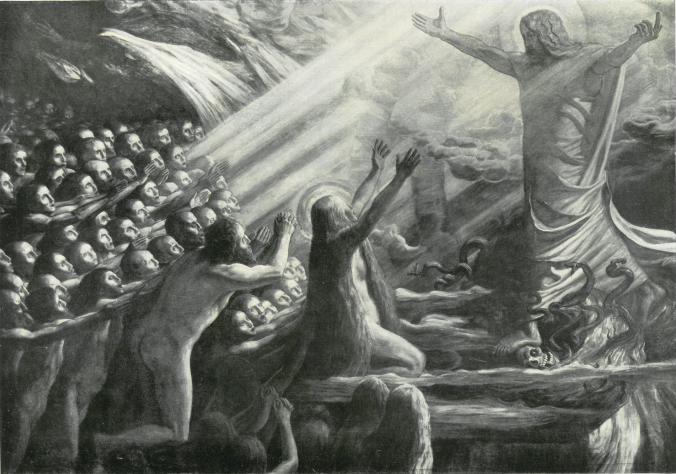
jeremiah_by_repin

Cry of Jeremiah by Repin.

The voters have spoken. They have chosen. They have selected the next President of the United States.

I have been cautious in my own political advocacy, at least about publicly supporting candidates. In the light of this day, with a President-elect who has espoused policies I condemn, I pledge here and now to advocate for what I believe to be good, and just, and right, and to resist what is evil, and oppressive, and wrong.

I expect that I will find a good deal to say over the next few years.

The President-elect has called publicly for a ban on Muslims entering the United States. Amidst the horrors perpetrated by the Islamic State, I understand the fear. I understand it, but I will not be governed by it. Nearly a quarter of the world’s population, 1.6 billion people, lives and worships peacefully guided by the Muslim faith. I will resist an America that excludes or oppresses people because of their religion. I will do it for Muslim, I will do it for Jews, I will do it for Buddhists, I will do it for Christians, I will do it for those who espouse no faith.

No religious tests. Ever.

The President-elect has pledged to repeal the Affordable Care Act. He has announced no replacement plan. His party has sketched a plan, but it remains nebulous.

I have family members and friends who, without the ACA’s protections against denial of coverage, could become uninsurable because of pre-existing conditions. They, more than any, will have need of health care. They are now at much higher risk of losing access to it.

Health care should serve the health of our nation’s citizens, and not the financial interests of a few of its citizens.

The President-elect has pledged to appoint officials who will actively work to end the marriages of people I know and love. He would tell them that they are secondary citizens in the society, unworthy of full participation.

I say that love between people deserves the acclamation and support of its society. Commitment is hard. Love is hard. Family is hard. Making it harder is a rank injustice.

Marriage equality must remain the law of the land.

The President-elect has declared that global climate change is a myth perpetrated by a foreign nation. He defies the evidence of scientists from around the planet. People already suffer from sea level rise. It will get worse even if we make significant changes now. It will get much worse if we make no change at all – and much, much worse if we accelerate the transfer of carbon from earth to atmosphere.

We must change our ways.

I could go on. I should go on. And in the days ahead, I will go on. Because health care is important. Because #BlackLivesMatter. Because human dignity is worth defending. Because the seas rise.

For now, though, I return to the day of my ordination, when I asked to have these words read:

‘Now the word of the Lord came to me saying, “Before I formed you in the womb I knew you, and before you were born I consecrated you; I appointed you a prophet to the nations.” Then I said, “Ah, Lord God! Truly I do not know how to speak, for I am only a boy.” But the Lord said to me, “Do not say, ‘I am only a boy’; for you shall go to all to whom I send you, and you shall speak whatever I command you, Do not be afraid of them, for I am with you to deliver you, says the Lord.” Then the Lord put out his hand and touched my mouth; and the Lord said to me, “Now I have put my words in your mouth. See, today I appoint you over nations and over kingdoms, to pluck up and to pull down, to destroy and to overthrow, to build and to plant.”’ (Jeremiah 1:4-10)

I was young, then, and that was part of what resonated with me. I admired the fierceness of the prophet, his willingness to challenge the powers of his time, and his insistence that the king’s faithlessness, follies, and faults would lead to national disaster. I did not think that I would be called to echo him.

I fear, however, that I shall have to do just that, and warn against the senselessness and sin of excluding some of our citizens from full participation in our society. I fear that I will have to warn against the senselessness and sin of favoring the powerful over the marginalized. I fear that I will have to warn against the senselessness and sin of proclaiming greatness in the absence of goodness.

I fear that, more often than not in these coming days, I will fail.