Story: The I’iwi Who Liked Spiders

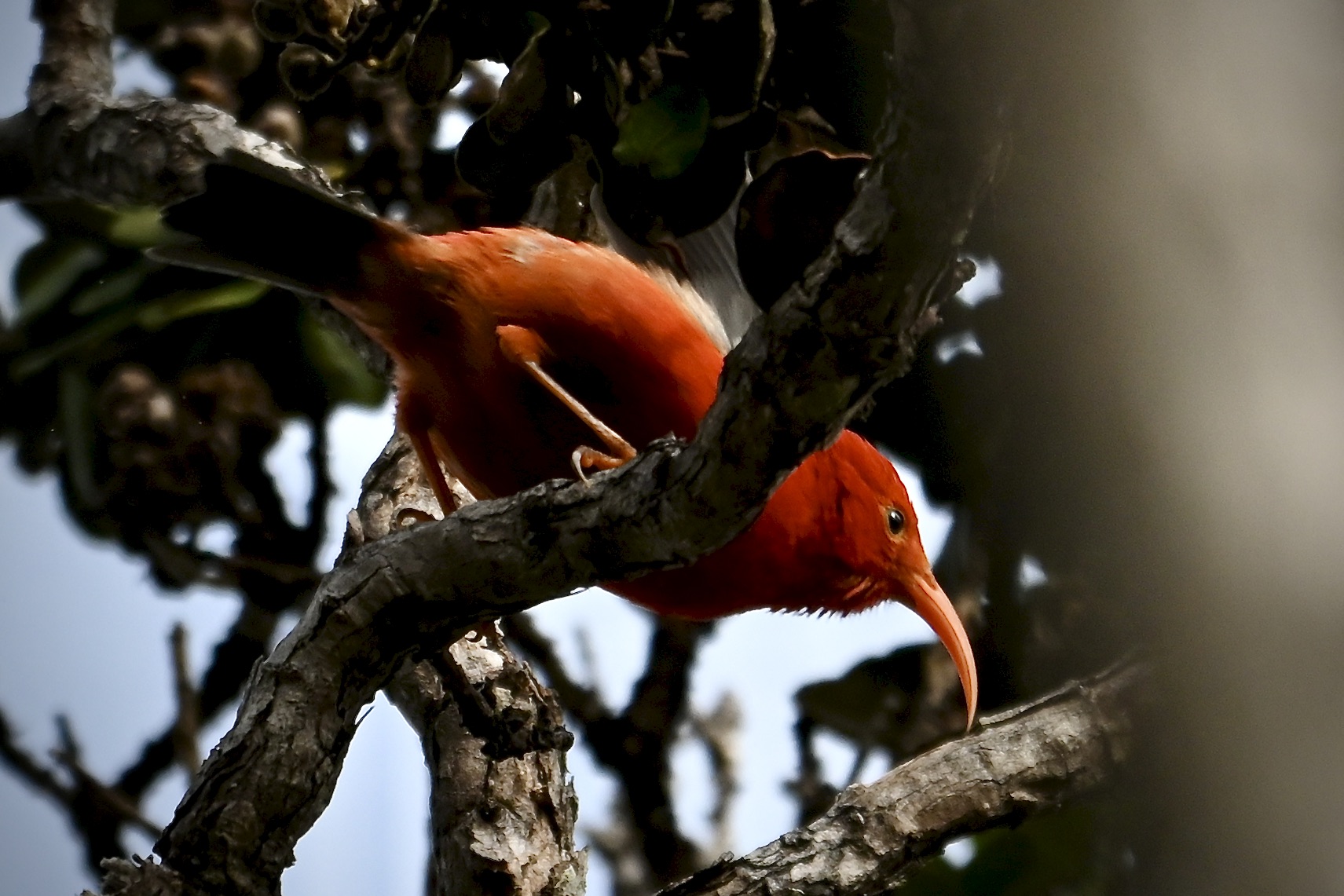
A red orange bird with a very long curved orange beak perched in a tree.

September 13, 2026

Romans 14:1-12
Matthew 18:21-35

I’iwi can be rather opinionated birds. They can also be very grumpy about their opinions. In their opinion, for example, blossoms full of nectar should be sampled by… me. That is, whatever i’iwi happens to have noticed those blooms at the time. ‘Apapane and ‘amakihi can go to another tree. Another i’iwi might be tolerated. Might. If they behave themselves. And aren’t greedy.

Most of all, though, they had to act like a proper i’iwi, and sip from the floral nectar. That’s how a proper i’iwi behaved. Most of all, they didn’t go looking for spiders.

I’iwi do eat spiders, but not very often by choice. They like the liquid diet of nectar, and they’ve got a long beak and a long tongue to drink it with. If a butterfly or moth happens by, they’ll eat it. They’ll fill in with other bugs as well. Far down the list, though, is spiders.

It’s something they’ll eat, but only if they’re really hungry.

Except for one i’iwi, who just so happened to really enjoy spiders. I don’t know why he did. He did. I’m pretty sure that if he explained it to me, I wouldn’t understand it, because I don’t like eating spiders. And I’m pretty sure that if I explained it to you, you wouldn’t understand it, since I suspect you’re not big fans of eating spiders.

If you are and I got that wrong, I apologize. You can explain it to me later.

The older i’iwi watched this younger one enthusiastically eating spiders with a certain feeling of, “Ick.” Most of them were content to let him enjoy his meals. After all, if he was eating the spiders, there was more nectar for them, wasn’t there?

One of those older i’iwi, though, got really annoyed with it all. He took it upon himself to fly over and grumble, “Knock it off, spider-lover. No more of this. Eat like a real i’iwi. Drink nectar.”

“I do,” said the i’iwi who liked spiders. “I drink plenty of nectar.”

“But you’re also eating all these spiders,” said the grumpy one. “Stop it.”

“I like spiders,” explained the younger i’iwi, which was really all that could be said, wasn’t it?

“No proper i’iwi likes spiders,” pronounced the elder. “No sensible i’iwi would make a full meal out of them. No real i’iwi prefers spiders to nectar.”

“And that’s how it is, youngster,” said that older i’iwi. “If you keep eating spiders like this, you’re not a real i’iwi, and we’ll treat you like a stranger and a nuisance.”

Word flashed around the little community of i’iwi about what had been said, and they called a very unusual little gathering to set matters straight. The older grumpy bird and the younger spider-eating bird perched before the flock.

“Do you eat spiders by choice?” they asked the younger one, who had to say, “Yes.”

“Did you tell him that eating spiders by choice meant he wouldn’t be a real i’iwi?” they asked the older one, who proudly said, “Yes.”

One of the grandmothers fluttered her wings at this, and said, “Diet does not make an i’iwi an i’iwi, or not an i’iwi. We’ve all eaten things we’d prefer not when times are lean, and we’ve all found that some of them tasted better than we’d expected. You’re just as much as i’iwi as anyone, youngster,” she said, “even if you eat things I’d rather not.”

“You, however,” she told the grumpy bird, “have taken it upon yourself and yourself alone to say what makes an i’iwi and what doesn’t. That’s something an i’iwi may do and remain an i’iwi, but they should not do it. The forest is hard enough with wind and rain and dry times. We do not need to make barriers for one another.

“You are an i’iwi. But you have not behaved like an i’iwi should. Make your apology to your cousin, and never let us hear you have done this again.”

by Eric Anderson

Watch the Recorded Story

I write these stories in full each week, but I tell them from memory and improvisation. The story you just read is not precisely the way I told it.

Photo of an i’iwi by Eric Anderson.
Story: The Molting ‘Apapane

May 25, 2025

Acts 16:9-15
John 14:23-29

He wasn’t the oldest among his siblings, cousins, and friends from nearby nests, but he was one of the first to molt from his young feathering to his adult colors. He’d had gray feathers on the chest and brown on his head and back, with black on his wings and tail. They all did. It made their games of hide-and-seek pretty difficult, because those colors melded into the shadows on the tree branches pretty well.

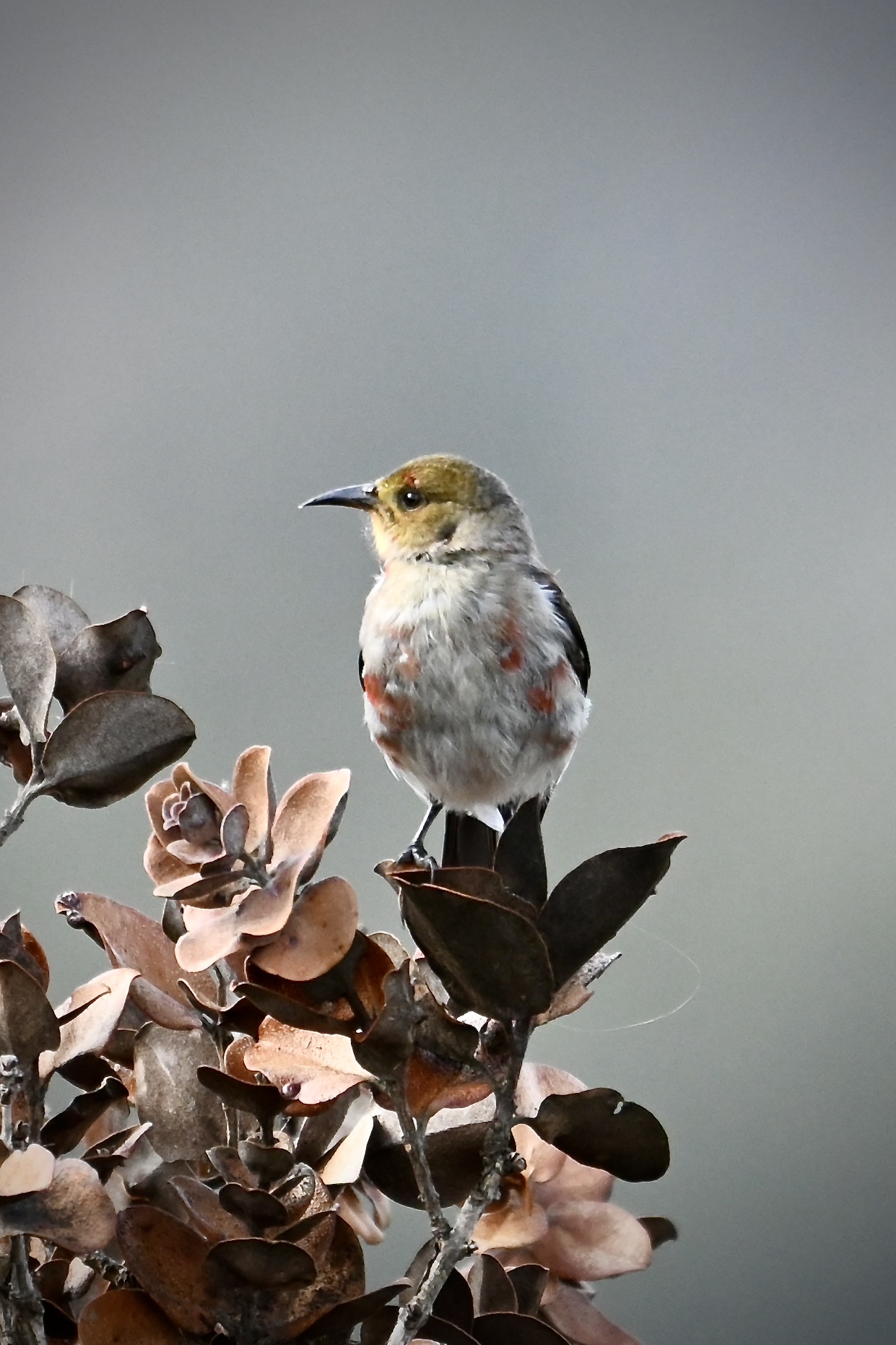
As I say, though, he was the first among them to start losing some of those brown and gray feathers, and start to gain the red feathers from head to tail. Frankly, it wasn’t going well. Loose feathers itched, and so did the new feathers as they grew in. They also didn’t fall out evenly. He found himself with a grayish belly blotched with the new red feathers.

“You look ridiculous,” said one of the young ‘apapane who played hide-and-seek with him, and, well, he felt ridiculous.

“Can’t you hide that?” asked another of the ‘apapane. He was a cousin, but he could be mean, even to a cousin. Our young ‘apapane couldn’t think of how.

“Go clean that up,” ordered one of the bossier young ‘apapane. She was one of those who thought she knew best for everybody else. But he still didn’t know how to take care of it, so he kept his perch and tried not to cry.

“Knock it off,” said the smallest of the young ‘apapane. All her feathers were still brown and gray, and she looked like she’d just been groomed by the finest feather-settlers of the forest. Everybody assumed that she was talking to the young bird with the splotchy red.

“Yeah, knock it off,” said the one who’d started this by calling him ridiculous in the first place.

“No, you knock it off,” said the smallest ‘apapane. “And you. And you. And all of you.”

She shook her wings and continued, “First of all, what can he do about it? You all know that our feathers will change from what we’re wearing to what our parents wear. Did you think that happened overnight? Didn’t you realize that it’s going to take time and that there are rough spots along the way?”

As it happened, none of them had thought about it.

“What are you going to do,” she demanded, “when this happens to you in a week or two? Are you going to make everybody going through this fly away, or are you going to help them when it itches and tell them it will be all right? What would you want for yourself?”

She asked that last question straight at the bird who’d ordered the molting ‘apapane to go clean that up. She didn’t say anything until it became clear that she had to answer.

“I’d want help,” she said.

“How about the rest of you?” demanded the smallest ‘apapane. They all admitted they’d want help.

“And that’s what you’ll get,” she said. “We’ll start with our friend here.”

“So how are you?” she asked. “Does it itch today?”

That’s how that generation of ‘apapane made it through their molt.

by Eric Anderson

Watch the Recorded Story

I write these stories in advance, but I tell them from memory and improvisation. What you have just read will not match the way I told it.

Photo of a juvenile ‘apapane in molt (at least that’s what I think it is) by Eric Anderson.

‘Apapane Solo

Once a young ‘apapane learned to sing (which is not unusual).

He grew up to sing with his family, with his friends, and with pretty much any other ‘apapane around. They liked to sing to each other in the trees as they sought the nectar from ohi’a lehua.

Singing just made this little bird feel good. Hearing the songs of the other birds around him made him feel even better. He wasn’t alone. He wasn’t forgotten. He was part of a flock, and they loved and cared for each other as they sang.

As ‘apapane go, he was an adventurous one. He would fly some distance away just to see what was there. He wanted to see new things, and discover new things, and (of course) going to a different part of the forest helped him find ohi’a that was in blossom.

The rest of the flock liked it when he’d explore, and they liked it when he came back, because he often could lead them to the next stand of trees bearing the bright red blossoms that sustained them.

One day, though, he went farther than usual. He was gone far longer than he’d been before, and while he was gone, the other ‘apapane realized they had to move on. The lehua on their stand of trees were going to seed. Making the best guess at the direction he’d taken, they set out after him.

They guessed wrong. Where he flew mauka, up the mountain, they flew makai, toward the lower slopes. They were sure he’d catch up, or they’d find him. But they didn’t.

When he made his long flight back to the ohi’a grove he’d left that morning, he found himself alone.

Sitting in the last tree with fading flowers, he felt very sorry for himself. He took a sip of the last nectar, and munched on some incautious insects, but mostly he felt alone. He opened his beak to make a sound something like a sob. It was a very sad noise.

In a moment, though, it shifted, because all his life he’d sung the ‘apapane song. His lungs and throat and beak all took that shape, purely by reflex, and he began to sing. He sang solo, no other ‘apapane replied, but in the song he realized that he still carried the ‘apapane music with him. His flock was with him, even if he had no idea where they were. They were with him in the song.

He carried on singing until he fell asleep.

The next day, he made a guess at which way the flock had flown, and they made another guess about where they might find him. They’d fly, and settle in the trees, and sing the ‘apapane tune. This time, good fortune was on the wing. He heard them first (there were more of them to hear, after all), but they soon heard his merry reply.

And so they sang once more together.

There is always something connecting us. Sometimes it’s a song, sometimes it’s a feeling. Always, though, it’s love – aloha – that links even people who are very far apart. Even when it seems that we’re at our loneliest, there is always someone who loves you, and best of all, there is always God who loves us best.

The video comes from the American Bird Conservancy’s YouTube channel.