“[Jesus said,] ‘But woe to you who are rich, for you have received your consolation.'” – Luke 6:24
What’s new, Beatitudes? Woe, woe, woe!
OK, Jesus. I’ll get serious with you, since you’ve got serious with me. I’m hardly rich, you know (except by global standards). I’m hardly full, except when I’ve scraped bare my dinner plate. Nor do I laugh, except, of course at my own jokes (a punster’s lot). And people don’t speak well of me, or, well, I guess they do. From time to time.
What’s new, Beatitudes? Woe, woe, woe!
I’d claim I do not need this list of warnings if I could maintain the case that I would honor them without them. And… as I’m relatively rich, and definitely full, and able to make merry, granted honor that is probably beyond my worth, it looks as if I haven’t taken heed of warnings you have made.
What’s new, Beatitudes? Woe, woe, woe!
Well, bring them on, these challenges to what I’ve done and do. Charge me once again to love my enemies and pray for them, to do them good and not bring harm. I’ll note they do not do the same for me. I’d rather not be struck upon the cheek, but if it comes, I’ll not strike back. I’ll turn the other way, and wait, and hope my tears dissuade a second blow.
A poem/prayer based on Luke 6:20-31, the Revised Common Lectionary Gospel Reading for Year C, All Saints Day.
The image is a detail of the figure of Mary Magdalene in the sculpture The Entombment of Christ in the Church of St. Martin, Arc-en-Barrois, France. Photo by User:Vassil – File:Sépulcre_Arc-en-Barrois_111008_12.jpg, CC BY 3.0, https://commons.wikimedia.org/w/index.php?curid=16942922.
“[Jesus said,] ‘Would you not rather say to him, “Prepare supper for me; put on your apron and serve me while I eat and drink; later you may eat and drink”?'” – Luke 17:8
Stand at your watchpost, Holy One, and see, if I have brought your sustenance to table where the hungry you have called are blessed by word, and heart, and bread.
Stand at your watchpost, by the door, to see if any leave with bellies pinched, with faces sad, with spirits quenched. See if your banquet has been served.
Stand at your watchpost, Jesus, to observe if I have nurtured that so precious seed of faith into a shelter for the birds and beasts and people. O Jesus, have I grown my faith in you?
A poem/prayer based on Luke 17:5-10, the Revised Common Lectionary Gospel Reading for Year C, Proper 22 (27), with an additional nod to Habakkuk 1:1-4, 2:1-4.
The image is a photo of the shrine at the Tomb of Habakkuk in Tuyserkan, Iran. Photo by hamid3 – Own work, CC BY 4.0, https://commons.wikimedia.org/w/index.php?curid=99699676. The tower may date to the 11th or 12th centuries, an architect’s attempt to render Habakkuk’s vision of the watchtower.
People, in general, don’t do well if they eat a lot of food quickly. It’s a good way to feel sick. Sometimes, somebody who eats a lot of food really quickly will get sick.
Ick.
The young ‘akekeke had learned something similar from his parents as they led him and his sister and brothers around the Alaskan tundra near where they’d hatched. There they found the bugs and worms that filled their bellies and kept them growing. Both mother and father, however, warned them against eating too much, and after one of his brothers ignored their advice and got a nasty stomachache the rest of the chicks decided their parents knew something after all.
As the summer wore on, it became time for the trip to Hawai’i. The four chicks became fledglings, learned to fly, and watched as more and more of the ‘akekeke began flying toward the coast. Their mother joined in with lots of the other mothers, leaving them with their father to finish flight school with him.
Even more birds departed before their father gathered them along with some other youngsters into a little flock and said, “It’s time to get ready.” They flew to the shoreline where they found a number of other groups of ‘akekeke probing through the shallows for small fish and shrimp.
“It will be time soon,” said their father, “to make the long flight to Hawai’i. You’ll need all the energy you can get for this. So eat. Eat all you can. Eat more than you think you can.”
“But wait,” said his son. “You’ve been telling us for weeks not to eat too much. In fact, when our brother tried it anyway, he got sick. Are you telling us that was wrong?”
“It was wrong then,” said father, “but now we’re doing something very different. We’re making a long flight and there’s nowhere to stop and eat until we get there. This is the time to plan. This is the time to prepare. This is the time to get ready.”
The young ‘akekeke wasn’t convinced. He wasn’t convinced that eating a lot was a good idea, even though his sister and two brothers had plunged right into an outcrop of mussels. He also wasn’t sure that taking such a long flight was a good idea, even if so many of the adults had already gone. His father looked at him with sympathy and with love.
“There’s some time, youngster,” he said. “Take time. Consider. I don’t think you’ll enjoy staying here for the winter – it gets cold, you see. But think it over. I hope you’ll join us.”
The young ‘akekeke thought about it. He thought about being cold, which he couldn’t really imagine. He thought about eating more than he ever thought possible, which he couldn’t really imagine, either, but he could see that his father, sister, and brothers didn’t seem to have any troubles as they ate their way along the shoreline. He thought about Hawai’i, which he also had trouble imagining, since he’d never been there before. Mostly he thought about being the only ‘akekeke in Alaska when everybody else had gone.
A little while later he was industriously feeding himself alongside his father.
“I’ve thought it over,” he said, “and I’ll stick with you.”
by Eric Anderson
Watch the Recorded Story
I write these stories ahead of time, but I tell them without notes, so the text I prepared does not match the way I told it in worship.
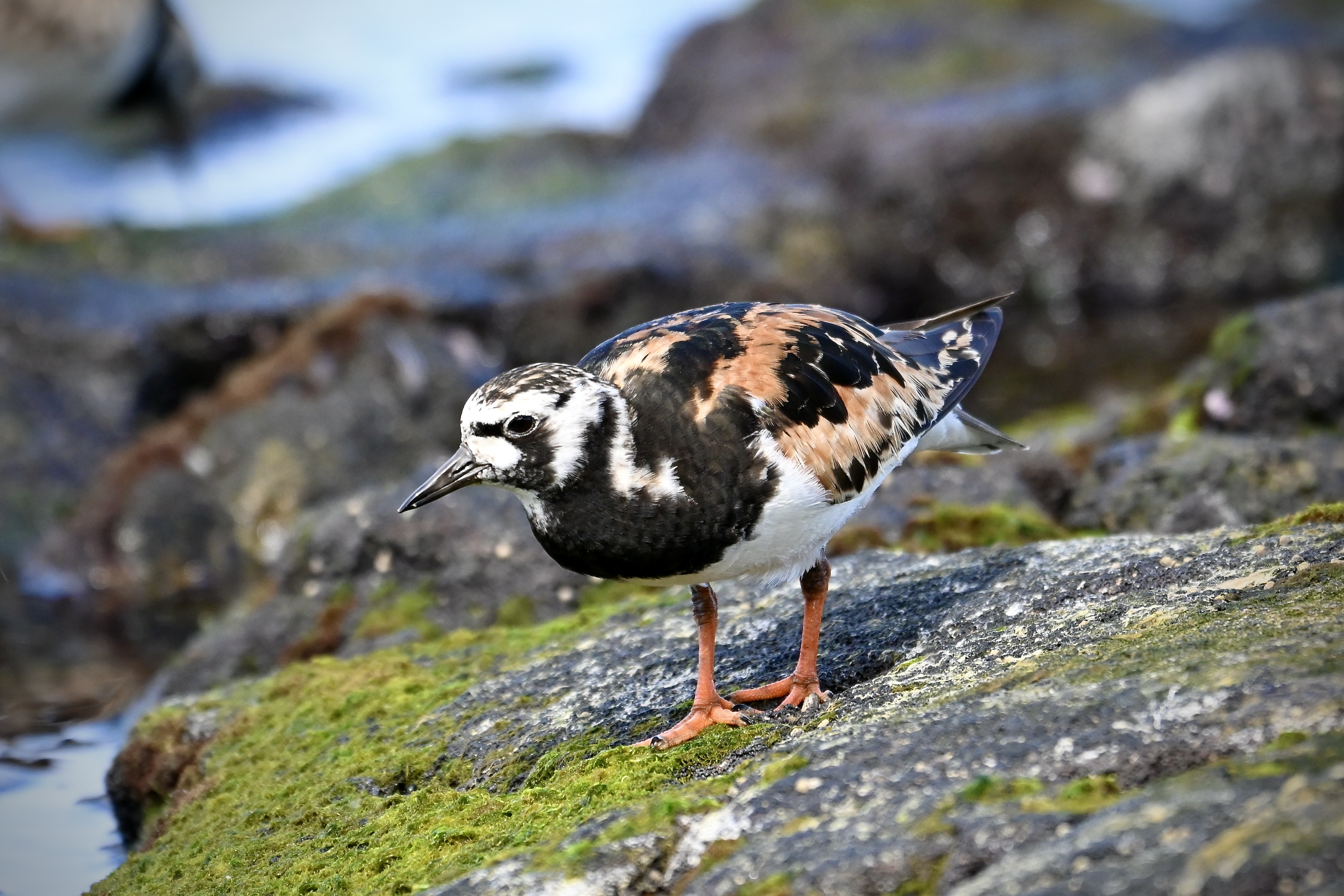
Photo of an ‘akekeke (ruddy turnstone) on Hawai’i Island by Eric Anderson.
“[Jesus said,] ‘Sell your possessions and give alms. Make purses for yourselves that do not wear out, an unfailing treasure in heaven, where no thief comes near and no moth destroys. For where your treasure is, there your heart will be also.'” – Luke 12:33-34
Jesus, I am not a wealthy man… by some standards. Were I to leave my work, I’d quickly run through savings, have no home, sell the things I use to give me joy – the instruments, the cameras, the things that prompt my memory.
By other standards, I have wealth beyond imagination. I do not know where my next meal will come from, but I know that it will come. I know that if a wave arises or a lava river flows, I’ll have a place where I am safe.
My wealth be great or small, I must confess, it still is mine. In honesty, I’d sooner heed Isaiah’s words: do good, seek justice, rescue the oppressed, defend the orphan, raise my voice in favor of the widow. But.
You, Jesus, raised the bar. The tithes has turned to everything: my ukulele, photographs; my work time and my leisure, what I think and write and speak and make. For you demand all these be yours, be God’s, be holy gift.
So Jesus, I confess that though I give you much, it is not all. I may give alms; I may give time; I’ve taken on the role of the religious, but: it is not all. It is not all.
Dear Jesus, please accept my offerings, my alms of treasure and of time, of sweat and contemplation. Take the portion of my heart that unreservedly I give to you. And forgive the heart, and treasure, which I still keep for myself.
A poem/prayer based on Luke 12:32-40, the Revised Common Lectionary Gospel Reading for Year C, Proper 14 (19).
So when Peter went up to Jerusalem, the circumcised believers criticized him, saying, “Why did you go to uncircumcised men and eat with them?” – Acts 11:2-3
You think I wanted to eat with them? I didn’t want to go at all. I was riding pretty high, you know, elated with a woman’s resurrection. OK, the only place they’d put me up was with a tanner, but a fisherman’s smelled worse.
Yes, I was riding high, and trying not to think about the things that happen when you’re riding high, the way success becomes a series of new challenges, new obligations. I was smelling those amidst the tannery. It came for Jesus; it would come for me.
I didn’t know that I could lie in dreams or visions, waking or asleep. I claimed I’d never eaten food that was unclean, and knew full well I’ve eaten shellfish when the Romans hadn’t purchased all my stock. And let’s ignore the grain I plucked on Sabbath Day.
A vision or a dream; regardless, it would summon me to something new I knew. I did not know what it would be, but who gets visions for a trivial thing? I didn’t know what that dream meant. I knew I’d go where I’d not wish to go.
The house of a centurion was not within my plan. Who knew what I would find when I reached there? Most likely was a naked sword to seek my naked gut. Why trouble with a cross when you can drain a troublemaker’s life without?
I had no plan to speak of Jesus there until they asked, but ask they did, and I pulled in my breath, and breathed it out, and spoke with sometimes trembling voice of Jesus, of his healing touch, his mercy to such fools and failures as I am.
I certainly did not expect the fire of the Spirit in a Roman house, of one who marshals military might against the people of this land. They said that he feared God, but this? The Holy Spirit, lit in him as it had been in me? Who knew?
And now, my friends, I have no plan for you. I didn’t want to go. I went. I didn’t want to speak. I spoke. I didn’t know the Spirit would appear. She did. I didn’t know that God had welcomed them, the Gentiles, just as openly as us. And now, I have no words for you, except
To tell my tale again.
A poem/prayer based on Acts 11:1-18, the Revised Common Lectionary First Reading for Year C, Fifth Sunday of Easter.
“[Jesus read from the scroll of Isaiah:] ‘The Spirit of the Lord is upon me, because he has anointed me to bring good news to the poor. He has sent me to proclaim release to the captives and recovery of sight to the blind, to set free those who are oppressed, to proclaim the year of the Lord’s favor.'”
“Today this scripture has been fulfilled in your hearing.” Your own words, Jesus, amazing them with graceful speech. Until they turned upon you.
Remind us once again of what is grace. I’m told that grace is strength, is force. I’m told that power is right, and might is good. I’m told that what we want we take.
Where is the news that sounds good to the poor? Where is the vision for the ones who will not see? Where is the freedom for the ones who are oppressed? Where are the prisoners released into the light?
You did not speak the words of grace alone. You needled them, you did, O Christ, until they burst in rage, and nearly did the work of Pilate three years earlier, by casting you to break upon a rock.
O, can we learn the lesson that you tried to teach? We claim your name but do not tread your ways. We leave the poor uncomforted, we close our eyes to the oppressed, and those we free are those who’ve flattered us.
May there be good news for the poor. May there be vision which will pierce the shade. May there be freedom for those who have been bound. Bring quickly, Jesus, the favored year of the LORD.
A poem/prayer based on Luke 4:14-21, the Revised Common Lectionary Gospel Reading for Year C, Third Sunday of the Epiphany.
The image is “The Rejection of Jesus in Nazareth” (“Prophets are not without honour, except in their hometown”); 18th-century tile panel by António de Oliveira Bernardes in the Igreja da Misericórdia, in Évora, Portugal, Public Domain, https://commons.wikimedia.org/w/index.php?curid=97133284.
“…Let us approach with a true heart in full assurance of faith, with our hearts sprinkled clean from an evil conscience and our bodies washed with pure water.” – Hebrews 10:22
There are mornings when I revel in the water which cascades along my form and carries off the aggravating dust and clinging grime.
In likewise do I cast my grateful soul into refreshment of a loving God, who takes away the grunge, the guilt, the shame.
And then I step upon the shower mat, to towel off the residue of cleanliness, prepare to wrap my form in clothing for the day.
In likewise does my soul release forgiveness’ bliss, replenished to the work which lies ahead, and clothed (we hope) in righteousness’ array:
Provoking those around to love, to acts of doing good, to mercy shared, to meet and raise the courage of those souls who’d do the same.
A poem/prayer based on Mark 12:38-44, the Revised Common Lectionary Gospel Reading for Year B, Proper 27 (32).
“One of the scribes came near and heard them disputing with one another, and seeing that he answered them well he asked him, ‘Which commandment is the first of all?’ Jesus answered, ‘The first is, “Hear, O Israel: the Lord our God, the Lord is one; you shall love the Lord your God with all your heart and with all your soul and with all your mind and with all your strength.” The second is this, “You shall love your neighbor as yourself.” There is no other commandment greater than these.'” – Mark 12:28-31
The scribe approved your words, or so says Mark, and silenced all the snare-deploying crowd. Yet he might ask (and yes, in Luke he did) “Who is my neighbor to receive my love?”
Then you, Redeemer, might have said (though you did not, or so says Luke), “Look to the Book of Ruth, to what is written there: ‘I will not leave you. Do not press me.
“‘Where you journey, I will go. And where you stop, there I will take my rest. Your people shall be mine, and more: Your God shall be my God.'”
A poem/prayer based on Mark 12:28-34, the Revised Common Lectionary Gospel Reading, and Ruth 1:1-18, the First Reading, for Year B, Proper 26 (31).
James and John, the sons of Zebedee, came forward to him and said to him, ‘Teacher, we want you to do for us whatever we ask of you.’ And he said to them, ‘What is it you want me to do for you?’ And they said to him, ‘Appoint us to sit, one at your right hand and one at your left, in your glory.'” – Mark 10:35-37
While you’re at it, Jesus, sign me up for that. For while I think I have one of the sittingest jobs there is, (I sit in chairs and cars and at so many meals), I’d really like to sit nearby to you and bask in glory.
Ahhhhhh…
Yes, I can follow you and what you do to find my place in glory, banquet marvelous, and if the places to your right and left are occupied already, I understand.
Ahhhhh…
So though I share the indignation of your other followers, I share as well their thought that it should not be them, but me, to sit at your right hand. Of course.
Ahhhh…
I’ve chosen to forget as James and John did then, so long ago, that you’d been laying out the likely forecast, which was stormy to be sure, a blow to carry you up on a cross.
Ahhh…
I’ve chosen to ignore again your call to servanthood and service. Humility, not arrogance, displays your Way. I’d be more comfortable, frankly, with my pride.
Ahh…
Instead, I sit dismayed. You’ve asked for all, for more than I prepared, for more than I have understood. It’s not enough, but in this moment, it is all I have to give.
Ah.
A poem/prayer based on Mark 10:35-45, the Revised Common Lectionary Gospel Reading for Year B, Proper 24 (29).
The image is “The Calling of the Apostles St. James and St. John,” print, Friedrich August Pflugfelder, after Johann Friedrich Overbeck (MET, 2004.451) (August W. Schulgen/ Josef Spithöver) – This file was donated to Wikimedia Commons as part of a project by the Metropolitan Museum of Art. See the Image and Data Resources Open Access Policy, CC0, https://commons.wikimedia.org/w/index.php?curid=60859225. Sadly, most artists’ renderings I could find of this interchange between Jesus, James, and John, favor Matthew’s version of the story, in which their mother made the request on their behalf.
“Finally, be strong in the Lord and in the strength of his power; put on the whole armor of God, so that you may be able to stand against the wiles of the devil…” – Ephesians 6:10-11
I’m grateful that the struggle is not with the powers of blood and flesh. Not if I’m to rely upon these items for protection of my vital spark.
What happens to the righteous? Why, they suffer, as do those who speak of peace. A shield of faith is powerless against an arrow, or a club, or fist.
Should I entrust my head to its salvation? The logic doesn’t work for me. I wish I thought an offense of the Spirit, of the Word, protected anyone, but… no.
And worst of all, to recommend I gird my waist with Truth, as if the truth has ever carried any weight when cut so easily by lies.
But then I see a brilliant coral called “The Armor of our God,” protected by no more than truth, feebly anchored to its rock.
These corals can be shattered by a careless underwater step, the floating residue of sun protection, by a current that directs its food away.
If coral, brilliant in its indigo, can live its fragile life beneath the sea, I might, perhaps, submit my life to living with this unprotective armor,
Rooted in the truth, acting righteously, striding ever toward the reign of peace, with faith displayed before me, head a-crowned with Christ’s salvific work,
Equipped to bring the Spirit’s Word to those who might, in turn, take on this truth, this righteousness, this peace, this saving faith, this summons from our God.
Author’s note: I have no idea what I was going to write about before I found this photo of an “Armor of God” Zoanthid coral.
A poem/prayer based on Ephesians 6:10-20, the Revised Common Lectionary Second Reading for Year B, Proper 16 (21).








 ordainedgeek
