John said to the crowds coming out to be baptized by him, “You brood of vipers! Who warned you to flee from the coming wrath?” – Luke 3:7
Who warned us, John? You did. We heard your words through others, much as those you called “a brood of vipers” heard your words through rapid rumor’s run.
We heard your warning through the memories and tongues and pens of those you had impressed with word, with deed, with baptism, with righteousness.
We heard because they passed along your warning that to wash with water would not cleanse the soul, but full repentance, all enacted, would receive the nod of God.
They came to hear themselves. They came to learn how they might change. They came to leave upon a road that might look like the one on which they had arrived, but was a road made new.
They came. They heard. They washed. They went away and told the tale. More came. More heard. More washed. More told. Soon one would come to wash though you would tell him, “No.”
You warned us, John, across the years. But tell me, we who follow him whom you baptized, have we been heedful of your warning? Do we bear the fruits of righteousness?
I fear, old harsh-voiced friend, that you would find us heedless of your words despite our claim to follow Christ. I fear you’d rail once more at broods of serpents writhing in the dust.
I fear it would not only be the ones I judge as frauds, or casual extortionists, or simply selfish souls withholding all their wealth,
But also me, secure in my self-righteousness, and satisfied with my reputed rectitude. What sins do I ignore, refuse to cleanse?
Shout on, old Baptist friend. Across the years, through others’ words I hear your call. Shout on, and by the grace of God may I repent, and wash, and bear good fruit.
A poem/prayer based on Luke 3:7-18, the Revised Common Lectionary Gospel Reading for Year C, Third Sunday of Advent.
The image is John Preaching in the Desert, a mosaic in the series of the Life of John the Baptist in the Florence Baptistery, Florence, Italy (ca. 1225-1330). Photo by Sailko – Own work, CC BY 3.0, https://commons.wikimedia.org/w/index.php?curid=41892069.
“And this is my prayer, that your love may overflow more and more with knowledge and full insight to help you to determine what really matters, so that in the day of Christ you may be pure and blameless, having produced the harvest of righteousness that comes through Jesus Christ for the glory and praise of God.” – Philippians 1:9-11
I am stripped down. I wait my fate. What will it be? Will it be gain? Will it be Christ? I will not choose, except, of course, that I have chosen by the words I’ve spoken, by the things I’ve done.
I am stripped down.
I have been stripped of agency. Another will decide my course. I’ve lived in faith that God has set my way, but set my way through me. A crueler hand now rests upon the tiller of my time. Does it grow short?
I am stripped down.
I struggle to bring influence, to speak good news, for few may hear me now. Is it hubris to believe that they who hold me in this place consider what I’ve said and turn their souls toward Christ?
I am stripped down.
Thank God Epaphroditus has recovered, though for him, like me, to die is gain. For Jesus and for me he’ll carry word to those I love that… well, that I love them from the heart. I am stripped down. What more to say?
Just that I love.
A poem/prayer based on Philippians 1:3-11, the Revised Common Lectionary Second Reading for Year C, Second Sunday of Advent.
“[Jesus said,] Then they will see ‘the Son of Man coming in a cloud’ with power and great glory.” – Luke 21:27
I’m looking, Jesus. I’m looking for those terrible disasters. I’m looking for the sun-signs, moon-signs, star-signs. Where is the earth distressed? Where are the nations fuddled by the roaring of the seas?
I’m looking, Jesus, and I’m finding all those terrible disasters. The sun burns warmer on the sands than once it did. Distressed, the earth would wrap itself in coolness, water rising, inundating coastlines of both continents and islands.
I’m looking, Jesus: where to find you? The clouds still float along without your figure stepping down to earth in glory and in power. Where are you, Jesus, when the seas are salt with tears?
I’m looking, Jesus, as disciples have been looking for two thousand years, to see the reign of God in light and thunderclaps and incense-scented wonder, but… You’re just behind my shoulder, aren’t you?
A poem/prayer based on Luke 21:25-36, the Revised Common Lectionary Gospel Reading for Year C, First Sunday of Advent.
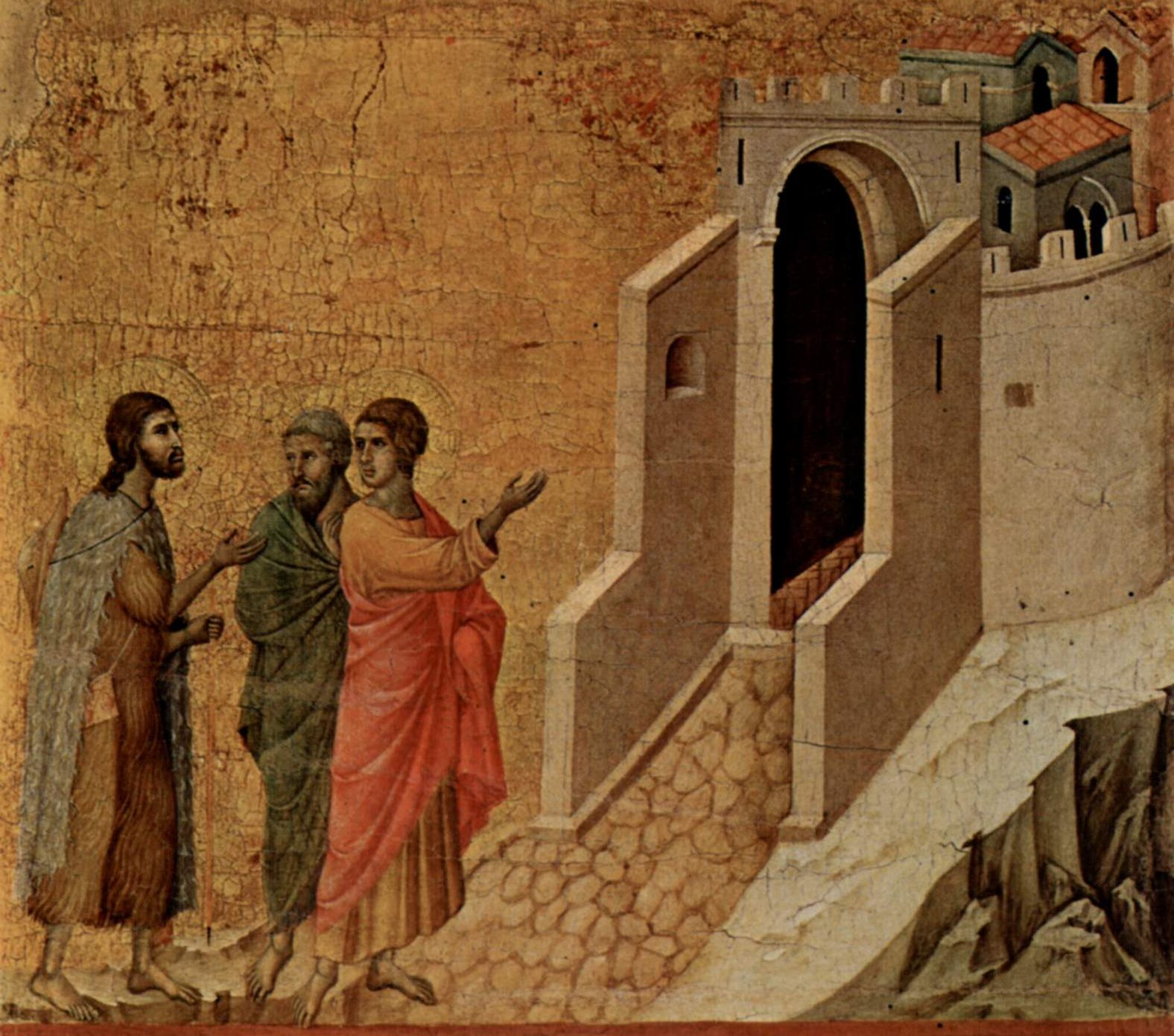
The image is Christ Appears to Two Apostles in Emmaus by Duccio di Buoninsegna – The Yorck Project (2002) 10.000 Meisterwerke der Malerei (DVD-ROM), distributed by DIRECTMEDIA Publishing GmbH. ISBN: 3936122202., Public Domain, https://commons.wikimedia.org/w/index.php?curid=3799693.
The world is filled with tears. They spring from eyes emotion-swollen, running down the cheeks across the bare or stubbled chin. The world is filled with tears.
The fountains spray their eloquence, responding to the pains of circumstance, of body or of mind, of tearing of the fragile soul. The world is filled with tears.
From other eyes the liquid leaps for joy like ocean spray and seething foam, a coruscating rainbow of delight. The world is filled with tears.
Oh, Holy One, I do not pray for you to dry our tears today, but that we weep, relieved of fear. Oh, let these be our tears.
The image is a detail of the figure of Mary Magdalene in the sculpture The Entombment of Christ in the Church of St. Martin, Arc-en-Barrois, France. Photo by User:Vassil – File:Sépulcre_Arc-en-Barrois_111008_12.jpg, CC BY 3.0, https://commons.wikimedia.org/w/index.php?curid=16942922.
“One of the scribes came near and heard them disputing with one another, and seeing that he answered them well he asked him, ‘Which commandment is the first of all?’ Jesus answered, ‘The first is, “Hear, O Israel: the Lord our God, the Lord is one; you shall love the Lord your God with all your heart and with all your soul and with all your mind and with all your strength.” The second is this, “You shall love your neighbor as yourself.” There is no other commandment greater than these.'” – Mark 12:28-31
The scribe approved your words, or so says Mark, and silenced all the snare-deploying crowd. Yet he might ask (and yes, in Luke he did) “Who is my neighbor to receive my love?”
Then you, Redeemer, might have said (though you did not, or so says Luke), “Look to the Book of Ruth, to what is written there: ‘I will not leave you. Do not press me.
“‘Where you journey, I will go. And where you stop, there I will take my rest. Your people shall be mine, and more: Your God shall be my God.'”
A poem/prayer based on Mark 12:28-34, the Revised Common Lectionary Gospel Reading, and Ruth 1:1-18, the First Reading, for Year B, Proper 26 (31).
I was ordained in my home church, Union Congregational Church UCC in Rockville, Connecticut, thirty-six years ago today.
A lot of things have changed in the intervening three and six-tenths decades. For one thing, my home congregation left the United Church of Christ, which is a lingering ache. My father retired from a distinguished career as a public school educator, completed a seminary degree, and was ordained himself. My daughter has also graduated from seminary and I look forward to celebrating her ordination. My son has kept his concentration on the writing and creating he wants to do, a quest that has taken him to the heartland of Arthurian stories in Wales.
The UCC has lost members and lost churches every one of these thirty-six years. We’re not alone. Similar things have happened in “mainline” Protestant denominations and in traditions that have rejected the mainline. The church has aged. Even now, as I have entered my sixth decade, I remain younger than a majority of my parishioners.
It seems like I ought to have learned something over all these years, and to have some wisdom to offer to colleagues, friends, church members, and church leaders. I feel like I should. If I do, I wish it were clearer to me.
The time has passed in the blink of an eye, a blink of an eye that has included innumerable endless days.
A couple weeks ago ministers of the Hawai’i Conference gathered for a retreat, which was held just a few miles from my home. On one of the afternoons, we participants could participate in “adventures.” For various reasons, including the vigorous advocacy of a young person in my congregation, I was asked to be the local pastor who accompanied (and joined) those who took part in a zipline adventure.
It wasn’t entirely outside my wheelhouse. While in Connecticut, I sought training as a ropes challenge course facilitator. I really enjoyed the training and the work of guiding people through an experience of testing their boundaries, trying something scary and finding a new sense of accomplishment. As I’ve put it more than once, facilitators spend their time safely on the ground, but in training we spent more time at the heights. The conference’s retreat center didn’t have a zipline, but I did get a chance to try one before moving to Hawai’i.
The simple truth is that I don’t have much fear of heights, and doing that training and that work taught me to trust the equipment.
I still wasn’t sure how I’d feel until I set off on the first zipline that afternoon. Would it be exhilaration? Had I developed a fear of heights without realizing it? Would something else happen that I didn’t anticipate?
It did. I settled into the harness, glided along the cable, and felt about as relaxed as I’ve felt in some time.
Yes. You read that right. I felt relaxed.
I was surprised, too.
Relaxation can be hard to come by in a pastor’s life. Sometimes pastoral duties come with a lot of anxious energy. The other day I received an urgent call to go to the hospital, as someone from another church, someone I have known and worked with, had been rushed there by ambulance. When I got there, nobody had a record. It turns out that they’d died in the ambulance without ever reaching the hospital.
That afternoon brought a lot of concern, anxiety, shock, and grief.
If I have any wisdom to offer on the thirty-sixth anniversary of my ordination, it’s this: Relax into the glide of the zipline. Ministry can feel like an uncontrolled glide over a yawning chasm at times: mercifully, not all the times. When it does, the mechanisms that keep me from falling aren’t readily apparent, or if they are, I may not be convinced of their strength. Those pitfalls look awfully deep.
Relax into the glide.
You’ll get to the other side.
It’s an imperfect metaphor, of course. One of the features of ziplines is that they make straight lines between one place and another. Ministry frequently doesn’t. You set off in one direction, and find yourself landing in a completely different place. Thirty-seven years ago, did I expect that I’d do interim ministry? Play the guitar and ukulele? Manage IT and publications for a Conference? Facilitate on a challenge course? Pastor a church in Hawai’i?
No, no, no, no, and no.
Not all of my transitions have been gentle (far from it) and not all of my landings have been soft (far from that, too). The ground that looked firm has crumbled beneath my feet both at the beginning and the end of the traverse. I still don’t really understand the systems that have kept from out of the crevasse all these times.
But if I have one piece of advice, it is: Relax into the glide.
You’ll get to the other side.
The photo shows me (a gray figure with an orange helmet) gliding down a zipline over a waterfall. Photo by Ben Sheets.
“[Moses said,] ‘I am not able to carry all this people alone, for they are too heavy for me.’ So the LORD said to Moses, ‘Gather for me seventy of the elders of Israel…'”
They wept for food, the wandering people did. Their palates had grown weary of the miracle, which sounds ungrateful. I suppose it is. But who does not grow weary of life’s wonders?
Then Moses was displeased, and not with weeping people, but with God, whom he accused of treating him so badly. “Why do you lay the burden of these people upon me?” For Moses, too, had wearied of the wonder.
And God – the singular, the Trinity not yet imagined, whose powers had rained flies and hail and pestilence and death upon the wailing people of the Pharaoh – said,
“You shall not lead alone. You never have. Did you forget? We’ve been a team, we have, with you and me and Miriam and Aaron. The team will grow by seventy today.
“They say too many cooks will spoil broth. Sometimes, you know, that’s true, if they neglect to speak and listen to each other. Now my Spirit shall be given to these elders.
“They shall prophesy, including those who missed the memo in the camp. And you, my harried, whiny Moses, shall at last be glad for helpers on the road.
“As for these weeping people, now: Let them eat quail.”
A poem/prayer based on Numbers 11:4-6, 10-16, 24-29, the Revised Common Lectionary Alternative First Reading for Year B, Proper 21 (26).
“Then they came to Capernaum, and when he was in the house he asked them, ‘What were you arguing about on the way?’ But they were silent, for on the way they had argued with one another who was the greatest.” – Mark 9:33-34
Sitting in your house, you catch my eye. I see the smile play upon the corners of your lips. “That argument you had along the way. Now tell me: What were all those snarling words about?”
Now, I don’t want to tell. You see that, right? Your eyes move on from mine to James, and John, to Andrew, Philip, Matthew, Simon, James, Bartholomew and Thaddeus, Thomas, Judas, too.
“So tell me!” you repeat and smile, still. You know, I know, because my frozen face declares it. So do all the faces of the twelve. You shake your head at our embarrassed silence.
“Would you be great?” you ask me, and I need not answer. Yes, I would! I’d be the warrior at the side of Christ, to fight and even die if need be. I would live in glory.
“If you’d be great,” you say, and lift the ragged cuff of my left sleeve, “you won’t be first, but last. You’ll be the servant of the least of these.”
All right, you’ve said such things before, and we had nodded, for your words were wise. I somehow never thought that they’d apply to me. I somehow never thought I’d die in poverty.
I may have held my tongue since your rebuke of “Get behind me, Satan!” but I do not yet accept your forecast of betrayal and a cross. I’d overcome those evils, not embrace them.
I see again, however, you and I have taken sides in opposition here. My greatness is not yours. Your greatness is not mine. I can’t think what to do.
Whatever happens, I will not abandon you. I’ll wrestle with these things I do not want to understand, and maybe one of us will change their mind. In honesty?
I hope it’s you.
A poem/prayer based on Mark 9:30-37, the Revised Common Lectionary Second Reading for Year B, Proper 20 (25).
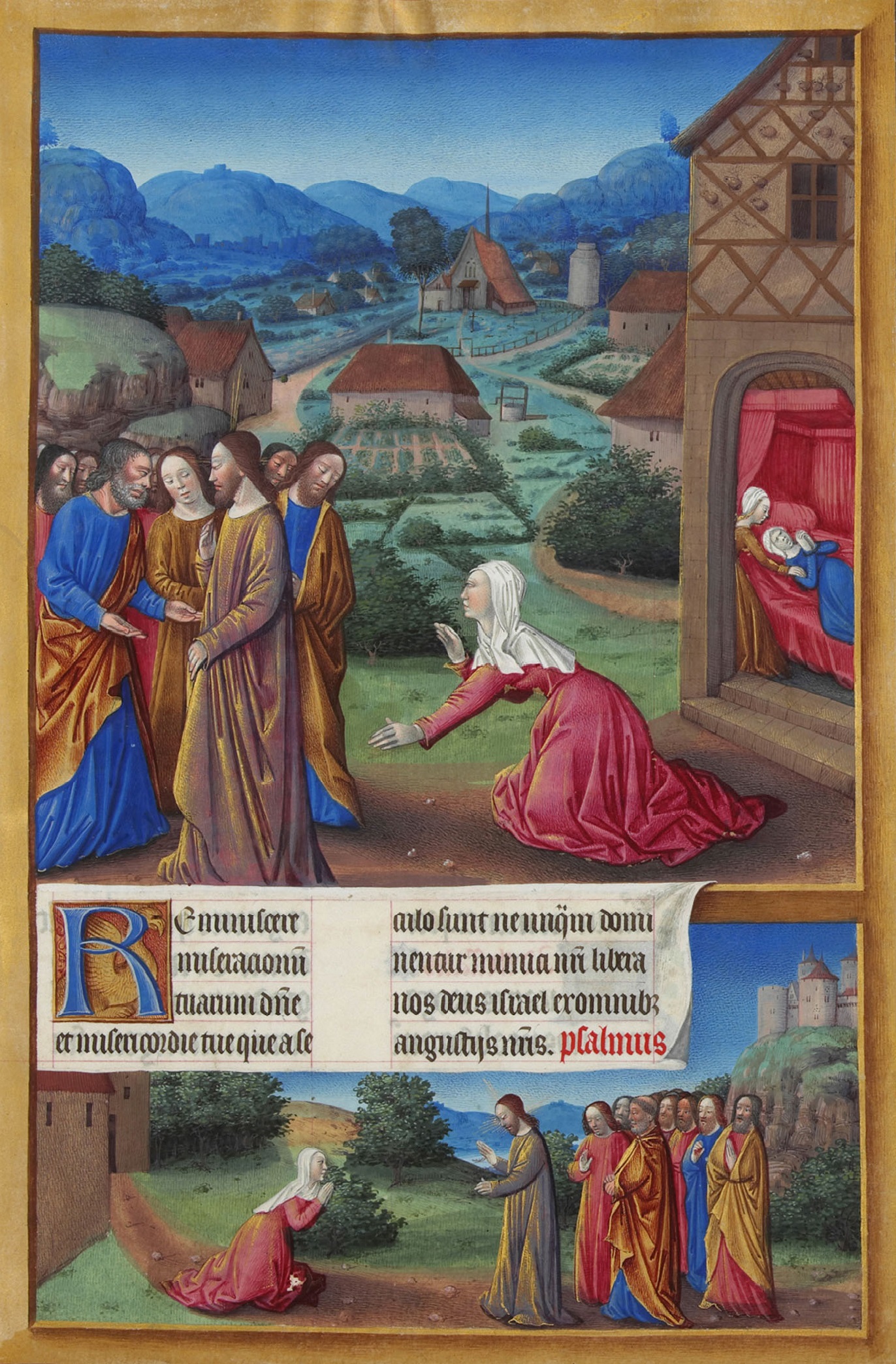
A poem/prayer based on Mark 5:21-43, the Revised Common Lectionary Gospel Reading for Year B, Proper 8 (13).
The image is of the healing of the woman with the hemorrhage from theTrès Riches Heures du duc de Berry. Artwork by the Limbourg brothers (between 1411 and 1416) – Photo. R.M.N. / R.-G. Ojéda, Public Domain, https://commons.wikimedia.org/w/index.php?curid=17443172.Somewhat unusually for images of this text, Jairus’ daughter is visible at right in the upper image.








 ordainedgeek
