Fragile Stones

When some were speaking about the temple, how it was adorned with beautiful stones and gifts dedicated to God, [Jesus] said, ‘As for these things that you see, the days will come when not one stone will be left upon another; all will be thrown down.'” – Luke 21:5-6

The flagstones and terraces, walls and pillars,
the walkways and courtyards, collonades and shrines.
Oh, look where the peak of the roof glows at sunset!
Oh, look how the glory of God has been housed.

The stones seem so durable, set and enduring,
but Jesus in sadness announces their fall.
Eternity’s structures are not built with masonry.
Instead, they are built on the soul.

It has been many days since I stood by the ocean
and watched while this island expanded its shores.
Incarnadine tendrils, dulling to sable,
forming a delta of newly poured stone.

And that delta has vanished. It broke
and it crumbled. The rocks of the ages
could be counted in days. Since then new eruptions
have fashioned the coastline anew and anew and anew.

Stone poured upon stone, broken to sand.
Stone stacked upon stone – by human hands.
They come and they go, they bloom and they fade –
But oh, what glory that these things should be.

Fragile stones, enduring for centuries,
collapsing in days, wrecked by malice,
swept away by the sea. Fragile stones that stand for a moment:
But oh, what glory that these things should be.

A poem/prayer based on Luke 21:5-19, the Revised Common Lectionary Gospel Reading for Year C, Proper 28 (33).

Photo of the 2016 ocean entry in Kamokuna by Eric Anderson.

Tell Us Another Story

[The Sadducees asked,] “Now there were seven brothers; the first married, and died childless; then the second and the third married her, and so in the same way all seven died childless. Finally the woman also died. In the resurrection, therefore, whose wife will the woman be? For the seven had married her.” – Luke 20:29-33

Tell us another story, Jesus.

Tell us a story in which a woman is valued
for what she brings and makes, and not
because she bears a child to be the heir
to one whom death has claimed.

Tell us a story in which a woman is treasured
and housed and clothed and nourished
because she is a child of God, and not
because she is a womb for children.

Tell us a story in which a woman determines
her home, her work, her speech, her course,
and does not submit her careful conclusions
to the random will of a man.

Tell us a story in which those thrust
to the margins in casual cruelty
rise strong in themselves, and claim their due place
as wealth and privilege wane.

Tell us a story of resurrection,
of life beyond these oppressing tears,
of dancing angels, of children of God,
of all who live and love in God’s sight.

Tell us another story, Jesus.

A poem/prayer based on Luke 20:27-38, the Revised Common Lectionary Gospel Reading for Year C, Proper 27 (32).

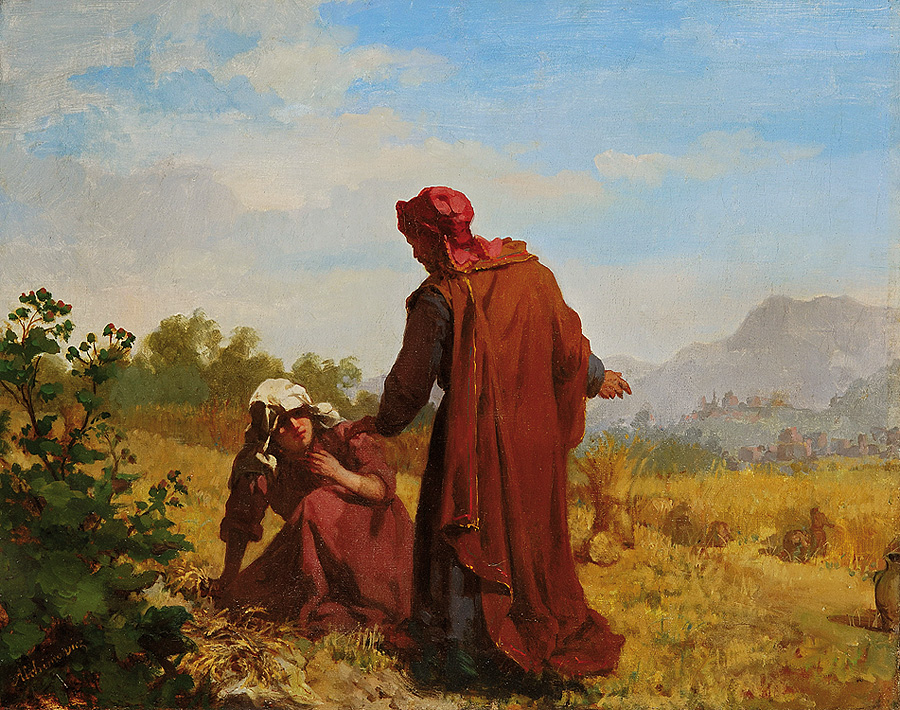
The image is Booz (Boaz) and Ruth Collecting Barley Ears by Kazimierz Alchimowicz – 1. AskArt2. AgraArt, Warsaw, 22.03.2009, lot 12529, Public Domain, https://commons.wikimedia.org/w/index.php?curid=19724130.

I highly recommend reading Maren Tirabassi’s poem on this text, “A few thoughts on Luke 20:27-38 for Día de los Muertos.” It redirected my thinking.

A Boast

“Therefore we ourselves boast of you among the churches of God for your steadfastness and faith during all your persecutions and the afflictions that you are enduring.” – 2 Thessalonians 1:4

Let me boast of the teacher
whose time in the classroom
was short, but whose time
to inspire was longer and glorious
and still… all too short.

Let me boast of the caretaker,
rarely at worship because of her charge,
but shining with spirit in every
encounter, aglow with affection
so clear in my memory.

Let me boast of the less-known,
forgotten, ignored,
whose passage of Earth left its light,
instead of the powerful, wretched indeed,
to leave us so broken in sorrow.

Let me boast of the saints.

A poem/prayer based on 2 Thessalonians 1:1-4, 11-12, the Revised Common Lectionary Second Reading for Year C, Proper 26 (31).

The image is The Forerunners of Christ with Saints and Martyrs by Fra Angelico (1420s) – Public Domain, https://commons.wikimedia.org/w/index.php?curid=3000363.

Contemptible

[Jesus] also told this parable to some who trusted in themselves that they were righteous and regarded others with contempt… – Luke 18:9

Truly you see that he is contemptible.
Imagine a collaborator, a Quisling, a snake
who slithers his way to take chicks from the nest.
Such is this man, who is rich from his friends –
if he has any, now, since he fronts for the Romans
and seizes their substance for them and himself.

I thank you, Creator, that I have not fallen
to such mean temptation or villainous deed.
You’ll find that my substance is shared with my household.
You’ll find that my giving to you is correct.
You’ll find I am faithful in all of my doings.
To you I give praise for your law and design.

Now listen, O Great One, as he struggles to pray.
My studies have given me words fit for angels,
to proclaim your glory as if my voice echoed
the song of the heavens and heaven’s chorale.
And he prays for mercy? Sure, mercy he covets,
but we know his plea is yet more of his greed.

Truly you see that he is contemptible,
in life and profession, in false piety.
Let not his petition leave grit in your ears,
but hear my thanksgiving and praise to your name.
You, and you only, can judge your Creation.
You, and you only, can say what contemptible is.

A poem/prayer based on Luke 18:9-14, the Revised Common Lectionary Gospel Reading for Year C, Proper 25 (30).

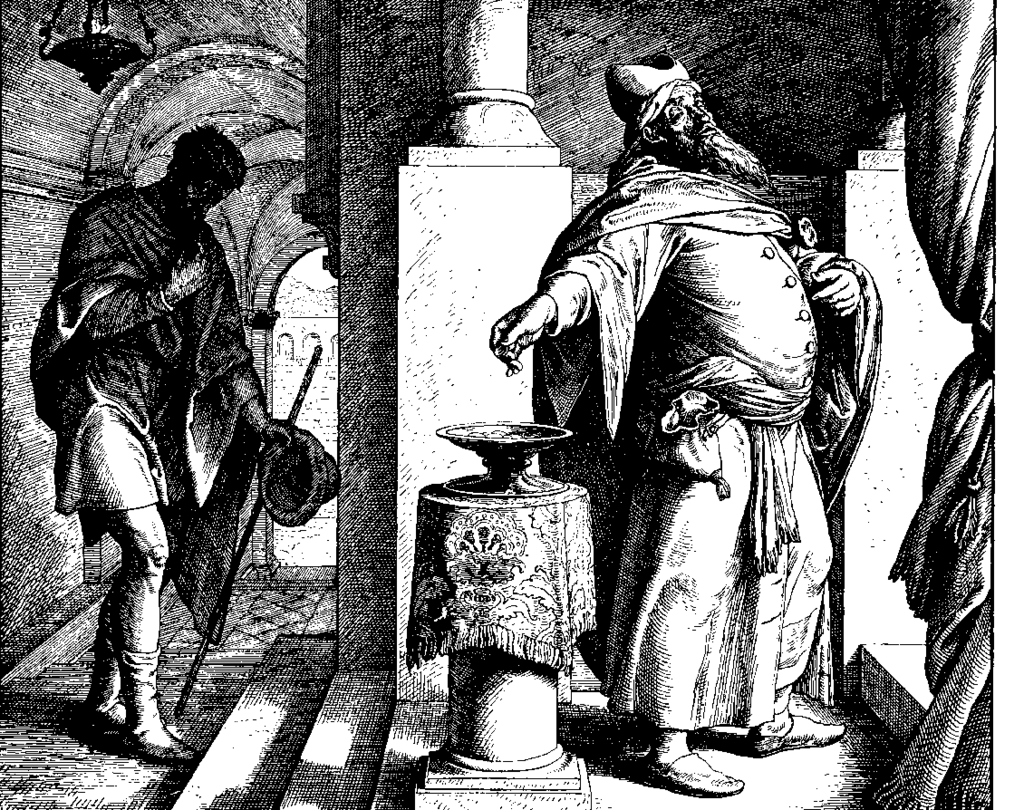
The image is a woodcut for Die Bibel in Bildern, 1860, by Julius Schnorr von Carolsfeld – Die Bibel in Bildern, Public Domain, https://commons.wikimedia.org/w/index.php?curid=5490865.

Subdued

“The sun rose upon [Jacob/Israel] as he passed Penuel, limping because of his hip.” – Genesis 32:31

I had you, God.
You know it. I know it.
You saw you weren’t prevailing.
You know it. I know it.
And then you pulled a dirty trick!
You know it. I know it.
You pulled my hip right out of joint.
You know it. I know it.
It didn’t matter; I held on to you and held.
You know it. I know it.
You did not want the daylight to reveal you.
You know it. I know it.
And so you called for me to let you go before the dawn.
You know it. I know it.
“Oh, no,” I said. “You have to bless me first.”
You know it. I know it.
You did; you gave me a new name.
You know it. I know it.
A name about the struggle.
You know it. I know it.
And now I limp.
You know it. I know it.
But I won.

A poem/prayer based on Genesis 32:22-31, the Revised Common Lectionary Alternate First Reading for Year C, Proper 24 (29).

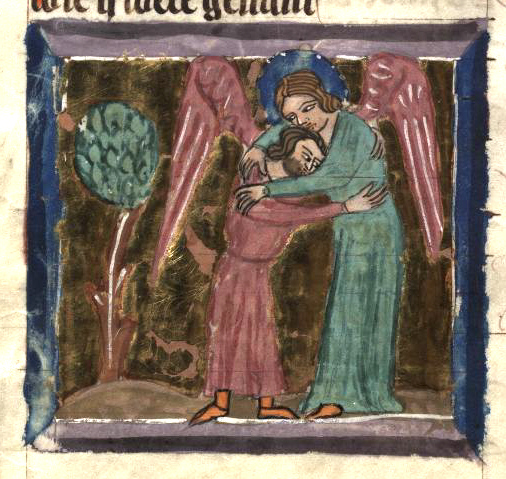
The image is Jacob Wrestling the Angel by Anonymous (Meister 1) ca. 1350-1375 – Hochschul- und Landesbibliothek Fulda, Public Domain, https://commons.wikimedia.org/w/index.php?curid=23797771.

How Many Miracles?

“Now the Arameans on one of their raids had taken a young girl captive from the land of Israel, and she served Naaman’s wife. She said to her mistress, ‘If only my lord were with the prophet who is in Samaria! He would cure him of his leprosy.'” – 2 Kings 5:2-3

“…his flesh was restored like the flesh of a young boy, and he was clean.” – 2 Kings 5:14

The first of the miracles was a girl enslaved,
who’d been torn from her home and forced to serve.
She was not embittered. She retained compassion.
She directed her “lord” to a prophet with power.

The general went to the king, and the king went and wrote
to a king, who in fury and fear rent his clothes.
By a miracle word reached the prophet, who said,
“Send the general here to be well.”

With chariots and horses and servants he came,
but only a messenger stood at the gate,
for the prophet, miraculously still unimpressed
remained in the house; directives he sent.

Now the general cursed and would fly down the road,
back to his home with his malady still.
“He told me to wash!” he denounced the directives,
and he would have rejected the miracles, save…

That his servants (among them, assuredly, slaves)
miraculously summoned their courage and said,
“It’s too simple for you? You can do what is hard.
Do the simple thing. See if it works.”

By a miracle the pride of the general faded.
He listened to those whom the culture despised.
He’d followed advice of a girl and a slave,
now the wisdom of slaves took him to Jordan’s side.

In the washing, the general found his skin cleansed.
A miracle true, a healing assured, his status restored.
A miracle once more: He sought out the prophet.
He raised up his thanks and he praised Israel’s God.

A series of miracles, built upon miracles,
a general who thanked, a general who listened
to slaves who cared and a prophet who ordered –
But the first of the miracles was a girl enslaved.

A poem/prayer based on 2 Kings 5:1-3, 7-15c, the Revised Common Lectionary Gospel Reading for Year C, Proper 23 (28).

Biblical illustration of 2 Kings 5:3 by Jim Padgett, courtesy of Sweet Publishing, Ft. Worth, TX, and Gospel Light, Ventura, CA. Copyright 1984. Released under new license, CC-BY-SA 3.0 by Distant Shores Media/Sweet Publishing, CC BY-SA 3.0, https://commons.wikimedia.org/w/index.php?curid=18903284.

Sproing!

[Jesus said,] “If you had faith the size of a mustard seed, you could say to this mulberry tree, ‘Be uprooted and planted in the sea,’ and it would obey you.” – Luke 17:6

Look, Lord, I have faith!

Sproing!

You pointed at this mulberry tree, and look!

Sproing!

It’s gallivanting all about, prancing on the shore.
I know you said to tell it to take root, but look!
What eye could turn away from jigging roots
and twisting trunk, from limbs a-sweeping in the dance?

Sproing!

Now isn’t that great?

Sproing!

Jesus? Isn’t that good?

Sproing!

Look, Jesus, I admit that servants have to serve
and all, but look! A leaping tree!
The spray upon your cheek comes from its hula
in the waves!

Sproing!

What happened to, “Well done, my faithful one”
(now that I’ve demonstrated faith)?
What happened to, “Your faith has made you well” –
and in my case, not well, but great!

Sproing!

You really mean discipleship is not about
the majesty of miracle, but finds its roots
in gentler dance, in tender care,
in humble healing, and in righteousness?

Sproing!

All right, Jesus. Mulberry, take your place.
My place, it seems, is with
the cranky and demanding
healer.

A poem/prayer based on 17:5-10, the Revised Common Lectionary Gospel Reading for Year C, Proper 22 (27).

Photo of a mulberry branch by Luis Fernández García – Own work, CC BY-SA 4.0, https://commons.wikimedia.org/w/index.php?curid=85431793.

Go Buy a Field

“For thus says the LORD of hosts, the God of Israel: ‘Houses and fields and vineyards shall again be bought in this land.'” – Jeremiah 32:15

O, Jeremiah, what a run you’ve had.

God called you in your youth,
a prophet to the nations,
destroyer, overthrower,
whose words would bring the powerful down.

So to a people well assured
their safety and their righteousness
were beyond query, you announced
they’d changed their fountains for a leaky cistern.

You spoke your words to Baruch’s pen,
to read before the king and summon him
and all the nation to repent, reform, renew.
At king’s command your words were shriveled in the flame.

From summons to reform you turned to warning,
warning of disaster unavoidable,
while all this time the guilty prospered,
and the linen loincloth festered in the earth.

You languished in the stocks and raised your plaint
to God, whose flaming word would not relent
within you, making you a laughingstock
and grieving that you’d lived your life.

You watched your city fall, its leaders hauled
away and into exile, a monarch’s uncle crowned
as client king, and knew (as who would not)
that folly’s day of triumph still was yet to come.

And now, confined by royal order in
the palace guard, invading armies all
around the city walls, you hear the Divine Word:
Come, Jeremiah, buy a field.

Come, Jeremiah, buy a field,
because though armies yet will harrow
this beleaguered citadel, destroy its
ancient temple, spatter it with blood,

A day will come when land once more
will pass from family to family,
from ancestor to progeny,
and grain will ripen in the sun.

O Jeremiah, now I have to ask:
Of all the things you suffered
(cisterns, stocks, and ridicule),
was anything so challenging as hope?

A poem/prayer based on Jeremiah 32:1-3a, 6-15, the Revised Common Lectionary First Reading for Year C, Proper 21 (26).

The image is Jeremiah Lamenting the Destruction of Jerusalem by Rembrandt (1630) – http://www.rijksmuseum.nl : Home : Info, Public Domain, https://commons.wikimedia.org/w/index.php?curid=10720351.

Anticipatory Grief

“My joy is gone, grief is upon me, my heart is sick.” – Jeremiah 8:18

Tell me, Jeremiah, down across the centuries,
just what you knew or thought you knew
when vainly seeking balm in Gilead?

Did you lament Josiah’s sad and foolish death?
Or did you hope that Judah would repent?
Or had you come to grieve disaster still to come?

Anticipatory grief.

Ah, Jeremiah, called so young, who saw
Josiah’s candle snuffed so raw,
whose life was marked by shameful taunts and blows,

Who raged anew at warnings burned,
who urged reform when few would hear,
who languished on a cistern’s sodden floor.

Anticipatory grief.

Your griefs indeed took form, took fire,
your people’s cries rebounded from
the city’s crumbling walls.

And so we hear again your warning to
avoid oppressing those at risk
or risk the consequences of our evil…

Anticipatory grief.

A poem/prayer based on Jeremiah 8:18-9:1, the Revised Common Lectionary First Reading for Year C, Proper 20 (25).

The image is Cry of prophet Jeremiah on the Ruins of Jerusalem by Ilya Repin (1870), http://www.art-catalog.ru/picture.php?id_picture=11437, Public Domain, https://commons.wikimedia.org/w/index.php?curid=3257688.

Precious

“Or what woman having ten silver coins, if she loses one of them, does not light a lamp, sweep the house, and search carefully until she finds it?” – Luke 15:8

If my fortune were confined
to just ten coins, well, Jesus,
then I’d search and search
to find the one I’d lost.

And if my flock were just
a century, and one astray,
because I treasure life I’d search
until I found it safe and whole.

The trouble is, dear Jesus,
that you’ve used the coin and sheep
as if they represented people
lost and disregarded.

If they were precious, we would seek.
Because we do not seek, you know they’re not.
Not precious to us.
Not precious in the world we’ve made.

And there you are, lamp-bearer,
there you are, sheep-seeker,
for those we do not treasure
are so precious in your sight.

A poem/prayer based on Luke 15:1-10, the Revised Common Lectionary Gospel Reading for Year C, Proper 19: (24).

The image is Parable of the Lost Drachma (ca. 1618) by Domenico Fetti – Web Gallery of Art:   Info about artwork, Public Domain, https://commons.wikimedia.org/w/index.php?curid=15453383.