Distracted

“With what shall I come before the Lord
    and bow myself before God on high?
Shall I come before him with burnt offerings,
    with calves a year old?
Will the Lord be pleased with thousands of rams,
    with ten thousands of rivers of oil?
Shall I give my firstborn for my transgression,
    the fruit of my body for the sin of my soul?”
He has told you, O mortal, what is good,
    and what does the Lord require of you
but to do justice and to love kindness
    and to walk humbly with your God?

Micah 6:6-8

Look, God, I’m happier when you are vague,
when there’s some wiggle, some uncertainty,
when I can find a space to justify
the things I want, I’d rather, do.

Or, better, when the clarity shines on
the things that hide the errors of the days behind,
that shield me from their consequence,
excuse me without need to change my course.

Look, God, I’m wise enough to leave the lambs
and rams behind. I’ll make my sacrifices with
my time (and maybe with my treasure; we will see).
I don’t intend to buy your favor, no.

Intend to, no. Attempt to… that’s a yes.

You have told me, God, what things are good,
and I have heard, and taken them to heart,
and held them close, and meditated on them, and…
sometimes I’ve done them. Sometimes I have not.

‘Cause damn it, God, your justice is beyond me,
beyond us, so it seems. Your love of mercy breaks
my heart with all its blinding brightness. How
can I do other than come humbly to you on our walk?

So that is why I pour my time into the almost just,
the near-to-mercy, all the things that don’t quite work.
With all this busyness, how could you notice, God,
that am running round, not walking by your side?

It’s easier, you see, to place my energy
upon the altar as a sacrifice of praise
than to do justice well, to love with steadfast mercy, and
walk humbly with the God of my salvation.

A poem/prayer based on Micah 6:1-8, the Revised Common Lectionary First Reading for Year A, the Fourth Sunday after the Epiphany.

The image is “High priest offering incense on the altar, as in Leviticus 16:12,” by Illustrator of Henry Davenport Northrop’s Treasures of the Bible, 1894 – http://www.lavistachurchofchrist.org/Pictures/Treasures%20of%20the%20Bible%20(Moses)/target20a.html, Public Domain, https://commons.wikimedia.org/w/index.php?curid=6611903.

The Smaller Boat

“…Immediately they left the boat and their father, and followed him.” – Matthew 4:22

It’s the same boat. It’s the same net.
It’s the same lake. It’s the same fish.

They all seem a little smaller now.

They always were too big for this small beach,
my “Sons of Thunder,” louder and more
vigorous upon the lines than even I,
the Thunderer himself, had been.

Brash? I’ll say, and I’ve been brash and more.
We should have seen it coming, I expect,
when two such souls as she and I
brought similar selves into the world.

We tried the obvious and useless, yes we did.
“Please use your inside voices!” at a roar.
They laughed when they grew old enough
to see the irony, and laughter filled the house.

It filled the village and the beach and echoed
to the skies, the laughter of these two,
and if two parents, sober citizens, could not
join in, well, we smiled and smiled and smiled.

They always were too big for this small beach,
but still, I never thought they’d step away
to follow a poor traveling preacher or
take up a life of shouting out for God.

I’m glad, although I grumble at this pile
of nets awaiting my attention and repair.
This teacher can expand their lives and minds
and souls. The nets and fish and boat… will not.

My breathing settles in a gut-deep sigh.
I’ll claim the tear is sand blown in my eye.
There’s more room in this boat than just a while ago,
so how has it grown smaller in that time?

It’s the same boat. It’s the same net.
It’s the same lake. It’s the same fish.

They all seem a little smaller now.

A poem/prayer based on Matthew 4:12-23, the Revised Common Lectionary Gospel Reading for Year A, the Third Sunday after the Epiphany.

The image is Jesus calls James and John from their boat; their father Zebedee stands behind them. Woodcut, date and author unknown. Credit: Wellcome Library, London. Wellcome Images images@wellcome.ac.uk http://wellcomeimages.org Jesus calls James and John from their boat; their father Zebedee stands behind them. Woodcut. Published: – Copyrighted work available under Creative Commons Attribution only licence CC BY 4.0 http://creativecommons.org/licenses/by/4.0/

Author’s note: I need to credit two writers with renewing my thinking about Zebedee and this scene and I commend their work to you: Melissa Bane Sevier’s essay “Left Behind” and Maren Tirabassi’s poem “Zebedee (portrait of the original empty-netter).”

Following the… Lamb?

The next day John again was standing with two of his disciples, and as he watched Jesus walk by he exclaimed, “Look, here is the Lamb of God!” The two disciples heard him say this, and they followed Jesus. – John 1:35-37

How peculiar.

It’s not so startling for a shepherd to
be following a lamb in all
its wandering immaturity.
But for adults now seeking spirit,
for a growth developing within:
How is “Lamb of God” attracting?
How is “Lamb of God” inviting?
How is “Lamb of God” revealing?

Still, John the Baptist recognizing
Jesus (majesty concealing),
summoning disciples from his
gathering to Jesus’ circle
only just beginning, made
the “Lamb of God,” inspiring,
the “Lamb of God,” empowering.
So “Lamb of God”: now following.

How peculiar, and how right.

A poem/prayer based on John 1:29-42, the Revised Common Lectionary Gospel Reading for Year A, the Second Sunday after the Epiphany.

The image is The Baptism of Jesus by Michael Astrapas and Eutychios (ca. 1295 – 1317) – Own work, Public Domain, https://commons.wikimedia.org/w/index.php?curid=106761431.

Radiant

Then you shall see and be radiant; your heart shall thrill and rejoice, because the abundance of the sea shall be brought to you, the wealth of the nations shall come to you. – Isaiah 60:5

Teach me to recognize radiance, O God.
Teach me to revel in brightness of spirit.
Teach me to raise up my voice in rejoicing
for radiance seen with the soul, not the eyes.

Teach me to recognize radiance, O God.
Teach me to gain it in greatness of heart.
Teach me to glorify generous spirit,
the radiance seen with the soul, not the eyes.

Teach me to recognize radiance, O God.
Teach me to mirror a magus of old.
Teach me to make free of marrow and mind, and
the radiance seen with the soul, not the eyes.

A poem/prayer based on Isaiah 60:1-6, the Revised Common Lectionary First Reading for Year A, Epiphany.

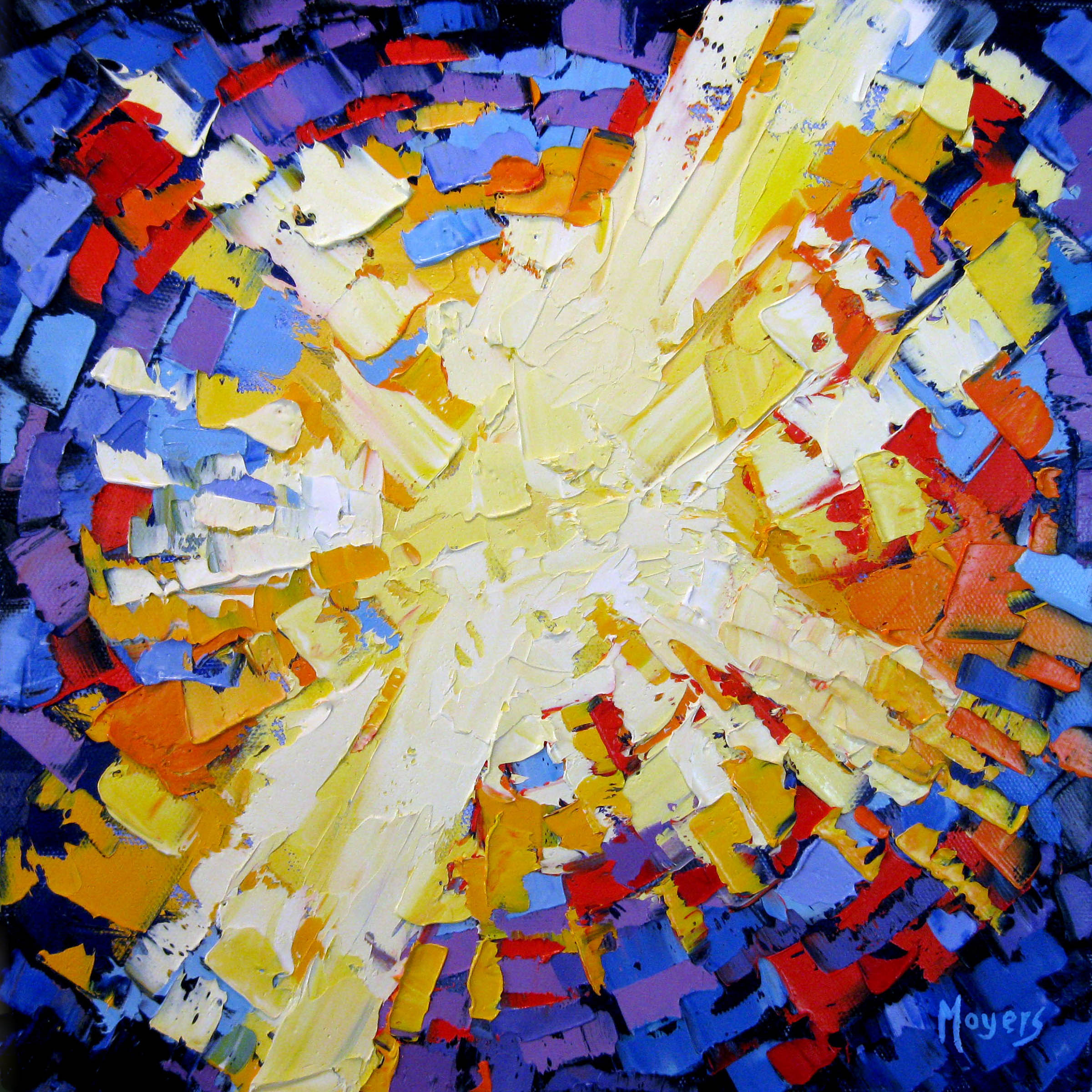
The image is Awake My Soul by Mike Moyers, from Art in the Christian Tradition, a project of the Vanderbilt Divinity Library, Nashville, TN. https://diglib.library.vanderbilt.edu/act-imagelink.pl?RC=57138 [retrieved January 5, 2023]. Original source: Mike Moyers, https://www.mikemoyersfineart.com/.

Mary Silent

“Now the birth of Jesus the Messiah took place in this way. When his mother Mary had been engaged to Joseph, but before they lived together, she was found to be with child from the Holy Spirit.” – Matthew 1:18

What should I, could I say?
His mind had closed. His ears had stopped.
No words I’d say would sway him.
What could I, should I say?

I tried; you know I tried.
I knew the difficulty of belief,
e’en with the confirmation of by body –
What could I, should I say?

He stomped away. I knew
that, unbelieved, I’d be
abandoned – quietly but sure.
What could I, should I say?

The very morrow he returned
much chastened by a dream.
It’s nice to be believed, I said.
What could I, should I say?

But Joseph, damn your faith
in dreams of angels, but refusal
to believe the one who loves you.
What could I, should I say?

And Matthew, you whose pen
could not record a single word
of mine, I wish you’d learned from Luke.
What could I, should I say?

So silenced, I rely upon the child
I bore to speak the words
I spoke to him, and which he magnified.
What could I, should I say?

He spoke of liberation and
he spoke of resurrection and
he spoke of God’s triumphant day.
So can I, must I say.

Author’s note: Matthew did not quote Joseph in his Gospel, either – but Joseph takes all the initiative and makes all the decisions which carry the Holy Family from Bethlehem to Egypt to Nazareth.

A poem/prayer based on Matthew 1:18-25, the Revised Common Lectionary Gospel Reading for Year A, Fourth Sunday of Advent.

Illustration of Joseph dreaming and Mary reading, woodcut attributed to the Second Master of Delft (ca. 1480-1503). Digital image by Rijksmuseum – http://hdl.handle.net/10934/RM0001.COLLECT.35552, CC0, https://commons.wikimedia.org/w/index.php?curid=84341678.

What We’re Waiting For

When John heard in prison what the Messiah was doing, he sent word by his disciples and said to him, “Are you the one who is to come, or are we to wait for another?” – Matthew 11:2-3

The clarity that comes with voices in
the clouds soon fades. The vibrant colors of
the golden sun, the azure river, and
the argent billows in the air transmute
to foggy grey as time saps confidence.
So ask the question, John, as well you may:
“Are you the One? Or must we wait to see
One you proclaim as I once proclaimed you?”

With you I bend my ear to the reply:
Look well, stern messenger of God. The ones
who could not see now see. The ones who could
not hear now hear. The ones who, ill, had lost
community and home have been restored.
The poor are cheered to hear good news proclaimed.

And so we see, and so we hear, dear John
the Baptist (caught in Herod’s snares), that one
has come to claim anointing by the One,
and not to seize a throne, or start a war,
or set himself apart from us. He’s come
to heal. He’s come to preach. He’s come to bring
us freedom from the cradle to beyond
the grave – a life for you, dear John, and me.

A poem/prayer based on Matthew 11:2-11, the Revised Common Lectionary Gospel Reading for Year A, Third Sunday of Advent.

The image is John the Baptist Thrown into Prison from Le Mont Ste. Odile, Alsace, by © Jörgens.mi/wikipedia, CC BY-SA 3.0, https://commons.wikimedia.org/w/index.php?curid=31709349.

Inconvenient Baptism

“…they were baptized by [John] in the river Jordan, confessing their sins.” – Matthew 3:6

Ah, baptist at the riverbank, I come
to seek the power of the cleansing touch
of water and of Spirit and of fire.
Anneal my harrowed soul. Your words have burned
their way into my heart and mind and I
do not forget. Who warned me, John? Well, you.
You with your party-breaking summons to
the realization – hardly new but strong
in its familiarity – that I
have not kept steadily the prophet’s road,
which is not straight, not even close, but winds
through thickets and through thorns like serpent’s teeth.

I wanted, baptist, to step quietly
into the muddy waters, duck my head
in quick and studied piety, then stand
and melt into my ordinary life
once more as surely as the water dried
upon my skin. The water I might thus
ignore, but not your harshly calling voice.
I shiver and I listen and I plan:
to learn and follow, learn and follow, learn
and follow Christ more faithfully today.

A poem/prayer based on Matthew 3:1-12, the Revised Common Lectionary Gospel Reading for Year A, Second Sunday of Advent.

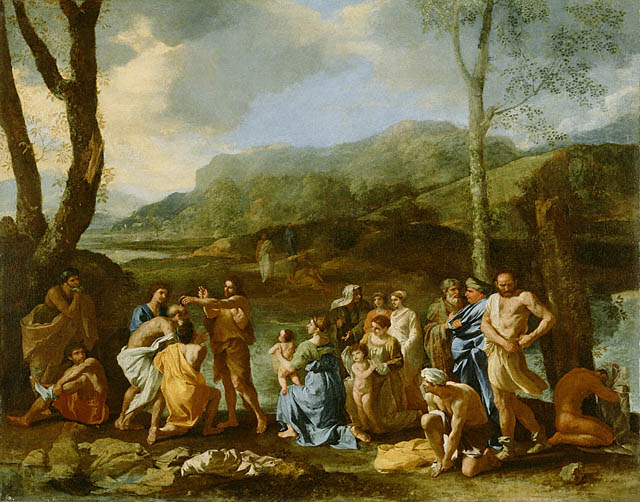
The image is Saint Jean baptisant sur les bords du Jourdain by Nicolas Poussin (ca. 1630) – Notice sur le site du Getty, Public Domain, https://commons.wikimedia.org/w/index.php?curid=15387068.

Fragile Stones

When some were speaking about the temple, how it was adorned with beautiful stones and gifts dedicated to God, [Jesus] said, ‘As for these things that you see, the days will come when not one stone will be left upon another; all will be thrown down.'” – Luke 21:5-6

The flagstones and terraces, walls and pillars,
the walkways and courtyards, collonades and shrines.
Oh, look where the peak of the roof glows at sunset!
Oh, look how the glory of God has been housed.

The stones seem so durable, set and enduring,
but Jesus in sadness announces their fall.
Eternity’s structures are not built with masonry.
Instead, they are built on the soul.

It has been many days since I stood by the ocean
and watched while this island expanded its shores.
Incarnadine tendrils, dulling to sable,
forming a delta of newly poured stone.

And that delta has vanished. It broke
and it crumbled. The rocks of the ages
could be counted in days. Since then new eruptions
have fashioned the coastline anew and anew and anew.

Stone poured upon stone, broken to sand.
Stone stacked upon stone – by human hands.
They come and they go, they bloom and they fade –
But oh, what glory that these things should be.

Fragile stones, enduring for centuries,
collapsing in days, wrecked by malice,
swept away by the sea. Fragile stones that stand for a moment:
But oh, what glory that these things should be.

A poem/prayer based on Luke 21:5-19, the Revised Common Lectionary Gospel Reading for Year C, Proper 28 (33).

Photo of the 2016 ocean entry in Kamokuna by Eric Anderson.

Tell Us Another Story

[The Sadducees asked,] “Now there were seven brothers; the first married, and died childless; then the second and the third married her, and so in the same way all seven died childless. Finally the woman also died. In the resurrection, therefore, whose wife will the woman be? For the seven had married her.” – Luke 20:29-33

Tell us another story, Jesus.

Tell us a story in which a woman is valued
for what she brings and makes, and not
because she bears a child to be the heir
to one whom death has claimed.

Tell us a story in which a woman is treasured
and housed and clothed and nourished
because she is a child of God, and not
because she is a womb for children.

Tell us a story in which a woman determines
her home, her work, her speech, her course,
and does not submit her careful conclusions
to the random will of a man.

Tell us a story in which those thrust
to the margins in casual cruelty
rise strong in themselves, and claim their due place
as wealth and privilege wane.

Tell us a story of resurrection,
of life beyond these oppressing tears,
of dancing angels, of children of God,
of all who live and love in God’s sight.

Tell us another story, Jesus.

A poem/prayer based on Luke 20:27-38, the Revised Common Lectionary Gospel Reading for Year C, Proper 27 (32).

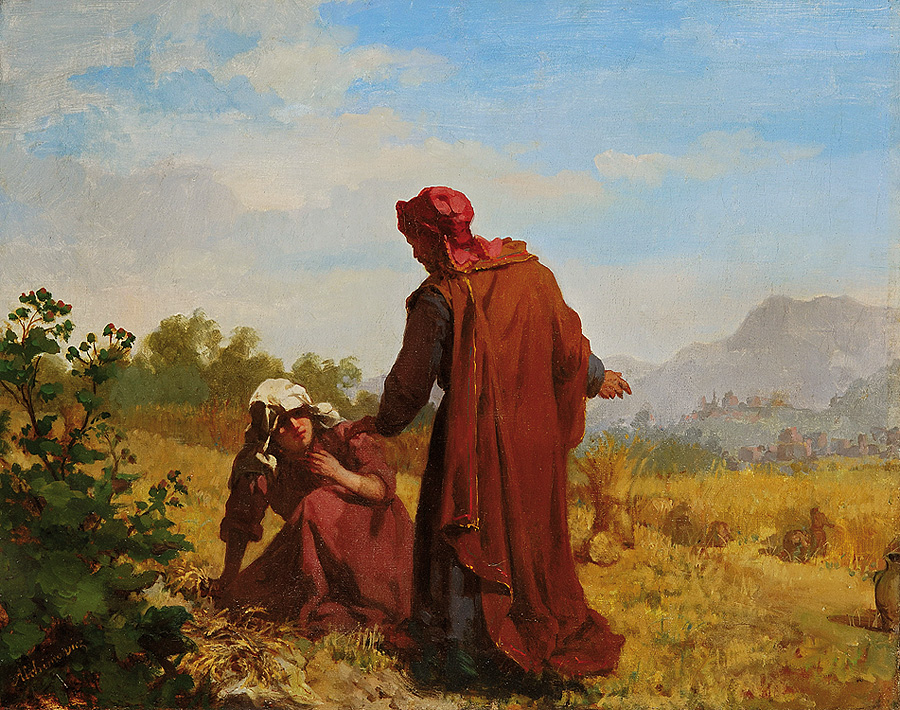
The image is Booz (Boaz) and Ruth Collecting Barley Ears by Kazimierz Alchimowicz – 1. AskArt2. AgraArt, Warsaw, 22.03.2009, lot 12529, Public Domain, https://commons.wikimedia.org/w/index.php?curid=19724130.

I highly recommend reading Maren Tirabassi’s poem on this text, “A few thoughts on Luke 20:27-38 for Día de los Muertos.” It redirected my thinking.

A Boast

“Therefore we ourselves boast of you among the churches of God for your steadfastness and faith during all your persecutions and the afflictions that you are enduring.” – 2 Thessalonians 1:4

Let me boast of the teacher
whose time in the classroom
was short, but whose time
to inspire was longer and glorious
and still… all too short.

Let me boast of the caretaker,
rarely at worship because of her charge,
but shining with spirit in every
encounter, aglow with affection
so clear in my memory.

Let me boast of the less-known,
forgotten, ignored,
whose passage of Earth left its light,
instead of the powerful, wretched indeed,
to leave us so broken in sorrow.

Let me boast of the saints.

A poem/prayer based on 2 Thessalonians 1:1-4, 11-12, the Revised Common Lectionary Second Reading for Year C, Proper 26 (31).

The image is The Forerunners of Christ with Saints and Martyrs by Fra Angelico (1420s) – Public Domain, https://commons.wikimedia.org/w/index.php?curid=3000363.