Nothing Will Be…

“For nothing will be impossible with God.” – Luke 1:37

I am content with ordinary miracles:
the way my day speeds up and slows
as down or up my foot puts pressure on
the accelerator pedal.

I am content with ordinary miracles:
the way I skip from isle to isle,
sometimes a-soaring o’er the sea,
sometimes with figures on a screen.

I am content with ordinary miracles
compressing space and time, compressing this
small planet into yet a smaller sphere,
connecting over oceans, over time.

I am content with ordinary miracles
that God concerns God’s self with women’s lives,
in resolute rejection of self-centered males,
unlikely to embrace a Savior.

I am content with ordinary miracles
so like the one in which a woman played
her necessary part, to bear and raise and love
a child, a sage, a Savior.

I am content with ordinary miracles
that mean my vision of the future with
its frights and fears and failings is,
most likely, wrong.

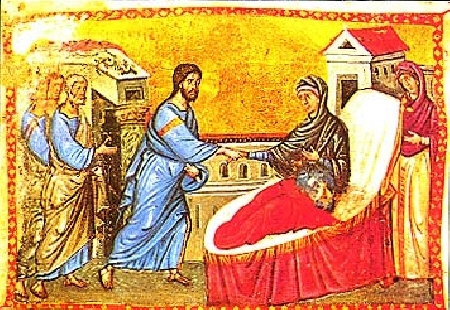
A poem/prayer based on Luke 1:26-38, the Revised Common Lectionary Alternate Psalm Reading for Year B, Fourth Sunday of Advent.

Mosaic of the Annunciation from the Cathedral of San Marco, Venice, by unknown author – http://azbyka.ru/forum/blog.php?b=1579, Public Domain, https://commons.wikimedia.org/w/index.php?curid=34067815.

Mary, Can We Talk?

Mary, can we talk?

You sang your magnifying song
in present tense, with “is” and “is”
relieved, just here and there, by a “has done.”
Did all this grace go by, or is it still to come?

For truly Mary, as your soul rejoices still,
and as a planet calls you blessed,
the generations still cry out for mercy and
relief from our unholy strife and greed.

The arrogant are scattered only in
imagination and in heart-felt hope.
The powerful are happy on their thrones;
the lowly wonder when they will be lifted up.

The hungry still are hungry while the rich
are filled with comfortable certainty.
A servant nation – any servant nation – shrouds
the light of love with its “my people first.”

So Mary, can we talk, unhindered by
the sobs and weeping of the world?
Can I obtain your voice of confidence
without the growth of grace within?

If not, then let me sit here at your feet
a while to shut my eyes and listen to
your song that magnifies the LORD
rejoicing in our God, our Savior.

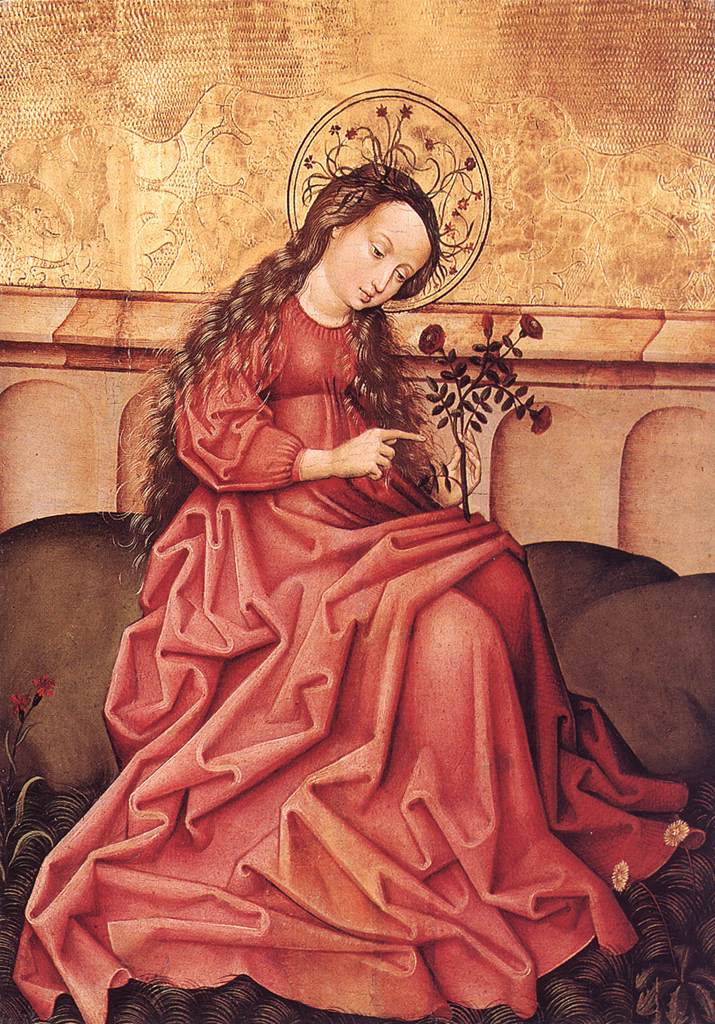
A poem/prayer based on Luke 1:46b-55, the Revised Common Lectionary Alternate Psalm Reading for Year B, Third Sunday of Advent.

The Virgin in the Garden by Unknown Master, German (active in 1490s in the Upper Rhineland) – Web Gallery of Art:   Image  Info about artwork, Public Domain, https://commons.wikimedia.org/w/index.php?curid=15465829.

Highway

“Make straight in the desert a highway for our God.” – Isaiah 40:3b

I hear the summons, Holy One, to lay aside
the poetry, the words and tunes, the voice,
and take up skills (I do not have) to build
a road, a path, a highway for your Way.

In my imagination, that highway would stream
across the plains into the setting sun
and I would squinting peer ahead
into the spreading light of glory.

My engineering skills, however, are more apt
to build a road that rolls and twists,
that dives precipitously down the hillsides, cracks
with perturbations of the Earth.

I am the grass, the flower of the field,
and with them I will grow and bloom,
then fall and fade. I cannot build a road
to match the word of God that stands forever.

A poem/prayer based on Isaiah 40;1-11, the Revised Common Lectionary First Reading for Year B, Second Sunday of Advent.

Photos by Eric Anderson.

Search for Your Sheep

Mauna Loa (where some sheep live).

Seek and you will find, O God.
(Who said that? You did, God, in Jesus.)
Seek and you will find, O God, and God:
Pray seek and search and find your sheep, O God.

Oh, we are lost. We are lost in fogs
of falsehood, lies, and gaslit speech.
Yes, we are lost in wealth’s allure
and power’s cravings – and we think we’re fine.

Yes, we are lost in understanding
what is great and what is craven bullying.
Are not the great hearts open to the world,
not walled into imaginary safety?

Yes, we are lost when shepherds seek their gain
and leave the sheep to sicken and to die,
reward the greedy with the choicest grass
and leave the thinner sheep unfed.

So, Holy One, pray save your flock, no more
to be the prey of ravishers. Yes, judge
between the shepherds and the sheep and sheep.
Feed us, one and all, with justice.

A poem/prayer based on Ezekiel 34:11-16, 20-24, the Revised Common Lectionary First Reading for Year A, Proper 29 (34), Reign of Christ Sunday.

Photo by Eric Anderson.

Where is the Palm of Deborah?

At that time Deborah, a prophetess, wife of Lappidoth, was judging Israel. She used to sit under the palm of Deborah between Ramah and Bethel in the hill country of Ephraim; and the Israelites came up to her for judgment. – Judges 4:1-7

It’s good to know, O God, the place that I could go for wisdom,
between the villages of Ramah and Bethel. Between “the height”
and “House of God,” why, yes, assuredly, is wisdom found.

Oh, let me find the palm of Deborah in days
when folly struts across the land, a Siren song
of foolishness which some dismiss and some embrace.

For folly is a foe of deadly consequence as ever were
the soldiers of King Jabin or his captain Sisera.
A quarter million deaths are close at hand.

Send us a woman of discernment such as Deborah,
a woman of quick courage such as Jael,
a woman to dispel the clouds of complementarianism.

Send us a woman, a figure of Wisdom, to speak:
and let the posturing of men
be left in history’s bin.

A poem/prayer based on Judges 4:1-7, the Revised Common Lectionary First Reading for Year A, Proper 28 (33).

Photo by Eric Anderson.

Oil Consumed

[The people said,] “Therefore we also will serve the LORD, for he is our God.” But Joshua said to the people, “You cannot serve the LORD, for he is a holy God.” (Joshua 24:18-19)

[Jesus said,] “The foolish said to the wise, ‘Give us some of your oil, for our lamps are going out.'” (Matthew 25:8)

My faithfulness is… erratic. Let’s get that right.
Strong in speech – sometimes.
Strong in action – well, it’s happened.
Strong in sustained endeavor… Um.

I’m cautious enough to carry extra oil
(batteries, cords, replacement lamps).
I’m aware enough to know the things
of human effort… tend to break.

I’m honest enough to look upon
my own faith practice with not
too much self-flagellation, not
too much contented self-approval.

I’m honest enough to see that as
I answer Joshua’s ageless question,
“Which God will you serve?” I am
likely to respond: “At this moment, me.”

In the next moment, though, I’ll say
with tears, “You have the words of life.
Who else should I follow? Who
to serve?” And then I’ll trim my lamp.

But…

In these days, I find, the lamp
is weighing less and less, the oil
level settling. The lamp still burns,
but for how long, O God? How long?

And where am I to find a store
of oil to replenish what I’ve saved,
and used, and burned? For light
is fleeting, and the night is long.

A poem/prayer based on Joshua 24:1-3a, 14-25 and Matthew 25:1-13, the Revised Common Lectionary First Reading and Gospel Reading for Year A, Proper 27 (32).

Photo by Eric Anderson.

Moses’ Seat

To be quite truthful, Jesus:
I cannot really claim to know
just what you meant by “Moses’ seat,”
and what you meant to say about
authority, interpretation of the law,
or representing God. For certain
we have called a host of people “Lord,”
or “Teacher,” “my Professor,” “Mom,” or “Dad.”

Whatever may be true about the Truth
Divine, how cloudy and obscured it is
when heard from human tongues or hands!
Just like a cosmic game of “Telephone”
in which the loss of clarity means life for some
and death for many more. But Jesus, we
have heard your words through intermediaries,
assembled generations after you had taught.

From you to eager followers who did not, I know,
take notes, from them to others who, perhaps,
would write a word or two, to others yet
who finally recorded what they heard on reeds,
on parchment, vellum, paper, with a press,
and on to me today reminding me once more
that greatness is the act of service,
and hubris is just asking to be tumbled into dust.

Once more my memory returns to a great soul,
who truly in her life embodied what you said
was great, whose smile was the mirror of her soul,
who sparked new life in all who saw her,
who heard her words, who knew with her such joy.
I’m sure she was a human, not a plaster saint,
because her passing pains me still, and woe, ye world,
that misappraises pride for what what is truly great.

Facing Faces

God: “…but my face shall not be seen.” (Exodus 33:23c)

Jesus: “Whose head is this…?” (Matthew 22:20b)

Faces clattering as coins descend
to bounce and roll across the counter;
faces whispering as fingers count
the bills, exchanging paper for some goods.

Faces flicker on the screen, three up
and three across to form a game
or set the stage for stories, echoed now
in tiny screens within a telephone.

Faces sheltered in the swaddling cloth
of masks, reducing by some meaningful
amount the risk of illness and of death
to me , to you, to those we love.

Faces twisted now by scorn and rage,
by privilege and power and by pique,
faces streaked with tears as faces
lacking breath are given to the earth.

Faces sighing from exhausting toil,
faces bright with gratitude for love,
faces furrowed with confusion,
faces that conceal the hearts within.

Each day I face the faces, Holy One
(if just the one that gazes from the glass),
and every day I long for one bright face,
O God, the one I cannot see and live.

Some day.

Some day.

A poem/prayer based on Exodus 32:12-23, the Revised Common Lectionary First Reading and Matthew 22:15-22, the Gospel Reading for Year A, Proper 24 (29).

The image is a denarius from the reign of Emperor Tiberius. Photographed by: York Museums Trust Staff – This file has been provided by York Museums Trust as part of a GLAMwiki partnership. This tag does not indicate the copyright status of the attached work. A normal copyright tag is still required. See Commons:Licensing., CC BY-SA 4.0, https://commons.wikimedia.org/w/index.php?curid=48143736.

If Only I Weren’t Distracted

Finally, beloved, whatever is true, whatever is honorable,

I used to call them “Squirrel Days,” O Jesus.
Before I moved here to this island without squirrels,
it was my tag for days when concentration
failed, when focus flailed, when even consciousness would fade.

whatever is just, whatever is pure,

It’s funny how the unimportant can assume
such prominence and even over what is right
before me. Who needs the phone to ring or text to buzz
when adolescent disappointments still possess me?

whatever is pleasing, whatever is commendable,

I cannot even concentrate upon the evils, cannot choose
which one is worst, which ones are worse, which ones
are dangerously proximate. Sufficient for this year
are evils, rages, suffering arising in a single day!

if there is any excellence and if there is anything worthy of praise,

Incarcerated children, children still not reunited with their parents,
refugees denied a hearing, tear gas fired at civilians,
a pandemic dismissed despite two hundred thousand graves,
a tax break for the rich and no relief for those now unemployed.

think about these things.

Oh, I’ll try to follow Paul’s advice, dear Jesus, but
I am… somewhat… distracted.

A poem/prayer based on Philippians 4:1-9, the Revised Common Lectionary Second Reading for Year A, Proper 23 (28).

Distracted photo by Eric Anderson.

Keeping Ten… Or Not

“All pay heed! The Lord! The Lord JEHOVAH, has given unto you these fifteen [Moses drops one tablet and it shatters] – Oy.

Ten! Ten Commandments for all to obey!” – Mel Brooks as Moses in History of the World Part I.

If you had given us fifteen commandments, God,
we would have kept them… even worse.

You shall have no other gods before me.

Except for wealth and power. Except for claiming
our self-righteousness. Except for comfort.
Except for what fulfills a moment or a day.

You shall not make for yourself an idol…

Except for units of exchange. Except for statues
celebrating history founded in illusion.
Except for pale-pigmented skin.

You shall not make wrongful use of the name of the LORD your god…

Except to justify oppression. Except to conjure up
Your favor of injustice. Except to claim
that wealth and power, even evil, are Your will.

Remember the sabbath day, and keep it holy.

Except for the essential workers. Except for those
we will not pay a living wage for their six working days.
Except for those at home we do not pay at all.

Honor your father and your mother…

Except for those the stresses of the world overwhelm.
Except for those whose errors are still lesser than their love.
Except for those we choose to lay aside.

You shall not murder.

Except for those we find a threat.
Except for those whose nations we oppose.
Except for those we fear.

You shall not commit adultery.

Except upon intense desire in a moment.
Except upon a disappointment with the spouse. Except
when something better comes along.

You shall not steal.

Except to maximize my profit over others’.
Except to minimize my workers’ compensation.
Except to claim Your work is mine.

You shall not bear false witness against your neighbor.

Except to emphasize my righteousness and power.
Except to render powerless the ones in opposition.
Except to maintain structures of oppression.

You shall not covet…

Except… every damn day.
Every damned day.
Every damnable day.

If you had given us fifteen commandments, God,
we would have kept the other five… even worse.

A poem/prayer based on Exodus 20:1-4, 7-9, 12-20, the Revised Common Lectionary First Reading for Year A, Proper 22 (27).

The photo “Broken stone” by smallcurio is licensed under CC BY 2.0.