All I Ask

[Jesus said,] “If in my name you ask me for anything, I will do it.” – John 14:14

I’m asking.

I’m asking for deliverance from a virus.
I’m asking for deliverance from all-encompassing folly.
I’m asking for deliverance from the demands of greed.
I’m asking for deliverance from injustice.

I’m asking.

I’m asking for deliverance from my loneliness.
I’m asking for deliverance from my narcissism.
I’m asking for deliverance from my burdens.
I’m asking for deliverance from my sin.

I’m asking.

I’m asking for deliverance from my grief.
I’m asking for deliverance of the world’s grief.
I’m asking for deliverance of the world’s violence.
I’m asking for deliverance from… it all.

I’m asking.

What say you, Jesus?
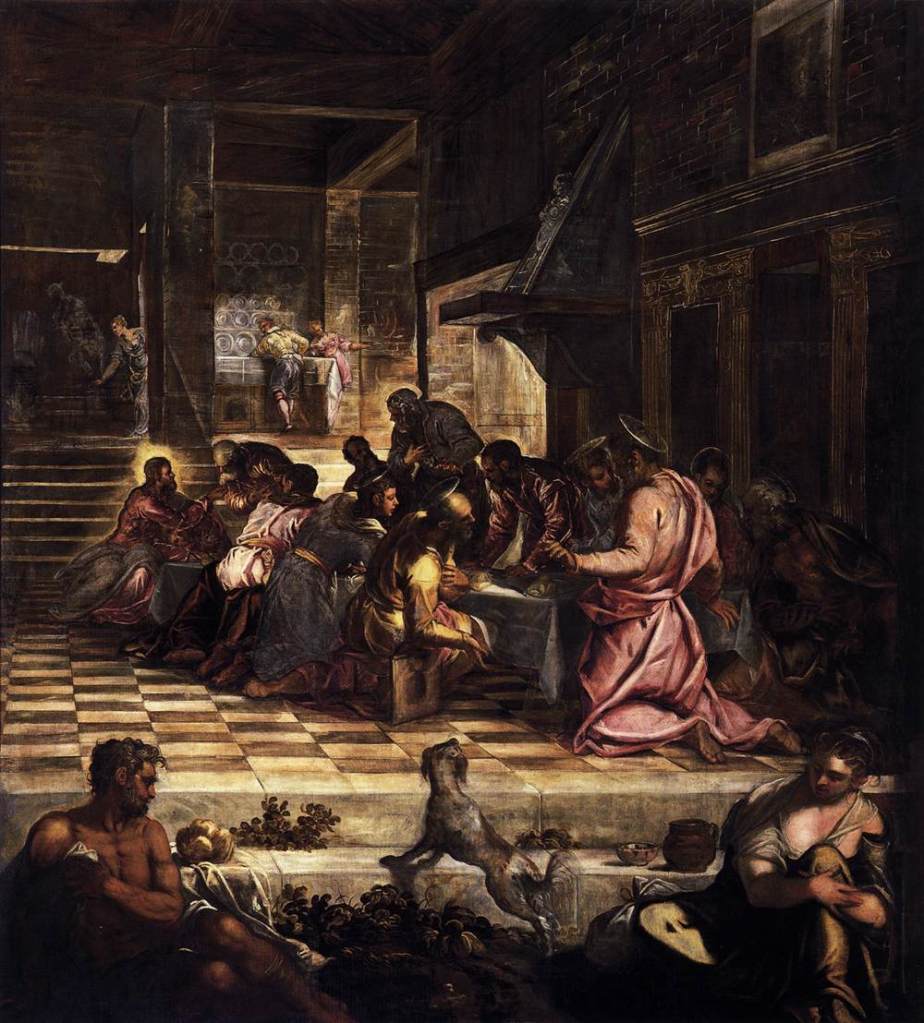
Shall we wait at this table until it comes to pass?
Here, at least, we have the bread to sustain us…
Except that it has not been broken yet in you.

A poem/prayer based on John 14:1-14, the Revised Common Lectionary Gospel Reading for Year A, fifth Sunday of Easter.

The image is The Last Supper by Jacopo Tintoretto – Web Gallery of Art:   Image  Info about artwork, Public Domain, https://commons.wikimedia.org/w/index.php?curid=15542032.

Reassure Me

It’s dark.

This is a valley of shadows.

This is a valley of death.

My grief and not my cup runs over.

Too many earthly shepherds flail
with rod and staff;
they maim and kill their flock,
and leave the predators untouched.

My enemies enjoy the feast
that I will never taste.

This is place from which I cry,
“De profudis clamavi ad te!”
“Mimma’amaqqim qeratika!”
“Mai loko o na wahi hohonu,
ua kahea aku au ia ‘oe!”
“Out of the depths I cry to you!”

Reassure me with your implements
of protection, Holy Shepherd,
for the night is long. I am afraid.
I turn my prayers to you.

A poem/prayer based on Psalm 23, the Revised Common Lectionary Psalm Reading for Year A, fourth Sunday of Easter, Good Shepherd Sunday.

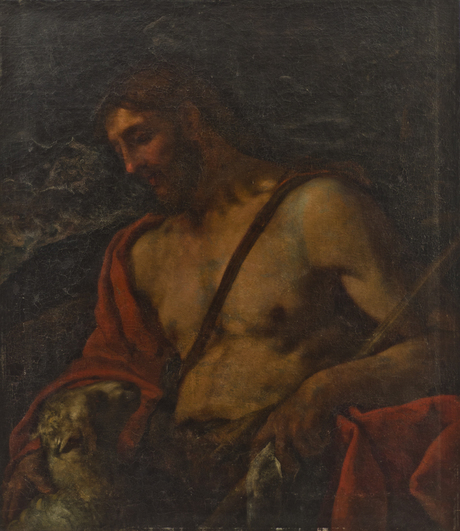
Image of The Good Shepherd by Luca Giordano – http://www.gallery.am/hy/database/item/6772/, Public Domain, https://commons.wikimedia.org/w/index.php?curid=20019538.

Untasted

The truth is that I’m pretty hungry now.
This walk from city to Emmaus has
been tiring, more than any walk I can
remember, since my heart is wrapped in grief
and fear because, you know, you’re dead and gone
and I refused to take much comfort from
the words the women shared (is it because
they’re women, now, I ask “enlightened” me?).

So I am famished when I sit to eat
with you (the you I do not recognize)
and my companion (oops, whose name I have
forgotten to report to history).
Can we get to it now? Just break the bread
and share it round, replenish my depleted
stores of stamina and strength of mind.
I’ll wait. You break. Then we can eat in peace.

Now hours and miles later, gasping with
the sweet exhaustion of a joy-filled run,
I find that you have traveled swifter yet
than I, to share the miracle of your
renewed and resurrected life. I share
the wonder that “The Lord has risen indeed;”
because I left the bread untasted on
the table when the Lord appeared to me.

A poem/prayer based on Luke 24:13-35, the Revised Common Lectionary Gospel Reading for Year A, third Sunday of Easter.

Image by RvdWeyer – Own work, CC BY-SA 3.0, https://commons.wikimedia.org/w/index.php?curid=27519876.

Untouched

[Thomas] said to them, “Unless I… put my finger in the mark of the nails and my hand in his side, I will not believe.” – John 20:25

I don’t want to make this a condition
of belief, my Friend. I don’t want
to make this a condition
of relationship; oh, no.

But.

While I don’t desire so to place
my finger on or in your wounds,
I crave in separation time your touch,
A hand, a breath, a deep embrace.

Just that.

So great a thing as that.

A poem/prayer based on John 20:19-31, the Revised Common Lectionary Gospel Reading for Year A, second Sunday of Easter.

The image is The Incredulity of Saint Thomas by Caravaggio – http://www.christusrex.org/www2/art/images/carav10.jpg, Public Domain, https://commons.wikimedia.org/w/index.php?curid=6804893.

Holy Week 2020: Easter Sunday

This is, perhaps, my way of emulating
your three days away, to let a silence
fall between a midday and a morn, to
wait and see if resurrection lifts the weary
bones once more, restores connections,
grants the boon of inspiration.

Perhaps.

But truth to tell, my risen friend,
I yearn much more that you would speak
to me and all the weary world
as you addressed your friends that night
behind the fast-closed door. Come wish me peace,
dear Jesus. Come and wish us peace.

A poem/prayer based on John 20:1-18 the Revised Common Lectionary Gospel Reading for Year A, Easter Sunday.

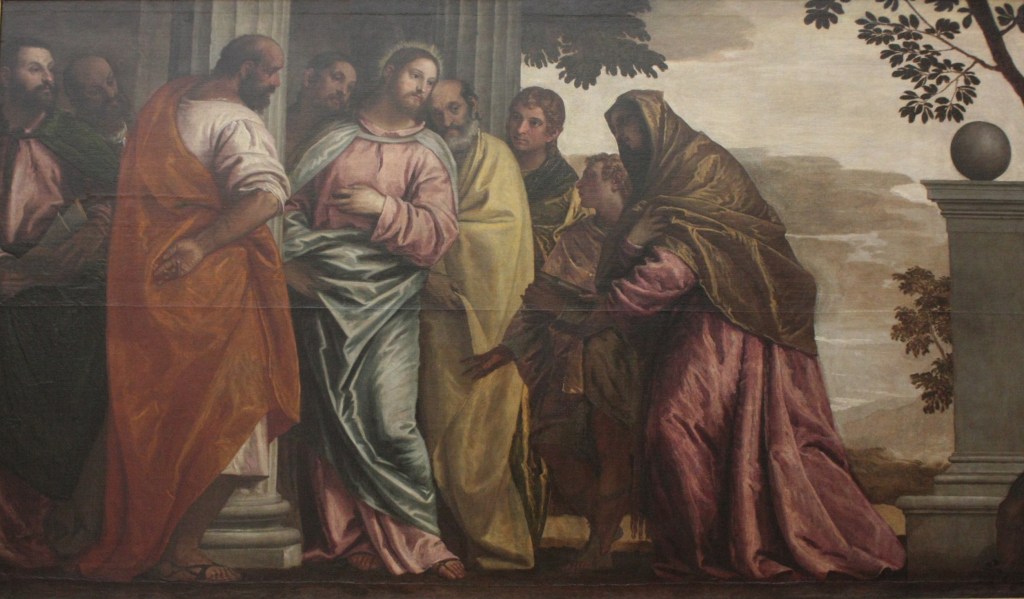
Image of Christ greeting his disciples by Duccio di Buoninsegna – http://www.wga.hu/frames-e.html?/html/d/duccio/buoninse/index.html, Public Domain, https://commons.wikimedia.org/w/index.php?curid=3925674.

Go into the Village

Jesus sent two disciples, saying to them, “Go into the village ahead of you, and immediately you will find a donkey tied…”

Send me into the village, Jesus.
I’d really like something useful to do.
Hanging around you lately
has been something of a strain.

First we had those children bugging you –
well, us – and then you missed
the perfect chance to call a
wealthy ruler as disciple.

You might have promised we would have
a seat of power in glory, but…
we’re mighty low on dinners, Lord.
I’d even eat a camel.

I’m also less than charmed to hear
that God is like the sorriest
employer ever known, who pays
all workers just the same.

And then, sweet Jesus, you would go
and say that we are on our way
into this city so that we can watch
you die. I just can’t even.

So give me something useful I can do.
Amidst the cheers and hollers,
above the leafy carpet,
I still hear your words to James and John:

“You will indeed drink my cup.”

Ah, Jesus.

You didn’t mean a royal chalice, did you?

A poem/prayer based on Matthew 21:1-11, the Revised Common Lectionary First Reading for Year A, Palm Sunday.

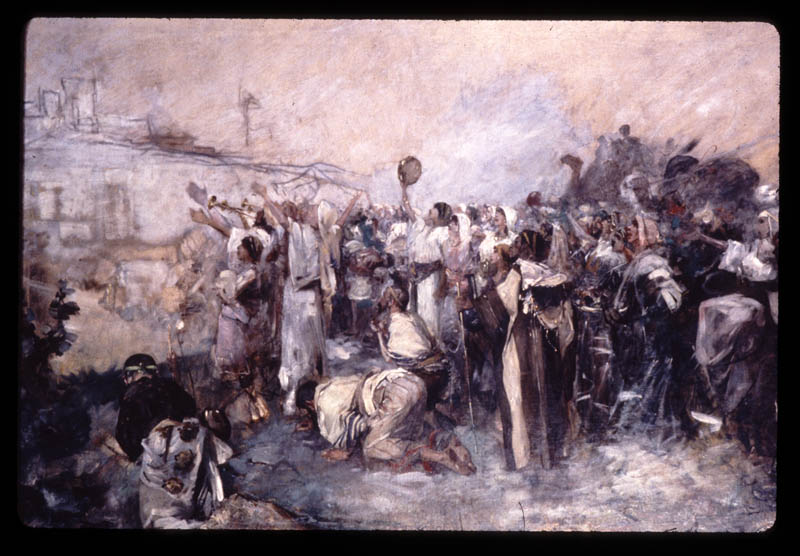
Painting by Lars Wikström/Ryttare (1800–1865) – Biblia Dalecarlica 1965, målat av Lars Ryttare 1830., Public Domain, https://commons.wikimedia.org/w/index.php?curid=6823191.

Prophesy to the Bones

Ezekiel once stood upon the city wall.
He stood, he gazed. I’m sure he wept.
For on that day he saw an army
terrible and merciless. It filled the valley,
all the valleys, that encircle Zion.
He stood. He gazed. I’m sure he wept.

When You showed him all those desiccated bones,
O God, what fashion did the valley take
in his imagination? Kidron?
The Outer Valley? Or Gehenna?
Or had You mercy enough to make it look
like a Babylonian valley spanned with gardens?

I doubt it mattered. Ezekiel wept, I’m sure,
upon the wall. I’m sure he wept the see
even an unfamiliar valley overflowing
with the dead. Bones so dry, dry as dust,
unmoistened even by the flood of tears
of a priest and prophet’s grief.

Command me, Holy One, to prophesy
and promise to the dusty bones that they
shall live again. Command me, Holy One,
to summon up the spirit breath to bind
with sinew all these bones. For then shall I
appreciate the salt of joyful tears.

A poem/prayer based on Ezekiel 37:1-14, the Revised Common Lectionary First Reading for Year A, Fifth Sunday in Lent.

Photo of a detail of the Knesset Menorah in Jerusalem by Deror avi – Own work, CC BY-SA 3.0, https://commons.wikimedia.org/w/index.php?curid=4085158.

No Explanation; No Blame

His disciples asked him, “Rabbi, who sinned, this man or his parents, that he was born blind?” (John 9:2)

All you need do, Redeemer, is explain.
Explain the suffering, the illness, the
dis-ease. Explain the disabilities,
ill fortunes, and abuse. Explain it all
so we may know the cause, the source, the blame.

In truth, we are less interested to see
the sufferer healed. We gain a measure of
self-satisfaction in our judgments, yes?
And leave the sad afflicted in the sad
result of “their own failed and sorry lives.”

But you, Redeemer, will not settle for
the sadness of our satisfaction. You
insist that we lay down our judgment, hear
the voices we would silence. You insist
we act as healers in the suffering world.

May we take your direction in this time:

[Jesus said] to him, “Go, wash…” (from John 9:7)

A poem/prayer based on John 9:1-41, the Revised Common Lectionary Gospel Reading for Year A, Fourth Sunday in Lent.

The image is Le aveugle-né se lave à la piscine de Siloë (The Blind Man Washes in the Pool of Siloam) by James Tissot – Online Collection of Brooklyn Museum; Photo: Brooklyn Museum, 2008, 00.159.173_PS2.jpg, Public Domain, https://commons.wikimedia.org/w/index.php?curid=10957455.

Sir, I See

Faster than a speeding teacher,
more focused than a paralytic healed,
more attentive than a crowd full of dinner:
Look! By the well! It’s a foreigner!
It’s a woman! It’s…
Me!

Could it be me, dear Jesus, so to grasp my thirst
so earnestly, so honestly,
to hold it up before you in its naked need?
Could it be me to have you take so seriously
all my urgent questions, still to leave me
speeding house to house, in all my
comic-fictive strength, inviting:

“Come and see! For I’ve been known
in strength and weakness, height and depth.
Come and see! For only you (and you and you)
and I together can determine once for all:
Could this One truly be the Christ?”

Could it be me?

A poem/prayer based on John 4:5-42, the Revised Common Lectionary Gospel Reading for Year A, Third Sunday in Lent.

Photo of a mosaic in Sant’Appolinare Nuovo in Ravenna, Italy, by © José Luiz Bernardes Ribeiro, CC BY-SA 4.0, https://commons.wikimedia.org/w/index.php?curid=52650776.

Hold the Complexity

I asked the Holy One, not once but time
and time again, to tell me what is first
and prime. The sound of silence breathed to me,
“Grace. Grace is first, and last, and everything.”

I might have raised a voice in protest to
the silent breath, to claim the privilege
of suffering for faith, through faith, in faith.
“Grace. Grace is first, and last, and everything.”

Have I not traveled farther in my span
of years than Abraham in his? Might I
not claim the mantle of such righteousness?
“Grace. Grace is first, and last, and everything.”

But breathed the silent syllables: “Did you
devise yourself, beloved child? Did you
create the feet you set upon the road?
Grace. Grace is first, and last, and everything.”

Blessed be the Holy One who makes to be
the things that were and things that have not been.
Blessed be the One whose sound of silence breathes:
“Grace. Grace is first, and last, and everything.”

A poem/prayer based on Romans 4:1-5, 13-17, the Revised Common Lectionary Second Reading for Year A, Second Sunday in Lent.

Photo by Eric Anderson.