Story: The ‘Io and the ‘Amakihi

November 10, 2024

Ruth 3:1-5, 4:13-17
Mark 12:38-44

There is a lot to learn when you’re a young bird. Or a young human, of course. But this story is about a young bird.

He was an ‘amakihi, and he’d hatched, fledged, and flown. He’d toured around with a little flock of various forest birds, and he’d seen plenty of sunrises and sunsets. All in all, he thought he was pretty wise.

Then he saw a creature he hadn’t seen before. It was big. It was impressive. It soared along in the air on broad wings. He watched it from an ohi’a branch with awe. Such presence. Such grace. Such magnificence. Such size.

To his surprise, it landed in a neighboring tree, where it seemed to rest.

“What are you?” asked the young ‘amakihi.

“I’m an ‘io,” said the big bird. “Haven’t you heard about me?”

In truth, the young ‘amakihi had been told about the ‘io, but he hadn’t been paying attention. These things happen sometimes, have you noticed?

“I can’t remember hearing anything about you,” said the ‘amakihi with some truth. “What are you like?”

“Oh, I’m a very friendly bird,” said the ‘io. “I fly around overhead and watch out for all the other birds in the forest. All the birds are safe when I’m around.”

“That’s really great,” said the young ‘amakihi. “And what do you eat?”

“Oh, this and that,” said the ‘io. “Kind of like yourself.”

“You mean, bugs and nectar and fruit?”

“Kind of like that,” said the ‘io.

“I’m a little hungry myself,” said the ‘amakihi, “and this tree has been pretty well picked over. If you don’t mind I’ll see you later.”

“That’s fine,” said the ‘io, who fortunately for the young ‘amakihi wasn’t hungry at the moment. “I’ll catch you later.”

The ‘amakihi flew off, and the ‘io didn’t chase him, fortunately. A little later he found his grandmother, and told her about the bird he’d just met.

“The ‘io told you he protects the other birds?” said his Tutu.

“Oh, yes,” said her grandson.

“Don’t you remember what your mother and father said about the ‘io?” asked his grandmother sternly.

“I’m afraid I don’t,” said the young ‘amakhi. “I may not have been listening all that well.”

“That wasn’t a good time to not listen,” she said. “Didn’t you notice the ‘io’s beak, and the talons on his feet? Do you think those are good for eating bugs and nectar?”
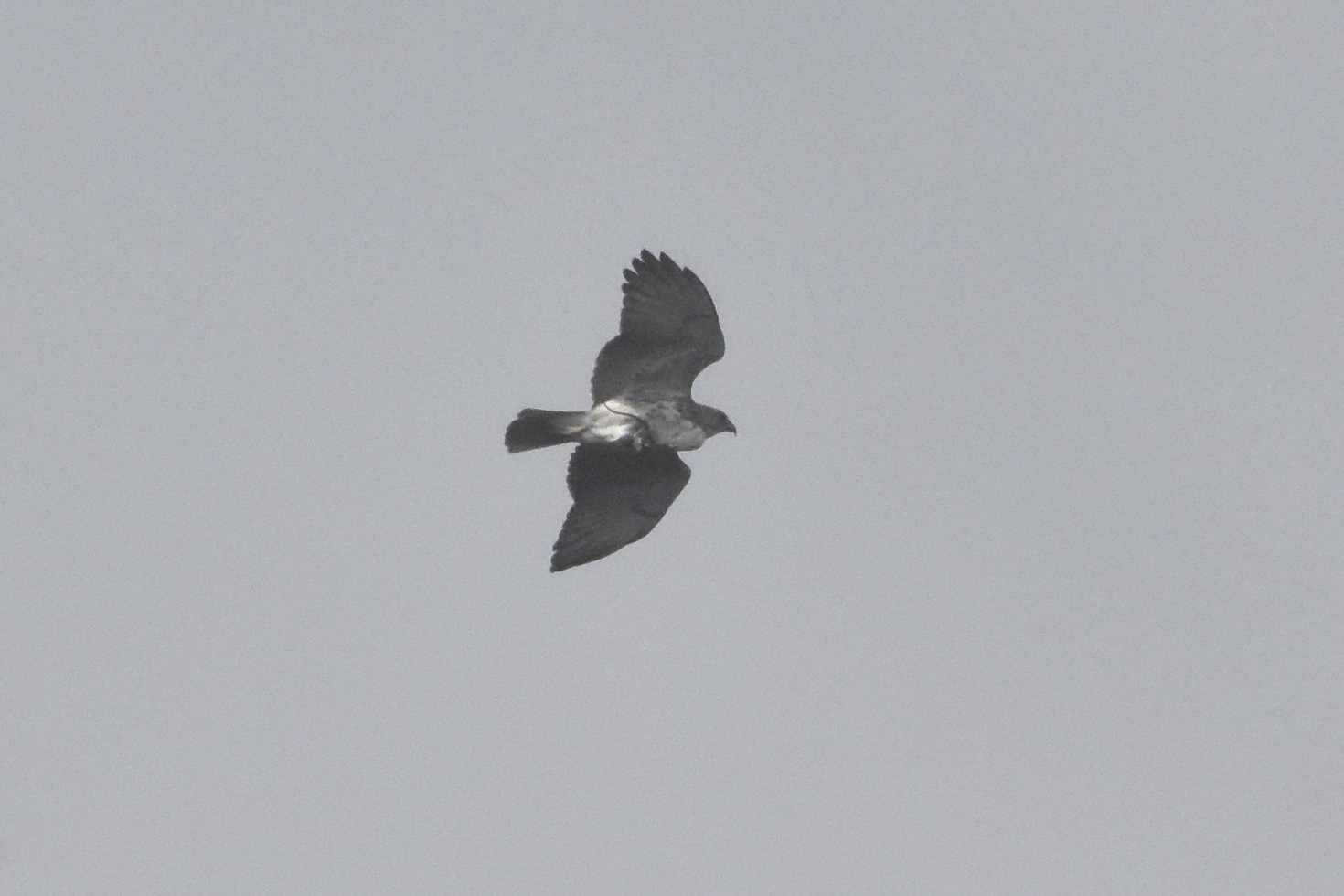
And she told him what an ‘io eats. He was horrified and pretty surprised that he’d survived that conversation.

“Those who are danger to you won’t always tell you so,” said Tutu. “Sometimes they’ll lie about it. Listen to the warnings of those who love you. We may not always be right, but we will always tell you what we know and what we believe we know.

“And keep an eye out for those ‘io.”

by Eric Anderson

Watch the Recorded Story

I write these stories in advance, and I tell them from memory during Sunday worship. Therefore, the story you’ve just read will likely differ from the story as I told it.

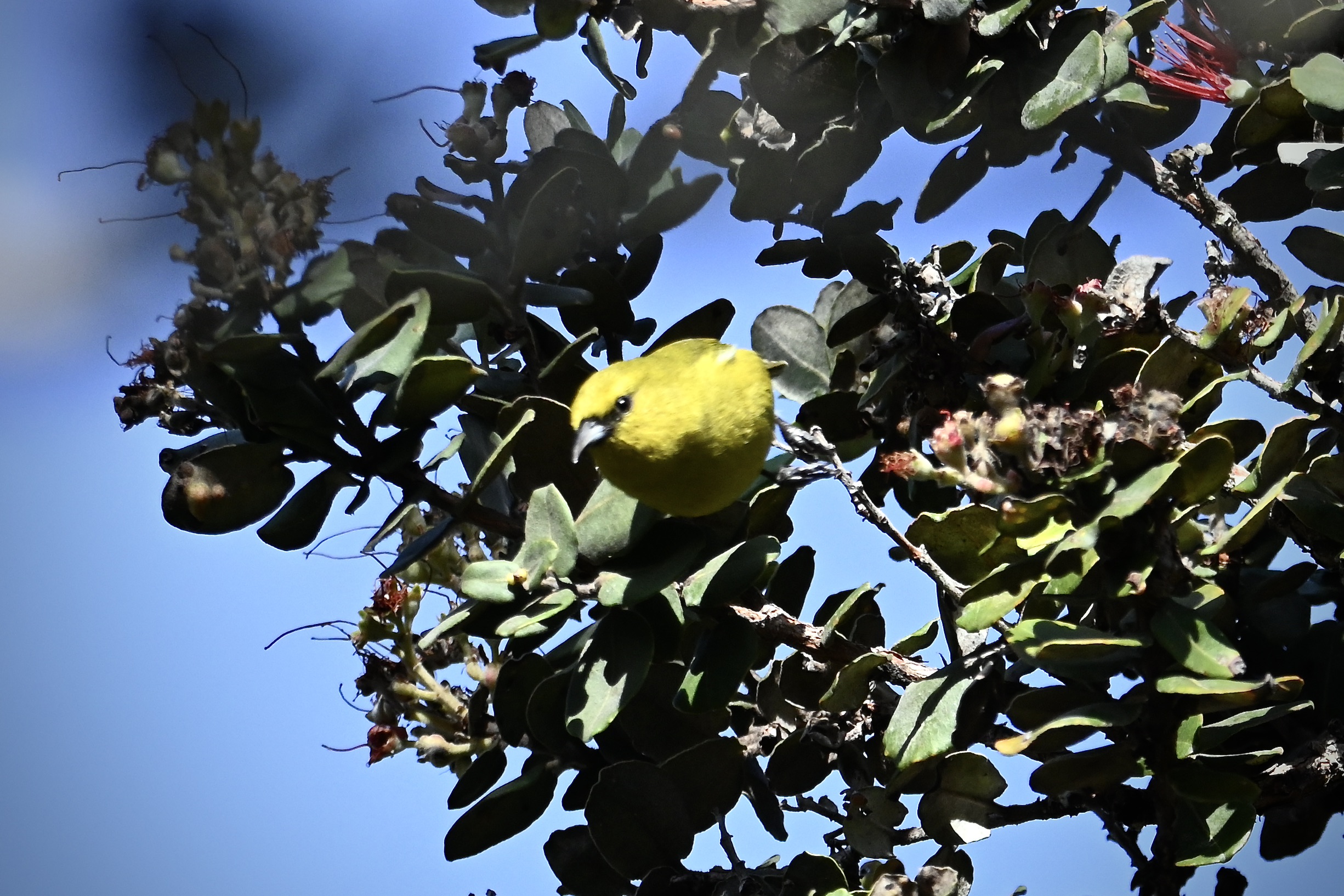
Photos of an ‘amakihi (top) and an ‘io (smaller photo on right) by Eric Anderson.
Story: Attempt to Deceive

May 12, 2024

Acts 1:15-17, 21-26
John 17:6-19

As I’ve said before, the ‘amakihi likes to eat lots of different things. I think it’s fair to say that the ‘amakihi likes to eat, and fortunately for the ‘amakihi, it has a wide range to its taste. Nectar is always good, and so are bugs and spiders, caterpillars, tree sap, fruits and berries. It will even eat pollen sometimes, which people with pollen allergies will find truly mysterious and a little uncomfortable.

But there was one ‘amakihi who didn’t eat nectar from ohi’a trees.

If that seems weird to you, it seems weird to me, too. There are a lot of ohi’a trees on the mountain slopes, and they have a lot of flowers. It’s a great food source for ‘amakihi and ‘apapane and ‘akepa and lots of birds up there. They’d happily perch near those flower clusters and merrily feed on the nectar while this one ‘amakihi watched.

He watched, and he felt sorry for them.

“Poor birds,” he told himself, “to be so desperately hungry that they’ll feed on ohi’a. I feel really sorry for them.”

Why, you ask, did he feel sorry for them, eating ohi’a nectar? Well, I’m afraid it’s because one day when he was young, and before he’d actually sampled any ohi’a nectar, he perched near an i’iwi. I’iwi can be kind of mean sometimes, and they will chase ‘amakihi away from a tree they want to feed at. This i’iwi, however, was feeling rather full and didn’t want to get up off his perch and chase this young ‘amakihi away. He decided to try words instead.

“Planning to feed at this tree?” he asked the young ‘amakihi.

“Oh, yes, uncle,” said the ‘amakihi. I’m afraid the i’iwi wasn’t happy to be called “uncle” by an ‘amakihi.

“You should search somewhere else if you want something good,” said the i’iwi. “This is a bad tree.”

“Ohi’a is bad?” said the young ‘amakihi.

“I’m afraid so,” said the i’iwi. “The nectar is sour, except when it’s bitter. When it gets old, it’s really bad. It will keep a bird going, of course, but nobody eats ohi’a nectar until they’re desperate.”

“Really?” said the ‘amakihi.

“Really,” said the i’iwi. “You can trust me. Go find something else you’ll like better. I’m sure it will be better for you, too.”

Misled by the i’iwi, the ‘amakihi avoided ohi’a from that day on. Eventually his mother noticed, and he told her the story.

“So one i’iwi told you this story, and you never checked it with anyone else, or tried ohi’a yourself?” she asked him in surprise, “even when so many other birds eat its nectar every day without signs of complaint?” Put that way, it did sound a little odd.

“Come along, son,” said Mother firmly. “You need to try what you’ve been avoiding, and see what you think yourself.”

Of course he found it delicious, which was a good thing to learn. But he also learned that some birds, and some people out there, will lie to you when it serves them, and sometimes you need to test their stories with the ones who love you and with your own experience, to learn the truth.

by Eric Anderson

Watch the Recorded Story

I write these stories ahead of time, then tell them from memory – well, lack of memory plus improvisation. The video does not match the text you’ve just read.

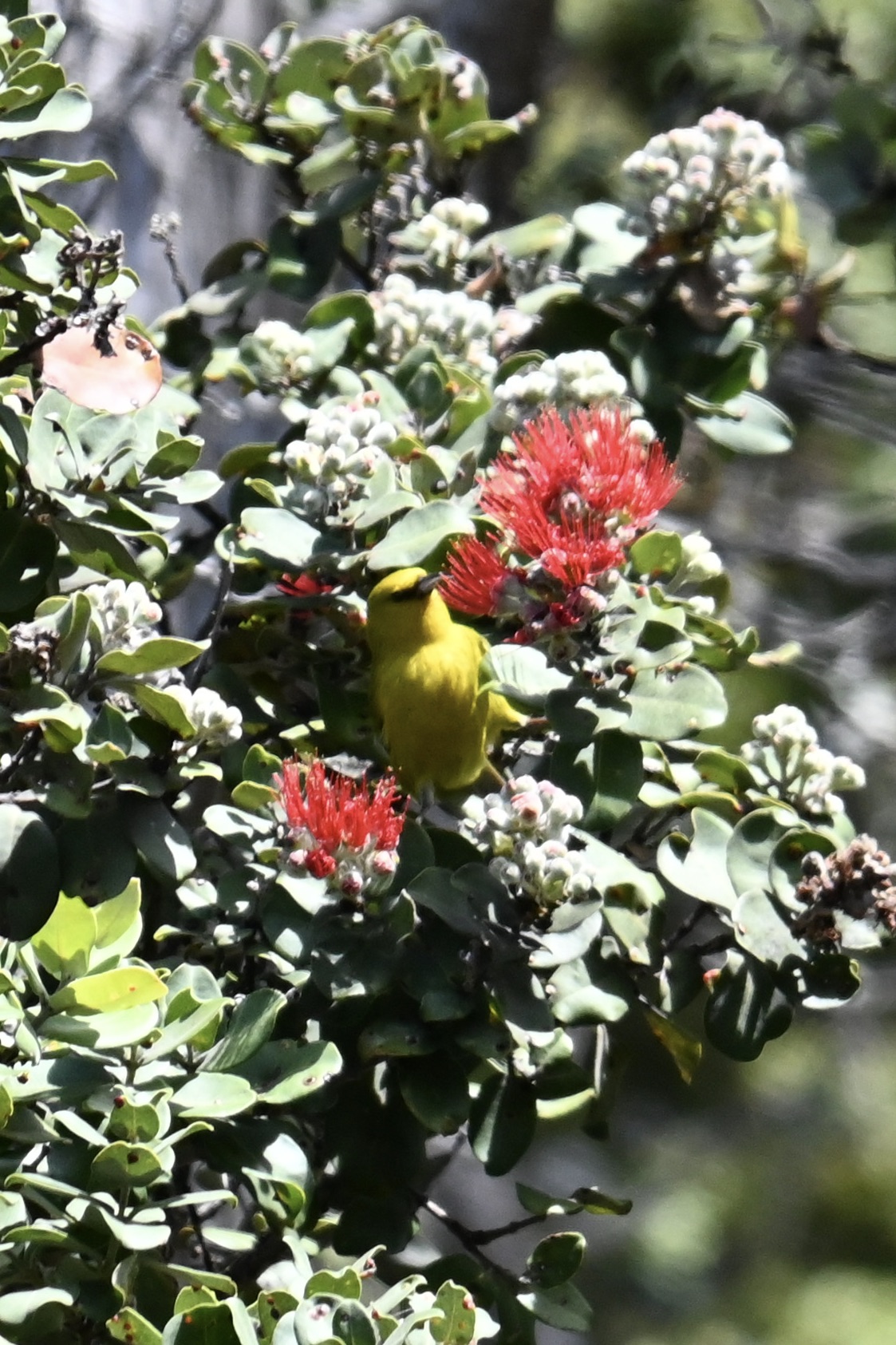
Photo of an ‘amakihi in the midst of ohi’a blossoms by Eric Anderson.

Story: The ‘Apapane Who Lied

July 30, 2023

Genesis 29:15-28
Romans 8:26-39

Generally, ‘apapane are pretty honest birds. They give warning calls when there’s danger near, they sing “Waiting for the rain to end” songs when it’s raining, and they sing “Oh, look what I’ve found!” songs when they’ve discovered a tree particularly rich in ohi’a blossoms.

One day an ‘apapane had a different idea. He had sung his “Waiting for the rain to end” song when it was cloudy, not raining, mostly because he was sure it was going to rain. Even though nothing ever fell from the sky, a number of birds, ‘apapane but also i’iwi and ‘amakihi, took shelter for a few minutes. It didn’t take long for them to come out again when the rain didn’t happen, but it started him thinking.

A day or two later he found a lovely ohi’a tree just dripping with nectar and already attracting a number of the bugs he liked to eat as well. He told some members of his family and a few close friends to wait for him in a certain spot, while he flew over to a place where there were trees with a few blossoms on them, but nothing like what he’d found on that one tree.

There, surrounded by mostly greenery, he sang his “Oh, look what I’ve found!” song.

When he heard wings approaching he flew off low to one side and circled back around to where his friends and family were.

“Somebody’s found something,” said his sister. “We should go see.”

“I just found something better,” he said. “Follow me.” And they did.

As a result, their little group of ‘apapane had quite some time enjoying the nectar-rich flowers before other birds discovered it – as a result, I should say, of them singing their own, “Oh, look what I found!” song.

He repeated the trick a few days later when he discovered another very nice tree, and about two days after that, and a couple days after that, and he was very pleased with himself.

He was caught, of course, and that was by his grandfather. There were rumors going about that some of these “Oh, look what I found!” songs seemed to be overly optimistic at best and downright deceptive at worst. Grandfather had perched at the top of a tall ohi’a and heard the early morning call from a group of trees he knew was pretty sparse for flowers. He looked for the flash of red and black wings, and when he spotted it, he followed. To his surprise, they led first to a little flock of his own family, and then to a tree that glowed red in the morning light.

As the birds fed, he perched next to his grandson. “Come,” he said, pointing to a neighboring tree. “We need to talk.”

When they both had landed on a branch with enough flowers for a breakfast that wasn’t nearly as extravagant as the other tree, the younger ‘apapane wanted to know what it was about.

“Grandson,” said the elder. “You’ve been lying.”

“Not to you, tutu,” protested the younger one. “Not to any of our family or my friends.”

“I appreciate that,” said grandfather, “but truth isn’t just for family or friends. Truth is for everyone.”

“What’s the harm?” demanded the grandson. “Everyone is getting fed. I haven’t prevented anyone from finding good trees. I mean, I haven’t driven anyone away.”

“You’ve misled them – and concealed that it was you doing it,” said grandfather.

“Well, sure. Because then they wouldn’t trust my song,” said the younger one, and that was when he realized.

“Because I wouldn’t be worthy of trust, would I?” he asked.

Grandfather said nothing.

“Because I haven’t been worthy of trust, have I?” he asked.

Grandfather and grandson sat quietly for a few moments.

“I’ll be worthy of trust, Tutu.”

“I know you will.”

by Eric Anderson

Watch the Recorded Story

I tell these stories from memory of what you’ve just read – without a manuscript or notes. Inevitably, it varies from the text I’ve prepared, as it does today.

Photo by Eric Anderson

Author’s note

I found myself with a real quandary in developing a story that comments on Genesis 29, a text with so much that just makes me stop and go, “That’s not right.” Bringing its themes to children (or even to adults) looked impossibly difficult. Finally I settled on one theme of Jacob’s saga, something that happens again and again to cause pain and distress to the people involved: deception and lies. Thus this story about lies and truth.

More Shrewd

Photo by Mohamed Rasheed Ahmed, used by permission.

I saw a photo once, a photo of three children.
One grinned a happy grin.
One wore the neutral look of child before a camera.
One’s eyes gazed into my soul.

I saw a photo once, a photo of three children,
“And these,” the speaker said,
“are children who will be homeless.”
Their island home is flanked by rising seas.

I saw a photo once, a photo of three children,
and that picture should have been enough,
the smile, the uncertainty, the soulful gaze
should have stopped us cold.

I saw a photo once, a photo of three children,
children whose homes will vanish due
to greed, to others’ comfort, and to lies.
Their truth overwhelmed in a wave of falsehood.

I saw a photo once, a photo of three children,
and I heard the voice of Jesus ask,
“How is it that the children of this age are shrewder
than the children of the light?”

“I see this photo, too, this photo of three children,
and I ask you, people, will you guard the wealth
of some and wreck the homes of many?
Are you less shrewd than these deceivers?”

I saw a photo once, a photo of three children,
children who will lose their homes to lies.
And I said to Jesus, “Yes. I am less shrewd.”
And wept.

A poem/prayer based on Luke 16:1-13, the Revised Common Lectionary Gospel reading for Year C, Proper 20.

The photo by Mohamed Rasheed Amed was shared by 350.org on their Flickr site under the Creative Commons license BY-NC-SA/2.0.