“…Let us approach with a true heart in full assurance of faith, with our hearts sprinkled clean from an evil conscience and our bodies washed with pure water.” – Hebrews 10:22
There are mornings when I revel in the water which cascades along my form and carries off the aggravating dust and clinging grime.
In likewise do I cast my grateful soul into refreshment of a loving God, who takes away the grunge, the guilt, the shame.
And then I step upon the shower mat, to towel off the residue of cleanliness, prepare to wrap my form in clothing for the day.
In likewise does my soul release forgiveness’ bliss, replenished to the work which lies ahead, and clothed (we hope) in righteousness’ array:
Provoking those around to love, to acts of doing good, to mercy shared, to meet and raise the courage of those souls who’d do the same.
A poem/prayer based on Mark 12:38-44, the Revised Common Lectionary Gospel Reading for Year B, Proper 27 (32).
There is a lot to learn when you’re a young bird. Or a young human, of course. But this story is about a young bird.
He was an ‘amakihi, and he’d hatched, fledged, and flown. He’d toured around with a little flock of various forest birds, and he’d seen plenty of sunrises and sunsets. All in all, he thought he was pretty wise.
Then he saw a creature he hadn’t seen before. It was big. It was impressive. It soared along in the air on broad wings. He watched it from an ohi’a branch with awe. Such presence. Such grace. Such magnificence. Such size.
To his surprise, it landed in a neighboring tree, where it seemed to rest.
“What are you?” asked the young ‘amakihi.
“I’m an ‘io,” said the big bird. “Haven’t you heard about me?”
In truth, the young ‘amakihi had been told about the ‘io, but he hadn’t been paying attention. These things happen sometimes, have you noticed?
“I can’t remember hearing anything about you,” said the ‘amakihi with some truth. “What are you like?”
“Oh, I’m a very friendly bird,” said the ‘io. “I fly around overhead and watch out for all the other birds in the forest. All the birds are safe when I’m around.”
“That’s really great,” said the young ‘amakihi. “And what do you eat?”
“Oh, this and that,” said the ‘io. “Kind of like yourself.”
“You mean, bugs and nectar and fruit?”
“Kind of like that,” said the ‘io.
“I’m a little hungry myself,” said the ‘amakihi, “and this tree has been pretty well picked over. If you don’t mind I’ll see you later.”
“That’s fine,” said the ‘io, who fortunately for the young ‘amakihi wasn’t hungry at the moment. “I’ll catch you later.”
The ‘amakihi flew off, and the ‘io didn’t chase him, fortunately. A little later he found his grandmother, and told her about the bird he’d just met.
“The ‘io told you he protects the other birds?” said his Tutu.
“Oh, yes,” said her grandson.
“Don’t you remember what your mother and father said about the ‘io?” asked his grandmother sternly.
“I’m afraid I don’t,” said the young ‘amakhi. “I may not have been listening all that well.”
“That wasn’t a good time to not listen,” she said. “Didn’t you notice the ‘io’s beak, and the talons on his feet? Do you think those are good for eating bugs and nectar?”
And she told him what an ‘io eats. He was horrified and pretty surprised that he’d survived that conversation.
“Those who are danger to you won’t always tell you so,” said Tutu. “Sometimes they’ll lie about it. Listen to the warnings of those who love you. We may not always be right, but we will always tell you what we know and what we believe we know.
“And keep an eye out for those ‘io.”
by Eric Anderson
Watch the Recorded Story
I write these stories in advance, and I tell them from memory during Sunday worship. Therefore, the story you’ve just read will likely differ from the story as I told it.
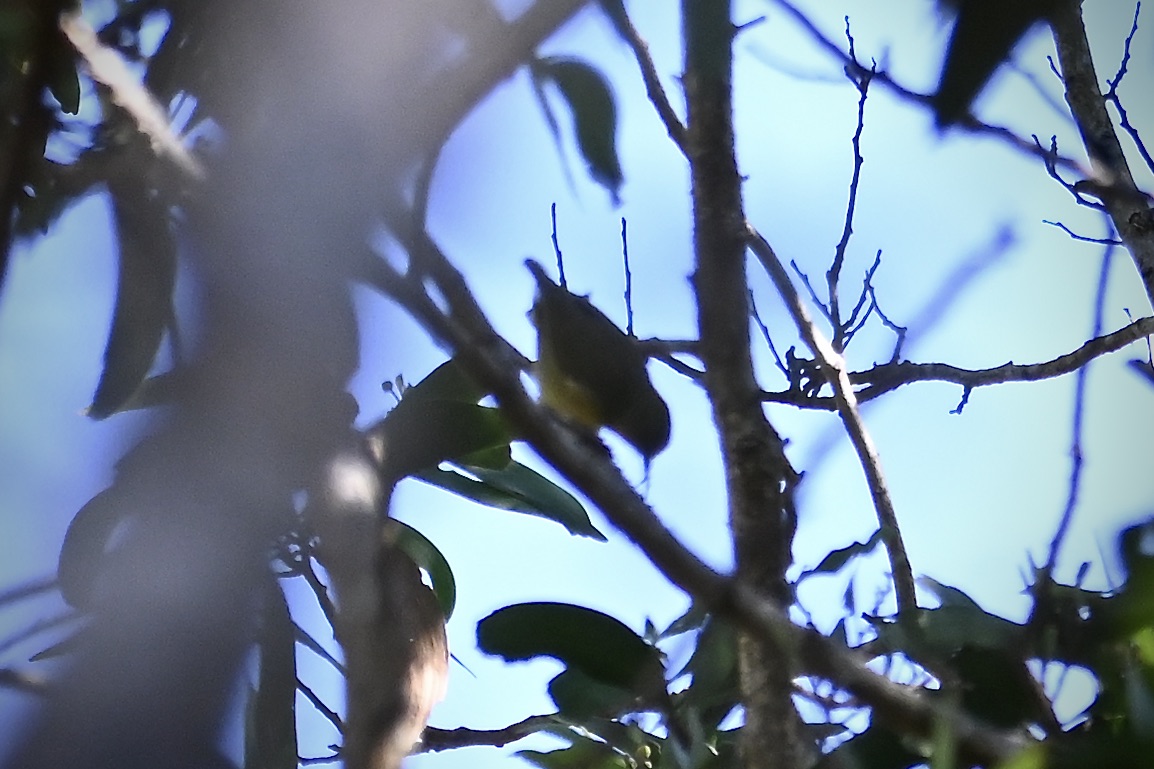
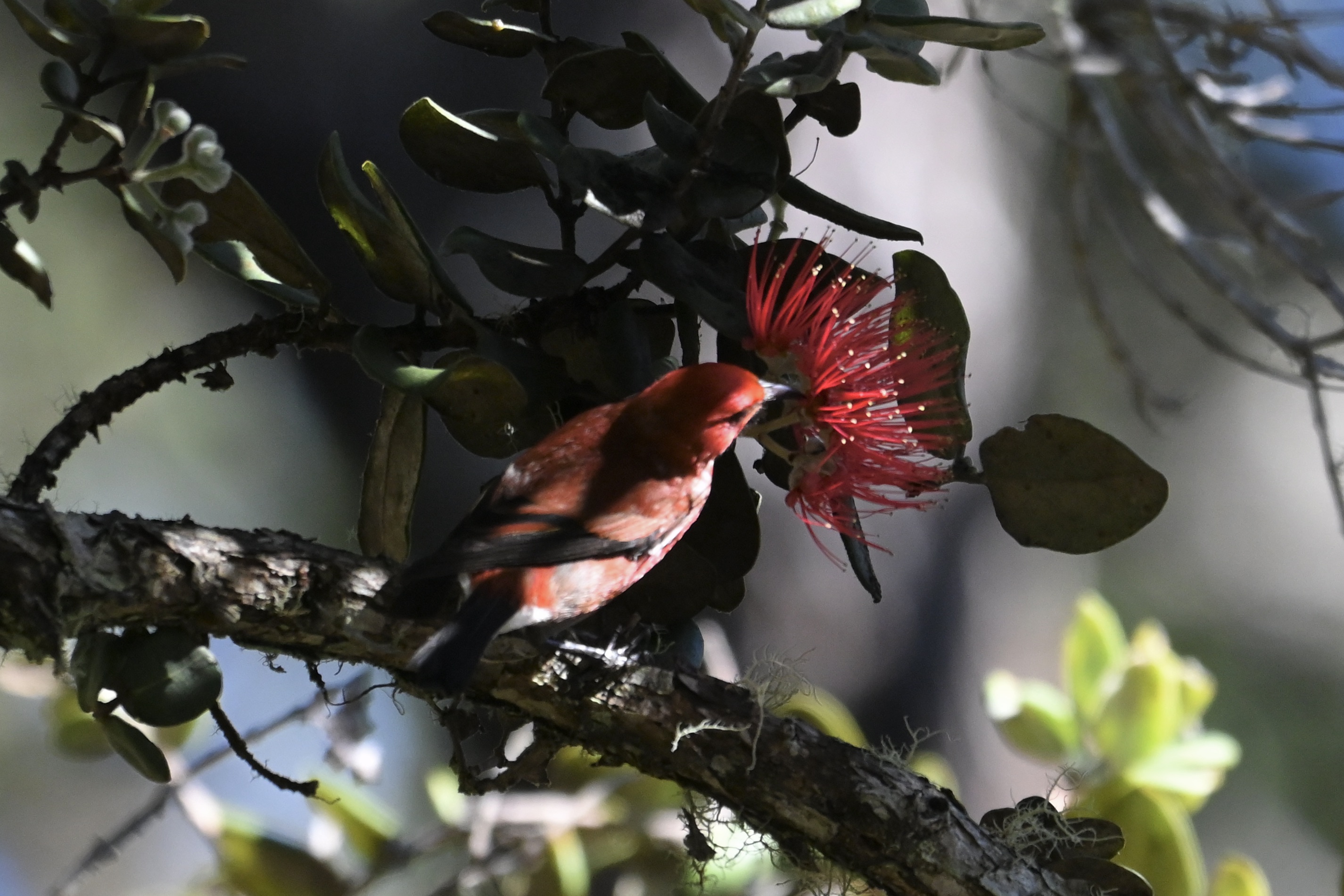
Photos of an ‘amakihi (top) and an ‘io (smaller photo on right) by Eric Anderson.
For all gave out of their abundance, but she—out of her poverty—gave all that she was having, her whole life. – Mark 12:44, translation by D. Mark Davis.
You’d warned about them, Jesus, all those who devour widows’ houses with religious obligation. I wonder, did you think you’d see it happen there in front of you, so poignant and so soon?
She dropped her life into the box or jar and heard it ring, so tinny and so small.
I wonder that you found the words to say to your disciples “She gave all. She gave her life, all that remained.” I would have been struck silent in my tears.
A poem/prayer based on Mark 12:38-44, the Revised Common Lectionary Gospel Reading for Year B, Proper 27 (32).
The world is filled with tears. They spring from eyes emotion-swollen, running down the cheeks across the bare or stubbled chin. The world is filled with tears.
The fountains spray their eloquence, responding to the pains of circumstance, of body or of mind, of tearing of the fragile soul. The world is filled with tears.
From other eyes the liquid leaps for joy like ocean spray and seething foam, a coruscating rainbow of delight. The world is filled with tears.
Oh, Holy One, I do not pray for you to dry our tears today, but that we weep, relieved of fear. Oh, let these be our tears.
The image is a detail of the figure of Mary Magdalene in the sculpture The Entombment of Christ in the Church of St. Martin, Arc-en-Barrois, France. Photo by User:Vassil – File:Sépulcre_Arc-en-Barrois_111008_12.jpg, CC BY 3.0, https://commons.wikimedia.org/w/index.php?curid=16942922.
It’s a funny thing. When you hear just part of a conversation, it can be misleading. I mean, you might think you know what folks are talking about, but it turns out you might not.
In this case, it was a kolea, a Pacific Golden Plover, who overheard some people talking about heaven. And yes, he got confused.
He heard enough to learn that the people talking about heaven believed it was a really nice place. He heard enough to learn that the people talking about heaven didn’t expect to go there for some time. He heard enough to learn that the people believed that other creatures could also go to heaven.
He didn’t hear anything about it being a new life and a very different kind of place. He didn’t hear anything about dying as a transition from one kind of life to another kind of life. They just didn’t mention that while he was listening.
But at the end of the conversation, as the people were walking away, one of them said something about heaven being beyond the clouds.
People tend to talk that way about heaven because even though we have telescopes and can look a long way into space, “beyond the clouds” is something most of us don’t know much about, and the life God intends for us beyond our lives here is also something we don’t know much about. But the kolea didn’t know that. He said to himself:
“Those people can’t fly beyond the clouds, but I can. I can get to heaven myself.”
And he launched himself into the sky.
A kolea migrating from Hawai’i to Alaska, or from Alaska to Hawai’i, can get very high indeed. He flew up over the low clouds that were raining on Hilo. Then he flew up over the middle clouds that were spotted about around the slopes of Mauna Kea. Then he flew up even above the high wispy clouds above Mauna Kea.
Each time, he looked about for signs of heaven.
Each time, he didn’t see them.
“I must be close to heaven,” he said.
What he found as he circled higher and higher was that it got colder and colder. He’d felt that before, but as he flew higher than he had before it got colder than he’d ever known. He didn’t like that. He also didn’t like that the air got thinner. Not only was it harder to breathe, he had to flap his wings harder to move enough air to keep flying. In fact, there came a point that he just couldn’t go higher. Gasping, he let himself fall, then circle, and glide back down to the ground.
He landed, still winded, on some grass near another kolea, who hopped over to see what was wrong. “I tried to fly up to heaven,” he said sadly, and told her the story. “I must have been close, but I couldn’t get there.”
“That’s too bad,” she said to him. “Here, take a bite or two. There’s some tasty things here. And you’ll find some good water to drink just over this way.” She led him over to the food, and water, and a safe place to rest.
He ate. He drank. He rested. His breathing settled. His wings regained their strength. He looked at his new friend.
“You know, I flew a long way up to get close to heaven,” he said, “but you’ve been kinder to me than I can remember anyone else being. It might just be that I’ve been closer to heaven here than I ever was up there in the sky.”
by Eric Anderson
Watch the Recorded Story
I write these stories in advance, then tell them from memory during worship. The story you just read and the story as I told you will not be the same.
Photo of a kolea (a Pacific Golden Plover) by Eric Anderson.
“One of the scribes came near and heard them disputing with one another, and seeing that he answered them well he asked him, ‘Which commandment is the first of all?’ Jesus answered, ‘The first is, “Hear, O Israel: the Lord our God, the Lord is one; you shall love the Lord your God with all your heart and with all your soul and with all your mind and with all your strength.” The second is this, “You shall love your neighbor as yourself.” There is no other commandment greater than these.'” – Mark 12:28-31
The scribe approved your words, or so says Mark, and silenced all the snare-deploying crowd. Yet he might ask (and yes, in Luke he did) “Who is my neighbor to receive my love?”
Then you, Redeemer, might have said (though you did not, or so says Luke), “Look to the Book of Ruth, to what is written there: ‘I will not leave you. Do not press me.
“‘Where you journey, I will go. And where you stop, there I will take my rest. Your people shall be mine, and more: Your God shall be my God.'”
A poem/prayer based on Mark 12:28-34, the Revised Common Lectionary Gospel Reading, and Ruth 1:1-18, the First Reading, for Year B, Proper 26 (31).
Well, that’s not an original way to begin a story, but it was pretty dark, and rain was falling, and the winds were howling up there on the mountain. If you were a pig, it was a good night to find a rocky overhang. If you were an ohi’a tree, it was a good night to rock back and forth with limbs and trunk, and a better night to hold on tight with your roots.
If you were one of the honeycreepers of the forest, it was a good night to shelter beneath lots of thick leaves and hope the branch you’d perched on was sturdy.
A grumpy ‘amakihi had found just such a space in a koa tree. He wasn’t exactly dry, but he wasn’t being pelted by rain, either. The branch he grasped with his feet was only tossing a little bit. He wasn’t comfortable – that’s why he was grumpy – but he was as comfortable as he was going to get until the sun came out so he could dry his feathers.
He wasn’t pleased when the branch gave another bounce that was out of rhythm with the winds and there was a new shadow among the leaves. A young ‘apapane – so young that she didn’t have her red feathers yet – had landed on the branch and stood shivering. She tried to shake the water from her wings, but mostly just banged herself against the leaves and twigs.
“Stop that,” said the grumpy ‘amakihi. “What are you doing here? You shouldn’t be flying in this storm.”
“I didn’t mean to,” said the young ‘apapane. “The wind swept me off the branch.”
“Well, you’d better go back there,” said the ‘amakihi. “Go on.”
The young ‘apapane looked out through a gap in the leaves to where they could both see the trees tossing in the gale.
“Well, maybe not right now,” said the ‘amakihi, who was still grumpy but a fairly considerate bird. “What can I get for you? Do you want a bug? There’s some here.”
“No, sir,” said the ‘apapane.
“How about a drink of water? Well, maybe not,” he said, when the young ‘apapane shivered. “You’ve probably had enough water.”
“Yes, sir,” said the ‘apapane.
“Well, what do you want? You don’t want me to help you find your own tree, do you?”
The ‘apapane shook her head.
“What do you want me to do for you?” insisted the ‘amakihi.
“Could I just stay here for a while, and not be alone?” asked the ‘apapane.
“You don’t want to be alone?” asked the ‘amakihi.
“No, sir,” said the ‘apapane.
The ‘amakihi thought about it, and realized even as he said it, “You know, I don’t want to be alone in this storm, either. Come find a dryish spot here on this branch. We’ll ride it out together.”
And that is how a grumpy ‘amakihi and a frightened ‘apapane were merciful to each other in the midst of the storm.
by Eric Anderson
Watch the Recorded Story
I write these stories in advance, then tell them from memory during worship. That means that changes happen.
“Jesus stood still and said, ‘Call him here.’ And they called the blind man, saying to him, ‘Take heart; get up, he is calling you.’ So throwing off his cloak, he sprang up and came to Jesus.” – Mark 10:49-50
“How strange. Do you see that?”
“See what? Oh, that? What is that, do you know?”
“I think that it’s a cloak.”
“Who’d leave a cloak abandoned in the road like this?”
“I wouldn’t. That’s the thing that keeps a being warm at night.”
“Let’s take a look. Perhaps the owner is not far, and if we raise it, they’ll come back.”
“What’s that? It rolled away into the dirt.”
“Hang on, I’ve got it now. Look: it’s a coin. It must have been entangled in the cloak.”
“You know, I’ve seen a beggar here with such a cloak. He’d plead for coins…”
“…Which people threw upon the cloak. You’re right. This must be his. But where is he?”
“I can’t believe he’d leave without his cloak.”
“I can’t believe he wouldn’t comb the cloak to find each coin.”
“He’s not here now… and if he left without the cloak…”
“I don’t think he’ll return.”
A poem/prayer based on Mark 10:46-52, the Revised Common Lectionary Gospel Reading for Year B, Proper 25 (30).
When the birds of the ohi’a forest start to flock together – which tends to happen when the chicks have learned to fly and left the nest – some of those flocks rotate leadership among the birds: an ‘apapane this week, an ‘akepa this week, and who knows? Perhaps an ‘alawi the next.
There came a week when one of the ‘amakihi was chosen to lead, and he was going to lead, by all that was feathered, he was. He had done a lot of watching and a lot of listening to the other leaders, and he knew he’d do a good job. He wouldn’t bully, and he wouldn’t brag, and he would get help from other birds to be sub-leaders, and above all else, he would keep an eye out for food, for shelter, and for danger.
He was, after all, the one in charge.
Things seemed to go just that way for the first couple of days. The other birds followed where he led, they sang cheerfully as they foraged for bugs and nectar, and they avoided both the nuisance of a cranky i’iwi and the dangers of two cats and an ‘io. On the third day, however, something seemed to be going… differently. The birds still followed where he led, but… it almost seemed like some of them were slightly ahead of where he was going. He thought they might just be faster fliers, but as the day went on he noticed that some of them seemed to open their wings just slightly before he did.
What puzzled him about all this was that, as he thought about it, it seemed… perfectly normal. The other flock leaders had also been just slightly behind two or three birds. Which seemed… perfectly normal and perfectly odd.
When the next day came, the same thing was happening, and he kept a close eye on things. Another ‘io came by over the course of the morning, so that a sudden alarm whistle sent everyone deep into the branches. A little while later, the same voice trilled that it was safe again, and the flock took wing for another ohi’a tree – one that he, the leader, hadn’t chosen. He probably would have tried that direction (because the ‘io went the other way), but he hadn’t chosen it. What was going on?
In early afternoon, it happened again. Two or three birds took off just before he did, and later on two or three more took off just before he did, but they were different birds. Still, he spotted what was the same: those birds had been close to another bird, an ‘amakihi, just before they flew.
So he landed right next to that bird when they got to a new tree and found… she was his mother.
“Are you… What are you doing, mother?” he asked. “Are you trying to take over as leader?”
“Not at all,” she said. “I’m following you, just like everyone else.”
“Then how come birds take off ahead of me from around you?”
“Well,” she mused. “I might be mentioning that you’re looking at a tree in a particular direction. They seem to think that’s a reason to go that way. You and I both have been paying attention to what’s safe and what’s in blossom.”
“Isn’t that leading?” he asked.
“It might be,” she said, “if leading is paying attention to what’s good for all the birds of the flock. Which you’re doing. But it’s something that all of us can do along with you. When your leadership time is over, you can do it, too.”
He was a good leader, they all agreed. They were surprised to find, however, that he was an even better follower when another bird’s turn came to lead. He did the best he could to see that all the birds were fed, warm, and safe – and so did his mother.
by Eric Anderson
Watch the Recorded Story
I write these stories ahead of time, but I tell them in worship from memory. Memory plus a fair amount of improvisation.
James and John, the sons of Zebedee, came forward to him and said to him, ‘Teacher, we want you to do for us whatever we ask of you.’ And he said to them, ‘What is it you want me to do for you?’ And they said to him, ‘Appoint us to sit, one at your right hand and one at your left, in your glory.'” – Mark 10:35-37
While you’re at it, Jesus, sign me up for that. For while I think I have one of the sittingest jobs there is, (I sit in chairs and cars and at so many meals), I’d really like to sit nearby to you and bask in glory.
Ahhhhhh…
Yes, I can follow you and what you do to find my place in glory, banquet marvelous, and if the places to your right and left are occupied already, I understand.
Ahhhhh…
So though I share the indignation of your other followers, I share as well their thought that it should not be them, but me, to sit at your right hand. Of course.
Ahhhh…
I’ve chosen to forget as James and John did then, so long ago, that you’d been laying out the likely forecast, which was stormy to be sure, a blow to carry you up on a cross.
Ahhh…
I’ve chosen to ignore again your call to servanthood and service. Humility, not arrogance, displays your Way. I’d be more comfortable, frankly, with my pride.
Ahh…
Instead, I sit dismayed. You’ve asked for all, for more than I prepared, for more than I have understood. It’s not enough, but in this moment, it is all I have to give.
Ah.
A poem/prayer based on Mark 10:35-45, the Revised Common Lectionary Gospel Reading for Year B, Proper 24 (29).
The image is “The Calling of the Apostles St. James and St. John,” print, Friedrich August Pflugfelder, after Johann Friedrich Overbeck (MET, 2004.451) (August W. Schulgen/ Josef Spithöver) – This file was donated to Wikimedia Commons as part of a project by the Metropolitan Museum of Art. See the Image and Data Resources Open Access Policy, CC0, https://commons.wikimedia.org/w/index.php?curid=60859225. Sadly, most artists’ renderings I could find of this interchange between Jesus, James, and John, favor Matthew’s version of the story, in which their mother made the request on their behalf.