Chasing Hope

June 12, 2022

Proverbs 8:1-4, 22-31
Romans 5:1-5

The young pueo had learned many things. He’d learned how to fly, and how to find his way home, and how to spot small creatures in the grasses. He was, in many ways, prepared to begin a life of his own.

But he didn’t know what hope was.

His mother talked about hope a lot. Or muttered about it a lot. “Do you think we’ll find mice out there today?” he’d ask, and she’d say, “Hope.” “Do you think it will be sunny and warm today?” he’d ask, and she’d say, “Hope.” “Do you think I’ll learn something new today?” he’d ask, and she’d say, “Hope.”

Sadly, one of the things that he hadn’t learned by the end of any day up to that point was what “Hope” meant.

So he went to ask grandmother, Tutu Pueo, his mother’s mother. He flew to the rock on which she’d perched and asked, “Tutu, what is hope?”

“Hasn’t your mother told you?” she asked, rather surprised.

“No,” he said. “She mutters ‘Hope,’ a lot, like when we set out to find dinner, or when I ask about what’s coming. But she never says what it is.”

Tutu laughed. “I’ll just have to teach you the way I taught her,” she said. “Come fly with me. Let’s chase Hope.”

Puzzled but willing, he followed grandmother into the sky. “You’ve got to chase Hope,” said Tutu over the rush of the air. “Yes, but what does Hope look like?” asked the grandson, but suddenly she shouted, “Look there! In the grasses!”

Down they pounced to where an unwary mouse had ventured out. They enjoyed their snack, but then he said, “That wasn’t Hope, was it? That was a mouse.”

“You’ve got to chase Hope,” said Tutu. “Come on.”

Once more they took to the air, but clouds were pouring through the gap between Mauna Loa and Mauna Kea. “Look! There’s Hope!” shouted Tutu and she poured on the speed, heading for the retreating sunshine. Before the rain began to fall they were circling again in the sun.

“That’s not Hope, is it?” said grandson. “Isn’t it just… sunshine?”

Tutu turned lazy circles. “You’ve got to chase Hope,” she called. “Have you learned anything?”

He thought about it. He thought about being hungry, and about chasing something to eat. He thought about wanting to be warm and dry, and chasing the gaps in the clouds. He thought about wanting to learn something, and…

“I’ve learned that you have to chase Hope,” he said. “It’s always somewhere out there ahead, isn’t it?”

Tutu nodded. “And when you catch it, it’s the thing you hoped for – and then Hope becomes the next thing you need or you want.”

When he went home, he found his mother waiting. “Did Tutu teach you anything?” she asked.

“She taught me to chase Hope,” he said. “Do you think I’ll learn something new tomorrow?”

She smiled a pueo smile and simply said, “Hope.”

by Eric Anderson

Watch the Recorded Story

The story as written does not match the story as told – I work from my memory of the text above, but not from the manuscript itself.

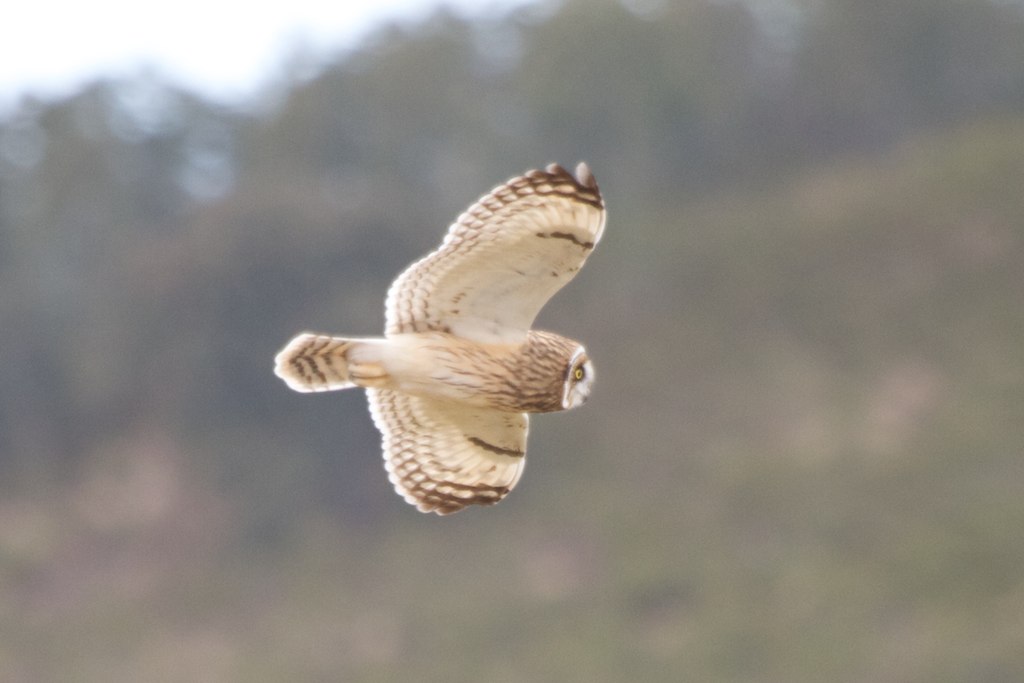
Photo of a pueo on Hawai’i Island by HarmonyonPlanetEarth – Pueo (Hawaiian Owl)|Saddle Rd | 2013-12-17 at 17-45-012 Uploaded by snowmanradio, CC BY 2.0, https://commons.wikimedia.org/w/index.php?curid=30241884.
Hope, Disappointment, Hope

“…Suffering produces endurance,
and endurance produces character,
and character produces hope,
and hope does not disappoint us…” – Romans 5:3-5

So much suffering
to endure
world-wounding,
nation-spanning,
wailing, weeping,
crashing, crushing.

Not all survive
what they endure,
bodies-bloodying,
soul-searing,
no comfort,
no healing.

Some endure
but suffer still,
character assassinated,
spirit speared,
throat raw
from silent shouts.

Character survives
but hope? Not always.
Heart-hurt,
future-foundered.
What to expect
but what we’ve known?

But hope
does not disappoint
even if suffering,
endurance,
and character all fail,
as they do.

Hope does not disappoint.
It has been fulfilled.
We suffer and endure,
and we are not alone.
There is a balm in Gilead.
It heals the shattered soul.

A poem/prayer based on Romans 5:1-5, the Revised Common Lectionary Second Reading for Year C, Trinity Sunday.

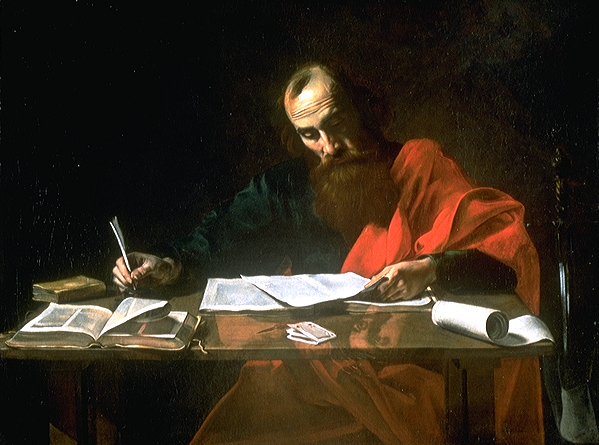
The image is Saint Paul Writing His Epistles by Valentin de Boulogne (one of my favorite artistic depictions of the Apostle) – Blaffer Foundation Collection, Houston, TX, Public Domain, https://commons.wikimedia.org/w/index.php?curid=596565.

Returning Tide

June 5, 2022

Genesis 11:1-9
Acts 2:1-21

The opihi – do you know about opihi? They’re a shellfish, a little bit like scallops or clams. Scallops and clams, of course, have two shells and a hinge. They’ve got protection from creatures that like to eat them on top and on the bottom. And when things are safer, they can open up and let the water bring the little bits of seaweed and tiny creatures to them.

An opihi, however, only has one shell. I suppose it’s a little bit like a hat, only it’s a hat that covers the entire creature. An opihi – they’re called limpets in English – finds a spot on the rocks and holds tight as its shell grows over its top. And then it continues to hold tight. It might move a little bit to get to another spot on the rock with more algae, but you and I might not even notice them on the move.

And they don’t talk much. There’s not a lot to talk about, when you’re an opihi.

Here’s the thing: they like to live in the shallows along the shorelines of our islands. In those places, the tides come in, and the tides go out. Sometimes when the tide goes out, an opihi is in a pool of water. But sometimes, it finds itself above the water after it drains away. Sometimes it just sits there in the open air.

A honu pulled itself up on a rock to nap in the sun one day and found an opihi already there. I’m a little surprised it noticed. A honu is a lot bigger than an opihi. But they both have shells, so the honu felt a little bit of sympathy for this opihi, stranded on the rock outside the water.

“Do you need help?” the honu asked. “I see you’re out of the water here.”

The opihi wasn’t used to conversation – there’s not a lot to talk about when you’re an opihi (I may have mentioned that). But finally it found a reply:

“No. I’m fine.”

“Isn’t being out of the water a problem?”

“Well, not so much. If it went on a long time, that would be a problem,” said the opihi.

“How do you know it won’t be a long time?”

The opihi thought about this. “Honestly, I don’t know that it won’t be a long time. I suppose it could be. This isn’t the first time I’ve been left high and dry. Some of those times really did seem pretty long.”

The honu waited. Finally the opihi finished:

“The tide has always come back. I trust the tide more than I trust myself to swim if you swept me off the rock into the water.

“The tide has always been good to me. I’ll hold on here until it returns again.”

by Eric Anderson

Watch the Recorded Story

The story is told from memory of this prepared text – and thus will never be quite the same.

Photo of opihi in Honokanaia, Kahoolawe, Hawaii, by Forest & Kim Starr, CC BY 3.0 us, https://commons.wikimedia.org/w/index.php?curid=71815389.

Were We – Are We – Ready?

“…This is only the beginning of what they will do; nothing that they propose to do will now be impossible for them.” – Genesis 11:1-9

“…In our own languages we hear them speaking about God’s deeds of power.” – Acts 2:11

The crumbling bricks of Babel’s ziggurat
still shape the land beyond mistake.
Imagine what they might have done
if they had only stayed together.

Imagine? I have seen it.
Each year machines of death advance.
Each year the wealthy gather plunder.
Each year we live in threat of global fire.

What human beings can do united
is matched alone by things that human
beings can do without intent. The tides
rise higher for our ever-growing folly.

I can’t but think a wise and caring God
would scatter human pride before it cost
uncounted workers health and lives, before
it cost a city the necessities of life.

And then: a Pentecost, a festival of Law,
when language’s divisions find reunion,
Babel’s judgement finds reversal.
What can not human beings do now?

One question, God, whose Holy Spirit
cannot be predicted or confined:
Were we ready to unite? Were we wise
enough? Are we? Are we ready now?

A poem/prayer based on Genesis 11:1-9 and Acts 2:1-21, the Revised Common Lectionary Alternate First Reading and Alternate Second Reading for Year C, Pentecost Sunday.

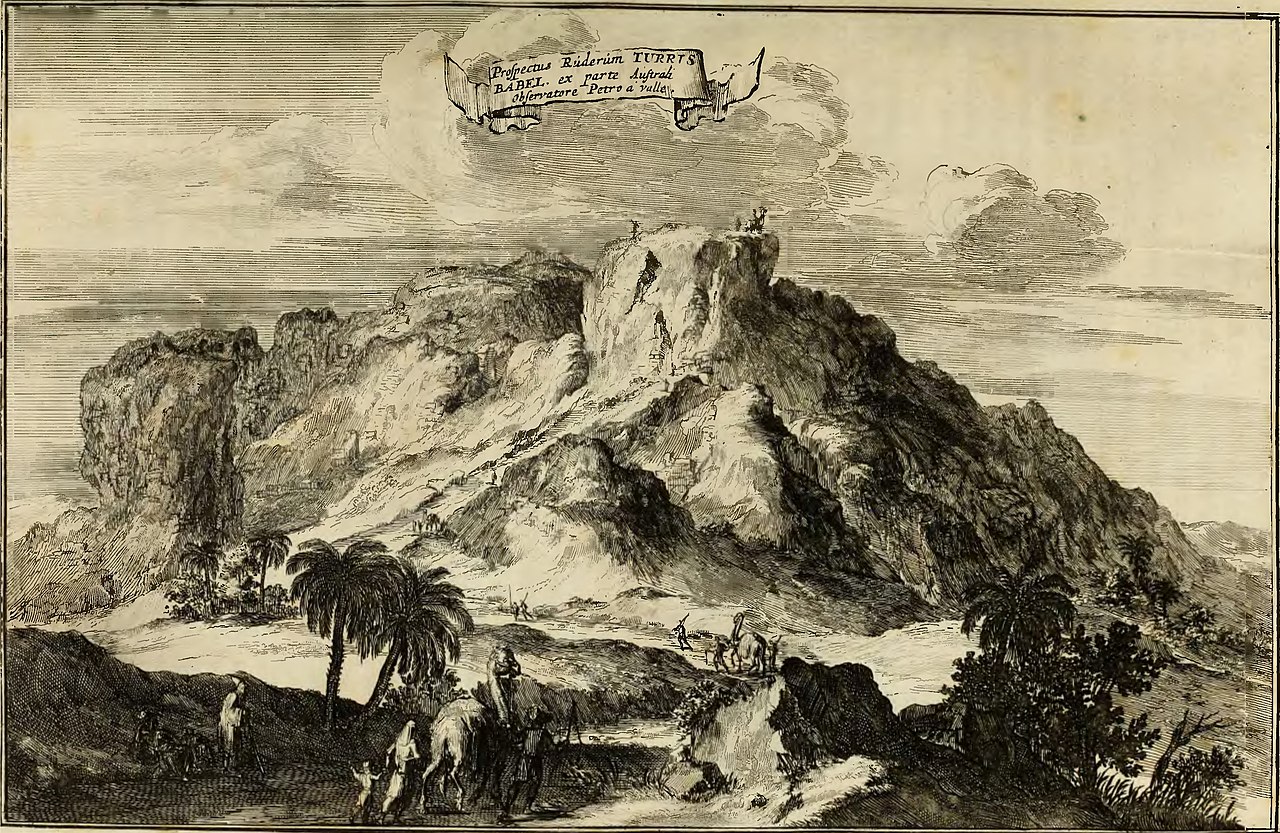
The image is a depiction of the ruins of the Tower of Babel, southern view, as described by Pietro della Valle and reported in Athanasius Kircher’s book Turris Babel (1679). Drawing by Athanasius Kircher – rotated crop from https://archive.org/details/turrisbabelsivea00kirc/page/n6/mode/2up, Public Domain, https://commons.wikimedia.org/w/index.php?curid=104471384.

Why the Stories Have Returned

Just a brief warning: this essay claims to share no great wisdom. It won’t give you either step-by-step hints about technology (a la An Ordained Geek Becomes a Televangelist) or assist you with deep reflection on a subject (a la… um). If you know you are interested in the way a pastor/writer/musician’s life works, this seems like something you’d appreciate. If you’re not, or don’t think you are, it’s harder to predict. Give it a try. Who knows? As well as learning something about me, you might learn something about you.

One of the most frequent descriptions people apply to me is: “storyteller.” It’s a title I receive with gratitude. I like telling stories. I like listening to stories. I like preparing stories for others to hear. I like interacting with them while I do.

As a pastor, I have always told stories, most often as part of a “Children’s Time” or “Moment with the Children” in worship. I’ve told stories in other contexts as well – places like summer camp or vacation Bible school – but for the most part they’ve had a place in worship.

For many, many years of my ministry, I prepared no more than a sketch for each story. I preached from notes. For stories I used no notes at all. Occasionally I would take time afterward to write the narrative in full, but that usually only happened when I’d had a specific request. As much as people told me they appreciated the stories, those requests were rare.

Then the stories became rare. For about fifteen years of my ministry I did not serve a local church. My responsibilities as a member of a UCC Conference staff did not include a great deal of worship leadership. I preached little and I told stories less – in part, because I developed the habit of telling one particular story the first time I spoke anywhere (that story isn’t on this blog, which I ought to correct at some point).

In 2016 I laid down my responsibilities in New England and took up the pastorate of Church of the Holy Cross UCC in Hilo. For the first time in a long time, I had to prepare a weekly sermon. For the first time in a long time, I had to prepare a weekly story.

During the preceding years, I’d made a big shift in my preaching practice. I’d switched to preparing a full manuscript rather than using notes. I’d done it, in fact, when I was invited to the pulpit of the church in which I worshiped. They had two Sunday morning services and the timing was a little tight. I had to control for time. A manuscript did the job. By the time I came to Hilo, I’d settled into the pattern and was happy with it.

I had not, however, made a similar adjustment with stories. The stories received no more than a few sparse notes. Within a few weeks I decided that I did want to share a written version of each one, so I began writing each story up on Sunday afternoon. The first was “Sun Astonished” in May 2016.

It turned out that this work process of Sunday afternoon note expansion wasn’t sustainable. Many of the church’s boards and committees met on Sunday afternoons, further separating the writing from the storytelling. Putting the sermon online required more work as we added an audio recording. The church’s electronic newsletter demanded attention on Sunday afternoons so that the office manager could send it Monday mornings. Gaps began to appear. In November 2018 “The ‘Apapane’s Own Song” became the last story to appear on this blog for over three years.

How have they returned?

Thank you, COVID.

When Church of the Holy Cross moved to an online-only worship format in March 2020 in the first days of the pandemic, I made a new shift in preparing sermons and stories. A streamed worship service, I felt, needed to take less time. I dropped several elements, mostly hymns and musical responses. I also merged the story with the sermon, or rather, I led the sermon with the story. For over two years the first words out of my mouth after the Scripture had been read were the first words of a story.

I began to craft the story as part of the sermon, and that meant that it would receive a full manuscript in its composition. That made sense for my writing process but it also made sense for the worship experiences I was trying to support. Along with the worship outline and response materials, I posted a written text of my sermon to the church website before worship each Sunday. Those with hearing difficulties or technical difficulties would have the sermon text to read as well as that of the pastoral prayer.

And, because it was the first thing in the sermon manuscript, they had the story.

On April 24, 2022, we resumed worshiping with a gathered congregation. On that first Sunday I continued the practice of combining the story and the sermon. I received some feedback, some very clear feedback, that that would not do. The young people liked the stories, but they also liked the time with their pastor, a time which said that they were important to me and to the Church and to God. Time with the Children returned on May 1.

When it did, I did not return to my long-time practice of brief notes. I kept writing the full manuscripts, and I also write the story before beginning the sermon proper. We continue to live-stream the service over the Internet, and that means a backup copy could easily be helpful. So now each worship service on our website includes a manuscript of the sermon, of the pastoral prayer, and of the story.

Those experiences do not and cannot match. In a virtual worship service, I could and did (mostly) read the story as written. With a congregation present – with children present – I do not use notes for the story except to remember certain words I’m likely to forget. I may have written a complete text, but I am still working from an outline in my memory.

Sunday afternoon has gained a new task. I still post the sermon text to the church’s website along with a video of the worship service. Side by side with that I post the prepared story text to Ordained Geek, accompanied by video of how the story was actually told in worship.

And that’s why stories have returned to Ordained Geek.

Photo by Eric Anderson.

You Can Do Something

May 29, 2022

Acts 16:16-34
John 17:20-26

by Eric Anderson

The i’iwi, I’m afraid, can be something of a bully.

Most of the time things are OK. They’ll even join a flock of ‘apapane to find good trees for nectar sipping. But… there are times when it all goes very badly. An i’iwi that finds an ohi’a tree in full blossom first is pretty likely to chase other birds away. ‘Apapane and ‘amakihi in particular aren’t welcome when there’s a tree full of flowers. When an i’iwi starts swooping at them, most of the time they leave.

There was one i’iwi in the ohi’a forest, though, who was a thoroughgoing bully. He would chase ‘apapane away from a tree with just a few flower clusters. He would dive at ‘amakihi as they passed by a tree he was sitting in. If there were more flowers, he’d just get more aggressive. Some ‘apapane had to dodge strikes with his long curved beak. Some ‘amakihi swerved away from his extended claws.

A group of ‘apapane were perched in a not-very-flowery ohi’a tree rather glumly. They weren’t exactly hungry, but they certainly weren’t well fed. They’d had to fly further to find ohi’a in blossom, and sometimes he’d come after them and chase them away from those trees, too. It was a bad situation.

“I wish there was something we could do about it,” said one of the ‘apapane.

“You know, I think there might be,” said an ‘amakihi at the edge of the group.

The birds, ‘apapane and ‘amakihi alike, and maybe an ‘akepa or two, listened in astonishment as she shared her idea.

“I don’t think that will work,” said a skeptical ‘apapane.

“If it doesn’t, we’re no worse off than we were,” said the ‘amakihi, and they all had to agree.

The next day, a few ‘amakihi joined the one whose idea it had been and flew by the tree the bully i’iwi was perched in. It was a tree just dripping with blossoms and nectar, so of course he took off after them to chase them off. What he didn’t notice was that as he flew after them, a larger group of ‘apapane and ‘amakihi and ‘akepa descended on the tree he had left and began to feed. When he returned, he found the tree full of birds. With more anger and confidence than good sense, the bully set in to chase them away, but found they weren’t very chase-able when they already had a purchase in the tree – and when there were quite a good number of them. The decoy ‘amakihi flew in behind and so they, too, were in the tree, as the i’iwi fluttered about, getting wings and beaks batted at him by three or four birds at a time, until he finally flew off in disgust.

“I didn’t think it would work,” repeated the skeptical ‘apapane.

“My tutu told me you can always do something,” said the ‘amakihi who’d led the flock. “Sometimes the something even works.”

You can always do something.

Watch the Recorded Story

The story is told from memory of this prepared text – and thus will never be quite the same.

Photo by ALAN SCHMIERER from southeast AZ, USA – HAWAI’I AMAKIHI (8-30-2017) Hakalau Forest National Wildlife Refuge, Hawaii Co, hawaii-03 male, CC0, https://commons.wikimedia.org/w/index.php?curid=74675379.

A River

“[Jesus said,] so that the love with which you have loved me may be in them, and I in them.” – John 17:26

I imagined I saw Jesus. He was kneeling by a river.
I walked up close behind him. He didn’t say a word.
“Oh, Jesus, have you heard of all the children who lie slain?”
He never turned his head; he said, “I’ve heard.”

“Why are you kneeling by the river?” I demanded of his back.
“There are children who need saving, there is evil beneath the sun.
In churches and in grocery stores the blood must surely shout.
He never turned his head; he said, “It shouts.”

“What will you do then, Jesus? Will the churches,
temples, stores, and schools be stained with blood?
Will we sup full of horrors every day of life?”
He never turned his head; he said, “You shouldn’t.”

I fell down there beside him, and I found the river’s source
as a torrent ran from Jesus’ streaming eyes.
“How can you bear this suffering?” I begged him with my tears.
He turned his head, and softly asked me, “How can you?”

A poem/prayer based on John 17:20-26, the Revised Common Lectionary Gospel Reading for Year C, Seventh Sunday of Easter.

Photo by Eric Anderson.

Surrounded by Air

May 22, 2022

Acts 16:9-15
John 5:1-9

by Eric Anderson

The young noio was confused.

The world was, let’s face it, a fairly confusing place, especially there on the ocean-fronted cliffs of Kamokuna. There’s a lot of wind down there, and that plays with your mind. There’s a lot of noise from the waves breaking against the cliffs, and that’s just distracting. And in addition to the things he felt most of the time – the warmth of his parents’ feathers, the ruffling of his own feathers in the wind, the warm sun of day and the coolness of night – there was the occasional spatter of wind-driven spray.

All that would confuse anyone.

His nest gave him a great view of his world. Perched on a rocky shelf, he could see far off into he distance where the ocean stretched away. He could see the other noio skimming the water’s surface and dipping their beaks in and sometimes diving in briefly before taking off again. As day began the other birds of the colony would take off and begin their fishing above the ocean. As day closed they’d fly back, landing at their nests and bringing food to their young – like him.

What confused him was… flying.

It didn’t frighten him, the way it did some other birds in some other stories I’ve told before. It confused him. He didn’t understand how it could work. He could clearly see that it did, but as far as he was concerned it simply shouldn’t work. How could gravity be so much a force here at the nest and stop being one when a noio had left it? How could his wings flap against nothing and accomplish something? What invisible thing were the other noio grasping – and wings can’t actually grab hold of anything – to change direction like that?

It was terribly confusing.

I don’t really know why he didn’t ask anyone about it. His parents were kind and caring, his grandparents wise and intelligent, all good qualities for someone looking for a good person to answer questions. But he didn’t. He didn’t ask his friends in neighboring nests, and he didn’t ask their parents, either. Maybe he was just trying to work it out himself. I don’t know.

So when the day came to take his first flight, with his parents and grandparents and friends and their families all watching in anxious pride, he was anxious, too. Could he do something he didn’t understand? Was that the magic to flight? But he stretched out his wings, did a hop or two, and the next thing he knew he was off the ledge and moving.

Somehow there was a substance to the nothing he couldn’t see beneath his wings. He could use his wings to shape it and push off from it, and there would be more when his wings came forward again. A subtle adjustment meant a turn. A greater adjustment made a tighter turn.

And since noio are members of the tern family of birds, turn about is fair play.

He flew back to the home ledge and successfully landed with a bit of a flurry of wings and feathers for that first attempt.

“I don’t understand,” he said.

“You don’t understand what?” asked his father.

“I don’t understand how it works. I can see rock. I can see water. But I can’t see what I’ve been flying on.”

“It’s air,” said his mother, “the same air you breathe, the same air in the wind. No, you can’t see it, but it’s there, always there, and it will carry you anywhere you want to go.”

Watch the Recorded Story

This story is not told from the manuscript above, but from a memory of its composition.

Photo by Eric Anderson.

One in a Million of Grief

This song mourns and honors the one million who have died of COVID-19 in the United States of America since 2020, as well as the 15 million more who have died elsewhere around the world. Let us not forget them.

May 18, 2022

[Verse 1]

We knew the day would come
though some denied, and some were mute.
We knew the day would come
Because the sorrow flowed so wide.
We knew the day would come
When the tears would overflow
for all the ones who had died.

[Chorus 1]

Each one one in a million,
the nurses, the meatpackers.
One in a million
The grandmas, the fathers
One in a million
The loving, the foolish.
One in a million of grief.

[Verse 2]

We knew the day would come
for the aged, and for the ill.
We knew the day would come
Because it was so hard to treat.
We knew the day would come
When the tears would overflow
for all the loved ones who died.

[Chorus 2]

Each one one in a million,
the grocery clerks, the drivers.
One in a million
the grandpas, the mothers.
One in a million
the old and the young
One in a million of grief.

[Verse 3]

We knew the day would come
When some refused the vaccines.
We knew the day would come
As each wave spread more quickly.
We knew the day would come
When the tears would overflow
for all the ones who had died.

[Chorus 3]

Each one one in a million,
Firefighters and teachers.
One in a million
Children and teens.
One in a million
16 million across the world.
One in a million of grief.

[Chorus 4]

Each one one in a million
So special to someone.
One in a million
With a smile to light the day.
One in a million
So our tears overflow.
One in a million of grief.

© 2022 by Eric Anderson

A Woman from Thyatira

“During the night Paul had a vision: there stood a man of Macedonia…” – Acts 16:9

“A certain woman named Lydia, a worshiper of God, was listening to us; she was from the city of Thyatira…” – Acts 16:14

I’ve got to hand it to you, Paul.
Some of us struggle with visions.
It’s hard to believe God’s directions sometimes.
“Go here! No, not there. I mean here, over here!”
It would be clearer if God didn’t
use pronouns alone.

But you saw a man from Macedonia.
(I’ve always wondered: how did you know?
Was there a look in the eyes? Or a pattern
of jewelry? Or an only-in-Macedonia,
for-a-limited-time-only, get-it-now haircut!)
You saw him. You said: “Let’s go.”

So far, so good. If my sense of God’s spirit
were only so clear as to know which “there”
was “here.” But “Come to Macedonia!
Enjoy the sun! See the crowds!
Hang out by the river and help us!
Bring the word!” That even I understand.

Now here is where I really hand it
to you, Paul. For there by the river
in Philippi, leading city of the district,
you found no men of Macedonia,
but women. And their leader Lydia –
was from Thyatira, near where you’d just been.

God’s visions can blind us, you know,
when we read them as anything
other than metaphor. You met a woman
from Thyatira in Asia, not a man
from Macedonia, and you recognized
God’s promises fulfilled in her.

A poem/prayer based on Acts 16:9-15, the Revised Common Lectionary First Reading for Year C, Sixth Sunday of Easter.

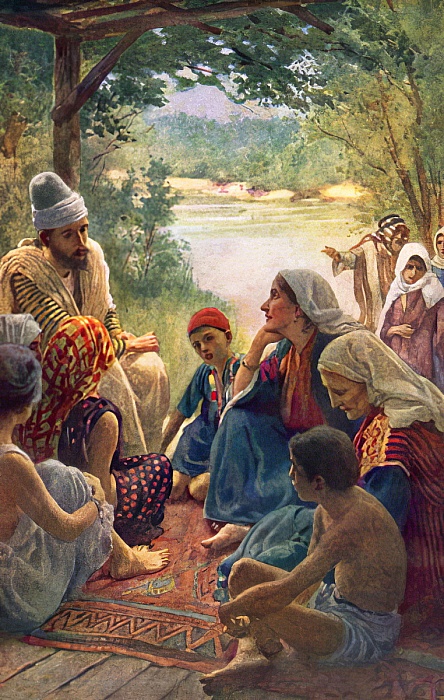
The image is Lydia of Thyatira by Harold Copping – https://www.meisterdrucke.de/künstler/Harold-Copping.html, Public Domain, https://commons.wikimedia.org/w/index.php?curid=84021913.