
Of Love and Kites

two-kitesToday’s story features the same little girl from last week’s story. You remember her, right?

You don’t?

Well, she was the one who wanted to fly a kite and wanted to know how she’d know when she was loved. Does that sound familiar? No?

Well, it’s on the Internet. You can look it up.

Anyway, this same little girl got up one morning and, once again, she had two things that she wanted to do with her day.

The first one was that she wanted to spend time playing with her neighbor, a boy just a little younger than she was, and a good friend.

The second thing was that she wanted to know how she’d know when she was being loving to someone else. You really have to admit that she liked to ask the Big Questions.

Since she knew it was a Big Question, too, she decided to start with the easier one, so off she went to her friend’s house and knocked on the door. He was perfectly willing to play with her that day, which meant she’d already accomplished one of her goals.

In fact, he wanted to fly his brand new kite, which was even better, because now she knew how to get a kite in the air, since she had been in last week’s story.

And it was nice and windy that day.

So they carried the package with his new kite to a nice open space, and she set out to get it unpacked. She’d done this in the last story, so she knew how it went. She laid out all the pieces, and got the spars together, and got the fabric tight over everything. She attached the tail, and fastened the string to the kite with a good strong knot. Everything was ready to go.

She handed him the assembled kite and told him to stand off a few feet, and when she started running, to toss the kite into the air. Sure enough, when she took off, the kite leaped into the air like it was meant to fly (which, of course, it was) and danced higher and higher into the sky.

He came over and reached for the string, but she said, “No, no, let me show you how to do it,” and that’s when he burst into tears and ran home.

Leaving her all alone in the open field with his kite in the air.

Well, she brought it down to the ground, and wound up the string, and walked it back to his house. She could still hear the crying from outside, so she left the kite on the porch, and went to find her Grandfather.

She cried a few tears of her own as she told him the story.

“Just to make sure I understand,” said Grandfather when she was through, “Did he ask you to put his kite together?”

Well, no, he hadn’t.

“Did he ask you to show him how to fly it?”

No, he hadn’t done that either.

“Did you ask him at all what he needed from you, or what he wanted you to do?”

Well, no.

“When you do the things that people really want or really need,” Grandfather told her gently, “that’s how they know you’re being really loving. So the only way for you to know whether you’re being truly loving is to ask.”

Oh.

She went back to her friend’s house, and this time she knocked on the door. When he came to see her (it must be said that his mother had to tell him to do it), she apologized for doing everything he wanted to do with his kite, and humbly asked, “What do you want to do?”

“I’d like to fly the kite with my own hand on the string,” he said, somewhat cautiously, because he wasn’t sure what she’d say.

“Then let’s do that. I’ll hold the kite while you run and get it into the air,” she said, and that’s just what they did.

The next day, there was wind again, so they both brought their kites, and soon there were two of them aloft. As they watched the two kites dance in the sky, both of them knew this:

They’d been loving to each other.
Love Like the Wind

dsc_0871

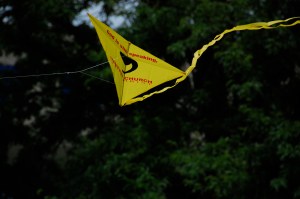
Kite in flight

A little girl set out one day with two things on her mind; two things she was determined to do.

The first looked pretty simple: she wanted to fly a kite.

The second looked more difficult: she wanted to know how she’d know when somebody loved her. She was pretty sure that this was the more awkward question.

That meant that the kite came first.

She got it out of its package, and she put the sticks in their places. She stretched the fabric over it, and attached a streamer tail to the end. She got out the kite string, and attached it to the kite with a good knot. She was all set to fly.

Unfortunately, she’d chosen to go out on a day which lacked one critical ingredient: wind.

Wind is usually plentiful here in East Hawai’i, but not that day. It was one of the hot, still, and muggy days of summer. I guess there was a storm offshore that blocked the trade winds from blowing, and the storm’s winds hadn’t reached Hilo yet.

Whatever the cause, there simply wasn’t a breeze to be felt.

She gave it her all, though. She raced back and forth across her chosen field, letting the kite string out behind her, and gasping each time the kite seemed to take leap skyward on her leg-driven wind.

Each time she came to stop, though, the kite would sag in mid-air, and fall gracelessly to the ground. Sometimes it would plunge to earth even as she ran. All in all, it was really frustrating.

Nothing she tried would get the kite to fly.

Grumbling, she went to see her grandfather, hoping that he would have some wisdom that would get the kite to fly. She poured out her troubles as he listened, and he cast a glance at the trees, where the immobile leaves confirmed the problem.

“I’m sorry,” he gently said when her sad tale had ended, “but without any wind a kite won’t fly.”

Some tears later (she’d been counting on this, after all), she remembered her other question for the day. Rather hopelessly, given how the kite flying had turned out, she raised her other question.

“Grandfather,” she asked, “how do I know when someone loves me?”

Grandfather considered this for a few moments, and smiled.

“Think about your kite for a moment. Without wind, what does it do?”

“Nothing,” pouted the granddaughter. “It falls to the ground.”

“Love is like the wind that lifts the kite,” said Grandfather. “If you feel like somebody is lifting you up; if you feel like somebody is supporting you; if you feel like somebody has helped you to fly, that’s somebody loving you. That’s how you know.”

As she listened, the girl realized that, despite the sorrows that had brought her to her grandfather, she now felt lifted up. She now felt supported. She now felt like her soul had taken flight – a low, short flight (it must be confessed), but flying nevertheless.

So she gave her grandfather and big hug, and said to him, “You mean like right now?”

Grandfather looked at her, and inside he, too, felt like he was being lifted up, like he was being supported. He felt his soul flying. So he smiled his widest as he said:

“Yes, granddaughter. Just like right now.”

There may not have been a kite flying that day, but two souls soared on the wind of love.

Addendum: It was at this point that one of the young people said to me, “Could you please tell us that she was able to fly the kite the next day?”

Why, yes. As it happened, the wind returned the next day, and she was able to fly her kite. Even better, though, it was also a day when she felt lifted up by love as well.

And that’s the best kind of day of all.

The Mongoose Who Wanted to Be Salt

32151641192_cef0f7a32e_o

A Mongoose in Hawai’i

I know a number of you read my Pastor’s Corner this week, about seeing an ‘apapane, so you’re all prepared for a story about what kind of creature this week?

An ‘apapane?

This story is, in fact, about…

A Mongoose.

This mongoose lived right near a church, much like this one. In fact, he lived in a little hole underneath the roof beams, kind of like that hole right over there where a mongoose lives.

In any case, living outside the church the way he did, he had plenty of opportunity to hear the Scriptures read. One day, he was deeply impressed by a reading of Jesus’ words during the Sermon on the Mount: “You are the salt of the earth.” I don’t know why those words, in particular, made such an impact, but he determined to become salt, as Jesus said.

I’m afraid he had a rather literal turn of mind.

Because he started out by searching for salt. Mongooses, as a rule, do not have salt shakers in their burrows. He managed to find a paper salt packet that somebody had dropped from their carry-out tray, and set out to open it and eat it.

Have any of you ever eaten just plain salt?

It’s pretty unpleasant, isn’t it?

This mongoose didn’t like it much either. In fact, he had to go drink a sizable amount of the Wailuku River before he could taste anything but salt. All in all, it was pretty nasty.

He didn’t give up, though. If the salt wasn’t supposed to be eaten, he thought, maybe it’s supposed to be on the outside. So he set out to re-create an ancient way of harvesting salt: by taking sea water, letting it sit in the sun, and gathering the salt as the water evaporated away. But the mongoose wouldn’t use a hollowed stone; he’d use his own fur.

So he took a swim in Hilo Bay, which he didn’t like very much, and then climbed up on shore to let the sun dry his fur.

The problem was that this was Hilo, and as soon as he came out of the water, the clouds rolled in and hid the sun, leaving the mongoose wet, shivering, and unhappy for quite a long time.

Eventually, just as his teeth stopped chattering, the clouds parted and the sun beamed through. At last, he could dry his fur, and the water steamed gently away leaving the salt crystals behind.

It turns out that if you’re a mongoose, it’s really uncomfortable to have salt crystals in your fur and rubbing your skin, so the poor creature returned to the Wailuku River for another bath (this time in fresh water). As he emerged, the clouds rolled in again and drenched him further with rain, leaving him cold, wet, and completely discouraged.

So he did what he probably should have done in the first place. He went to visit his grandmother.

She spent the first part of his visit carefully grooming his fur, which was suffering from all these salt baths and rain, while he poured out his story. “How am I going to become salt?” he moaned.

Grandmother thought about this for a bit, and then said, “When you’re not eating a whole packet of it, salt makes things taste better, doesn’t it?”

The mongoose thought it did, though with the memory of the salt packet still in his mouth he was less sure than he might have been.

“Well, if salt makes things better, then perhaps that’s what you could do. You make my life better every time you see me, every time you talk to me. You’re kind of like salt that increases my happiness rather than dazzles my taste buds.”

The younger mongoose just listened.

“You just keep making my life better, grandson, and make your family’s lives better, and your friends lives better. That will make you salt; the very best salt there is.”

You are the salt of the earth.

Photo by Tony Hisgett, used by permission under Creative Commons license.

The ‘Apapane Chorus

apapane-on-puu-oo-trail-by-harmony-on-planet-earthWell, last week I told you a story about an ‘ea, a hawksbill sea turtle. So, you know what this week’s story is going to be about, right?
Because you know I tell stories about birds a lot, and there’s one particular bird I keep coming back to. Anybody have a guess as to what this story is about?

That’s right. It’s about an ‘apapane.

Actually, it’s about several of them, and for once, they’re not nestlings. Well, OK, they were nestlings when then met. They happened to grow up in neighboring nests in an ohi’a grove, so they all knew each other. They’d fly about together, and they played games together.

You know, the usual games of small birds, like… football. Or soccer (that’s football in Europe). Or… board games.

Growing up together, whatever games they played, they knew a lot of the same things. Their parents taught them how to live in an ohi’a forest: what an ohi’a lehua blossom is like when it’s the ripest, and which bugs are tasty, and which ones aren’t.

There was one question, though, that none of them could seem to get a straight answer to, no matter how many times they asked their parents.

(Does that ever happen to you? It happened to me. I’d ask my parents something and they just wouldn’t have an answer. It still happens.)

(It probably happens to my kids, too, now that I think about it.)

The question was, “How do you know when it’s time to sing?”

So the parents, no matter which ones they were, would start out by saying, “Well, you know it’s time to sing when…” and their voices would trail away.

“Oh, I know,” they might continue, “it’s when… No. No, that’s not it.”

Long silences would follow, and then this:

“You’ll just know.”

The young ‘apapane didn’t think this was a good answer.

No, not a single one of them.

Fairly soon, the time came for the birds to move on. Ohi’a bloom for a time, and then other trees go into blossom, and the ‘apapane followed their food. Soon the young birds were scattered into several groves, still within earshot, but they couldn’t always see one another.

That’s when they realized how they’d know when it was time to sing. Because it would just happen.

One bird, for no reason he or she could ever describe, would suddenly burst into the distinctive ‘apapane call. The others would join in so quickly that sometimes they couldn’t be sure who had started the song. It just happened.

Over and over again, it just happened.

Someday, it’s going to be time for you to sing. And you’ll know. Somehow, you’ll know, and I know that’s not a great answer to the question, “How will I know?” but you will.

You’ll know.

Sometimes it will be you who’ll be the first to sing – or it will be you – or it will be you. It might be all three of you. Or it might be somebody else’s turn.

But you’ll know. You’ll know when it’s time to sing, when it’s time to lead the song.


The ‘Ea Who Wanted to be a Christian

hawksbill_turtle_doeppne-081

An ‘Ea

One day an ‘ea…

You know what an ‘ea is, right? It’s the Hawaiian name for a hawksbill turtle. They live in the sea, and hardly ever come to shore.

So. One day an ‘ea was sort of lazily swimming along the beach, when along came a group of people. They were part of a church and they were there so that some could be baptized.

The ‘ea watched, first rather lazily, but as time went on she got more interested. The people were talking about how much God loved everybody, and how they should share that love with everybody else. The ‘ea thought this sounded like a wonderful idea. Then, one by one, the people to be baptized stepped into the water with the leader, ducked beneath the rolling waves, and came back up to everybody’s smiles and applause.

The ‘ea was particularly impressed with how broad the smiles were of everybody stepping back onto the beach. With the water still streaming from them, their grins seems to add new sunbeams to the day. The ‘ea, in fact, couldn’t help smiling as well.

Or at least trying to. An ‘ea’s mouth, sad to say, isn’t built to change expression.

So the ‘ea decided to become a Christian.

How to do it, though, remained a puzzle for her. Clearly Christians were baptized, but the ‘ea observed that she’d been baptized nearly all her life, having spent all but a few moments surrounded by ocean water. She didn’t think it would work well to go live on the shore. Her flippers moved her gracefully through the currents, but she’d done enough sunning on the beach to know they were decidedly awkward on land.

The people didn’t help, and I can’t really blame them. They hadn’t thought at all about the problems of a sea creature who’d overheard them – in fact, they didn’t know she’d been listening. So they left her with an awkward question:

“How do I stop being baptized?”

She stayed near the beach for a few days, hoping the people would come back, but even when they did she didn’t overhear the answer to her question. So she decided to go find an older, wiser ‘ea. Perhaps one of them would know.

It took a little while, but she found one, and she described the scene on the beach, the words of love, the entry into the water, the smiles, and the steps of a new life on the land.

“I want to be a Christian,” she told the older ‘ea. “How do I stop being baptized?”

The older ‘ea thought about it. He turned lazily about in the rollers as he did. After a meditative spiral crowned with a gentle loop and a slow roll, he came back and said:

“I’m not sure you do stop being baptized.”

Even without a face that moved much, her confusion must have been evident, because he went on.

“I think God’s love surrounds you all the time,” the older ‘ea told her. “In fact, the ocean bears you up just as God’s love carries you along. Even those humans, once they’re out of the water, dry, and on land, are still surrounded by God’s love. They’re being held up and they’re swimming in an ocean that they can’t feel with their senses, but they know it’s there.

“Isn’t it lovely to be an ‘ea, a sea turtle, where you always feel God’s love right on your skin?”

“I also think the ocean – of water or of God’s love or both – can carry you places where you can share awareness of that love with others. As you did today with me.”

The younger ‘ea watched him slowly roll through the ocean of God’s love, and said, “As you did today with me, too.”

Photo credit: By Tom Doeppner – http://www.cs.brown.edu/people/twd/home.html, CC BY-SA 3.0, https://commons.wikimedia.org/w/index.php?curid=2226375

Two Roads

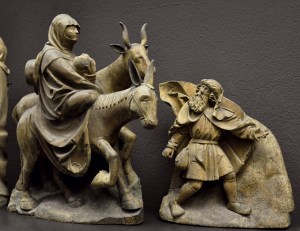
flucht_nach_agypten_liebieghaus_898abIf you find yourself wondering why I’m trying to capture what was a very visual worship experience this morning on text, well, I’m ahead of you. What made it work was the real interaction with the participants, some of them children, some of them adults. I’m not going to attempt to quote any of their contributions here, but instead indicate them by my responses.

Wish me luck.

All right. For the story today, I need some help. I need some folks with energetic feet this morning (I realize this is a rough day to ask for that). But come on down now. Right here. Join me.

No, don’t sit down. We’re moving about today. That’s why you need your energetic feet.

OK. We are now the magi, the wise men who went to bring gifts to the newborn Jesus. So. We’ve read the stars in the sky, and we know that there’s a new king that’s been born in Israel. But… Where do we go? The stars aren’t telling us that much.

Where can we go to find a newborn king?

The North Pole? Well, yes, I suppose so, but that’s awfully far and I doubt we’ll find a King of Israel there.

Well, where do you usually find a newborn King?

That’s right, in the palace in the capital. So we’ll go to Jerusalem!

Follow me up the aisle. Here we go. Now we cut through this pew here, and then up that way. Some of these valleys get pretty narrow.

All right. We made it. Now, can I get somebody to be King Herod? We’ve got to ask him. Great. Thank you.

So, King Herod, where do we find the newborn King?

Perfect. That shrug was absolutely perfect. Folks, this is exactly the shrug that King Herod used when the magi came to visit, because he didn’t know, either. He had to ask.

And the person to ask would be a religious professional. Hm. Are there any religious professionals in the house?

Well, yes, we can ask the Chair of the Board of Deacons, but I did have somebody else in mind.

Me? Why, yes, I am a religious professional. And so, King Herod, I tell you that the Messiah is to be born in Bethlehem of Judea.

Oh, you’d like me to tell the magi that? Now that’s delegation for you!

All right, magi, now we’re off to Bethlehem. Which is down this aisle, and between these pews, and gets a little rocky when we get back up to the front of the church. Everybody here? Great!

Who brought the gifts?

You’ve got one? What did you bring? Spices? Hey, that’s cool. You’re right, they are worth their weight in gold.

Say, gold. What a good idea. Did anyone bring any gold? Wonderful! All right, we’ll leave the gifts here. And it’s time to go home. But… wait.

Now we need somebody to be an angel in a dream. Great, we’ve got you. What’s your message to us?

Not to return to Herod? Because he’s going to do this baby in? Right. Back home by another road.

Now we’re switching roles. We’re still in Bethlehem, but we’re no longer the magi. We’re the Holy Family – granted, a rather bigger Holy Family than three, but that’s great, the more the merrier. And we need our messenger angel to come in a dream again.

What’s that you say, messenger angel? King Herod is after us, and we should go to Egypt?

Oh, you don’t want to go to Egypt? It doesn’t sound safe there, huh? Well, I have to agree with you. But still. We’ve got two options: stay here with King Herod, or go to Egypt. So which is it: Herod or Egypt?

Right. Egypt it is.

So. Up this aisle, and cut across, and down the other way, and across again, and here we are in Egypt.

Yes, I know it looks a lot like Bethlehem.

All right. So, we’ll spend some time here, and watch the baby grow – wow, look at how big he is! – and we’ve got some news that King Herod has died. We can go back home! Joseph’s got family in Bethlehem, so we could go there.

Except that… Herod’s son Archelaus isn’t any better than his father. We’re not going to be safe.

OK. Scratch Bethlehem. Where else can we go?

Nazareth, you say? Well, why not?

With another trip up and down the aisles and between the pews, we’re safely in Nazareth, and Jesus will be safe here.

And it should feel rather like home, since it looks so much like Bethlehem, and, for that matter, Egypt. And like Church of the Holy Cross in Hilo.

I thank you so much for coming up and helping. I hope it’s given you a sense, if not of how far everybody traveled, at least of some of the difficulties they faced, and the roads they followed. I hope you’ll all travel your roads with God’s help all along the way.

One final note: the lay leader observed that reading the Matthew 2 text after this “story” was a tad anticlimactic.

Magic Words

2mhane

Painting by Jacob Hane

‘Twas the week before Christmas
And all through the house,
The children were screaming –
And they’d frightened the mouse.

Well, I’m afraid that’s as far as my memory will let me get with rhyming. So I’ll have to tell you the rest as a story. OK?

Sometimes, when children are screaming, it’s good screaming. Sometimes you’re just so happy or full of energy or overflowing with good feelings that they come out at full voice. And if everybody else is doing the same thing, well, it just gets louder and louder, doesn’t it?

Unfortunately, on this day, in this house, the screams weren’t happy screams. The kids were screaming with anger.

They’d reached the point – you’ve been there, right? – where they’d forgotten what they were mad about. It was all just yelling and name-calling and sorrow and rage now. Lots and lots of screaming.

One of the children went in search of the mother, who had sought a place at the far side of the house in the (forlorn) hope of escaping the screaming din. The child, with some difficulty because of the way tears and indignation combine to disrupt a coherent story, demanded that the mother come and stop all the rest of the children from being jerks.

“Well,” said the mother, “why don’t you just use the magic word?”

The child had some experience of this, however, and would not be put off by this ploy. With folded arms, a tossed head, and (I’m afraid) rolling eyes, the child informed the mother that “Please” had already been tried and the other children were still jerks.

“All right,” said the mother. “Why don’t you try this one?”

Leaning over, she whispered softly and briefly in the child’s ear. The child’s face went through the contortions of surprise and puzzlement, but recognizing that this step had to be taken before anything else happened, the child made the trip back to the other side of the house and the screaming room.

The screaming, I have to admit, continued.

But a few minutes later, one of the other children appeared before the mother with the same complaint. Once again, she whispered a few words into the ear, and the child exited her room, with a face filled with surprise and doubt.

The screaming continued, but with somewhat less volume.

One by one, all the children made their way to see the mother, and one by one returned with the same whispered instructions. Finally the last and littlest one seized her hand and would not let go until she, too, made her way to the surprisingly quiet screaming room.

The children were no longer screaming. They were repeating their magic words, sometimes one after another, sometimes overlapping each other, sometimes all at the same time. Their faces held the surprise that had overwhelmed them some time ago when the screaming faded away.

They were all saying, “I love you.”

I can’t promise that those words will magically end any of the screaming matches you find yourselves in. I can definitely tell you that it’s worth trying: It’s worth trying to say them, and it’s definitely worth trying to live up to them.

As for the mother, she smiled.

This story takes its inspiration from one told in my hearing some years ago by the Rev. Dr. Ronald Brown, senior pastor of First Congregational Church UCC in Southington, Connecticut. I haven’t found that story available online, but you’ll find Ron’s wit, wonder, and wisdom on his blog.

The Box

53e50304-51fa-4840-be1a-af2a2887612c

Boxes

This story is about a family that was having a difficult December.

Mostly, they were doing OK. Everyone was healthy, and their home was a happy one. But some bills had to be paid just as the month began, and their savings dipped. There was still plenty to offer their daughter plenty of presents, though, and to have a festive meal.

They came home one day, however, to find that the kitchen refrigerator had stopped humming. Their first clue, I’m sorry to say, came when they opened the door and two things happened: (1) the light didn’t come on and (2) a really sour smell came out. All the food in the refrigerator had spoiled when it stopped working.

They called a repair person, but that worthy individual just shook his head and said, “That’s it for this one.” The family had to buy a new refrigerator just before Christmas.

That brought their savings down quite a lot, and replacing the spoiled food made a big dent in what was left. The parents knew there wouldn’t be many Christmas presents for their daughter that year, and a sadness crept into their holiday smiles.

On Christmas morning, however, their daughter showed no disappointment when fresh fruit rather than toys filled her stocking. She peeled her orange and promptly stuck one of its sections into her mouth whole. When she peeled back her lips in an impish grin, the fruit section smiled orange for her.

Beneath the tree, the small stack of boxes mostly contained clothes – she was growing, of course, and truly needed the new outfits. She showed now disappointment at the lack of toys, though. She glowed with pride that she was probably the only girl in her class who would have Spider-man pajamas.

As the last box passed from wrapped to unwrapped, the parents glanced at each other sadly at how little she had to play with from her Christmas morning. Their daughter, however, didn’t hesitate at all. She made a beeline for the kitchen, where the cardboard box for the refrigerator still stood beside its former contents.

“Can I play with this?” she asked.

Over the next few hours, it became a house, then a castle, then a cabin on a mountain, then a mountain itself, then a boat, then a treehouse, and finally something that she called a “creaturecrater” and refused to explain to her parents, solemnly informing them (with a giggle in her voice) that it was a secret.

For the next week, and all through the holiday break, she was the most popular child on the street, as all her friends filed through to play in the house, or on the mountain, or in the boat, or amidst the “creaturecrater.”

But this story isn’t about her, nor is it about her amazing big box. And it’s not about how she made a lot of fun for herself out of something ordinary, or about making the best of things. All those happened, but that’s not what this story is about.

This story is about the smiles on her parents’ faces as they held hands on the sofa and watched her play with the box. This story is about their fears that they could not give their daughter joy at Christmas – and how, instead, she gave theirs back to them.

I think we all can help those we love find joy at Christmas. Do you?

You do, too?

Then let’s do it.

The Climber

christmas-treeThe boy in this story loved to climb. Oh, my, how he loved to climb.

He was young – three or four years old, say – and he climbed everything in sight. If there was a chair, he’d climb it. If there was a stair, he’d climb it. If there was a sofa, he’d swarm up it until he perched on its back. If there was a bush, he’d worm his way among the branches until his face poked out the top. Hills and counters were all one to him.

His favorite, of course, was to climb people (he was three or four, after all). Seated people were the easiest, but he’d clamber up the standing people as well. One moment he’d be on the floor, and the next moment he’d be waving from the shoulders.

It’s possible, just possible, that he got a little help on the way up to the shoulders.

There was one exception to his love for climbing, though, and it was the stepladder his parents set out when it came time to decorate the Christmas tree. I don’t know why he didn’t like it. Maybe it wiggled in some way that seemed wrong. Maybe the steps were too far apart. Maybe he didn’t like the color (it was bright yellow, and doesn’t that just scream “Danger!”?).

Whatever the reason, when his parents set it out so that he could climb onto it to put decorations on the tree, he wouldn’t go near it. He didn’t even put his hand on the uprights, let alone a foot on the treads. He placed his ornaments from the safety of the ground and, it must be admitted, from the extended arms of his father who held him out like a person-shaped crane.

Even at three or four, though, he knew that a ladder shouldn’t hold him back (or at least on the ground), and he determined that next Christmas he’d make a start on that ladder. He wouldn’t go for the top – not yet – but maybe the first rung would be an accomplishment.

That’s how it went. The next year he summoned his faltering courage and put one shaking foot on that first tread, then the other. Between the step and his growing height, he could reach further up the tree with his ornaments. The next year, on the second step (and still taller), he reached higher still.

He was determined to reach that highest step, and place the star on top of the tree with his own hands. Someday. Year by year, little by little, he’d make his way there.

Has he reached the top? Well, no. He’s still young, and there’s a few steps left on the ladder. He’s making progress, though, each year a step higher.

He knows where he wants to go. He knows what heights he wants to reach. He knows that he wants to be the one to place the star.

To Win or to Play

kids-soccer

Photo by Susan Lloyd, used by permission

This story has no squirrels, no mongoose, and not even any ‘apapane in it. In fact, it doesn’t have any furred or feathered creatures in it at all, unless you count the hair on our heads as fur.

This story has actual people in it.

It’s about a soccer coach.

It was his first time acting as a soccer coach, and his team were all brand new to the sport: young, growing, and excited to play on their first team of anything. At the first practice, they were all over the place. A couple of them ran up to the stationary soccer ball and kicked at it so wildly that they missed it completely. A couple more kicked it where they wanted it to go, but rather more shanked it to the right or watched it careen off to the left.

It had to be said, they weren’t terribly good. But they shouted merrily, called encouragement to each other sometimes, and (rather more than they should, perhaps), laughed when the ball sailed off to the sides again.

And they got better. The coach taught them skills, and they learned. He got to know which children had natural ability, and which ones had to work hard. He got to know which of them picked up skills quickly, and which ones needed more demonstrations, and which ones might never get it. He got to know which ones would be the better players on his team, and which would always struggle.

Their first game wasn’t pretty. In the excitement, most of them forgot to stay in their positions, and instead they all converged on the ball, so that a knot of players (from both teams, it’s true) bounced up and down the field with the ball. Practice after practice, game after game, they did get better. They won some, and they lost some.

The coach could see which players had the skills, and which ones were developing the skills, to make a winning team. These were the ones who played their positions and remembered the plays. They could (mostly) kick the ball where they wanted it to go. They kept moving, and they kept their heads.

Gradually, it was these players who spent more time in the game, and the others, who hadn’t learned so well, played less and less.

Then came the game where one on the team didn’t play at all. The next match, it was two of them.

It was one of the better players who dared to speak to the coach. “Look,” he said, “I know that you’re keeping some players in so that we can win. But we’re all here because we want to play. Even more than we want to win, we want to play.

“Could you make sure that everybody gets some time to play?”

On other teams in other times, they might value winning over playing. Here at the start, they favored playing over winning, and friendship over victory.

Myself, I hope that everyone everywhere gets a chance to play, and to share in the game.