Grit

A gentle hand applied the consumed palm

Leaves to my skin last eve. No oil here,

Just coarse and grainy dust, a deep

Gray stain upon my brow. “Remember you

are dust, and that to dust you will return.”

The dust of Earth, as Genesis infers,

Is dust of all creation: Hydrogen

Which makes two-thirds of all the water in

My cells is even now ignited in

A conflagration glorious, that glows

Serenely in each star and bathes this globe

With energy that is the root of life.

Dust, yes, but dust of majesty! And when

I lay this body down at last, its dust

Can then return to Earth, stems spring from it

And reach unto the Sun: the living dust

Arising to the splendid, blazing dust

Of fire. Still, the coarse and grimy cross

Emblazoned on my countenance evokes

As well the harsh realities of life,

The grit of illness, pain, and death,

The grating sense of sorrow, injury’s

Affliction, and the misery of sin.

Gray grains of glory and gray grains of grief

Creation manifest in this crude cross

Of grit.

Ash Wednesday Before Dawn

So it begins…

Another Lent has come

With its demands of piety, privation,

Discipline, devotion,

Confession, contemplation,

Absolution, abstinence, 

And ashes.

Awake before the spinning world

Turns my face to the cheery sun

You summon me from rest

To this, a consecrated concentration

That rests, in its own way,

My whirling mind.

“Sufficient unto the day is the evil thereof,” 

You said so long ago,

That those who heard 

(And those who heard from them),

That even I

Might lay aside tomorrow’s cares and ills

To live entirely in today.

Such a facile phrase!

Yet has there ever been

A task more trying?

So here before dawn’s rosy fingers

Stretch across the hills

I tune my thoughts,

Settle my spirit.

Let the disquiet and distractions

Kindle with the leaves of last year’s palms

And fill this solemn season

With ashes of anxiety

All aglow with grace.


#face for #lookinlent

Saturday

Upon my shoulders I lay the stole

Rough-woven cotton dyed bright blue

The symbols of the faith shine boldly:

A chalice, a chi rho, a city gate, a cross.

This is a borrowed stole

I wear it as we celebrate the life

Of the kind soul who wore it

The soul now passed on to the One

He served so well.

Wednesday

I park the car and walk back down the hill

To where the door swings open

Before I even grasp the handle.

No stole upon my shoulders:

Instead the charcoal grey of my lapels

Bears only one small spark of color,

Red and gold proclaiming

That God has not stopped speaking

And even the finality of death

Is only a pause in the grand sentence

In which God speaks our lives.

Upon the satin pillows I regard the face

Of a man I’ve known for many years

Suddenly diagnosed, suddenly ill,

Suddenly critical, suddenly gone.

How strange the stillness

When what I remember best

Was the sudden smile

And the twinkling eyes

When he’d see me unexpectedly

And we’d catch up on the family news.

I pray God’s comfort for those who grieve his loss,

And I pray new joys for him.

“He’s due new joys,” I say,

And his sister agrees.

Thursday

Once again the charcoal suit.

Once again a door I need not touch

Swings open and I join another line.

Amidst the strangers suddenly

The familiar face whom I’d expected.

It is his sister whose life we mourn,

A woman whom I never knew as an adult –

I recall an adolescent girl

Sometimes amused by her big brother,

Sometimes annoyed, sometimes determined

She will get his goat (and the goats of all his friends);

Sometimes desiring her own space,

Sometimes wondering when she’ll be that old.

I greet her parents, who remember me

(and things about me I do not recall)

I greet her children, and her son’s companion,

I look upon the face that rests upon the satin,

A face that I had never seen in life

As an adult.
Thirty-one years ago, in this very room,

I looked upon the face of another woman,

A face which I had never seen as teen or child,

The face which had looked down on mine

In cradle, crib, and stroller.

Like this young man, like this young woman,

I waited as the line

Of mourners filed through

To take my hand, assure me of their sympathy,

Some family, some friends,

Some much like I would be, decades to come,

A stranger to the son whose mother lies

Where we so wish that she were not.

Saturday, Wednesday, Thursday

In just six days, three times I must #face death

In just thirty-one years, I have long since lost count

Of funerals and wakes, receptions and remembrances.

In just eight days, when Good Friday comes

I will recall another death

Endured by One I worship as the source of life,

Transformed by Jesus into life eternal,

Life redeemed.

A charcoal gray to demonstrate respect

An azure stole to celebrate a minister

A scarlet comma edged in gold

To faithfully declare

That Death’s is not the final word

And at the end of human life,

Our God has placed a comma,

For there is more to come

#blind for #lookinlent

Braille_text.JPG#blind may be an inevitable metaphor for a species that, in the main, relies so heavily on one particular sense to make its way through the world. It turns out there are other people in the world who see a greater range of colors than most; it turns out there are animals that see a greater range of colors than any human – and we see a greater range than any member of some other species.


Would we, would they, consider the others #blind?

Would a dog who could only smell scents in the range that I can suddenly feel blinded, with a more limited sense of the world? I wonder.

When a family member meets the legal definition of #blind – when she reads Braille in preference to monumentally magnified text – then the inevitable metaphor becomes a commentary, intended or not, on someone I dearly love.

Let’s face it, with blindness comes a certain degree of ignorance. I know more things about my environment, because I can see it, than someone who can’t see it does. I’ve spent a good deal of time serving as a guide through unfamiliar spaces. And I’ve read many, many menus aloud because there wasn’t one available in Braille.

Blindness, however, is not a moral condition, and that’s where the metaphor frequently fails. Ignorance is not a moral condition, either. It’s a state of knowledge, and best of all, it’s correctable. Someone who can’t see overcomes their ignorance of their environment in different ways – some with dogs, some with canes, some with a supportive elbow, and nearly all with repeated experience.

In short, the average #blind individual routinely seeks to learn what they do not know.

When we use the metaphor, however, all too frequently the person described as “blind” is one determined to maintain their ignorance. That’s a slander. I know from experience that a #blind person can be plenty stubborn, but determined to maintain her ignorance? No. What would be the point?

What is the point of determined ignorance?

Far better to feel your way through the world. Far, far better.

#healing for #lookinlent

After fever, cough, and chills

#healing comes and I am grateful.

It’s not so swift as it used to be.

I guess #healing aged as much as I;

We both move more slowly than we did.

#healing comes with time.

How long, I wonder, will it take to heal from grief?

And grief, and loss, and loss again?

Too, too many gone who had a place within my heart

And too, too many gone whose place was in the hearts

Of others.

#healing comes with time – long time

And time, of course, given to #healing

Not frittered to distraction.

I’m much better at the latter.

Worse still, I find, is #healing from betrayal,

Betrayal in a promise given,

Betrayal in a trust conferred.

Betrayal, if I’m honest, which I have committed

As well as that which I still suffer now.

Now: there’s the word.

Why does #healing take so long

When the hurt is so, so deep?

#healing comes with time

The Kiss of Judas by James Tissot

#healing needs much time

Which leads me then to wonder

How long after the creatures God had made

Betrayed the trust implanted in their souls at birth,

How long after we rejected God’s out-reaching

Hands and arms and grace,

How long after we denied, or ran,

Or for silver’s sake

Betrayed

Did it take

For God’s own #healing to arrive

And dry the tears

Of the Divine?

#cloud for #lookinlent

#cloud is an ephemeral creation

Rather like its element of water

It wisps across the sky in lacy veils

Sunset over Silver Lake

Incarnadined by sunset

Then settles greyly, grimly onto a groaning planet

Which then rejoices in life-bearing rain.

Even photographers cannot agree:

A grey day on the beach muffles drama

But lends softness to the portrait.

The fog bank settles like a wall

But parts to let the traveler pass –

Which the unwary captain may regret

When reef proves less permeable than mist.

I’m still most captivated by the rarest view of #cloud

(At least in my experience)

Looking from the odd side, as it were,

Above the cloud.

They float, I float,

Far above the ground.

I may not walk among the angels yet

But what a dance that will be!

When soft mist bears the weight of foot

And cold wall parts so hand and hair can fly

Away in celestial exaltation.

So I tell myself, knowing full well

That whatever life may be when this one ends

It is more difficult to define in the here and now

Than a #cloud.

#stubborn for #lookinlent

I really don’t want to talk or to think about Fred Phelps.

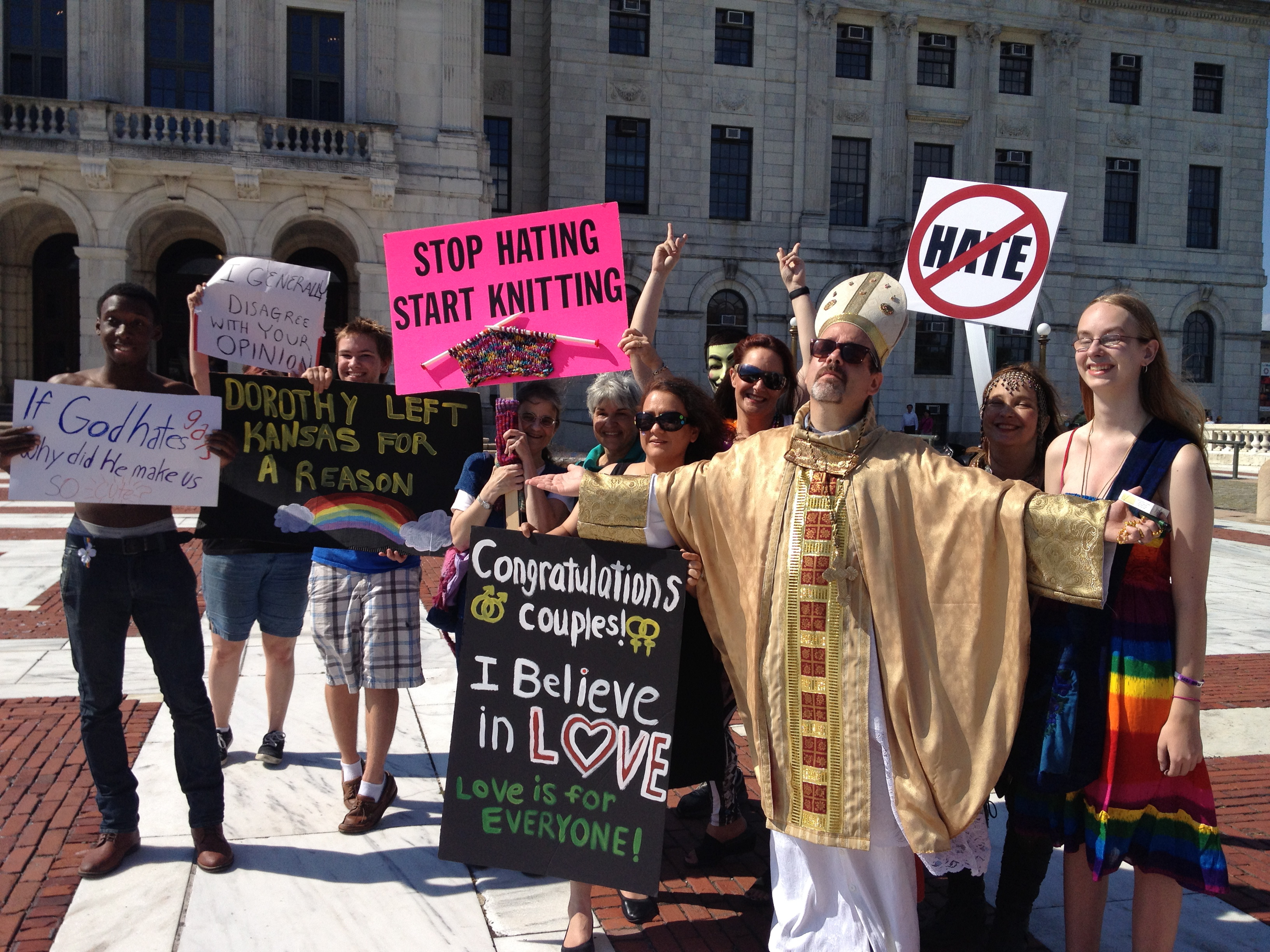
Protesters hold anti-hate signs

Demonstrators counter-protest the WBC on August 1, 2013, as same-gender marriage takes effect in Rhode Island.

By following the extreme logic of their extreme beliefs, he and his family – hardly the worshipful gathering that would dignify the name of church – succeeded in gaining attention far beyond their deserts. Their primary tactic was – sadly, is – abominable behavior. And the society they would have us create in their image would be hellish: either an endless sea of incoherent rage, or lock-step automatons all following the same deadly creed.

I do not want to think about Fred Phelps.

I do not want to think about a trait we have in common. We’re both #stubborn.

I recognize that piece of myself in the relentless efforts to hold back the tide. I do believe that, however long it be, the arc of the moral universe bends toward justice for the disenfranchised, and that includes persons of color, women, those with disabilities, and Phelps’ sworn enemy, those who are LGBTQ. In some ways the arc is bending faster than I’d expected – I never expected to see legal marriage between same-gender couples in my lifetime – and in some ways the arc is bending slower – why, oh why, do African-Americans suffer so much worse than their white counterparts from poverty, unemployment, and violence?

Unlike some, I do not believe in universal salvation. I believe in the forgiveness of God, but also in the righteous judgement of God. I believe that what we do in this life matters. I believe we have a part to play in coming to a reconciliation with God. As my New Testament professor Charles Carlston said many years ago, universalism denies two things: the sovereign power of God to judge and the full capacity of human beings to screw up.

I may have paraphrased him a bit there.

The next critical step, of course, is to remember that the judgement doesn’t belong to me, it belongs to God. So I’m trying to be cautious of judging Fred Phelps himself, even as I have no difficulty condemning what he did. I wonder just how #stubborn he is.

You see, I expect that when I meet God face-to-face (if that’s how it works), I will learn about a whole raft of things that I’ve been wrong about. Many of them, I hope, will be trivial. I’m pretty sure that more than a few will not be. What will that be like? Can I let go of those critical things in order to be reconciled to God?

I hope I wouldn’t be so stubborn that I wouldn’t.

And Fred Phelps? When he comes to the Pearly Gates (if that’s what they are), I believe he’ll find the souls of those he’d picketed waiting for him there: soldiers, Fred Rogers (whose birthday is today), and Matthew Shepard. How will he react? It almost seems that he’d prefer to picket outside the gates of Heaven rather than enjoy its joys with them. Perhaps.

If a person brought to heaven the view that some were there who should not be – and was too #stubborn to let that go – would that not turn Heaven into Hell?