I didn’t want a divorce but I got one, Jesus. A broken relationship handed to a judge. No prison, but I’ve never been released.
So many gifts I’ve laid before your altar never certain whether there was someone I had hurt. But no, I lie. There was always someone whether I knew or not.
To reconcile, though – ah, there’s the rub. For now I’ll ask “On whose terms, precisely, Jesus? I have my injuries, my hurts. Who’ll make their peace with me? Who’ll listen to my terms?”
Don’t say it, Jesus. I know just what you’ll say to such a question; you’ve no need to say, “My terms.” Oh, go ahead. I’ll wait. Just say it… Oh. You did.
A poem/prayer based on Matthew 5:21-37, the Revised Common Lectionary Gospel reading for Year A, Sixth Sunday after Epiphany.
Sometime toward the end of 2018, a Tweet (that I can no longer find) challenged weekly preachers like myself to include a quote from a non-white, non-male, non-straight person in every sermon of the coming year. Intrigued, I decided to do it.
I was a little worried about finding those quotes.
I wasn’t worried that the materials didn’t exist. I know very well that people of every gender identity and every race have done great work in theology, social commentary, and Biblical studies. That didn’t mean that I’d have success in finding it. My personal library’s authors are predominantly white and male (and presumably heterosexual). I’ve been using online commentaries as a research aid, but hadn’t deeply considered who the authors were. I knew I’d been quoting particular people fairly often, and that some of these were women or people of color, but in what proportion? I didn’t know.
As it happened, finding those quotes was quite easy. There are several solid websites around offering lectionary-based commentary to preachers. In some cases, the editors have intentionally sought diversity in their contributors. When a site has several years of commentary available (as Working Preacher does), it increased both the likelihood of finding strong quotes from non-white, -male, and -straight voices and widened the spectrum of perspectives I read about a text.
The remarkable aggregation site The Text This Week has the virtue of several years of material and also of casting a very large net. Even when its editor is behind on things because of life challenges, it remains a must-visit collection for its links to prior years’ commentaries.
Record-keeping was the bigger challenge.
I’m a geek (note the title of the blog). I decided that the best approach to a question like this was a database, so I built one. Each quote gets its own record. Each person quoted gets a record as well, and I record their gender identity, race, religious affiliation, time period, and some other information. Sometimes that information was not easy to find, by the way.
It was pretty easy in any week to see that I had or hadn’t met my objective. At the end of the year, a report confirmed that I had met the goal.
I’m quite grateful to the challenger (I just wish I could be certain who it was). They brought my attention to something I hadn’t thought about, and I plan to keep that attention. I’m also grateful because I rather like my quote-recording tool, and I’m thinking about ways to make it useful in other ways as well.
Thanks for the challenge. I’m pretty sure it made me a better preacher this past year.
Searching for hymns that used the Beatitudes as their inspiration, I was quite surprised to find very few of them. And, well, I decided to add one. It was first sung in worship at Church of the Holy Cross UCC, Hilo, Hawai’i, on February 2, 2020.
Upon the mountain, Jesus sat with all his friends about him, The crowds drew close and silence fell. He taught them without shouting. He spoke of blessings to the poor. He spoke of new creation. He spoke of a world overturned when mourners find their comfort.
You meek take hope, the earth is yours, though others pride to take it. The ones who thirst for righteousness will drink until they slake it. There will be mercy for the ones whose mercy flowed in rivers. The pure in heart will see our God in majesty forever.
You who make peace have always been the children of the Maker, And so are those who suffer for their holiness of labor. If you are caged and tortured for your witness to redemption The gates of heaven will open wide when you are present to them.
The hardships of the world are real, as human eyes keep weeping, But every tear that falls is held within the Savior’s keeping. Blessed are the humble, meek, and poor; the pure in heart, the peaceful. Yes, God embraces those who bear the burdens of earth’s evil.
The image of the Sermon on the Mount is an etching by Jan Luyken from the Phillip Medhurst Collection of Bible illustrations housed at Belgrave Hall, Leicester, England (The Kevin Victor Freestone Bequest). Photo by Philip De Vere. Credit: Phillip Medhurst – Own work, CC BY-SA 3.0, https://commons.wikimedia.org/w/index.php?curid=20116195.
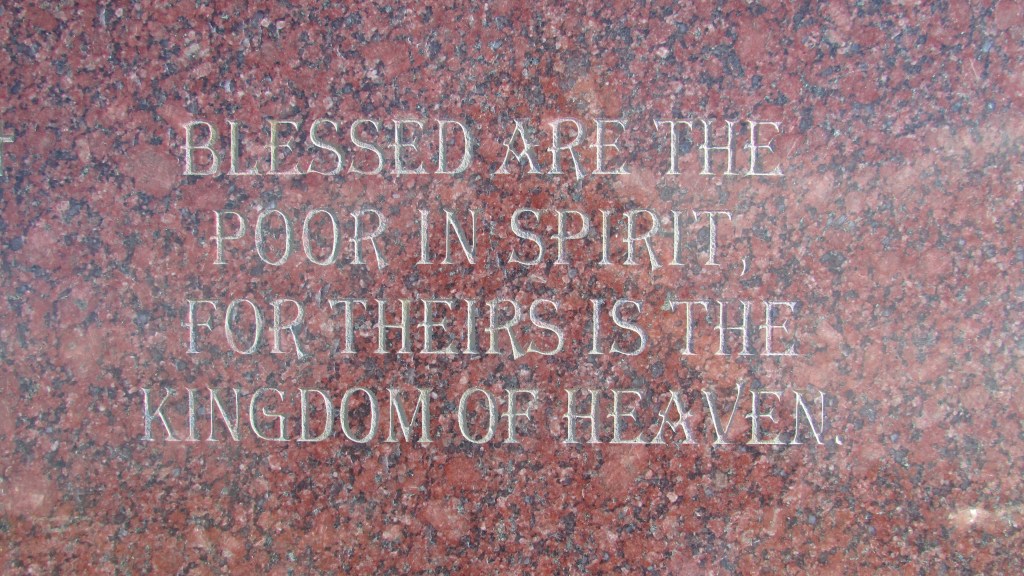
You can stop right there, Jesus, after beatitude/blessing/makarios (Hey! I can pray in Greek!) the first. You know as well as I the poverty of my spirit.
No mustard seeds to see, no pearls beyond appraisal, no fields a-hundred-fold to view for you. Just sighs and bluster nearly equal there.
So you might want to think again about this notion you would make the realm of heaven mine. I can’t conceive of an idea much worse despite the virtues of the thinker.
For you to give the realm of God to me is just as ludicrous as if you gave the keys of heaven to a fisherman named, “Rock.”
Oh. That’s right. You did.
A poem/prayer based on Matthew 5:1-12, the Revised Common Lectionary Gospel reading for Year A, Fourth Sunday after Epiphany.
“How can I do that? My hands are full with the lines of the net I just cast, Andrew. Haul it in yourself.”
“Must I do everything?”
“No. Just haul your own net in.”
Sigh. “Just give me one hand, Simon. This one’s heavy. First mine, then yours.”
Sigh. “All right then… Got my lines together. Here’s my hand. Give the call to pull.”
“Pull! Now pull again! OK, move your hand along; I’ve got it steady… PULL!”
“Well, you weren’t kidding. That’s a heavy net.”
“Thanks, Simon. Let’s do yours.”
“All right. Oh, look.”
“Look where?”
“Behind you, Andrew. There’s that Jesus coming back.”
“Did he leave?”
“I thought he did. He went down the Jordan, where that fellow John’s been preaching. I didn’t think that he’d be back.”
“He’s always been a funny one. Half a foot on earth and half in heaven.”
“Yeah. But here he comes.”
“It’ll be good to see him.”
“Yeah.”
“Well, here’s my hand. Let’s get your net hauled in, my brother.”
“Maybe Jesus will be impressed how good we are at catching fish.”
A dialogue based on Matthew 4:12-23, the Revised Common Lectionary Gospel reading for the Third Sunday after the Epiphany.
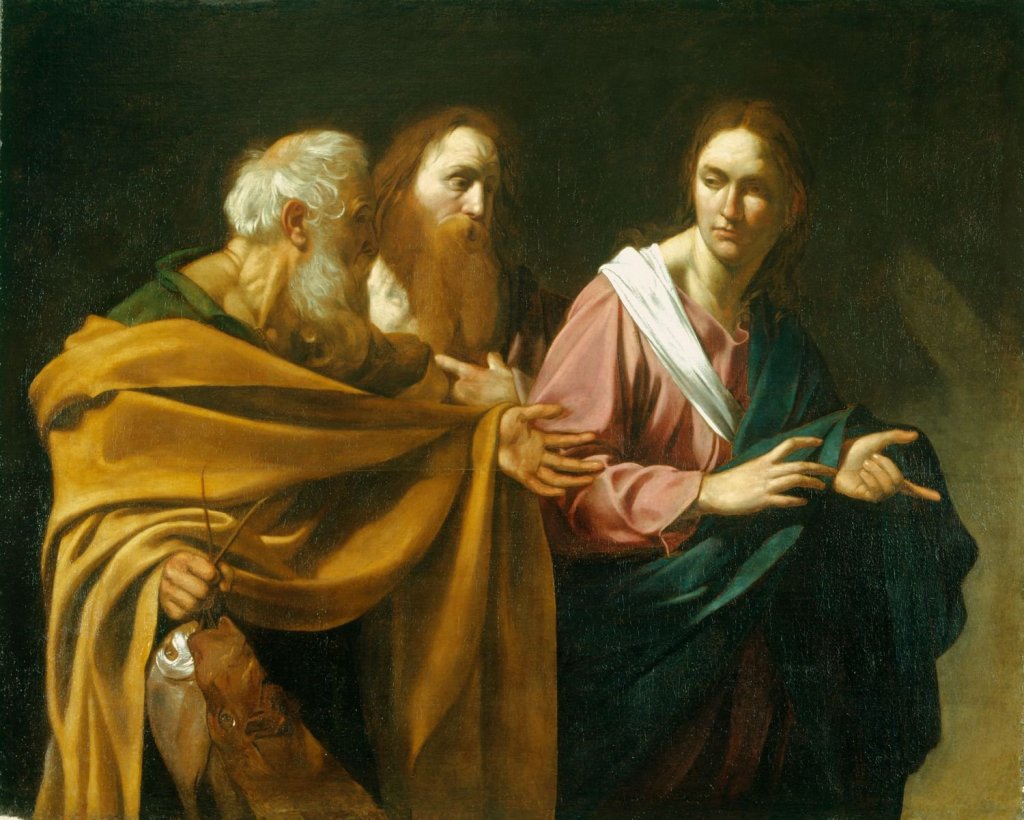
The image is The Calling of Saint Peter and Saint Andrew (Vocation de Saint Pierre et Saint André) by James Tissot – Online Collection of Brooklyn Museum; Photo: Brooklyn Museum, 2007, 00.159.56_PS1.jpg, Public Domain, https://commons.wikimedia.org/w/index.php?curid=10195832.
2019 began in modified delight. Both Brendan and Rebekah had been with me for Christmas in Hawai’i, but Brendan flew back to Boston and the Starbucks counter on December 29. Bekah, on a student’s holiday schedule, stayed until January 14 before flying back to cat and classes at Union Theological Seminary in New York City. I wish my son had been able to stay longer, but it was a delightful way to begin the year. Bekah and I were able to sing together at Church of the Holy Cross and also for Pu’ula Church’s ‘Aha Mele.
I welcomed a number of visitors this year, some as special guests of the church and others as friends (and one or two as both). They included David Vasquez-Levy, President of the Pacific School of Religion; my seminary classmate John Madsen-Bibeau; my Uncle John and Aunt Lana Simonds; Tracy Barnowe of the Hawai’i Conference staff; Connecticut Conference Minister Kent Siladi; former Silver Lake Conference Center A-Team Coordinator Jesse Huhn; friend and colleague Liz Miller with her spouse Beth Scanlon; Hawai’i Conference Minister candidate David Popham (he preached at Holy Cross as Conference Minister toward the year’s end); and dear college friends Polly Goldman and Bruce Feist.
I did some traveling, too. It was a General Synod year, and the editors at United Church News asked me to join the news team for the denomination’s national gathering again. I wrote stories and took photos for both the national coverage and the Hawai’i Conference. Or to put it another way: I wrote a thing.
Synod is also a UCC family reunion, so I got to see lots of friends and even family. Rebekah attended as a delegate for UCC Disabilities Ministries and led a workshop with proud poppa in attendance. It became a story, of course, that father and daughter met in Milwaukee, halfway between their homes.
With Synod over, I took a week to visit the East Coast, which wasn’t enough time. I shuttled from Brendan’s home in Boston to my brother Christopher’s in New Haven to Paul Bryant-Smith’s in Norwalk to Rebekah’s apartment in New York. Paul and I enjoyed playing a Boys in Hats concert in Danbury, including some participation from Bekah and with Brendan at the camera.
That was my only formal concert performance for the year. In May, however, the Faith Hui held a dinner to give thanks for all the work we had done together during the 2018 eruption. I sang for a fair amount of that event, including an original song in recognition of the crisis. Much later in the year, I was astonished to receive a certificate of thanks from the state Senate for my small part in doing that work during the disaster.
The summer set another crisis in sharp relief: the dispute over appropriate use of Mauna Kea, sacred to some Hawaiians and bearing or symbolizing sacredness to others in different ways. At the request of Connie Larkman at United Church News, I put on my reporter hat again and wrote “Conflict of souls around Hawai’i’s sacred mountain.” The story fails to describe fully the depth of emotion around the issues. The dispute revealed existing fractures in the community that we had been accustomed to discount or ignore. Kia’i blocked the access road for months in numbers from less than a hundred to over 3,000. Everyone was determined.
I spent the fall trying to help my congregation build resilience in stress and deepen their listening skills. At some point, the particular question of the Thirty Meter Telescope will be settled, though I doubt it will be to everyone’s satisfaction. We will still need to live with one another in the community. We will need skills to do it.
We lost some very special people in our congregation over the year. Blanche, Karl, Millie, and Anita just at year’s end. All Saints’ Sunday in October was very poingnant.
I did quite a lot of other writing this year. I edited and contributed to a Church of the Holy Cross Lenten devotional Open the Heart. On my blog, I continued to write a poem/prayer each week based on the lectionary texts. As Advent approached, we repeated An Advent of Giving, with new devotionals by yours truly.
I took a lot of pictures of sunrises in 2019, in great part because I took morning walks for several months before some mole removals led me to take a break that, um, hasn’t ended yet. My hope is that the symbol of sunrise dominates 2020: new beginnings. Light. Hope.
In the manger of Bethlehem, the infant sleeps. On the Judean hillsides, the shepherds seek their flock. Which of the parents dozes? The father? The mother? Neither one? Both? Love made flesh, power made weak, Majesty made lowly, will soon awake in tears, Seeking the warmth of skin and blood and milk.
Let that infant grow within our hearts. Let that love take form within our purpose. Let that mercy take shape in what we make. Let that peace enfold those we embrace. Let that grace shine forth just like that star: Let the work of Christmas begin in me. Let the work of Christmas begin in us.
A poem inspired in part by Luke 2 and in part by “The Work of Christmas” Howard Thurman. This poem was written for the Christmas Eve meditation of December 24, 2019, at Church of the Holy Cross UCC, Hilo, Hawai’i.