You know what an ‘ea is, right? It’s the Hawaiian name for a hawksbill turtle. They live in the sea, and hardly ever come to shore.
So. One day an ‘ea was sort of lazily swimming along the beach, when along came a group of people. They were part of a church and they were there so that some could be baptized.
The ‘ea watched, first rather lazily, but as time went on she got more interested. The people were talking about how much God loved everybody, and how they should share that love with everybody else. The ‘ea thought this sounded like a wonderful idea. Then, one by one, the people to be baptized stepped into the water with the leader, ducked beneath the rolling waves, and came back up to everybody’s smiles and applause.
The ‘ea was particularly impressed with how broad the smiles were of everybody stepping back onto the beach. With the water still streaming from them, their grins seems to add new sunbeams to the day. The ‘ea, in fact, couldn’t help smiling as well.
Or at least trying to. An ‘ea’s mouth, sad to say, isn’t built to change expression.
So the ‘ea decided to become a Christian.
How to do it, though, remained a puzzle for her. Clearly Christians were baptized, but the ‘ea observed that she’d been baptized nearly all her life, having spent all but a few moments surrounded by ocean water. She didn’t think it would work well to go live on the shore. Her flippers moved her gracefully through the currents, but she’d done enough sunning on the beach to know they were decidedly awkward on land.
The people didn’t help, and I can’t really blame them. They hadn’t thought at all about the problems of a sea creature who’d overheard them – in fact, they didn’t know she’d been listening. So they left her with an awkward question:
“How do I stop being baptized?”
She stayed near the beach for a few days, hoping the people would come back, but even when they did she didn’t overhear the answer to her question. So she decided to go find an older, wiser ‘ea. Perhaps one of them would know.
It took a little while, but she found one, and she described the scene on the beach, the words of love, the entry into the water, the smiles, and the steps of a new life on the land.
“I want to be a Christian,” she told the older ‘ea. “How do I stop being baptized?”
The older ‘ea thought about it. He turned lazily about in the rollers as he did. After a meditative spiral crowned with a gentle loop and a slow roll, he came back and said:
“I’m not sure you do stop being baptized.”
Even without a face that moved much, her confusion must have been evident, because he went on.
“I think God’s love surrounds you all the time,” the older ‘ea told her. “In fact, the ocean bears you up just as God’s love carries you along. Even those humans, once they’re out of the water, dry, and on land, are still surrounded by God’s love. They’re being held up and they’re swimming in an ocean that they can’t feel with their senses, but they know it’s there.
“Isn’t it lovely to be an ‘ea, a sea turtle, where you always feel God’s love right on your skin?”
“I also think the ocean – of water or of God’s love or both – can carry you places where you can share awareness of that love with others. As you did today with me.”
The younger ‘ea watched him slowly roll through the ocean of God’s love, and said, “As you did today with me, too.”
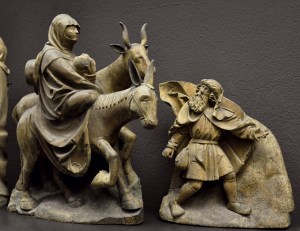
If you find yourself wondering why I’m trying to capture what was a very visual worship experience this morning on text, well, I’m ahead of you. What made it work was the real interaction with the participants, some of them children, some of them adults. I’m not going to attempt to quote any of their contributions here, but instead indicate them by my responses.
Wish me luck.
All right. For the story today, I need some help. I need some folks with energetic feet this morning (I realize this is a rough day to ask for that). But come on down now. Right here. Join me.
No, don’t sit down. We’re moving about today. That’s why you need your energetic feet.
OK. We are now the magi, the wise men who went to bring gifts to the newborn Jesus. So. We’ve read the stars in the sky, and we know that there’s a new king that’s been born in Israel. But… Where do we go? The stars aren’t telling us that much.
Where can we go to find a newborn king?
The North Pole? Well, yes, I suppose so, but that’s awfully far and I doubt we’ll find a King of Israel there.
Well, where do you usually find a newborn King?
That’s right, in the palace in the capital. So we’ll go to Jerusalem!
Follow me up the aisle. Here we go. Now we cut through this pew here, and then up that way. Some of these valleys get pretty narrow.
All right. We made it. Now, can I get somebody to be King Herod? We’ve got to ask him. Great. Thank you.
So, King Herod, where do we find the newborn King?
Perfect. That shrug was absolutely perfect. Folks, this is exactly the shrug that King Herod used when the magi came to visit, because he didn’t know, either. He had to ask.
And the person to ask would be a religious professional. Hm. Are there any religious professionals in the house?
Well, yes, we can ask the Chair of the Board of Deacons, but I did have somebody else in mind.
Me? Why, yes, I am a religious professional. And so, King Herod, I tell you that the Messiah is to be born in Bethlehem of Judea.
Oh, you’d like me to tell the magi that? Now that’s delegation for you!
All right, magi, now we’re off to Bethlehem. Which is down this aisle, and between these pews, and gets a little rocky when we get back up to the front of the church. Everybody here? Great!
Who brought the gifts?
You’ve got one? What did you bring? Spices? Hey, that’s cool. You’re right, they are worth their weight in gold.
Say, gold. What a good idea. Did anyone bring any gold? Wonderful! All right, we’ll leave the gifts here. And it’s time to go home. But… wait.
Now we need somebody to be an angel in a dream. Great, we’ve got you. What’s your message to us?
Not to return to Herod? Because he’s going to do this baby in? Right. Back home by another road.
Now we’re switching roles. We’re still in Bethlehem, but we’re no longer the magi. We’re the Holy Family – granted, a rather bigger Holy Family than three, but that’s great, the more the merrier. And we need our messenger angel to come in a dream again.
What’s that you say, messenger angel? King Herod is after us, and we should go to Egypt?
Oh, you don’t want to go to Egypt? It doesn’t sound safe there, huh? Well, I have to agree with you. But still. We’ve got two options: stay here with King Herod, or go to Egypt. So which is it: Herod or Egypt?
Right. Egypt it is.
So. Up this aisle, and cut across, and down the other way, and across again, and here we are in Egypt.
Yes, I know it looks a lot like Bethlehem.
All right. So, we’ll spend some time here, and watch the baby grow – wow, look at how big he is! – and we’ve got some news that King Herod has died. We can go back home! Joseph’s got family in Bethlehem, so we could go there.
Except that… Herod’s son Archelaus isn’t any better than his father. We’re not going to be safe.
OK. Scratch Bethlehem. Where else can we go?
Nazareth, you say? Well, why not?
With another trip up and down the aisles and between the pews, we’re safely in Nazareth, and Jesus will be safe here.
And it should feel rather like home, since it looks so much like Bethlehem, and, for that matter, Egypt. And like Church of the Holy Cross in Hilo.
I thank you so much for coming up and helping. I hope it’s given you a sense, if not of how far everybody traveled, at least of some of the difficulties they faced, and the roads they followed. I hope you’ll all travel your roads with God’s help all along the way.
One final note: the lay leader observed that reading the Matthew 2 text after this “story” was a tad anticlimactic.
Let’s face it, the difference between the Old Year and the New Year is pretty arbitrary. The calendar doesn’t align well to any particular astronomical phenomenon (why isn’t it on the solstice, anyway?) or historical reference of great note. One may well ask why observe it now as, say, on March 1st, or September 8th, or April 31st (“Eric, there is no April 31st.” “As long as we’re fiddling with the beginning of the year, why stop with that?”).
And one will not get a very useful answer.
But as I wrote in a Pastor’s Cornercolumn that hasn’t been published yet, touchstone points are valuable things. People who worship regularly have developed a habit that, potentially, offers them a valuable reflection point every week. Birthdays and anniversaries alike provide additional moments to look back and consider. National and cultural holidays can do the same.
I told a few family members, friends, and colleagues, and they predictably shared the news a bit further. One friend shocked me by asking if I was going to Hawai’i before it was public. It turned out that he’d visited the Holy Cross website and found the material about their upcoming vote.
Other friends, well, they just got the word. The photo above is of me and my friend Kim Hoare, Executive Director of the Carpenter’s Boat Shop in Maine. She was visiting Connecticut for a few days between Christmas and New Year’s, and knowing it might be the last opportunity to see her for some time, I made a point of getting together. I’d also planned to give her the news.
Well, she already knew. But it was the beginning of many farewells, farewells that dominated (what I experienced as) the winter of 2016.
I tried hard not to “leave in place,” as happens so often in transitions, and found that while I could succeed to some degree, I also had to let more and more things go as those who would follow me in that work needed to take the lead. Still, I made podcasts and took photos right up until the end – I spent my last official day with the Connecticut Conference taking photographs at the March Super Saturday.
The Conference’s farewell service had me laughing and smiling and in tears. So many people expressed so much love for me – so many people revealed that they understood the things that have been important to me and which I’ve tried so hard to do – so many people offered their best wishes and their prayers. I confess I still go back and watch the video of that service sometimes.
Moving from Portland was somewhat bitter, and mostly sweet. I don’t miss that apartment, which had never been a home to me despite living there for over ten years. However jarring it was to see the floors cleared of everything and the hatrack empty (and it was jarring), it was more exciting to see the boxes loaded into the container as it made it trip across the continent and then halfway across the ocean.
Last karoake nights, last collections of photos, last hugs to friends and colleagues as their near neighbor… and then I was off. I had hoped to make something of a “Grand Tour,” visiting friends in three or four cities across the country as I made my way to Hilo, but it just didn’t come together. I ended up making one “side trip” to spend a few days in Orlando, Florida, with my good friends Leigh and Sue. Leigh and I have known each other since our days at Andover Newton Theological School, and she was a tender and gracious host as I caught my breath before beginning my ministry in Hilo.
Church of the Holy Cross members welcome Eric Anderson to Hilo.
The photo of my arrival at Hilo International Airport, greeted by many church members, rapidly became the most “liked” photo I’d ever posted to Facebook. I came to the office the very next morning – late. The hours are different in Hawai’i – work days run from 8:30 to 4:30, not 9 to 5. Well, I learned that fast. I’ve also started to learn about the people, and about the community, and about the communities of the Big Island, and about the communities of Hawai’i.
There’s a lot to learn. The people who live here come from many different cultures, many of which I know little about. There are differences not just between people of varying heritages, but also between the different islands (and, heaven help us, between sections of the same island – ask someone from the Windward Side of O’ahu about Honolulu and you’ll get an earful). The accents are different, the music is new.
Just as an indicator, Church of the Holy Cross also provides time and space to six other worshiping communities speaking six different languages and coming from two faith traditions. That doesn’t count Church of the Holy Cross itself!
I’ve been re-learning the joys and sorrows of pastoral ministry. The people are wonderful, simply wonderful, and that’s the root of the joys. It’s also the root of the sorrows. I’ve officiated at nine funerals since I arrived, and although some were for people peripherally connected with the church, others were not. The most recent funeral was for the woman who greeted me so warmly on my first day in the office, and made sure that I pronounced her name correctly. She is only one of the ones I miss terribly despite having known them such a short time.
That is, of course, the downside of this move, because there are others far away whom I miss terribly. Parishioners have graciously invited me to share in their Thanksgiving, Christmas, and (tonight) New Year’s celebrations with them. Those have been wonderful occasions. There are still faces I long to see at those times, and it will be some time yet before I can see them again.
I’ve been fortunate, however, to have some visitors. My daughter Rebekah spent nearly a month with me last summer, and we were able to celebrate her 21st birthday together with her uncle (my brother) Christopher who came out that week. In September, as the Hawai’i Island Association installed me, my dear friend and singing partner Paul Bryant-Smith came out to charge me and to get a quick sense of the island. We literally drove all the way around in a day.
In addition to installing me as pastor, Church of the Holy Cross celebrated its 125th anniversary this year. That meant, among other things, that I wrote a song for the occasion, which Hawai’i Conference Minister Charles Buck managed to record on this video:
Did I mention that I’ve been learning ukulele?
I’ll say this for pastoral ministry: it’s better suited to songwriting than Conference communications work! I’ve written far more this year than I have for some time – perhaps ever. It’s not all great, I’ll be the first to admit, and I’m a little stymied to find recording time (and keeping traffic noise out of the studio). But it’s happening.
A brief weekly video is happening, too, for those who miss my face or voice. The series is called, “What I’m Thinking,” and it comes out on Mondays on my YouTube channel (and embedded in the Church of the Holy Cross website).
I’ve also been exploring and appreciating this beautiful place which is now my home. I keep coming back to the Kilauea Crater with its power and stark beauty. Lava entering the sea means that this island is bigger today than it was when I arrived, and it will be bigger tomorrow than it is today. There are waterfalls and rainbows, waves and caverns, blossoms and birds which regularly astonish me.
And there are the people whom I’ve been called to serve. I’m very fortunate to be among them, and I hope that I’ll be a blessing to them in the days and years to come.
May you all have a New Year of wisdom, insight, inspiration, determination, and abundant blessing.
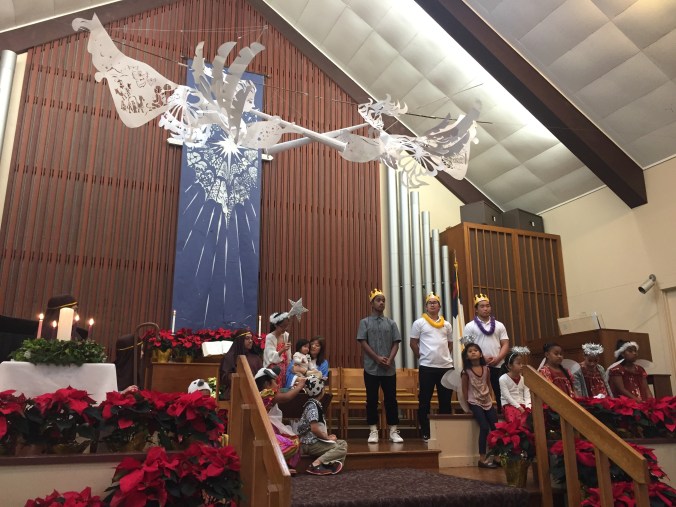
When Christmas falls on Sunday, it’s not just any service. It’s not just any Sunday service, and it’s also not just any Christmas service. Though every worship experience should connect with the heart and soul, Christmas truly demands it, and it also demands that we step outside the “usual” – since God did precisely that by coming to Earth in Jesus.
Thus this song, which was the pastoral prayer this morning. Mele Kalikimaka – Merry Christmas!
[Chorus]
Come to us, Christ Child
With the wailings of a newborn
Interrupt our sleep with an infant’s shrill demands.
Let us clothe your flailing arms with hope for all tomorrows.
Let us feed your hungers for deep peace around the world.
Let our arms enfold with the tender love of mother.
Let us sing a lullaby of joy
As our Christmas prayer:
As our Christmas prayer.
Your family fled from Herod
So we pray for refugees
May the ones oppressed by rage and fear
Soon shout that they are free.
You were given gifts by magi
So we pray we might be wise.
When we turn away from suffering
Redirect our eyes.
[Chorus]
As you grew from child to teacher
So we pray for all to learn
The depth of your compassion
And the love for which we yearn.
From your first hours in the manger
To your triumph over the grave,
Give us hope and confidence
You were born on Earth to save!
[Chorus]
Let us sing a lullaby of joy
As our Christmas prayer,
As our Christmas prayer,
As our Christmas prayer
We have heard the stories. We have sung the songs. We have lit the candles. We have shared Christmas greetings. We have shared Christmas treats.
Now comes the silence which comes so rarely in this busy technological world. Gradually, the excited children will succumb to the fatigue excitement brings. The wide-eyed stares of anticipation will relax into dreams, whether there is snow outside to cushion the anticipated sleigh or not. Ears tuned to the clatter of reindeer will be disappointed, once again, to find that the miracle happened while they slumbered and could not warn their owners that the moment had arrived.
Two thousand years ago, there must have been such a moment. I doubt it lasted long, babies being babies, but there must have been a moment when the exhausted newly-christened mother dreamed, and when the wondering father slumbered, and when the infant made only the soft snuffling sounds that reassure anxious parents that their child breathes.
In that moment, God could appreciate the miracle new-wrought in Bethlehem, and make whatever cosmic sound we imitate with a contented sigh. The miracle new-wrought, alive, and growing.
‘Twas the week before Christmas
And all through the house,
The children were screaming –
And they’d frightened the mouse.
Well, I’m afraid that’s as far as my memory will let me get with rhyming. So I’ll have to tell you the rest as a story. OK?
Sometimes, when children are screaming, it’s good screaming. Sometimes you’re just so happy or full of energy or overflowing with good feelings that they come out at full voice. And if everybody else is doing the same thing, well, it just gets louder and louder, doesn’t it?
Unfortunately, on this day, in this house, the screams weren’t happy screams. The kids were screaming with anger.
They’d reached the point – you’ve been there, right? – where they’d forgotten what they were mad about. It was all just yelling and name-calling and sorrow and rage now. Lots and lots of screaming.
One of the children went in search of the mother, who had sought a place at the far side of the house in the (forlorn) hope of escaping the screaming din. The child, with some difficulty because of the way tears and indignation combine to disrupt a coherent story, demanded that the mother come and stop all the rest of the children from being jerks.
“Well,” said the mother, “why don’t you just use the magic word?”
The child had some experience of this, however, and would not be put off by this ploy. With folded arms, a tossed head, and (I’m afraid) rolling eyes, the child informed the mother that “Please” had already been tried and the other children were still jerks.
“All right,” said the mother. “Why don’t you try this one?”
Leaning over, she whispered softly and briefly in the child’s ear. The child’s face went through the contortions of surprise and puzzlement, but recognizing that this step had to be taken before anything else happened, the child made the trip back to the other side of the house and the screaming room.
The screaming, I have to admit, continued.
But a few minutes later, one of the other children appeared before the mother with the same complaint. Once again, she whispered a few words into the ear, and the child exited her room, with a face filled with surprise and doubt.
The screaming continued, but with somewhat less volume.
One by one, all the children made their way to see the mother, and one by one returned with the same whispered instructions. Finally the last and littlest one seized her hand and would not let go until she, too, made her way to the surprisingly quiet screaming room.
The children were no longer screaming. They were repeating their magic words, sometimes one after another, sometimes overlapping each other, sometimes all at the same time. Their faces held the surprise that had overwhelmed them some time ago when the screaming faded away.
They were all saying, “I love you.”
I can’t promise that those words will magically end any of the screaming matches you find yourselves in. I can definitely tell you that it’s worth trying: It’s worth trying to say them, and it’s definitely worth trying to live up to them.
As for the mother, she smiled.
This story takes its inspiration from one told in my hearing some years ago by the Rev. Dr. Ronald Brown, senior pastor of First Congregational Church UCC in Southington, Connecticut. I haven’t found that story available online, but you’ll find Ron’s wit, wonder, and wisdom on his blog.
This story is about a family that was having a difficult December.
Mostly, they were doing OK. Everyone was healthy, and their home was a happy one. But some bills had to be paid just as the month began, and their savings dipped. There was still plenty to offer their daughter plenty of presents, though, and to have a festive meal.
They came home one day, however, to find that the kitchen refrigerator had stopped humming. Their first clue, I’m sorry to say, came when they opened the door and two things happened: (1) the light didn’t come on and (2) a really sour smell came out. All the food in the refrigerator had spoiled when it stopped working.
They called a repair person, but that worthy individual just shook his head and said, “That’s it for this one.” The family had to buy a new refrigerator just before Christmas.
That brought their savings down quite a lot, and replacing the spoiled food made a big dent in what was left. The parents knew there wouldn’t be many Christmas presents for their daughter that year, and a sadness crept into their holiday smiles.
On Christmas morning, however, their daughter showed no disappointment when fresh fruit rather than toys filled her stocking. She peeled her orange and promptly stuck one of its sections into her mouth whole. When she peeled back her lips in an impish grin, the fruit section smiled orange for her.
Beneath the tree, the small stack of boxes mostly contained clothes – she was growing, of course, and truly needed the new outfits. She showed now disappointment at the lack of toys, though. She glowed with pride that she was probably the only girl in her class who would have Spider-man pajamas.
As the last box passed from wrapped to unwrapped, the parents glanced at each other sadly at how little she had to play with from her Christmas morning. Their daughter, however, didn’t hesitate at all. She made a beeline for the kitchen, where the cardboard box for the refrigerator still stood beside its former contents.
“Can I play with this?” she asked.
Over the next few hours, it became a house, then a castle, then a cabin on a mountain, then a mountain itself, then a boat, then a treehouse, and finally something that she called a “creaturecrater” and refused to explain to her parents, solemnly informing them (with a giggle in her voice) that it was a secret.
For the next week, and all through the holiday break, she was the most popular child on the street, as all her friends filed through to play in the house, or on the mountain, or in the boat, or amidst the “creaturecrater.”
But this story isn’t about her, nor is it about her amazing big box. And it’s not about how she made a lot of fun for herself out of something ordinary, or about making the best of things. All those happened, but that’s not what this story is about.
This story is about the smiles on her parents’ faces as they held hands on the sofa and watched her play with the box. This story is about their fears that they could not give their daughter joy at Christmas – and how, instead, she gave theirs back to them.
I think we all can help those we love find joy at Christmas. Do you?
Today marks the 75th anniversary of the Japanese air and sea attack on the United States at its bases around Pearl Harbor. The day continues to fulfill President Franklin D. Roosevelt’s prophecy that it will “live in infamy” to Americans, and indeed to others around the world. Over 2,400 Americans died in the one-sided two hour battle, the first of some 419,000 who would perish before the war ended four years later.
Hundreds of survivors attended today’s observance at Pearl Harbor, according to news accounts. They honored the friends they lost seventy-five years ago for the dedication and valor they showed on the last day of their lives. War calls upon human beings to offer all they have to give – their talents, their freedom, and their very lives – on behalf of others. They offer it all for their nation, they offer it all for their families, and they offer it all for those beside them.
There is a greatness in that. It calls for the best.
Here in Hawai’i, however, I find it easier to see the price of that greatness. The commitment and the dedication and the valor (which can be found on both sides of the battle) preserve a nation, but also imperil its values. Martial law was imposed on the Territory of Hawai’i within hours, and would not be lifted until 1944. American citizens were detained and imprisoned without criminal charge or conviction. Military courts suspended the writ of habeaus corpus. In fear for their liberty, people buried or burned possessions that linked them to Japan: records, photographs, mementos.
The infamy of Pearl Harbor has company, lots of company: The Bataan Death March. The horrors of Germany’s invasion of the Soviet Union. The firebombing of London. The abduction and rape of thousands of women by Japanese soldiers. The murders of millions of military prisoners, gay men, Romani, and Jews in German death camps.
Lest we assume a virtue that is unwarranted, however, the infamy of Pearl Harbor has plenty of Allied company: The savage campaign on the Eastern Front. The firestorm of Dresden. More firestorms in too many Japanese cities to list. The atomic bombs of Hiroshima and Nagasaki.
Over 60 million people died in the fires of World War II.
We may, and should, honor the best. We dare not ignore the worst.
As 94-year-old World War II veteran Kenzo Kanemoto told Hawai’i News Now, “If you win, you still lose a lot.”
Let Pearl Harbor Day be one we honor for its summons to peace, for its warnings of the costs of war. Let it stand for the infamy of war itself, and its crushing weight upon humanity. Let it shine as a beacon for peace.
The boy in this story loved to climb. Oh, my, how he loved to climb.
He was young – three or four years old, say – and he climbed everything in sight. If there was a chair, he’d climb it. If there was a stair, he’d climb it. If there was a sofa, he’d swarm up it until he perched on its back. If there was a bush, he’d worm his way among the branches until his face poked out the top. Hills and counters were all one to him.
His favorite, of course, was to climb people (he was three or four, after all). Seated people were the easiest, but he’d clamber up the standing people as well. One moment he’d be on the floor, and the next moment he’d be waving from the shoulders.
It’s possible, just possible, that he got a little help on the way up to the shoulders.
There was one exception to his love for climbing, though, and it was the stepladder his parents set out when it came time to decorate the Christmas tree. I don’t know why he didn’t like it. Maybe it wiggled in some way that seemed wrong. Maybe the steps were too far apart. Maybe he didn’t like the color (it was bright yellow, and doesn’t that just scream “Danger!”?).
Whatever the reason, when his parents set it out so that he could climb onto it to put decorations on the tree, he wouldn’t go near it. He didn’t even put his hand on the uprights, let alone a foot on the treads. He placed his ornaments from the safety of the ground and, it must be admitted, from the extended arms of his father who held him out like a person-shaped crane.
Even at three or four, though, he knew that a ladder shouldn’t hold him back (or at least on the ground), and he determined that next Christmas he’d make a start on that ladder. He wouldn’t go for the top – not yet – but maybe the first rung would be an accomplishment.
That’s how it went. The next year he summoned his faltering courage and put one shaking foot on that first tread, then the other. Between the step and his growing height, he could reach further up the tree with his ornaments. The next year, on the second step (and still taller), he reached higher still.
He was determined to reach that highest step, and place the star on top of the tree with his own hands. Someday. Year by year, little by little, he’d make his way there.
Has he reached the top? Well, no. He’s still young, and there’s a few steps left on the ladder. He’s making progress, though, each year a step higher.
He knows where he wants to go. He knows what heights he wants to reach. He knows that he wants to be the one to place the star.

 If you find yourself wondering why I’m trying to capture what was a very visual worship experience this morning on text, well, I’m ahead of you. What made it work was the real interaction with the participants, some of them children, some of them adults. I’m not going to attempt to quote any of their contributions here, but instead indicate them by my responses.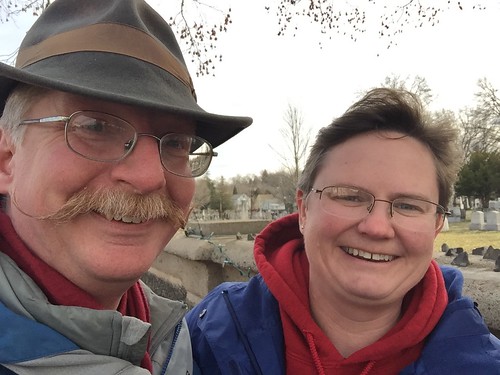

 When Christmas falls on Sunday, it’s not just any service. It’s not just any Sunday service, and it’s also not just any Christmas service. Though every worship experience should connect with the heart and soul, Christmas truly demands it, and it also demands that we step outside the “usual” – since God did precisely that by coming to Earth in Jesus.

 Today marks the 75th anniversary of the Japanese air and sea attack on the United States at its bases around Pearl Harbor. The day continues to fulfill President Franklin D. Roosevelt’s prophecy that it will “live in infamy” to Americans, and indeed to others around the world. Over 2,400 Americans died in the one-sided two hour battle, the first of some 419,000 who would perish before the war ended four years later.
 The boy in this story loved to climb. Oh, my, how he loved to climb.
 ordainedgeek