To Win or to Play

kids-soccer

Photo by Susan Lloyd, used by permission

This story has no squirrels, no mongoose, and not even any ‘apapane in it. In fact, it doesn’t have any furred or feathered creatures in it at all, unless you count the hair on our heads as fur.

This story has actual people in it.

It’s about a soccer coach.

It was his first time acting as a soccer coach, and his team were all brand new to the sport: young, growing, and excited to play on their first team of anything. At the first practice, they were all over the place. A couple of them ran up to the stationary soccer ball and kicked at it so wildly that they missed it completely. A couple more kicked it where they wanted it to go, but rather more shanked it to the right or watched it careen off to the left.

It had to be said, they weren’t terribly good. But they shouted merrily, called encouragement to each other sometimes, and (rather more than they should, perhaps), laughed when the ball sailed off to the sides again.

And they got better. The coach taught them skills, and they learned. He got to know which children had natural ability, and which ones had to work hard. He got to know which of them picked up skills quickly, and which ones needed more demonstrations, and which ones might never get it. He got to know which ones would be the better players on his team, and which would always struggle.

Their first game wasn’t pretty. In the excitement, most of them forgot to stay in their positions, and instead they all converged on the ball, so that a knot of players (from both teams, it’s true) bounced up and down the field with the ball. Practice after practice, game after game, they did get better. They won some, and they lost some.

The coach could see which players had the skills, and which ones were developing the skills, to make a winning team. These were the ones who played their positions and remembered the plays. They could (mostly) kick the ball where they wanted it to go. They kept moving, and they kept their heads.

Gradually, it was these players who spent more time in the game, and the others, who hadn’t learned so well, played less and less.

Then came the game where one on the team didn’t play at all. The next match, it was two of them.

It was one of the better players who dared to speak to the coach. “Look,” he said, “I know that you’re keeping some players in so that we can win. But we’re all here because we want to play. Even more than we want to win, we want to play.

“Could you make sure that everybody gets some time to play?”

On other teams in other times, they might value winning over playing. Here at the start, they favored playing over winning, and friendship over victory.

Myself, I hope that everyone everywhere gets a chance to play, and to share in the game.

Other Veterans

tule_lake_relocation_center_newell_california-_harvesting_spinach-_-_nara_-_538316

Internees at Tule Lake, California, in 1942.

Last Friday was Veterans’ Day in the United States, which is a day off for those of us who work for Church of the Holy Cross UCC in Hilo, Hawai’i. I wasn’t relaxing on a beach, however (which isn’t where I relax in any case). I was presiding at a funeral.

The funeral of a veteran. A different kind of veteran.

On Veterans’ Day we honor those who serve the country and defend it from war, “who stand between their loved homes and the war’s desolation” (Francis Scott Key). And as Abraham Lincoln observed at Gettysburg, it is altogether fitting and proper that we should do this. Yet there are others who endure the impact of the world’s and the nation’s conflict, and receive no honors, no recognition, no holy day. Evelyn was one of these.

Evelyn was a native-born American citizen interned by the United States Government during World War II.

Between 110,000 and 120,000 people whose parents, grandparents, or great-grandparents had been born in Japan, 62% of them U.S. citizens, were ordered from their homes in Pacific coastal states (though not Hawai’i, where it was simply impractical) and housed in camps from Louisiana to California. Evelyn, a college-age young woman, observed that disabled children received no schooling at the Tule Lake, California, camp where her family was sent. So she taught them.

Thinking about Evelyn led me to think about so many others who endure the stresses of war. Gold Star families endure terrible losses in each conflict. Parents, siblings, spouses, and children live each day with anxiety for those they love who go in harm’s way. Support people, some who wear the uniform and some who do not, labor to support those who return. Some they treat for wounds. Some they assuage the psyche. Some they help find housing, or to resume interrupted careers. Some they aid to understand the now-unfamiliar ways of civilian life.

There are other veterans, too. These are the people who live where the war occurs, where if somebody had stood between their homes and the war’s desolation, their efforts failed and desolation came. These are the ones we see bloodied in films and photographs from Syria. These are the ones who come weeping for their dead to shuttered government houses. These are the ones swimming desperately to shore from overcrowded boats, and mourning their drowned children who lie silently on the beach.

In many conflicts, more civilians die than soldiers. They die from bullets and grenades that come their way, they die from bombs and shells, and they die from malnutrition and disease. The catastrophe we call World War II claimed the lives of 21 to 25 million people in uniform. It slew 50 to 55 million civilians, including 19 to 28 million who died from contagion or hunger.

Today, I honor these civilian veterans: the refugees, the interned, the families, the supporters, and those who pray that the shooting and shelling around them will just stop.

Today I honor them, and for their sake, I pray that God’s children will learn the ways of peace, and make no new civilian veterans to endure the sorrows of war.

A Musical Prayer

On November 13, 2016, Church of the Holy Cross UCC celebrated “Sing Praise Sunday,” a service with very little speaking and plenty of music. Children sang, the choirs sang, the people sang (their favorite hymns, so they sang right out!), and the pastor couldn’t quite see speaking a pastoral prayer, so, there was this:


Here are the lyrics:

Creator God be with us.
Send us rain and shine upon us all.
In steadfast love incline our hearts to justice.
Raise us when our weary spirits fall.

Savior Christ be with us.
Heal all those suffer, those who sigh.
Forgive us when we serve ourselves, not justice.
Raise us to eternal life on high.

(Chorus)

God, hear our prayer.
Christ, hear our prayer.
Holy Spirit, hear our prayer.
Bring your grace
To your world.

Holy Spirit be with us.
Guide us as we find our way.
Fill us with the fire of your compassion.
Inspire your children as we pray.

(Chorus, repeat third verse)

Committed

jeremiah_by_repin

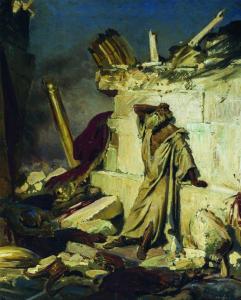
Cry of Jeremiah by Repin.

The voters have spoken. They have chosen. They have selected the next President of the United States.

I have been cautious in my own political advocacy, at least about publicly supporting candidates. In the light of this day, with a President-elect who has espoused policies I condemn, I pledge here and now to advocate for what I believe to be good, and just, and right, and to resist what is evil, and oppressive, and wrong.

I expect that I will find a good deal to say over the next few years.

The President-elect has called publicly for a ban on Muslims entering the United States. Amidst the horrors perpetrated by the Islamic State, I understand the fear. I understand it, but I will not be governed by it. Nearly a quarter of the world’s population, 1.6 billion people, lives and worships peacefully guided by the Muslim faith. I will resist an America that excludes or oppresses people because of their religion. I will do it for Muslim, I will do it for Jews, I will do it for Buddhists, I will do it for Christians, I will do it for those who espouse no faith.

No religious tests. Ever.

The President-elect has pledged to repeal the Affordable Care Act. He has announced no replacement plan. His party has sketched a plan, but it remains nebulous.

I have family members and friends who, without the ACA’s protections against denial of coverage, could become uninsurable because of pre-existing conditions. They, more than any, will have need of health care. They are now at much higher risk of losing access to it.

Health care should serve the health of our nation’s citizens, and not the financial interests of a few of its citizens.

The President-elect has pledged to appoint officials who will actively work to end the marriages of people I know and love. He would tell them that they are secondary citizens in the society, unworthy of full participation.

I say that love between people deserves the acclamation and support of its society. Commitment is hard. Love is hard. Family is hard. Making it harder is a rank injustice.

Marriage equality must remain the law of the land.

The President-elect has declared that global climate change is a myth perpetrated by a foreign nation. He defies the evidence of scientists from around the planet. People already suffer from sea level rise. It will get worse even if we make significant changes now. It will get much worse if we make no change at all – and much, much worse if we accelerate the transfer of carbon from earth to atmosphere.

We must change our ways.

I could go on. I should go on. And in the days ahead, I will go on. Because health care is important. Because #BlackLivesMatter. Because human dignity is worth defending. Because the seas rise.

For now, though, I return to the day of my ordination, when I asked to have these words read:

‘Now the word of the Lord came to me saying, “Before I formed you in the womb I knew you, and before you were born I consecrated you; I appointed you a prophet to the nations.” Then I said, “Ah, Lord God! Truly I do not know how to speak, for I am only a boy.” But the Lord said to me, “Do not say, ‘I am only a boy’; for you shall go to all to whom I send you, and you shall speak whatever I command you, Do not be afraid of them, for I am with you to deliver you, says the Lord.” Then the Lord put out his hand and touched my mouth; and the Lord said to me, “Now I have put my words in your mouth. See, today I appoint you over nations and over kingdoms, to pluck up and to pull down, to destroy and to overthrow, to build and to plant.”’ (Jeremiah 1:4-10)

I was young, then, and that was part of what resonated with me. I admired the fierceness of the prophet, his willingness to challenge the powers of his time, and his insistence that the king’s faithlessness, follies, and faults would lead to national disaster. I did not think that I would be called to echo him.

I fear, however, that I shall have to do just that, and warn against the senselessness and sin of excluding some of our citizens from full participation in our society. I fear that I will have to warn against the senselessness and sin of favoring the powerful over the marginalized. I fear that I will have to warn against the senselessness and sin of proclaiming greatness in the absence of goodness.

I fear that, more often than not in these coming days, I will fail.


Food in the Gaps

ohia-blossoms

Ohi’a lehua (Ohi’a blossoms)

This story is about a young ‘apapane – a small bird which is part of the Hawaiian “honeycreeper” family – who was looking for food.

As a nestling, he’d been raised to eat whatever his parents put in his mouth, which works pretty well when you’re a young bird. He’d grown bigger, he’d learned to fly, and he’d learned to sip nectar from the ohi’a lehua, the blossoms of the ohi’a tree. In fact, that’s what he’d eaten ever since leaving the nest.

He thought it was delicious.

But now, he was hungry. Trees don’t blossom all the time; the flowers come and go. The bit of forest where he’d grown up had gone through its cycle, and the other, older ‘apapane had already flown off to find food elsewhere, and he hadn’t quite noticed.

He was pretty sure that there were other stands of blooming ohi’a, though – at any rate, he certainly hoped there were! – so he flew up the mountain and down the mountain and from side to side. Truthfully, he ended up flying in circles for quite some time without covering a lot of territory. And the whole time he got hungrier and hungrier.

Finally, he got lucky. One of his circles swept farther away than he’d gone before, and he heard the singing of other ‘apapane. That caught his attention. If they were singing, he thought, then they’re probably not hungry, and that means: Food. And off he flew toward the singing.

Sure enough, there were ‘apapane in the trees, and the trees were festooned with ohi’a lehua.

He gratefully gripped a branch between two clusters of blossoms, and got ready to dip his beak into their flowers. Before he did, something moved along the twigs in front of him. Startled, he took a second look.

There were small insects sharing the tree with him. They were just as attracted by ohi’a lehua nectar as he was, and quite a number were hopping between the blossom clusters.

His first thought was probably similar to what any of us would think: “Ick! There’s a bunch of bugs on my lunch!” But his second thought, which happened between his belly and his beak without spending much time in his brain, was: “I’m hungrier than I ever remember being before. I’ve flown all around, and I need food. Rich food. In fact, I need…”

CRUNCH.

Yep. He ate the bugs.

Now, I don’t think anyone expected me to compare the goodness of God with eating bugs, but that’s precisely what I’m doing here. Our ‘apapane knew what was good to eat, and he searched for it, and he found it. What he hadn’t imagined was that in the gaps between what he knew, there’d be something he didn’t know, something that would meet a more desperate hunger than he’d felt before.

That’s true for us. Between what we know are the new things God may do for and with us, which will nourish us in ways we haven’t been before, and haven’t needed to be before.

I’ll just mention that the ‘apapane at the bugs and he thought they were pretty good.

What God has for us, waiting between what we know, is even better.

The Persistent Cloud

img_1632

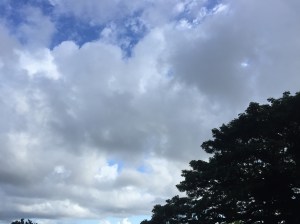
These clouds want to rain on Hilo, too.

There was a cloud who wanted to rain on Hilo.

Living here, you wouldn’t think that would be so difficult, but from the cloud’s point of view, it’s a lot harder. You see, as far as anyone can tell, all clouds want to rain on Hilo. I guess it’s because they love us so much.

With every other cloud also trying to rain on Hilo, it got pretty difficult. This cloud was rather younger and smaller than the other clouds, and I’m afraid that, just like people, there were bigger clouds who would tend to ignore, or jostle, or push away the smaller clouds. So the cloud would try to get in line for Hilo, and get blocked and nudged and shoved away off the the north, where it found itself raining on Honomu.

That’s a perfectly nice place, but it’s not Hilo.

So the cloud circled around to try again.

(I know, I know, I know: clouds don’t “circle around,” they follow the wind. And since Hilo gets the easterly trade winds, clouds just go west. But… This is a story. So the clouds can circle back and try again. It’s my story and I said so.)

The next time it tried to get the Hilo, the other clouds crowded it further and further to the south. So it ended up raining on Kalapana. Which is, once again, a very nice place to be (and to rain on), but still, it wasn’t Hilo.

The cloud tried again and again, circling back and joining the group, and getting shoved off to one side or the other. Most of the time it made steady gains, but one very bad day it ended up raining way off in Waimea. Which is, I emphasize, a wonderful community, but it’s a long way from Hilo.

The cloud was beginning to feel just a little bit like the Chicago Cubs trying to win the World Series.

(My apologies to Chicago fans, but it must be said that with the headquarters of the United Church of Christ located in Cleveland, there are a lot of fervent prayers being said for Cleveland right now. Just saying. And… Back to our story.)

The cloud kept at it, trying new things, new techniques, studying what the other clouds did who made it to Hilo. And so there came a day when it found its rhythm. It fell in behind a medium-sized cloud, then filled a quick gap when it opened to one side. It ducked beneath the ponderous bulk of a big cloud, then scooted in ahead of another.

At last, like a basketball player who’s made it to the top of the key with an easy layup in sight (Congratulations, Cleveland!), it was squarely over Hilo. And the rain fell.

Did you notice, as I did, that there were some moments in the rain this past week when it just came down really hard? Buckets of rain.

I think that might have been our friend the cloud, giving us some extra love for the pure joy of visiting us.

Gripping the Tower

block-game

Photo by Igor Trepenshchenok, distributed by Barn Images. Used by permission under Creative Commons license.

You may remember that a couple weeks ago I brought in a tower of blocks, one that’s a game.

You probably know how the game goes. The players each have to remove one block from the tower in their turn. And you keep going around to see who ends up pulling the block that makes the tower fall down.

Those who like to win select their blocks very carefully, and they move them gently, slowly sliding them out from their place and leaving it just that much harder for the next person.

Those who like to watch block towers fall down, well, they play it differently.

This story is about two girls who liked to win. One of them had been playing the game at her friend’s house, and when she got home, her mother noticed that she looked angry and upset.

“What’s wrong,” she asked, “Didn’t you have fun?”

“No,” announced her daughter. “She cheated. Every time she went to pull a block out of the tower, she held onto the tower with her other hand. That’s against the rules. She cheated.”

She continued on this theme for some time, more time than I really have to tell you this story. Eventually, so ran out of steam.

And her mother, who’d been thinking about this for some time, said:

“You know, if both of you held the tower while you were pulling your blocks out, that would still be fair, wouldn’t it?”

“Well, yes,” said her daughter, “but it’s against the rules. It’s wrong.

“Yes,” her mother nodded, “but which would you like better: To play the game with your friend, or to be right?”

“I want to do both,” said the little girl.

“I’m sure you do,” laughed her mother, “but we don’t always get to do both.”

It took the little girl some time to make that choice. It wasn’t easy at all!

But the next day, she was back at her friend’s house, and they each held the tower as they gently pulled out their blocks.

Because the game could go on.

The Appreciative Goat

mauna-kea-from-the-air

Mauna Kea from the air. Photo by Eric Anderson.

A few weeks ago, I revealed that I didn’t know that there were wild goat living on Hawai’i Island. So I went to learn a little more about them, and thus today’s story is about…

Wild goats living on Hawai’i Island.

It’s not an easy life being a wild goat on Hawai’i Island. They tend to live up the slopes of the mountains, where the big lava flows have left a landscape of broad swathes of old lava rock, with just a few plants growing in crevices. If you’re a goat, that’s what you eat, and so you spend most of the day looking for something to eat.

If you’re the small goat in the herd, you get last place for everything: for a spot under a tree when it rains, or for water at the high lake or spring, and, of course, for food when the herd has found a patch of green.

Now, the herd thought this one small goat was actually rather peculiar.

You see, when the herd found something to eat, they’d shoulder him aside, and he’d stand and wait to see what was left for him. But as they looked up and saw him standing there, sometimes he’d be looking up to the sky, as if he were watching the clouds.

“What are you doing?” they’d ask, and he’d say, “I’m watching the clouds.”

“Do you see how they come and wrap around the mountain, and then tail off into feathers as they blow away downwind?”

“Not really,” said the other goats, and went back to eating.

A little while later they’d look up, and he was gazing down the mountain to where the sea glowed in the distance. “What are you doing?” they demanded.

“I’m looking down at the ocean,” said the goat, “with all its shades of blue, and I’m watching how it fades up into the blue sky, and how all those blues come together so beautifully.”

“Huh,” said the other goats, and went back to eating.

As day ended, and they were actually feeling full (they’d found a good patch), they glanced up and there he was, staring into the distance again. “What are you doing?” they sighed.

“I’m watching the sunset,” said the small goat. “Look at the reds, and the oranges, and the purples. They’re all over the sky and the clouds and even reflected in the sea.”

“Ah. Right. You’re just crazy,” said the other goats, ignoring this. “Come and eat.”

Now I’ll be honest. I’m not really certain that a goat can appreciate the sunset, or the ocean, or the clouds. I hope they can, but I really don’t know.

I do know that people can appreciate the sunset (or the sunrise!), and the ocean, and the clouds above. I know that people can. And I know that some do not.

I hope that you’ll be people who do look up at the clouds with wonder, and the ocean with amazement, and the sunset with awe. I hope that you’ll do it always.

Song: “Holy Cross at 125”

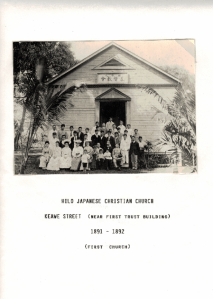
hilo-japanes-christian-church-1891Author’s Note: I wrote this song for the celebration lunch of the Church of the Holy Cross UCC in Hilo, Hawai’i, which was founded in 1891 to serve newly arriving immigrants from Japan. Most of them came as contract workers, spending 3 years on a sugar plantation and returning home (or staying and making the Big Island their home). Originally known as the “Japanese Christian Church,” the congregation took a new name in 1942.

I wrote and perform this song on ukulele, by the way.

They followed the summons of a man across the sea
To plant and to weed and to cut
Some returned to their homelands, some stayed in Hawai’i
And with them, the cultures of Japan.

When Jiro Okabe came to serve in Hilo Bay
He led a new church from his home.
He gathered the Workers Mutual Aid Society
To bring good works to the town.

[Chorus]

They had a vision
To bring good news to the poor
They had a mission
To bring good news to the poor
Poor in substance. Poor in spirit.
Poor in hope. Poor in dreams.
They had a vision.
They brought good news.

The sands of time flowed and the Christian Church grew
They took as their name Holy Cross
Through war and tsunami they lived out their hope
To raise up the lowly and lost.

[Chorus]

We march to remember those whom illness forgets
We help the poor build new homes.
We care for the dying and for the hungry
We worship the God of All.

As each era offers its challenges and change
We look ahead in awe:
A world beckons there both familiar and strange.
There we hear Christ’s call.

To have a vision
To bring good news to the poor
To have a mission
To bring good news to the poor
Poor in justice. Poor in freedom.
Poor in faith. Poor in deeds.
We need a vision…

Let’s seize a vision
To bring good news to the poor
Let’s seize a mission
To bring good news to the poor
Poor in substance. Poor in spirit.
Poor in hope. Poor in dreams.
Let’s seize the vision.
Let’s bring good news.

Tough Enough

9e42e40a-58c1-4c02-a3ab-94f914855df3I’m afraid that this story begins in much the same way that another story I told you began. I don’t think I’m running out of ideas already, but actually, I can imagine a lot of stories might begin this way, so…

Perhaps I’d better begin again.

This story begins with some children playing. All was as it should be, that is: just a bit exuberant, just a bit frenetic, just a bit noisy.

I’m not entirely sure what they were doing, whether it was throwing a ball, or a Frisbee, or having a game of tag, or something completely different. What I do know is that as they were running through the grass, one of them tripped and fell down, and the One Rule of Grassy Fields is that where your knee lands is where the rock is.

All the adults in the room seem to know this; did you hear them all groan?

Well, the little girl that fell and skinned her knee: She was determined to be tough. She got right up and she didn’t let it stop her, even though it looked pretty bad. I mean there were lots of cuts, and it was starting to bruise, and all in all I don’t want to think about what it looked like so let’s just skip it.

I can tell you it hurt her pretty badly.

But she was tough, and so when she went home you know there were two people she didn’t tell about it, right? It was Mom and Dad, of course. She wasn’t going to make a fuss about it, or ask for help.

So for the next couple of days she put on long blue jeans each day so that nobody could see her scraped up knee. She’d have been much more comfortable in shorts or a dress, especially because the hard fabric of the blue jeans rubbed right on the gouges. It hurt her a lot, but she was tough, and she wasn’t going to show it.

It was her mother who figured out that something was going on, and she finally got it out of her. So the next few minutes were filled with cleaning off the scratches, and putting ointment on them, and covering them with a bandage so they stopped rubbing against things.

Only then did her mother ask, “Now. Why didn’t you tell me about this?”

Her daughter sat up straight and said, “I’m a tough kid. I can handle things. I want to handle things myself.”

Her mother sat for a moment. Then she replied:

“I’m glad that you want to be strong. I’m glad that you want to take responsibility for yourself. I’m glad that you want to be your own person. I’m glad you want to be tough.

“I also want you to think about the thing that was too tough for you to do: telling me and your dad. I want you to be tough enough to tell the truth. I want you to be tough enough to say what’s happening with you. I want you to be tough enough to say that you need help when you need it.”

I hope I’m tough enough to tell the truth, too.