Wrasse-ling with Destiny

cleaning_station

Cleaner wrasses at work on a Hawaiian reef. Photo by Mbz1 (see below)

I’d like to apologize for the pun in the title. Unfortunately, I can’t, because I haven’t repented it. I do offer my regrets for any pain that it may cause.

I’m going to tell you about a small fish of a type called a “wrasse.”

This little wrasse was, well, just a bit of a thing when he hatched. He darted about with his many brothers and sisters through the water, and any time something drifted by that looked about the right size for their mouths, they’d snatch at it to see if it was food. Sometimes it was, and sometimes it wasn’t, but you know, when you’re a little fish in a big ocean, that’s as good a way to find out as any.

Come to think of it, human children take much the same approach… Pick up, put in mouth… Yuck!

But I digress.

As he grew, this young wrasse discovered that he had been born into a family business, which is kind of unusual for a fish. His parents and aunts and uncles and grandparents and so on would hang out at certain spots on the reef, where other fish – much bigger fish – would come and gather. The adult wrasses would swim around them, poking at their scales to find weeds and little creatures that latched onto them. Then they’d pick those little things off and eat them.

That was their supper.

Aren’t you glad that you’re not a cleaner wrasse?

Well, this little one wasn’t sure he wanted to be a cleaner wrasse. He’d watch wide-eyed as the older ones would swim right around the huge fins and gills, and even dart between their long sharp teeth to pick the parasites out of their mouths. All he could do was gulp and wonder.

But it was the family business, so…

The day came when he took his place on the reef with everyone else, and up swam a great big fish. He gave the “clean me” signal, so the little wrasse started in. He picked away little crabs and loose scales (and incidentally, he thought they were delicious).

But he still hesitated when he got to the big fish’s mouth.

He stopped, and looked the big fish right in the eye, and asked, “Um. Are you going to eat me if I go in there?”

The big fish seemed to think about it.

“Well, if I eat you,” asked the big fish, “will you come back and clean these little nuisances of critters that are driving me crazy?”

“Well, um, no,” said the little wrasse. “If you eat me, I wouldn’t do that.”

“Oh,” said the big fish. “In that case, I won’t eat you now.”

“In fact,” it continued, “I won’t eat you next time, either. How does that sound?”

It sounded pretty good to the little wrasse, who went back to work in the family business and never looked back.

And that’s how thing are on the reef: In the big ocean, there are creatures who now that they need each other. They need each other just as we need other people. They need each other just as we need every other living thing on this Earth.

Photo credit: By Wikimedia user Mbz1 (assumed based on copyright claims). – No machine-readable source provided. Own work assumed (based on copyright claims)., CC BY-SA 3.0, https://commons.wikimedia.org/w/index.php?curid=2660436

The Best Bakers

img_0583

Cookies!

I’d like to tell you a story about the best baker in all the world.

He could do wonders with flour and butter and eggs and salt. He made French pastires filled with custard and covered with chocolate. He brought Italian biscotti to that perfect balance of sweetness and crunch. He could turn out a Japanese mochi that danced with tart and sweet.

He made apple pies. Lemon cakes. Liliko’i tarts. And, of course, because no baker’s repertoire is complete with them: malasadas.

He knew he was the best baker. He had time and he had the means, so he traveled all of the world, and all over the world he’d sample pastries, and pies, and breads, and filled buns. He ate tres leches cake in Mexico, and sesame cake in China.

And wherever he went, he never tasted anything without knowing – because he’d tried it – that he’d made one that was better.

The trouble was, he was the only person who knew this. He was the only person who ever tasted what he baked, or fried, or steamed.

I’ve never known why this was so. Maybe he was shy, and didn’t want to embarrass himself (as if he would). Maybe he was just plain greedy and selfish and didn’t want to share. Maybe he wanted us all to be healthy and didn’t want to feed us so much sugar. I don’t really know.

But he was the only person who ever tasted what he made.

So… Let me tell you about the second-best baker in the world.

She, too, made amazing cakes, and pies, and tarts, and rolls, and pastries, and (of course) an astounding malasada. Hers weren’t always the best – I know, for instance, that the best squash pies are made by someone who lives in Norwalk, Connecticut – but on the whole, she was the best baker that anybody had every known.

You see, everybody believed that she was the best baker in the world, because she shared. When she made cookies, other people got to eat them. Her cakes got cut up and shared at parties. They went far and wide.

People tasted her glazes and their eyes would glaze over in wonder.

They’d go pie-eyed in astonishment at a bite of her pies.

And as her pastries disappeared, those who enjoyed them wore grins pastried plastered all over their faces.

Now, if I could choose between being one of them or the other…

If I could choose between being the best baker in the world and never seeing the joy on another face from tasting my work, or being the second-best baker in all the world and sharing widely, I know exactly which I’d be.

I’d be the second-best, and I’d share.

May all of us always, always, choose the same.

This story was told in worship during the installation of the Rev. Eric Anderson as Pastor of Church of the Holy Cross UCC in Hilo, Hawai’i, on September 10, 2016.

If We Could Love the Ocean

IMG_1212How can we love the ocean?
Its friendly waves deceive;
They rise to overturn and overthrow.
Its cooling depths will smother;
Its countless fathoms crush.
Its gentle surface warmth rises up
In thickening clouds
Which rage in rain and tempest.
So unlike us – or not so unalike?
If we could love each other,
Then we might love the ocean.
If we could love the ocean,
Perhaps we’d love ourselves.

The Wonders of the Sea

789C9037-A767-46EA-AD89-F54A843249C1The wonders of the sea are grand
The flowing wave which flings its diamond spray
Into the air, the glistening schools of fish,
The massive dignity of whales serenely swimming.

The wonders of the sea are tiny
A garden blooms within each pearl of water
And the ripples barely dampening the rocks along the shore
Glint merrily when lightly kissed by sunbeams.

This poem was written for a sermon on Ocean Sunday (Sept. 4, 2016): “Waves of Grace Command the Morning.”

Imagine the Ocean

0B2B5449-9B2D-4584-80D6-5228A482F2E8

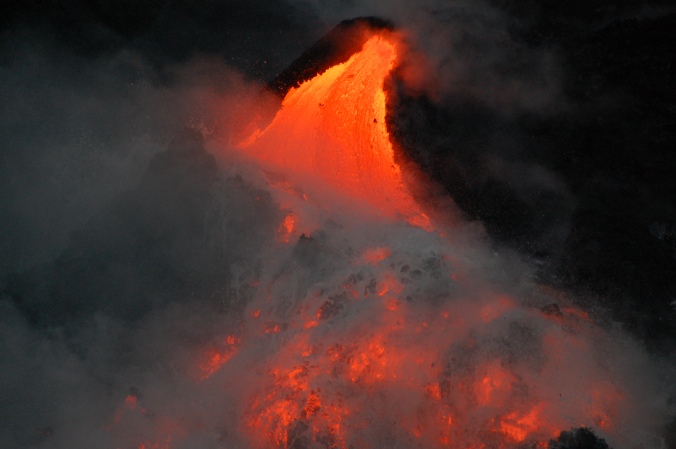
Lava enters the Pacific Ocean in August 2016. Photo by Eric Anderson

This week I’m not going to tell you a story about a sport that you don’t play (or that I don’t play), so we don’t have to worry about not knowing the rules.

Instead, I invite you to use your imagination. That’s something all of us can do.

Imagine the ocean, the seas of this planet, as if it were a person: someone who could think, someone who could feel, and someone who could talk.

Imagine the ocean rising up all around the earth as the skies poured with rain for years and years and years.

Imagine the ocean flexing its currents as they started to move about.

Imagine the ocean, as its surface climbed higher and higher above the sea floor, wondering aloud if would cover all the earth.

Imagine God looking over it all, and saying, “No. I think not. There won’t be quite so much water for you, Ocean. There will be dry land in the world.

“But…

“Even on the highest peaks, Ocean, there can be water.

“Even on those highest peaks, Ocean, water will fall in rain or snow. In fact, the highest summits of Earth will always wear a crown of snow.

“Above those highest peaks, Ocean, clouds may float: your water, suspended in mid-air, raining down from time to time to return to you again.”

And so, to this day, the Ocean drinks in the rain and snow that falls above land or sea. And to this day, the Ocean grumbles at the shores, constantly reshaping and reforming the boundaries of the land, hoping, perhaps, to one day cover all the globe.

And to this day, slowly but surely, land still rises higher in places, pushed from below by currents of rock.

And to this day, in other places the currents of rock run down the mountainsides, where they may reach the ocean and win new land from the sea amidst a scarlet glow, and the water hisses and fumes.

And to this day, God looks upon land and ocean, and smiles.

Soccer Woes

Emerald Dragons play soccer

Photo by Andy Elck – Used by permission under Creative Commons license.

In introducing this story, I asked if the kids were soccer players, because a few weeks ago I told a story about baseball, hoping they played it and would know about it. Well, I struck out. Then I tried telling a story about a Yu-Gi-O, the card trading game, hoping they played that. And I ended up with an empty hand.

So this week I turned to soccer, which everybody plays now, right? and once again, I failed to score. I think they’re due a penalty kick…

There was a boy who really wanted to play soccer. He loved it and he was always eager to play, so he joined a league and he joined a team.

There was only one problem: it turned out he wasn’t very good at it.

There are kids who run fast. He wasn’t one. There are kids who can kick the ball any direction they like. He could kick it pretty much anywhere but where he wanted it to go.

He kept forgetting that you can’t touch the ball with your hands, and he’d reach out to grab it as it sailed by. And the first time he tried to “head” the ball, which is to hit it with his head, it went very badly indeed. Not only did he miss the ball, he managed to trip himself and fell face-first into the grass.

It’s hard on a team when there’s a player who’s not very good. Sometimes, though, those players bring a sunny spirit to the game, and they make everybody else feel good. It happens.

But… not this time. Every time he missed a kick, he’d mope. He griped about his slowness and his clumsiness, and he moaned every time the team lost, which, it has to be said, was most of the time. It wasn’t his fault (entirely), but they weren’t winning.

His teammates, frankly, would have been just as happy to see him go. He wanted to play, though, and his coach said he could stay, so he did. Poor skills and sour attitude and all.

As the weeks went on, though, his teammates began to notice that he was always at practice. He never missed a game. He moaned and groaned, but he worked hard to get better.

And he did get better. Not a lot, it’s true, but he kept trying and trying. He stopped raising his hands to catch the ball, and he stopped tripping over his own feet. He didn’t get fast, but he got faster. He didn’t kick the ball terribly hard, but more and more it went his way.

He never got worse. Each time, he was a little bit better. Never very good, but always a little bit better.

The rest of the team noticed. First one or two, then two or three, and then the rest: they noticed he was getting better.

And if he could get better, they thought, so could they. So they did.

They worked the way he worked, and sure enough they got better. They got better, and they started to win games. By the end of the season, they had more wins than losses.

As for this one boy who wanted to play soccer, it’s true that he was never a very good player, let alone a great one. But he was a leader. He was the one who led his friends to improve, just a little, each time, to be come a pretty good team.

Sunglasses

IMG_1399

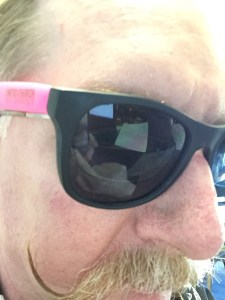
Why yes, I do have United Church of Christ themed sunglasses. Why do you ask?

Before worship began, I wore these sunglasses as I walked down to church from my house. And they worked really well. I could see where I was going, and I wasn’t squinting in the bright sunlight. That’s pretty cool.

Now, however, I’m wearing them here in the church. And it’s not working so well. In fact, I can’t see very well at all.

If anybody’s looking to sneak out without my noticing, this is probably a good time.

In fact, is anybody still here?

When I take them off: Look! There you all are!

In bright daylight, the sunglasses help me to see.

But in a darker place, taking the sunglasses off helps me to see.

There are lots of things in life that are like this. They work in some places, and they don’t work in others. You have to try and see what helps in this situation, but don’t assume that what works now works then, and that what didn’t work then doesn’t work now.

Life can be complicated.

One thing always works, though: seeing the world through Jesus. Seeing the world through the love and kindness and compassion that he showed. Seeing people around us as beloved by God. Seeing the world God made as lovely and precious.

It’s better than sunglasses in a dark room.

It’s even better than sunglasses on a bright sunny day.

When Did God Create Music?

IMG_1373Well, I don’t know when God created music.
I’ve sometimes liked to say that God created music on the fifth day of Creation (as it’s described in Genesis): “And God created the birds of the air (who sing!) and the fish of the sea (who sing in water!), and it was morning and it was evening, and it was choir night: the fifth day.”

That, of course, comes from spending time in several churches whose choirs rehearsed on Thursday night.

But in truth, I like to believe that God created music first.

I like to think that God created music by singing first into the vastness of the universe, one voice ringing in the void.

I like to think that the stars and galaxies came to be so that the music could echo from them – and become the music of the spheres.

I like to think that when the planets formed, the sighing of wind and waves carries the songs of God.

I like to think that birds began to sing so that they could join the melodies of God.

I believe that you and I exist so that we might harmonize with our Creator, that we might make the music even greater.

Sometimes we’ll join with instruments or voices, blending with each other to swell the chorus of the ages. Sometimes we’ll join with dance, with swaying bodies or lilting hands. Sometimes we’ll join by building other harmonies: with kindness, compassion, love, and care for people, creatures, and this created planet of ours.

I believe that when we make our harmonies, God smiles…

And keep on singing.

Card Sense

There was a boy who loved the card trading game Yu-Gi-Oh. He loved the time with his friends, he loved the play, and he loved the cards themselves, with their figures and monsters.

He’d save his chore money to buy new expansion sets of new cards, and then he’d do more chores so that he could buy more cards.

He’d trade cards he had many of for other cards he hadn’t obtained.

And then he’d gather his friends, and the games would begin. It was fun.

Over the course of a few weeks, though, things changed. He came to think more of the cards than of what he did with them. He played less, and traded more. His trades grew more self-serving, and downright shrewd. He managed to talk his friends into exchanges that worked for him, and not for them.

When they actually stopped trading and played, he won more and more often as his increased collection of “special” cards gave him more and more of an advantage. It wasn’t much fun for his friends when he had all the winners and they didn’t. He hardly noticed that when he brought out his cards that suddenly they were busy, or wanted to do something else, or just hadn’t brought their cards that day. It allowed him to scan through his collection instead.

Until one day, as he was laying out his cards on a table, and wanted to point one of them out to his friends. When he looked up, there was nobody there. Nobody would enjoy it with him.

He thought hard about that.

A few days later, he brought out his special cards, and one by one, he passed them around to his friends. One for you, one for you, one for you, one for you… until they were all shared.

And then: they could play. And it was a good game.

Half the Way: Shrink!

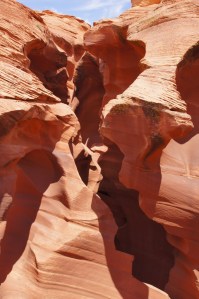
CanyonThis story is about a wizard on his travels.

Do you know what a wizard is? It’s somebody who can work magic – at least in stories. In stories, magic is a pretty cool thing to have, or be able to do: to make things happen by using a spell.

This wizard had a spell that was really, really useful when traveling, so he set out in confidence, even though the road he was following could be a difficult one. It went through a narrow canyon, with cliffs rising steeply to either side, and sometimes big rocks would fall and block the way.

Plenty of people would choose another road, but not this wizard. He made his way down the path, enjoying the sunlight winking over the canyon walls.

And sure enough, he got to a place where a huge boulder had come loose from the cliff high above, and fallen in a very narrow section of the gorge. There was no space between the boulder and the side that he could squeeze through on the right, and no space that he could squeeze through on the left. It was too tall and too rugged to climb, and as for going under, well, he hadn’t brought a shovel.

So now was the time for the spell to prove its worth. He stood resolutely before the boulder, pointed his finger at its rocky greatness, and intoned:

“All the way, all the way, all the way… Shrink!”

The boulder shuddered, and some gravel came loose and pattered on the path, but the huge rock remained absolutely huge.

The wizard, confused, confronted the rock again, pointing his finger at its stony magnificence, and intoned:

“All the way, all the way, all the way… Shrink!”

This time the boulder didn’t even shudder. It did nothing except sit there in all its immensity.

“All right,” said the wizard to himself. “I’m tired. I’ve been walking all day, and I haven’t had supper. I’ll eat, I’ll get a good night’s sleep, I’ll wake fully rested, I’ll make breakfast, and then I’ll take care of this rock.”

And that is exactly what he did. He made his supper and ate it, he went to bed early and slept well under the stars (a good night’s sleep is important; ask your parents!), he got up and ate a good breakfast (a good breakfast is important; ask your parents!), he packed up his gear for the day, and stood once more before the boulder, and cried:

“All the way, all the way, all the way… Shrink!”

Once more the great rock shuddered, and more dust rose on the path below it. But other than that, it remained just as gigantic as it had the night before.

Now the wizard sat down to do something he hadn’t done to this point: he sat down to think.

(Thinking is a good thing. Just ask your parents!)

He thought for a good while, and then an idea lit up his face. He sprang to his feet again, and once more faced the rock. He directed his finger, and with all the strength he could mustered declared:

“Half the way, half the way, half the way… Shrink!”

And the enormous boulder shivered as it did, indeed, collapse to half its size. Which was still gigantic, and still blocked the path, so the wizard cried again:

“Half the way, half the way, half the way… Shrink!”

Again the rock shrank, and still it blocked the path, so the wizard repeated four or five times (he lost count):

“Half the way, half the way, half the way… Shrink!”

Until the boulder was a rock he could step around with ease, and go on his way.

There are things in the world that are too big to change, for sure and certain. But sometimes, we can take them on in smaller ways, chunk it down and do a little at a time. Eventually, those small things add up to make a big difference.

Photo “2011-06-13 Arizona, Antelope Canyon 065 Lower Antelope Canyon” by Allie_Caulfield via Flickr. Used by permission under Creative Commons license.