Story: Wide World

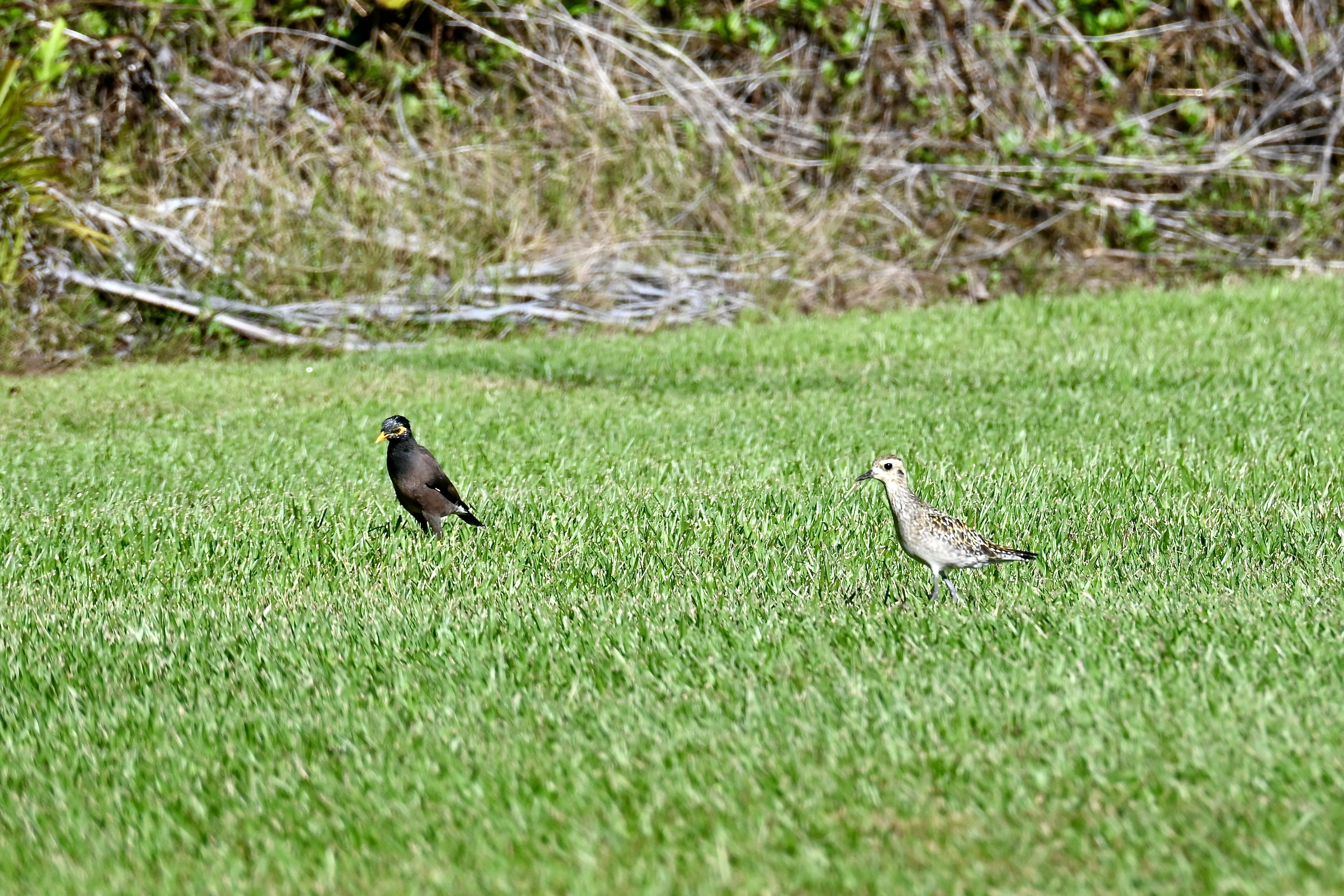
Two birds near each other in mown grass. One is dark brown with a yellow beak and feathery mask. The other is cream colored speckled with darker brown.

July 26, 2026

Romans 8:26-39
Matthew 13:31-33, 44-52

Over the next few weeks we’re likely to start seeing one of our famous Hawaiian birds again. We’re approaching the time of year when the kolea make their 3000 mile non-stop flight from Alaska to Hawai’i where, like sensible birds, they’ll spend the winter.

A myna and a kolea happened to be scrounging for worms and insects side-by-side one day. As you know, kolea are generally pretty quiet, and mynas are frequently pretty noisy. They didn’t much mind one another, though, poking through the grass stems to put together a good breakfast.

The myna, naturally, was the first to say anything. “Where have you been?” he asked. “I haven’t seen you for months.”

“A long way away,” she said. “Someplace that’s pretty cool in the middle of summer.”

“Oh, come on,” said the myna. “There’s no such place.”

“There is,” she said. “It’s a long flight, though. It took me four days to get there, and it’s taken me four days to get back.”

“Look, if you want to spin fables for me, go ahead,” said the myna, who was getting increasingly grumpy about all this. “The world isn’t that big.”

“It is,” she insisted. “It’s even bigger, as far as I can tell. There are coastlines and lands far, far away. I’ve even met birds who’ve come from other lands with other shores. It’s a big world.”

“Nonsense,” scoffed the myna.

“Go take a look,” said the kolea. “Fly as high as you can. You won’t see the shore where I spent the summer, but you’ll see at least one other island, and you’ll see a great big ocean.”

“I’m not going to stick around to be lied to,” grumped the myna, and he flew off to another lawn where there wasn’t a kolea to tell him stories. But her last words stuck. She’d seemed so sure and so sincere. It seemed incredible. At the least he should take her challenge and prove her wrong.

So he flew up along the slopes of Mauna Kea, bound for the sky above the summit. He’d never been there before, since he had all the seeds and worms he needed right here. Up he went, and to his surprise it got cold. Then the air got thin, and he had to work harder to keep his place in the air. He was a determined myna, though, and he kept going, until he could see the ocean all around the shores of Hawai’i Island. It seemed to go on forever, much further than he’d imagined.

And he could see the summit of Haleakala rising above the clouds on Maui.

He spiraled his way back down to the lawn where he’d disbelieved the kolea. She was back again, poking at the ground, making herself a good breakfast.

He broke the silence. “It is a big world, isn’t?”

“Bigger than I imagined,” she said. “I couldn’t believe there was anyplace like here the first time I made that flight.”

“I’m sorry I disbelieved you,” he said. “Could you tell me about the places you’ve been?”

And she did. The world was more wonderful and more amazing than he’d thought, and he was glad to know it.

by Eric Anderson

Watch the Recorded Story

I write these stories in advance, but I tell them from memory and improvisation – so the story you read is not precisely how I told it.

Photo of a common myna (at left) and a kolea (Pacific golden-plover, at right) by Eric Anderson.
Story: ‘Apapane Faith

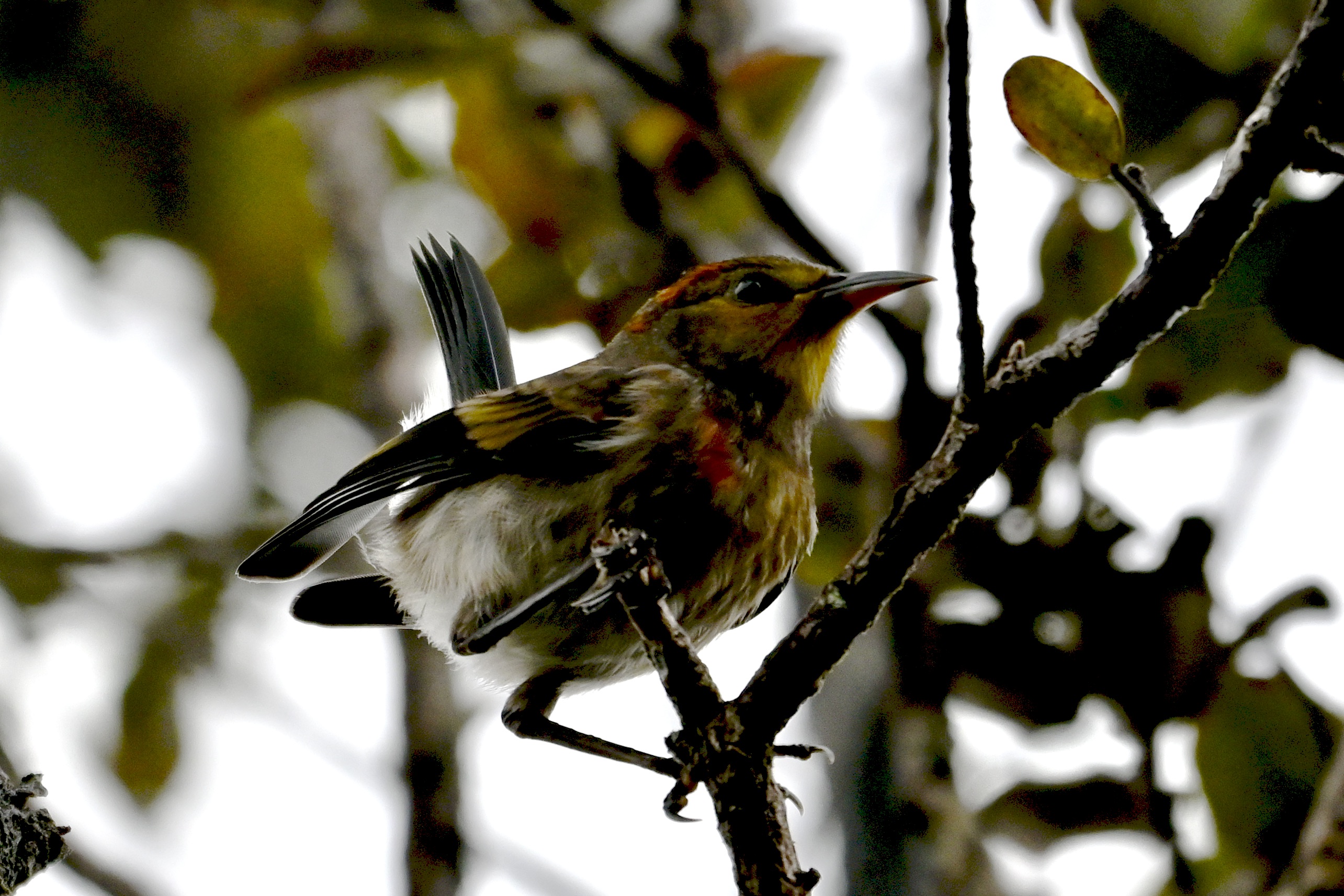
Juvenile 'apapane with spotted feathering

October 5, 2025

Habakkuk 1:1-4, 2:1-4
Luke 17:5-10

Birds, by their very nature, rely on faith. Every bird knows about gravity; every bird knows that what goes up must come down. Every bird knows that while flight is the most natural thing in the world to them, it is also the most unnatural thing in the world. Somehow they hold those two things together.

At least, most of the time they do.

One young ‘apapane had learned to fly from his parents. He’d flown any number of times on his own. He was also still pretty young, so a lot of his feathers were still grey and brown. That had been fine. Now, however, some of his adult colors were coming in, so he had red feathers mixed among the grey and brown, and he had a speckled look. Frankly, I think he looked really interesting, but he thought he looked odd, even a little ugly.

With feathers that looked like that, he thought, how could he keep up with flying?

I don’t think that makes much sense, do you? He’d been flying just fine, and suddenly he didn’t believe he could fly because his feathers were changing? But you know, the first step in doing something is believing that you can do the thing. He stopped believing he could do the thing.

So he stopped flying.

He did manage to feed himself by journeying to other trees in the slowest, and possibly most exhausting way possible. He hopped from twig to twig, then from branch to branch, and when branches got close he jumped from tree to tree. It took time, and it wore him out, and frankly made him hungrier, but he did it.

It was a funny way to live for an ‘apapane.

It took a while for the other birds to notice, because he did turn up among his family and friends, even if he turned up later than everyone else. They just assumed he’d flown off in some other direction and finally got turned around the right way.

It was Tutu, his grandmother, who noticed the way he hopped, rather than flew, from tree to tree. She hopped over to his branch and said, “Are you all right, grandson? Have you hurt your wings?”

“No, they feel fine,” said her grandson.

“Then why are you hopping everywhere?” she asked. “Why aren’t you flying?”

“Well, just look at me,” he said. “Do these look like flying feathers? If I take off with these I’ll crash a moment later.”

“You think you can’t fly because of these feathers?” asked his grandmother.

“That’s right, Tutu,” he said.

Grandmother thought. She was a wise old bird, and she knew that you have to believe you can fly if you’re going to fly. She was tempted to let him hop around until he finished molting, but she knew he’d be pretty miserable the whole time. And who knows? He might never come around to believing again. That would be sad.

“Grandson, are you an ‘apapane?”

“Yes, of course I am,” he said, puzzled.

“Do you believe that you have wings?”

“Of course I do.”

“Do you believe in your feathers?”

“They’re right here,” he said.

“I believe in your feathers, too,” said Tutu, “the ones you have and the ones you’ll grow. In fact, all your family believes in them. Do you believe us?”

“I’m not sure,” he said.

“It takes just a little belief,” said his grandmother, “and that’s the amount of belief it takes to spread your wings. You’ve done it before. You can do it now.

“Believe it. Spread your wings, grandson. Fly.”

by Eric Anderson

I regret that we continue to have problems with the audio in our video stream, so a recording of this story is not available.

Photo of a young ‘apapane by Eric Anderson.

Story: Unbelief

March 31, 2024


Isaiah 25:6-9
John 20:1-18

In the gospel stories about Easter, there’s a common theme. It’s unbelief. People heard – from angels, initially – that Jesus had risen from the dead, and… they didn’t believe them. Later people heard from other people that Jesus had risen from the dead, and they didn’t believe the people. I guess that makes sense. If you don’t believe angels, how likely are you to believe people?

Once there was an ‘apapane who didn’t believe in love.

If that seems hard to believe, well, it was hard to believe. He had been raised with two sisters by attentive parents who fed them well, kept them warm in the rain, and taught them all to sing. They flew with him, they brought him to good trees to find bugs and nectar, and they kept him company when the nights got long and lonely.

But he didn’t believe in love.

You might be thinking that his sisters teased him all the time and that’s why he didn’t believe in love. It’s true. They teased him. But not much, really. More to the point, the teasing didn’t bother him. He teased them back and they all would laugh at the silly things they’d say.

Still, he didn’t believe in love.

“You’re just taking care of me because it keeps the family going,” he told his parents, who really didn’t know what to say about that.

“You’re just good to me because you expect I’ll be good to you,” he told his sisters, and he was good to them, but as he said, it was because he expected them to be good to him.

I suppose it might have been because nearly the entire time since he’d cracked the shell that the skies had been gray, the winds had been cold, and the rain had plummeted down.

I sometimes find it hard to believe in love after too many days of cold, grey, windy rain.

He and his sisters had put in a hard day of nectar- and bug-seeking. There might have been ohi’a flowers in blossom, but they were hard to see in the grey light. The bugs were hiding from the rain, not even troubling to go find nectar to eat. The three siblings huddled for the night on a branch, cold, wet, and hungry.

He was grateful for their warmth but he still didn’t believe in love.

When morning came, he blinked his eyes to an unfamiliar light. The clouds had cleared overnight, and the wind gently rustled the leaves. He and his sisters, all three, stared at the golden light of the sun rising over the trees. As it got higher, the ohi’a blossoms opened in scarlet and gold glory. As it got higher, its warmth dried their feathers.

“Wow,” said the sisters. “What a difference that makes.”

“More than you know,” said their brother. “It’s like a completely different world.”

“Is this a world where you can believe in love?” asked one sister.

He thought about it for a while.

“You know, I think it might be,” he said.

They helped one another get their drying feathers into shape – that’s kind of an ‘apapane hug – and flew off into the sunrise over the glorious bloom of ohi’a.

As they flew, they sang together. You know what they sang?

“I think I believe in love.”

by Eric Anderson

Watch the Recorded Story

I write these stories ahead of time, then tell them from memory – memory plus whatever I feel like saying in the moment.

Photo of an ‘apapane by Eric Anderson.