September 13, 2026
Romans 14:1-12
Matthew 18:21-35
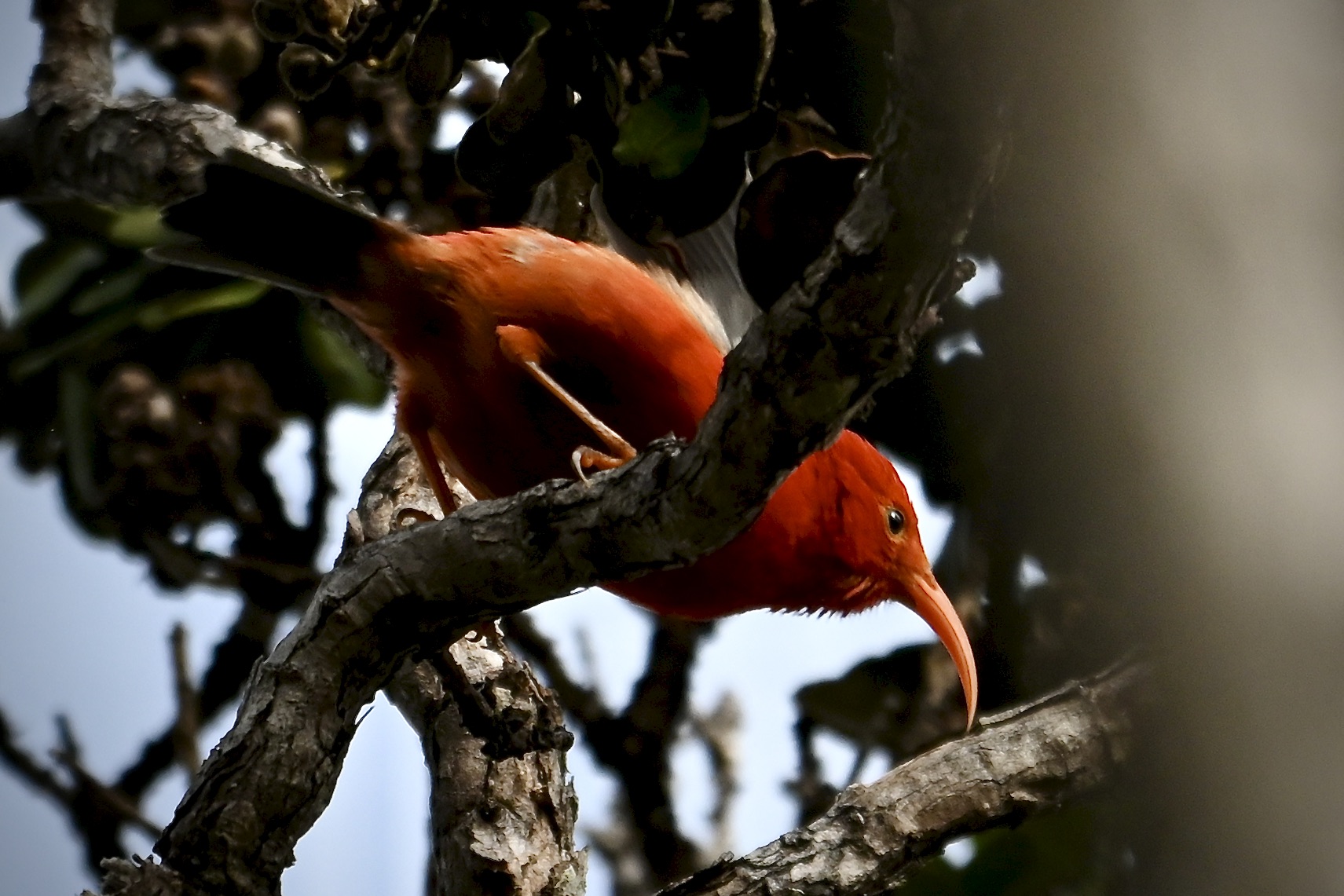
I’iwi can be rather opinionated birds. They can also be very grumpy about their opinions. In their opinion, for example, blossoms full of nectar should be sampled by… me. That is, whatever i’iwi happens to have noticed those blooms at the time. ‘Apapane and ‘amakihi can go to another tree. Another i’iwi might be tolerated. Might. If they behave themselves. And aren’t greedy.
Most of all, though, they had to act like a proper i’iwi, and sip from the floral nectar. That’s how a proper i’iwi behaved. Most of all, they didn’t go looking for spiders.
I’iwi do eat spiders, but not very often by choice. They like the liquid diet of nectar, and they’ve got a long beak and a long tongue to drink it with. If a butterfly or moth happens by, they’ll eat it. They’ll fill in with other bugs as well. Far down the list, though, is spiders.
It’s something they’ll eat, but only if they’re really hungry.
Except for one i’iwi, who just so happened to really enjoy spiders. I don’t know why he did. He did. I’m pretty sure that if he explained it to me, I wouldn’t understand it, because I don’t like eating spiders. And I’m pretty sure that if I explained it to you, you wouldn’t understand it, since I suspect you’re not big fans of eating spiders.
If you are and I got that wrong, I apologize. You can explain it to me later.
The older i’iwi watched this younger one enthusiastically eating spiders with a certain feeling of, “Ick.” Most of them were content to let him enjoy his meals. After all, if he was eating the spiders, there was more nectar for them, wasn’t there?
One of those older i’iwi, though, got really annoyed with it all. He took it upon himself to fly over and grumble, “Knock it off, spider-lover. No more of this. Eat like a real i’iwi. Drink nectar.”
“I do,” said the i’iwi who liked spiders. “I drink plenty of nectar.”
“But you’re also eating all these spiders,” said the grumpy one. “Stop it.”
“I like spiders,” explained the younger i’iwi, which was really all that could be said, wasn’t it?
“No proper i’iwi likes spiders,” pronounced the elder. “No sensible i’iwi would make a full meal out of them. No real i’iwi prefers spiders to nectar.”
“And that’s how it is, youngster,” said that older i’iwi. “If you keep eating spiders like this, you’re not a real i’iwi, and we’ll treat you like a stranger and a nuisance.”
Word flashed around the little community of i’iwi about what had been said, and they called a very unusual little gathering to set matters straight. The older grumpy bird and the younger spider-eating bird perched before the flock.
“Do you eat spiders by choice?” they asked the younger one, who had to say, “Yes.”
“Did you tell him that eating spiders by choice meant he wouldn’t be a real i’iwi?” they asked the older one, who proudly said, “Yes.”
One of the grandmothers fluttered her wings at this, and said, “Diet does not make an i’iwi an i’iwi, or not an i’iwi. We’ve all eaten things we’d prefer not when times are lean, and we’ve all found that some of them tasted better than we’d expected. You’re just as much as i’iwi as anyone, youngster,” she said, “even if you eat things I’d rather not.”
“You, however,” she told the grumpy bird, “have taken it upon yourself and yourself alone to say what makes an i’iwi and what doesn’t. That’s something an i’iwi may do and remain an i’iwi, but they should not do it. The forest is hard enough with wind and rain and dry times. We do not need to make barriers for one another.
“You are an i’iwi. But you have not behaved like an i’iwi should. Make your apology to your cousin, and never let us hear you have done this again.”
by Eric Anderson
Watch the Recorded Story
I write these stories in full each week, but I tell them from memory and improvisation. The story you just read is not precisely the way I told it.
Photo of an i’iwi by Eric Anderson.