Story: One Loves

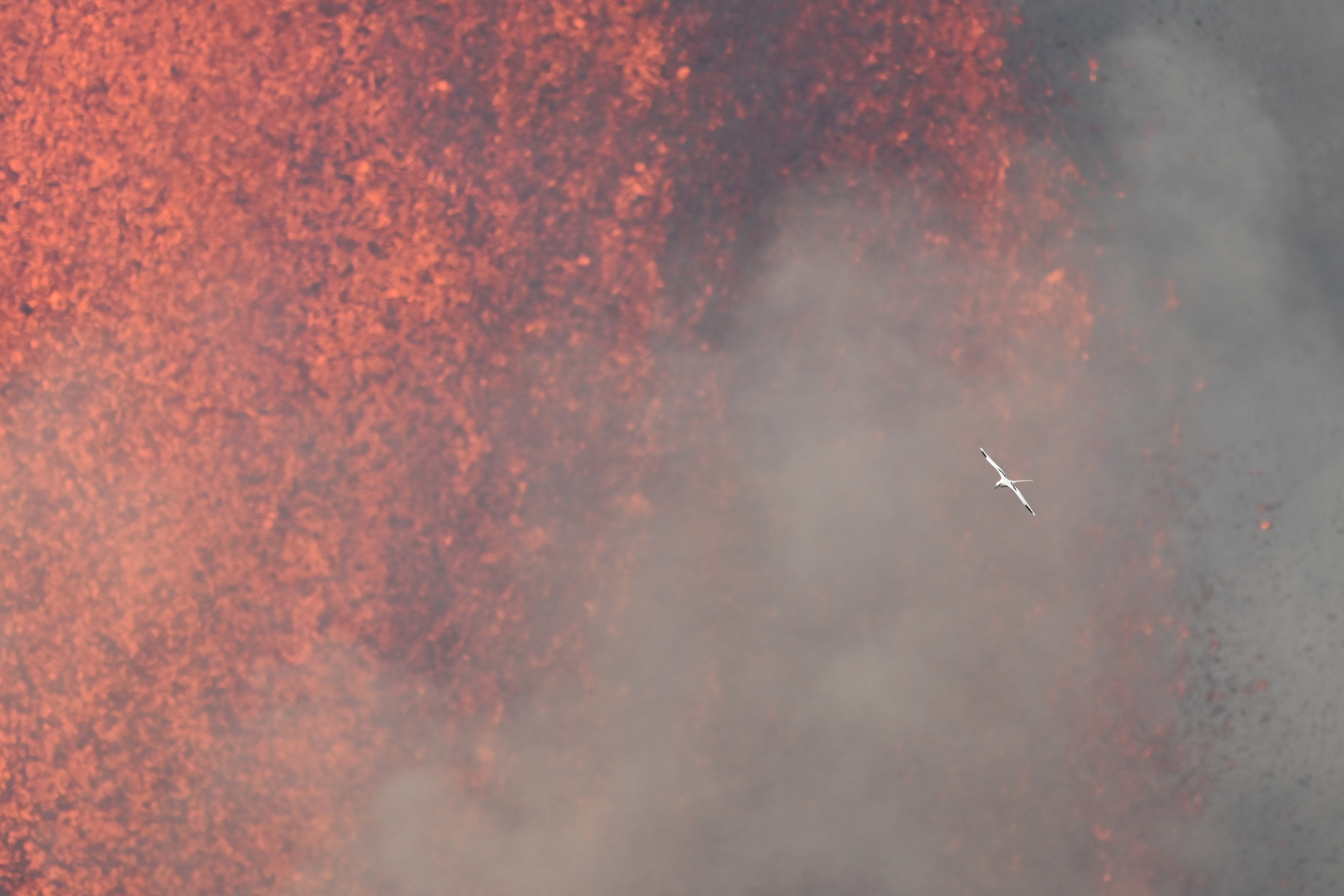
Most of the frame contains a massive lava fountain, but also visible is a white bird with black bars near the end of its wings and a long thin white tail.

July 19, 2026

Psalm 86:11-17
Matthew 13:24-30, 36-43

The koa’e kea (white-tailed tropicbird) loved to fly. She loved to fly over the sea, and to hover over the water before diving to capture a fish or squid. She loved to fly over the land as well, to feel the thermals lift her wings as she crossed from sea to shore. And of course, as a koa’e kea from Hawai’i Island, she loved to fly around the Kilauea summit, with all the excitement of the rising hot air and, from time to time, the thundering lava fountains.

When Kilauea has fountained recently, she’s tried to be there.

“You can’t love all of these,” said a grumpy friend. “Love isn’t like that. You love some things, but that means that you don’t love other things. You can’t love all those different airs.”

“But of course I love them,” protested our koa’e kea, but her friend repeated:

“You can only love one. Just one. Love is for one. Pick just one.”

That’s all her friend would say.

How was she to choose? She couldn’t imagine. Yes, flying over the water could be more challenging, because sometime the spray would leap toward her, but she liked that. Flying over bare rock gave her a lift, and flying among and around trees and branches gave her a thrill.

She supposed that she probably loved flying around a lava fountain the best, but that was mostly because it didn’t happen that often. She flew over water every day. Lava only fountained once or month or so. If it happened every day, it wouldn’t so special, and she thought she’d probably love it, but not quite as much.

And besides, as much as she loved flying around the fountains, she still loved the other flying. How could she choose one? She just wanted to weep.

“What are you sad about?” asked another friend, one who wasn’t quite as grumpy as the first friend.

“How can I choose what kind of flying to love?” she asked, and was very surprised when her friend said:

“Why would you?”

She explained what their other friend had said, and he shook his head in unbelief.

“Love is bigger than that,” he said. “I love all sorts of things and all sorts of birds. Sometimes I love them in different ways. I love squid, but I love to eat it. I love my parents, but I’m not going to eat them.”

The two birds laughed at that.

“I think you’ve got enough love in you for lots of things, and lots of birds, and lots of different kinds of air and flying. Besides, it’s all the same in the end. It’s the world we were given, and I say we can love all of it.”

“Then that’s what I’ll do,” said our koa’e kea. “I’ll love all of it. Come fly with me. Let’s have a lovely time.”

by Eric Anderson

Watch the Recorded Story

I write these stories ahead of time, but I tell them from memory and improvisation. The story as I wrote it is not identical to the way I told it.

Photo of a koa’e kea in flight near a lava fountain by Eric Anderson.
Story: Caterpillar’s Hope

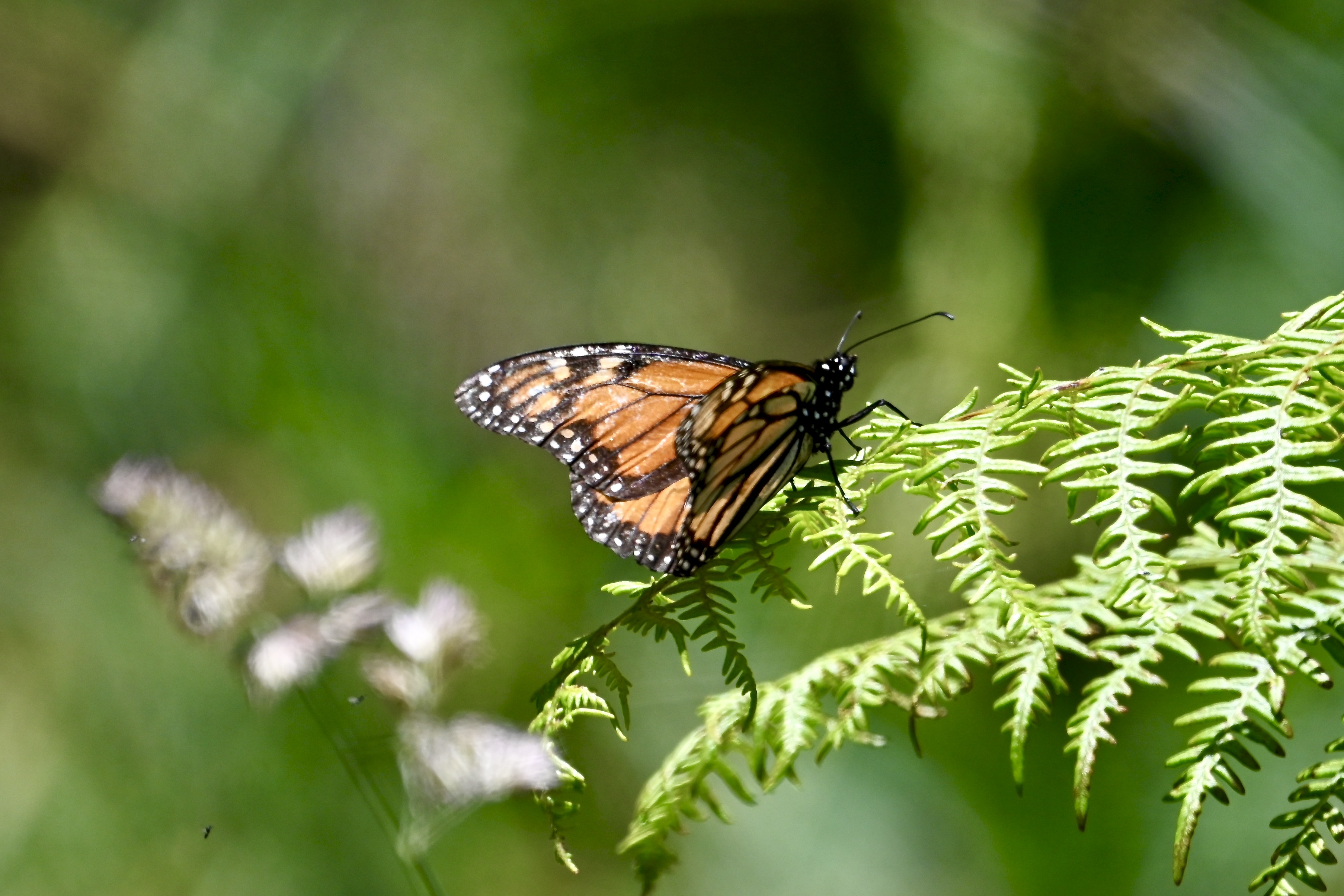
An orange and black butterfly resting on a fern leaf.

November 30, 2025

Isaiah 2:1-5
Romans 13:11-14

Caterpillars don’t have the easiest life. They don’t get around very much – but then, when you move mostly to find another leaf to eat, you don’t need to move very far. There are things about that, while you’re eating leaves, would be very happy to eat you, and that makes for more than a few anxious moments. A lot of the birds I happily tell stories about would happily eat a caterpillar, and that makes them rather sad.

Caterpillars are among the most hopeful creatures on Earth, however. Each one of them hopes to go from an animal that crawls slowly across the branches to one that flies through the skies. They hope to go from someone that you hope will be overlooked (and so not eaten) to one that glows brightly in the sunlight. They hope that the beauty they feel on the inside will be mirrored on the outside.

What’s amazing is that that’s what happens.

Two caterpillars were sharing their hopes on a branch one day between bites of leaf. I’m going to leave out the biting and chewing, because it actually took more time than the conversation. Caterpillars are serious about eating.

“I’m really looking forward to being a butterfly,” said the first.

“Me, too,” said the second.

“I can’t wait to fly,” said the first.

“Me, too,” said the second.

“I’d like to see more of the world than this flower patch,” said the first.

“It’s a good patch,” said the second.

“I’m not saying it isn’t,” said the first.

“You’re right, though,” said the second. “It would be nice to visit another one.”

“All we’ve got to do,” said the first caterpillar, “is wait.”

“Just wait?” asked the second.

“Just wait,” said the first.

“That doesn’t’ sound right,” said the second. “I think we’ve got to build a chrysalis, and stay in it, and then come out as butterflies.”

“Don’t be silly,” said the first. “You hope for it, and then it happens.”

“I don’t think so,” said the second. “I think you hope for it, and then you do something about it. And then it can happen.”

I don’t know what happened to the first caterpillar. I hope it made a chrysalis and became a butterfly, because the second caterpillar was quite right. Caterpillars become butterflies in the chrysalis. They’ve got to make things happen to make other things happen.

Dream of better days. Hope for them, and believe they can come to be. But don’t forget to do the work for them. Hope is good, but hope and effort are better.

by Eric Anderson

Watch the Recorded Story

I write these stories ahead of time, but I tell them on Sunday from memory plus inspiration. The story you just read will not be identical to the story as I told it.

Photo of a monarch butterfly by Eric Anderson.

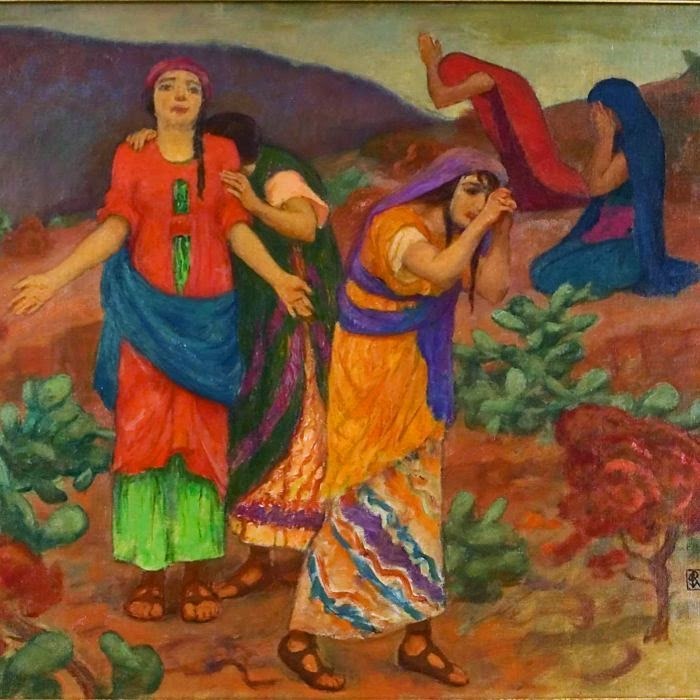
First Commandment

A brightly colored painting showing two women facing forward, both showing grief, with a third holding the shoulders of one from behind, face hidden. Two other women show signs of grief at right and to the rear.

“One of the scribes came near and heard them disputing with one another, and seeing that he answered them well he asked him, ‘Which commandment is the first of all?’ Jesus answered, ‘The first is, “Hear, O Israel: the Lord our God, the Lord is one; you shall love the Lord your God with all your heart and with all your soul and with all your mind and with all your strength.” The second is this, “You shall love your neighbor as yourself.” There is no other commandment greater than these.'” – Mark 12:28-31

The scribe approved your words, or so says Mark,
and silenced all the snare-deploying crowd.
Yet he might ask (and yes, in Luke he did)
“Who is my neighbor to receive my love?”

Then you, Redeemer, might have said
(though you did not, or so says Luke),
“Look to the Book of Ruth, to what is written there:
‘I will not leave you. Do not press me.

“‘Where you journey, I will go.
And where you stop, there I will take my rest.
Your people shall be mine, and more:
Your God shall be my God.'”

A poem/prayer based on Mark 12:28-34, the Revised Common Lectionary Gospel Reading, and Ruth 1:1-18, the First Reading, for Year B, Proper 26 (31).

The image is Whither Thou Goest: Naomi and Ruth by Rupert Bunny – http://www.abc.net.au/radionational/programs/360/rupert-bunny-whither-thou-goest.jpg/4079790, Public Domain, https://commons.wikimedia.org/w/index.php?curid=56415654.