Story: Two Wings and a Prayer

August 7, 2022

Hebrews 11:1-3, 8-16
Luke 12:32-40

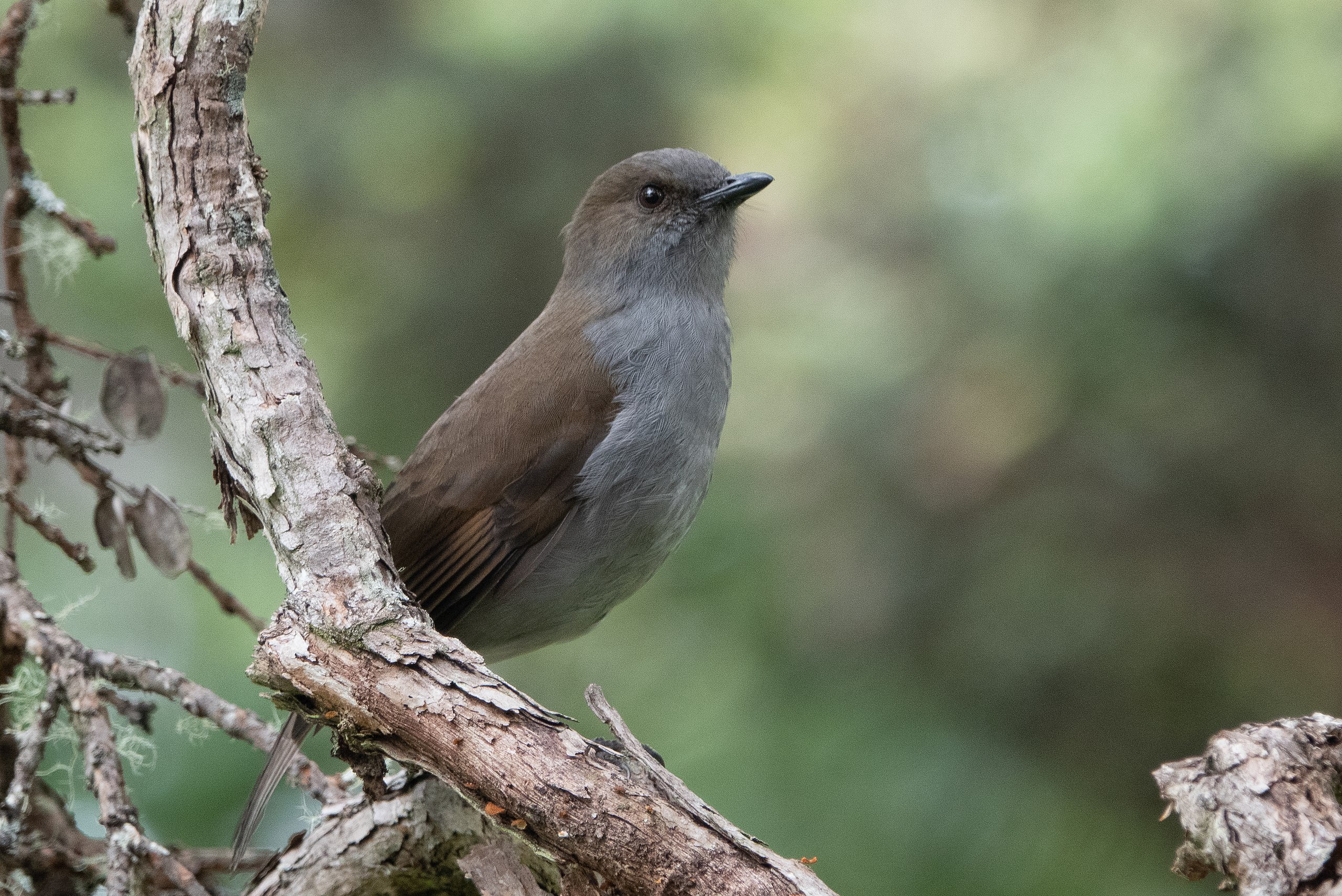
The oma’o is a fairly small bird, living on the lower slopes of the volcanoes from Hamakua to Ka’u. When you’re an oma’o chick, you’re even smaller. He hatched and grew up in a hole in a koa tree, and about the only thing he could even imagine as he looked out from the hole was:

It’s a great big world, and I’m a very small bird.

He was, of course, a very small bird, but he grew to become, well, a larger but still very small bird. The world outside was still a lot bigger than he was. He watched his parents fly back and forth to and from the nest, and wondered how they did it. Their wings seemed awfully small to carry even their small bodies. Their feet seemed awfully fragile to grip a twig. How was someone like him to have any place in a huge world like this?

Young oma’o do some experiments that lead to flying. They move their wings around and start to preen them, to settle their feathers with their beaks. They start to hop and stretch their legs in the nest – but they don’t leave the nest. In fact, after they leave the nest, they don’t come back to it. They’ll stay where their parents can find them – they still feed them for a  while – but they don’t go back to the nest.

This young oma’o, however, wasn’t sure he wanted to leave the nest. Big world. Small bird. Small wings, big air. It was a night that the winds blew hard that he came to a decision.

“No,” he told his father. “I’m staying here.”

“Very smart, son,” said his father. “It’s a nasty night. The nest is a good place for now, and it’s not a great time to take your first flight.”

“No,” said the youngster. “I mean I’m just staying here. I’m not going to leave.”

The father didn’t know what to say, so he didn’t say anything. Nor did mother when the youngster told her in the morning.

“What are you going to do just staying in the nest?” asked mother.

“What I’m doing now,” he said.

“Wouldn’t you like to fly?” asked father.

“I don’t think so,” said the child.

It was mother who settled down with him and got him to say what was going on. The world was too big. The winds were too strong. His wings were too fragile. He was too small.

Then he asked, “How do you do it, Mom?”

She thought about it. “It is a big world,” she said. “I’m a small bird. My little wings aren’t much to carry me through strong winds. But I’ve got a couple of things that carry me through it all.”

“What?”

“Well, I haven’t got one just wing. I’ve got two. With only one, I don’t think I’d get far. With two, I can get anywhere I want.”

“But how did you make that first leap of faith?” he asked.

“I just flapped my wings and hopped, and as I hopped I hoped and prayed. Suddenly my wings caught the air and I was flying.”

Without even realizing it, the young fledgling was hopping and flapping. “So a wing and a prayer?” he asked.

“Two wings and a prayer,” said his mother, “and I took my first flight – just like you’re doing now.”

Sure enough, his flapping wings had caught the air and he’d taken off on his first short flight.

“Just like that,” he marveled, “on two wings and a prayer.”

by Eric Anderson

Watch the Recorded Story

The story was told from memory of this manuscript text – which means that in the recording, it’s told differently.

Photo by Bettina Arrigoni – Omao | Hakalau NWR | HI|2018-12-02|13-40-46, CC BY 2.0, https://commons.wikimedia.org/w/index.php?curid=75174855.
Chasing Hope

June 12, 2022

Proverbs 8:1-4, 22-31
Romans 5:1-5

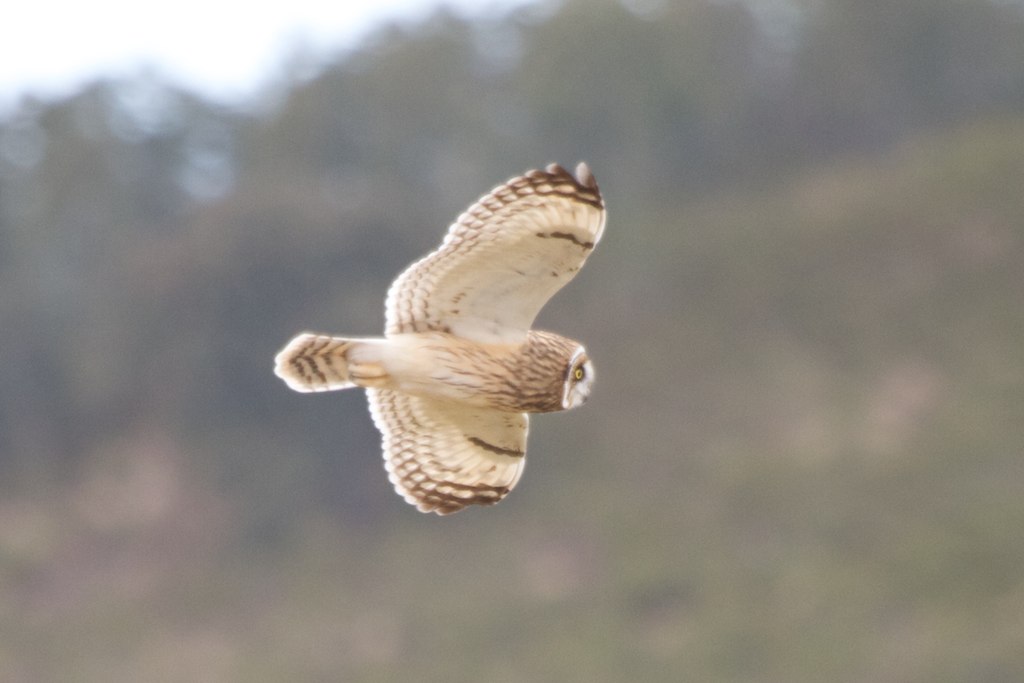
The young pueo had learned many things. He’d learned how to fly, and how to find his way home, and how to spot small creatures in the grasses. He was, in many ways, prepared to begin a life of his own.

But he didn’t know what hope was.

His mother talked about hope a lot. Or muttered about it a lot. “Do you think we’ll find mice out there today?” he’d ask, and she’d say, “Hope.” “Do you think it will be sunny and warm today?” he’d ask, and she’d say, “Hope.” “Do you think I’ll learn something new today?” he’d ask, and she’d say, “Hope.”

Sadly, one of the things that he hadn’t learned by the end of any day up to that point was what “Hope” meant.

So he went to ask grandmother, Tutu Pueo, his mother’s mother. He flew to the rock on which she’d perched and asked, “Tutu, what is hope?”

“Hasn’t your mother told you?” she asked, rather surprised.

“No,” he said. “She mutters ‘Hope,’ a lot, like when we set out to find dinner, or when I ask about what’s coming. But she never says what it is.”

Tutu laughed. “I’ll just have to teach you the way I taught her,” she said. “Come fly with me. Let’s chase Hope.”

Puzzled but willing, he followed grandmother into the sky. “You’ve got to chase Hope,” said Tutu over the rush of the air. “Yes, but what does Hope look like?” asked the grandson, but suddenly she shouted, “Look there! In the grasses!”

Down they pounced to where an unwary mouse had ventured out. They enjoyed their snack, but then he said, “That wasn’t Hope, was it? That was a mouse.”

“You’ve got to chase Hope,” said Tutu. “Come on.”

Once more they took to the air, but clouds were pouring through the gap between Mauna Loa and Mauna Kea. “Look! There’s Hope!” shouted Tutu and she poured on the speed, heading for the retreating sunshine. Before the rain began to fall they were circling again in the sun.

“That’s not Hope, is it?” said grandson. “Isn’t it just… sunshine?”

Tutu turned lazy circles. “You’ve got to chase Hope,” she called. “Have you learned anything?”

He thought about it. He thought about being hungry, and about chasing something to eat. He thought about wanting to be warm and dry, and chasing the gaps in the clouds. He thought about wanting to learn something, and…

“I’ve learned that you have to chase Hope,” he said. “It’s always somewhere out there ahead, isn’t it?”

Tutu nodded. “And when you catch it, it’s the thing you hoped for – and then Hope becomes the next thing you need or you want.”

When he went home, he found his mother waiting. “Did Tutu teach you anything?” she asked.

“She taught me to chase Hope,” he said. “Do you think I’ll learn something new tomorrow?”

She smiled a pueo smile and simply said, “Hope.”

by Eric Anderson

Watch the Recorded Story

The story as written does not match the story as told – I work from my memory of the text above, but not from the manuscript itself.

Photo of a pueo on Hawai’i Island by HarmonyonPlanetEarth – Pueo (Hawaiian Owl)|Saddle Rd | 2013-12-17 at 17-45-012 Uploaded by snowmanradio, CC BY 2.0, https://commons.wikimedia.org/w/index.php?curid=30241884.

Hope, Disappointment, Hope

“…Suffering produces endurance,
and endurance produces character,
and character produces hope,
and hope does not disappoint us…” – Romans 5:3-5

So much suffering
to endure
world-wounding,
nation-spanning,
wailing, weeping,
crashing, crushing.

Not all survive
what they endure,
bodies-bloodying,
soul-searing,
no comfort,
no healing.

Some endure
but suffer still,
character assassinated,
spirit speared,
throat raw
from silent shouts.

Character survives
but hope? Not always.
Heart-hurt,
future-foundered.
What to expect
but what we’ve known?

But hope
does not disappoint
even if suffering,
endurance,
and character all fail,
as they do.

Hope does not disappoint.
It has been fulfilled.
We suffer and endure,
and we are not alone.
There is a balm in Gilead.
It heals the shattered soul.

A poem/prayer based on Romans 5:1-5, the Revised Common Lectionary Second Reading for Year C, Trinity Sunday.

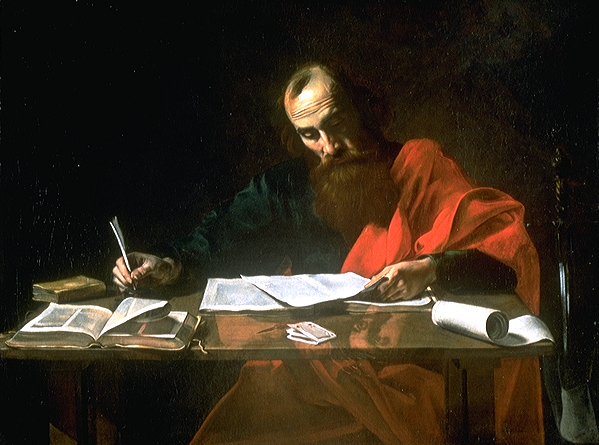
The image is Saint Paul Writing His Epistles by Valentin de Boulogne (one of my favorite artistic depictions of the Apostle) – Blaffer Foundation Collection, Houston, TX, Public Domain, https://commons.wikimedia.org/w/index.php?curid=596565.

Election Day 2020

Amidst a global pandemic (which some deny),
amidst racist violence (which some discount),
amidst xenophobia (which some applaud),
amidst voter suppression (which some embrace),
we come to express the will of the People, O God.

May there be wisdom.
May there be health.
May there be compassion.
May there be mercy.

May the will of the People be love, O God.

For this I must hope.

The image “hope” by @polsifter is licensed under CC BY 2.0.

Prophesy to the Bones

Ezekiel once stood upon the city wall.
He stood, he gazed. I’m sure he wept.
For on that day he saw an army
terrible and merciless. It filled the valley,
all the valleys, that encircle Zion.
He stood. He gazed. I’m sure he wept.

When You showed him all those desiccated bones,
O God, what fashion did the valley take
in his imagination? Kidron?
The Outer Valley? Or Gehenna?
Or had You mercy enough to make it look
like a Babylonian valley spanned with gardens?

I doubt it mattered. Ezekiel wept, I’m sure,
upon the wall. I’m sure he wept the see
even an unfamiliar valley overflowing
with the dead. Bones so dry, dry as dust,
unmoistened even by the flood of tears
of a priest and prophet’s grief.

Command me, Holy One, to prophesy
and promise to the dusty bones that they
shall live again. Command me, Holy One,
to summon up the spirit breath to bind
with sinew all these bones. For then shall I
appreciate the salt of joyful tears.

A poem/prayer based on Ezekiel 37:1-14, the Revised Common Lectionary First Reading for Year A, Fifth Sunday in Lent.

Photo of a detail of the Knesset Menorah in Jerusalem by Deror avi – Own work, CC BY-SA 3.0, https://commons.wikimedia.org/w/index.php?curid=4085158.

Mary’s Prayer

O Jesus, I can hear
the clatter of the crockery,
the puffing of the bellows,
the swirling of the aprons.

O Jesus, I can hear
the half-resentful voice
my sister raised to you;
I hear her dripping sweat.

And Jesus, I can hear the wailing
children, crying refugees,
groaning sufferers, weeping
hungry seekers after justice.

And Jesus, I can hear the silence:
Silence of the powerful.
Silence of the privileged.
Silence of the unjust judges.

What I strain to hear, sweet Jesus,
is your voice. I long to hear
the words of comfort, words of
challenge, words of love.

I long to hear the words
that will unbreak my heart
and melt it into Martha’s,
love showering in tears.

Hold me, Martha, as we weep
together for these words of hope.
I’ll tune my ears to hear your voice
declare your faith in life renewed.

A poem/prayer based on Luke 10:38-42, the Revised Common Lectionary alternate first reading for Year C, Proper 11.

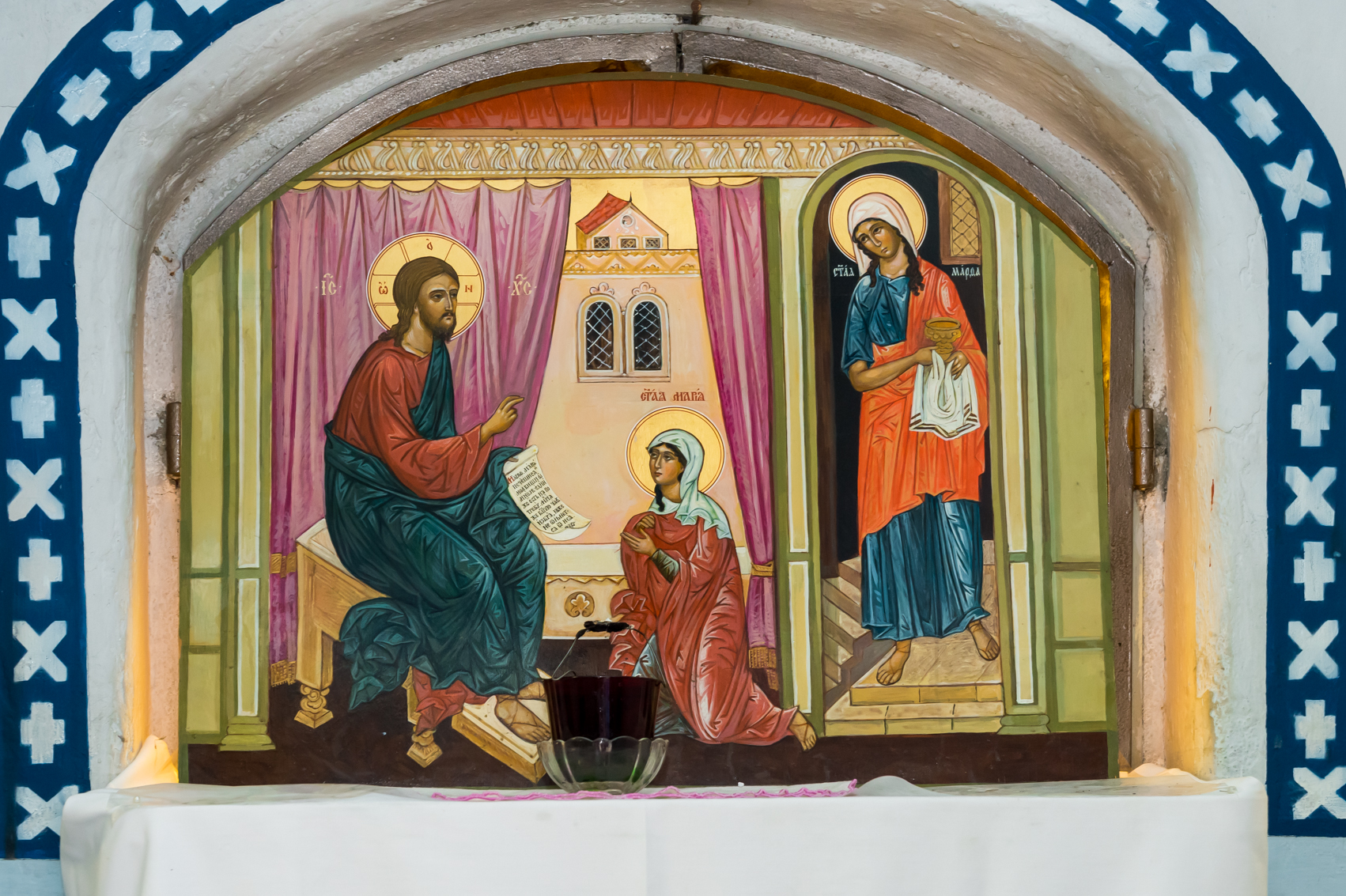
The image is Russian; I regret that I cannot translate the attribution that follows: By Владимир Шелгунов – фотографии переданы представителем ИППО, CC BY-SA 3.0, https://commons.wikimedia.org/w/index.php?curid=33504499

Martha’s Prayer

Worried and distracted
by many things?
O, Jesus, if you knew!
Yes, if you only knew!

It’s not the bread and cookies
or the trays of snacks,
nor the fraying linens
or the dusty sills:

It’s the wailing children, Jesus.
It’s the hopeless refugees.
It’s the pain-wracked sufferers.
It’s the justice-denied and hungry.

It’s the comfortable oppressors.
It’s their eager lackeys.
It’s the ones determined
that they will not see injustice.

Worried and distracted
by many things?
O Jesus, if you knew!
But then, you did; you knew.

Breads and cakes forsaken,
I will shed my tears upon your feet.
How will we dry the moisture
lavished there from streaming eyes?

Hold me, Mary, as we weep
together for the long-awaited reign of God.
Unbind your hair, to wipe away
betraying symbols of our grief.

A poem/prayer based on Luke 10:38-42, the Revised Common Lectionary alternate first reading for Year C, Proper 11.

The image is Christ in the House of Martha and Mary, by Johannes Vermeer. Public Domain, https://commons.wikimedia.org/w/index.php?curid=21865869