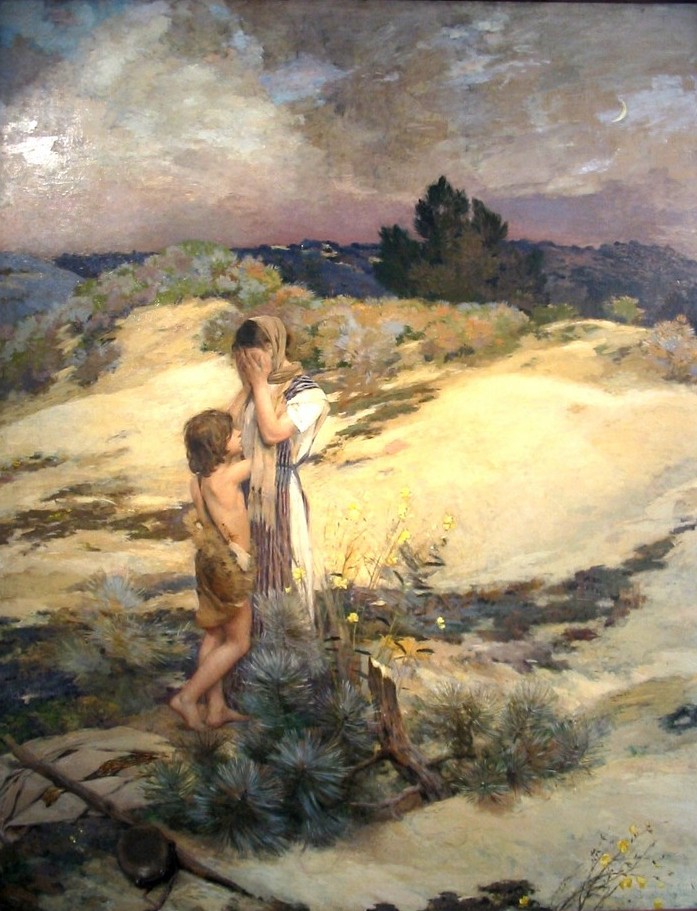
“But Sarah saw the son of Hagar the Egyptian, whom she had borne to Abraham, playing with her son Isaac. So she said to Abraham, ‘Cast out this slave woman with her son, for the son of this slave woman shall not inherit along with my son Isaac.'” – Genesis 21:9-10
They laughed, the boys at play.
How many mothers watched? But one
saw threat and dissolution of
the wealth expected for her own.
How precious was her Laughter! She
had laughed to hear an angel say
that she would bear a much-desired son,
for she had forced her maid already to
Her husband’s bed, there to conceive
the older laughing child. No wonder that
she laughed, not just at things that could not be,
but that she’d brought an heir to life.
But now, she finds that promises fulfilled
have made a change. The boy she forced
another human being to bear, what is his place?
She could not bear to share the wealth.
“Go, cast them out,” she said to Abraham.
“He cannot have a place beside my son.”
Now Abraham had argued with his God
to find a place for his first born, but no.
He would not argue with his wife. He cast
them out. He knew the skin of water would
not last, and neither would the food. He cast
them out to where the sun would bleach their bones.
They were disposable, these two,
to Sarah and to Abraham. They’d had
a purpose once, but it had flown.
No purpose in the camp? Then go.
Too often and too many people find
they have been named “disposable”
by others with the power to displace
them, cast them out, and let them die.
But God, despite a failure to tell Abraham
and Sarah, “No. You shall not kill,” at least
preserved the lives of Hagar and of Ishamael,
declared that they were not disposable.
How soon will our humanity see what
our sacred texts still strain to see: no people are
disposable. All souls have worth to God,
and if to God, then how much more to us?
A poem/prayer based on Genesis 21:8-21, the Revised Common Lectionary First Reading for Year A, Proper 7 (12).
The image is Agar and Ismael (Hagar and Ishmael) by Jean-Charles Cazin (before 1880) – webmuseo.com, Public Domain, https://commons.wikimedia.org/w/index.php?curid=16403268.
 ordainedgeek