We pray for the mothers of the world: for the ones who have borne children, for the ones who have adopted children, for the ones who have, by the sharing of love and care, mothered someone or some ones around them. We thank you for the gift of love which mothers may share. We praise you for the care so many children receive from diligent and compassionate mothers. We ask your Holy Spirit to be present when motherhood stumbles and love fades, when children suffer neglect or abuse, or when a much-loved and much-loving mother is taken from them by the sad realities of the world.
We pray for the mothers who do not know where they will find the resources needed by their children. We pray for the mothers who do not know where they will find the resources needed for themselves. We pray for the mothers who, for whatever reasons, have yearned for and never had children. We pray for the mothers who struggle to live in war zones, or abusive homes, or with illness, or with children who do not return their love. We pray for mothers with gratitude and with urgency, when so many things can go wrong.
May we, as so many mother strive to do, live up to the high standards of your call. May we search diligently for truth and courageously bear witness to it. May we be held in your Holy Spirit when we need strength and renewal. May we be guided by your Holy Spirit when the time to work is at hand.
Jesus said he would gather the people as a mother hen gathers her chicks. Gather us, O God, and all those nations of the world, beneath the comfort of your wings.
There is no fear in love, but perfect love casts out fear; for fear has to do with punishment, and whoever fears has not reached perfection in love. – 1 John 4:18
Fear is not just about punishment, John. Fear is also about being hurt. Fear is about taking a risk. Fear is about the unknown.
I fear punishment, of course. The pain is not just the harsh words, hard tones, spoken to me. I punish myself as well.
I fear as well the hurt that is not punishment, but comes from accident or malice done around me.
I fear to take a risk, of course, because, deserved or not, if risk turns into failure, I will feel the pain.
And I fear the unknown because who knows (I don’t) what dangers lurk for me, what hurts I’ll face and feel?
So John, I know that God is love, rejoice that God loves without fear. I live in love and fear. I fear I am not God.
A poem/prayer based on 1 John 4:7-21, the Revised Common Lectionary Second Reading for Year B, Fifth Sunday of Easter.
As in (some) years past, I wrote a new song for Easter to play and perform for the post-Easter Sunday episode of What I’m Thinking, my weekly video program at holycrosshilo.com. It’s a song that refers both to the events of the first Easter and of the Sunday that followed.
Am I thinking this week after Easter Sunday? Well, no, not yet. But I am singing “Tell Me to Turn Around.”
Here’s a transcript:
In the week after Easter Sunday I’m afraid I find it difficult to think about much of anything. That’s sad, because the Gospel lesson for this coming Sunday is the story of Thomas and his doubts (John 20:19-31). Poor Thomas gets less of my thinking than he deserves.
As a result, What I’m Thinking this week is What I’m Singing. This is something I have done a few times at Easter over the years, and so I’m pleased to bring you this song: “Tell Me to Turn Around.”
Where have you brought him? How can I see him? I want to know why these ugly things happen. But for now, just tell me. Tell me to turn around.
[Chorus]
Turn around, look behind, where I haven’t looked before. Turn around, clear my eyes. The life is glowing, and I am crowing That the world has changed since I turned around.
[Verses]
You told me already we’ve lost him completely. I want to know why these ugly things happen. Mary, what more can you tell me today? Tell me to turn around.
You told me, and told me, but what good are your stories? I want to know why these ugly things happen. Why are you lying about his wounds, brothers? And you tell me to turn around.
In the gospel stories about Easter, there’s a common theme. It’s unbelief. People heard – from angels, initially – that Jesus had risen from the dead, and… they didn’t believe them. Later people heard from other people that Jesus had risen from the dead, and they didn’t believe the people. I guess that makes sense. If you don’t believe angels, how likely are you to believe people?
Once there was an ‘apapane who didn’t believe in love.
If that seems hard to believe, well, it was hard to believe. He had been raised with two sisters by attentive parents who fed them well, kept them warm in the rain, and taught them all to sing. They flew with him, they brought him to good trees to find bugs and nectar, and they kept him company when the nights got long and lonely.
But he didn’t believe in love.
You might be thinking that his sisters teased him all the time and that’s why he didn’t believe in love. It’s true. They teased him. But not much, really. More to the point, the teasing didn’t bother him. He teased them back and they all would laugh at the silly things they’d say.
Still, he didn’t believe in love.
“You’re just taking care of me because it keeps the family going,” he told his parents, who really didn’t know what to say about that.
“You’re just good to me because you expect I’ll be good to you,” he told his sisters, and he was good to them, but as he said, it was because he expected them to be good to him.
I suppose it might have been because nearly the entire time since he’d cracked the shell that the skies had been gray, the winds had been cold, and the rain had plummeted down.
I sometimes find it hard to believe in love after too many days of cold, grey, windy rain.
He and his sisters had put in a hard day of nectar- and bug-seeking. There might have been ohi’a flowers in blossom, but they were hard to see in the grey light. The bugs were hiding from the rain, not even troubling to go find nectar to eat. The three siblings huddled for the night on a branch, cold, wet, and hungry.
He was grateful for their warmth but he still didn’t believe in love.
When morning came, he blinked his eyes to an unfamiliar light. The clouds had cleared overnight, and the wind gently rustled the leaves. He and his sisters, all three, stared at the golden light of the sun rising over the trees. As it got higher, the ohi’a blossoms opened in scarlet and gold glory. As it got higher, its warmth dried their feathers.
“Wow,” said the sisters. “What a difference that makes.”
“More than you know,” said their brother. “It’s like a completely different world.”
“Is this a world where you can believe in love?” asked one sister.
He thought about it for a while.
“You know, I think it might be,” he said.
They helped one another get their drying feathers into shape – that’s kind of an ‘apapane hug – and flew off into the sunrise over the glorious bloom of ohi’a.
As they flew, they sang together. You know what they sang?
“I think I believe in love.”
by Eric Anderson
Watch the Recorded Story
I write these stories ahead of time, then tell them from memory – memory plus whatever I feel like saying in the moment.
“And this is the judgment, that the light has come into the world, and people loved darkness rather than light because their deeds were evil.” – John 3:19
Too close to power, Nicodemus, to be unaware of what a savage place the palace, or the council chamber, is.
The finest houses are adorned with “those retired” by the coups and calumnies of those who rule.
Sometimes they’ve stepped across the corpses slaughtered on the battlefields of Munda or the streets of Rome.
By sprays of blood or of dishonor, Caesar’s heirs and Herod’s threaten you, poor Nicodemus, and you know it well.
The light has come into the world by law and prophets’ words, and greed has shrouded it in murder, theft, and royal robes.
So nod, then, Nicodemus, as you ponder on the snake which, lifted up, no longer threatened life but gave it back again.
How strange to find the light at night as Moses’ people found their healing in the very form they feared. So, Nicodemus, nod.
The day approaches when you’ll gaze upon the lifeless form of light, and carry it into the dark, and light will shine once more.
A poem/prayer based on John 3:14-21, the Revised Common Lectionary Second Reading for Year B, Fourth Sunday in Lent.
Then he began to teach them that the Son of Man must undergo great suffering and be rejected by the elders, the chief priests, and the scribes and be killed and after three days rise again.He said all this quite openly. And Peter took him aside and began to rebuke him.But turning and looking at his disciples, he rebuked Peter and said, “Get behind me, Satan! For you are setting your mind not on divine things but on human things.” – Mark 8:31-33
Don’t you like it, Simon, when I say that your Messiah is not what you want? Don’t you like it, Simon, when I tell you raising up will be upon a cross?
Of course you don’t, dear Simon. How could anyone be pleased to hear Messiah is no conqueror, no King except to turn the tables over Death.
I told you, but you wouldn’t hear that, Simon. You tell me how I’ll live my life and die my death, and no. That is not yours to settle or define. It’s mine. And God’s.
Ah, Simon Peter, my dear Rock, so hard of head, so transparent of heart, so certain of what must be true, and come to pass, and be:
I chide you hard for this denial now. A night will come when your denials will emerge like clockwork ticking toward the dawn. And then, I will not chide, for you will turn aside
And weep.
A poem/prayer based on Mark 8:31-38, the Revised Common Lectionary Gospel Reading for Year B, Second Sunday in Lent.
Author’s Note: This sermon was written for the installation of Kahu Keoki Kiwaha as Pastor of Puka’ana Congregational Church UCC in Captain Cook, Hawai’i. Unfortunately I fell ill and was unable to deliver it. I am deeply grateful to the Rev. Jonathan Roach for taking on that task, literally reading it in the car on the way to the church that Saturday morning.
Kahu Kiwaha has my best wishes and fervent prayers as he begins the work of his calling as Pastor and Teacher, and I look forward to many years of shared ministry.
January 13, 2024
Exodus 3:1-12 Luke 22:14-20, 24-27
When a kahu is first installed or ordained, they make the choice of the Scripture for that ordination or installation service. Other kahu look carefully at their selection, which most of the time, unsurprisingly, is a call story: one of the prophets, one or more of the disciples, perhaps an apostle. It says a lot about how they understand God’s call to them, about the ministry they believe they’ll undertake, even about their ongoing relationship with God.
So I eagerly awaited the word: whose call story would Keoki Kiwaha choose? And it was: Moses.
Wait. Moses?
Moses.
Oh, dear. Keoki, you poor unfortunate soul.
Moses had about as unwelcome a call, and as challenging a ministry, and as unsatisfactory a fulfillment of his ministry, as you can imagine. He was just out watching sheep, when the burning bush and the divine voice called. He was directed to perform the simple task of freeing the people of Israel from Pharoah, and later to guide them to their ancestral home. In the end, he died on a hilltop, gazing at the promised home that he would not reach.
Keoki, I am so sorry. And this certainly explains why you’ve been holding God’s call at arm’s length for so long.
Moses may hold the record for most protests offered to God by a summoned prophet. I count four. One: “Who am I?” Two: “Who are you?” – a good question when a deity starts giving you directions, actually. Three: “They won’t believe me or listen to me.” Four: “I’m a lousy public speaker.”
Four protests. Actually, four unsuccessful protests. Take note. God was more stubborn than Moses. God is more stubborn than you.
Cheryl Lindsay writes at ucc.org, “A common thread in biblical call narratives is the inherent insufficiency of the called. Some are reluctant due to the costs associated with the work. Others question that God is actually seeking them. Nearly all considered themselves ill-equipped for the assignment that God invites them to fulfill.” Dan Clandenin echoes that at JourneyWithJesus.net: “No one in their right mind would think themselves worthy or capable of that call — or any call, for that matter. To speak the unspeakable. To name the Unnameable. The presumption. The audacity. The futility. To remove your sandals and stand on ‘holy ground.’”
Of course you’re not “worthy.” Who is? What you are is the one God called. You have everything you need, or you have the ability to learn everything you need, or you will grow into what you need, and what did God say when Moses asked, “Who am I?”
God said, “I will be with you.”
God says the same to you, Keoki.
Like Moses, you have things to learn. Please learn not to whine as much as Moses. My goodness, he could whine. Yes, the people are hungry. Yes, the people are thirsty. Yes, you don’t know how to find the food and the water not just to satisfy but to nourish them. But you don’t need to go to God and say, “They’re about to kill me.” If they are, God knows that and doesn’t need to be reminded. If they’re not – and they’re probably not – God knows that, too, and do you really need to hear the divine sigh that goes with the divine rolling of the eyes?
“The people are hungry and the people are thirsty and God, I don’t know what to do. I need your help.”
Why couldn’t Moses learn that prayer?
You could also learn to delegate better than Moses. It’s a low bar. One of his regular whines was that everybody depended on him. Because he was really bad at assembling a team of leaders to support his community. Who told him he needed help? Everybody. His family. His father-in-law. The elders he ought to have equipped. His designated successor, Joshua. God. I mean, everybody knew that Moses overdid it.
You have congregational leaders who have done this for a long time. I know that leads to the frustration of “We’ve always done it that way” – but you folks here at Puka’ana know not to say that, right? Some of the things we’ve always done that way – which haven’t always been done that way, just done that way in living memory and sometimes not even that – some of those things are done that way because they work. Some of them don’t work any more. Some of them never did work but it looked like they did. Together you’ll figure out what’s good, what’s better, and what we can leave behind because the past is where it belongs.
Moses… wasn’t good at that.
Moses also wasn’t good at getting support from other leaders around him. You have colleagues on this island, on other islands, and throughout the United Church of Christ. You have access to an educational system that has been equipping kahu for about four hundred years – which, I have to admit, sometimes falls into the category of “perhaps we ought to change this process just a lot.” Get the support you’ll need.
Moses wasn’t good at that.
He was good at staying centered in God’s call – eventually. He kept his focus on the freedom of his people. He kept his focus on their survival. He kept his focus on the standards by which they would live. He kept his focus on their journey with God. None of those tasks were easy, by any means. If Moses had gone after the frequent distractions, however, far too many of them might have failed.
Be clear in your call. That’s not a one-and-done. The fact that you’ve accepted a call to leadership in Christ’s Church at this moment does not define how you live out that call in the coming years. It will shift and it will change. The world’s needs are not constant, so God’s call is not changeless. God’s love, yes. The ministry you do to express God’s love: that is new with the dawn. Be clear in your call.
Moses’ first call was to human freedom. I think that may be a common element for most calls to ministry. Whether it is freedom of the body, or release of the mind, or the unburdening of the soul, God has consistently called prophets and apostles and a Messiah to set my people free.
Be clear in your call.
Remember that you are not Moses. You are Keoki. Keoki has strengths and abilities that Moses did not. You, for example, do not need somebody else to speak for you. You can sing like Miriam as well as speak like Aaron. So you don’t need to make Moses’ mistakes, either. You can make Keoki’s mistakes. I assure you that I’ve found it much easier to make Eric’s mistakes than those of Jeremiah, my own Biblical call icon.
Learn from Moses’ mistakes as well as his successes. Learn also from Keoki’s mistakes and from your successes.
You have a long road ahead, Kahu, and I suspect that like Moses’ journey, the one thing it will not resemble is a straight line. As Harry Chapin sang, “There’s no straight lines make up my life, and all my roads have bends.” Lean with the curves. Lean into the curves. Slow down where you have to, because roadside ditches are unpleasant and the plummeting cliffs that are their alternatives are worse. As I found one day on a road on Maui, sometimes you’ll have to back up and let others go by or things will go very badly indeed.
And… don’t be surprised when you don’t reach the Promised Land in this lifetime.
Commentators over the centuries have spilled a lot of ink over Moses’ death before he reached the Promised Land. Why why why didn’t he make it over the Jordan River? Was it fair? Was it right? Was it consistent with the mercy of God?
Our journey to the Promised Land, however, isn’t one that ends in this lifetime. In this lifetime, we labor and lead and preach and teach for a community that more closely resembles the Peaceable Realm of God. Nobody – including Moses, including Isaiah, including Jeremiah, including Ezekiel, including Mary, including Simon Peter, including Paul of Tarsus, including Jesus – have established the Peaceable Realm on Earth. People have gotten closer. People have stepped further away. But reached it? No.
With all the best wishes for your success in ministry and with all appreciation of your talents and with all anticipation of your growing skills, you’re not going to get there either. Not in this life.
It’s the grace of God that, in the end, sustains us throughout our Earthly journey. It’s the grace of God that, in the end, guides us in sight of our destination. It’s the grace of God that, in the end, makes the bridge from this life, through death, to the goal toward which we’ve labored. It’s the grace of God that, in the end, will bring us home.
Moses. Really? Well. God bless you.
God blessed the world when Moses was called. God blessed the world when Keoki was called. God bless us all as we find our freedom and make our way to God’s eternal home.
by Eric Anderson
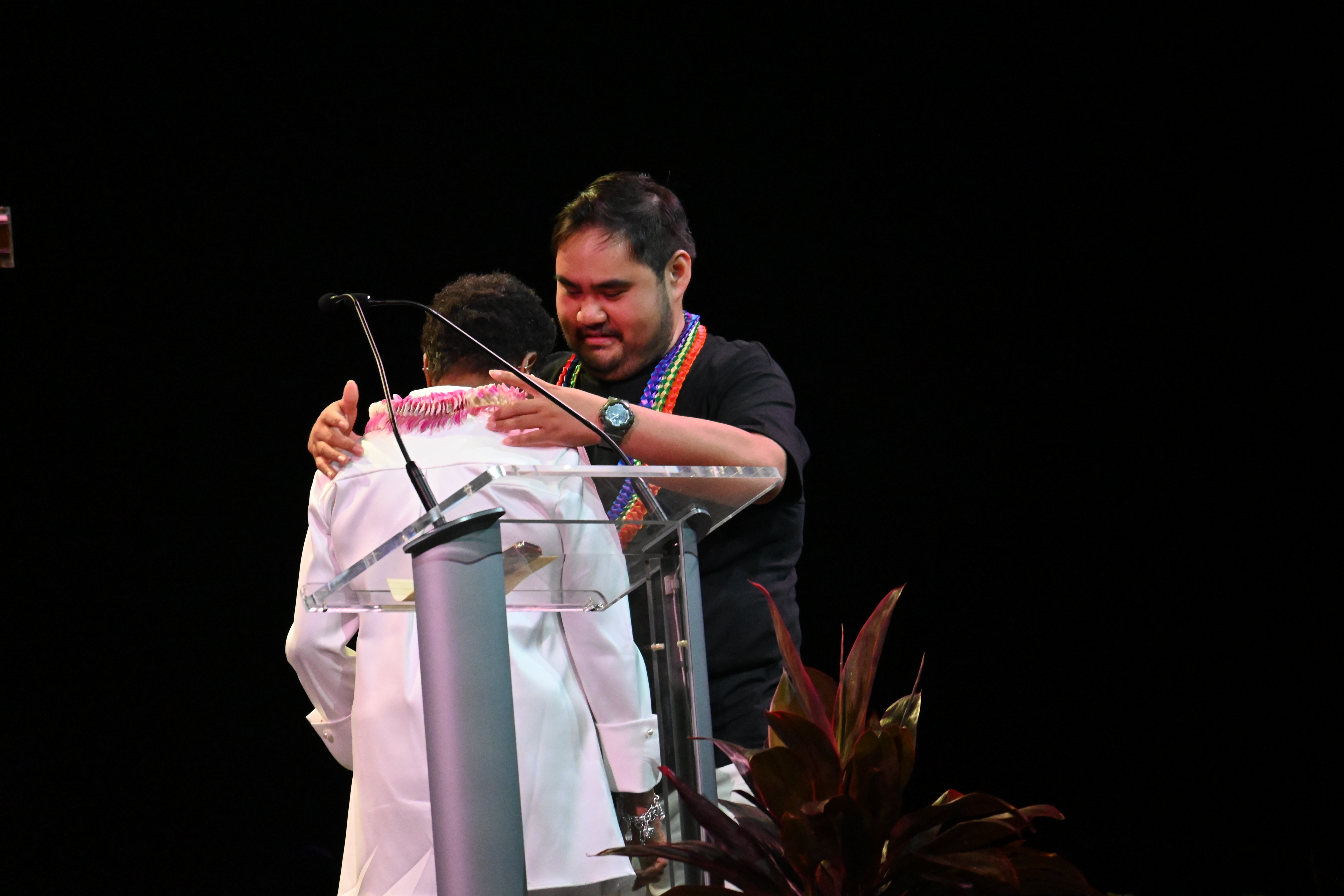
The photo of Keoki Kiwaha (r.) presenting a lei to the newly elected General Minister and President of the United Church of Christ, the Rev. Dr. Karen Georgia Thompson, was taken in July 2023 by Eric Anderson.
They were astounded at his teaching, for he taught them as one having authority, and not as the scribes. – Mark 1:22
Astounded I was, for certain – not, however, in a good way.
I know there’s nuance, theory, opinion, but not so this Jesus.
I’m a great one for clarity. Say what you think but modestly, right?
Not so this Jesus. He laid it out clear and said he was right.
Astounded I was, and a little offended by arrogance there.
That’s when the shouting began. Oh, not me. A poor man afflicted
By demons within. I knew him. We knew him. The Teacher did, too.
“I know who you are!” he cried out, then called him “the holy one of God.”
I was moving to gentle him, comfort him, lead him away and to home, when
Jesus delivered his order: “Be silent! Come out of his spirit!” And silence.
The man drew his breath, then exhaled with a sigh, clearing the tension away.
He smiled, gave his thanks, took his seat near the wall. Nobody knew what to say.
And now I must listen again to this arrogant Jesus who seems to know everything,
Because with a word he set this man’s spirit free. None of the rest of us did.
Perhaps Jesus’ ideas are not just opinion. Perhaps he knows more than he says.
A poem/prayer based on Mark 1:21-28, the Revised Common Lectionary Gospel Reading for Year B, Fourth Sunday after the Epiphany.
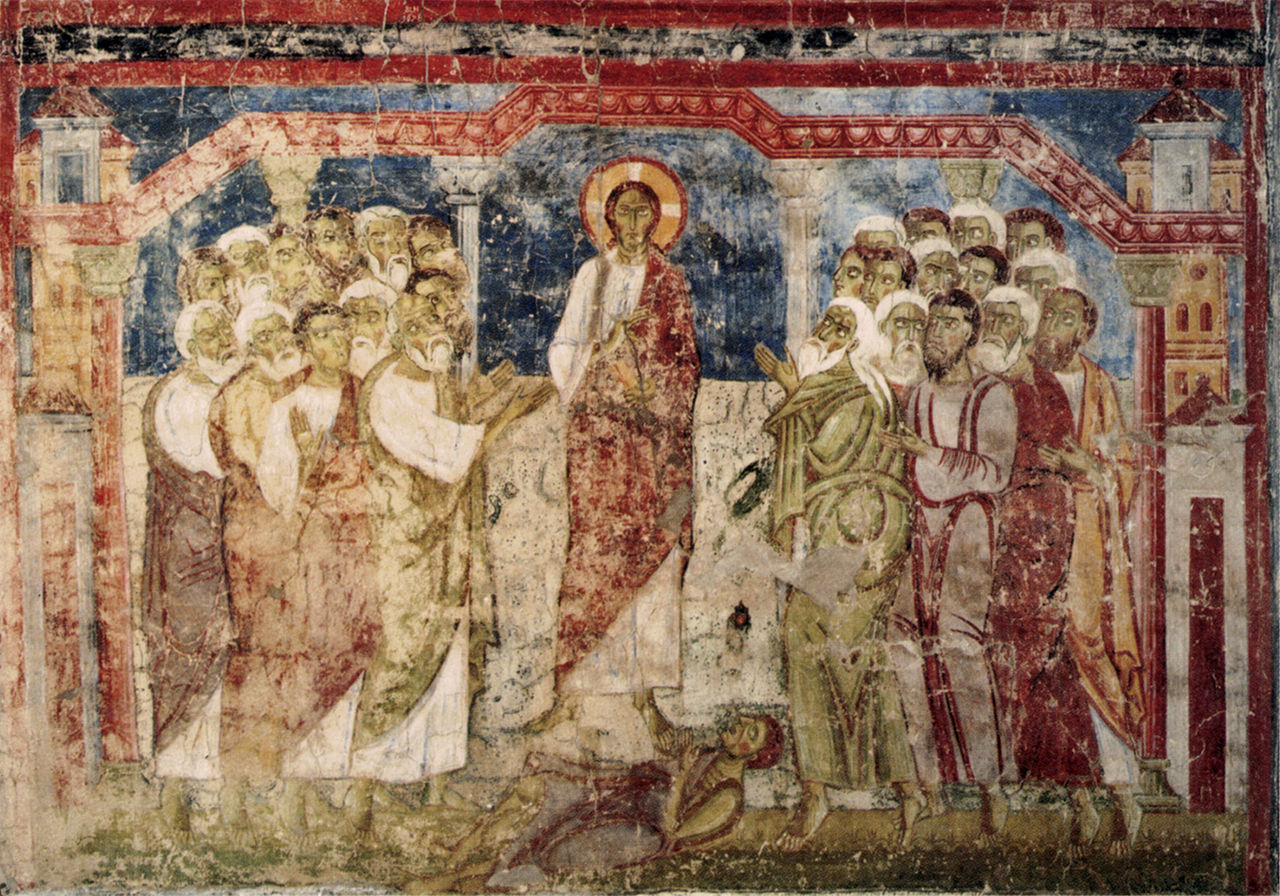
The image is Christ Healing a Possessed Man in the Synagogue at Capernaum, an 11th century fresco in the bell tower of Lambach Abbey, Lambach, Austria, by an unknown artist – Scan aus: Rudolf Lehr –- Landes-Chronik Oberösterreich, Wien: Verlag Christian Brandstätter 2004 S. 79 ISBN 3-85498-331-X, Public Domain, https://commons.wikimedia.org/w/index.php?curid=6633986.
It wasn’t enough, you said,
to ask what you were doing here
(though that’s a loaded question,
to be sure).
“You didn’t come for me,” you said:
“You came for bread.”
But did you not direct us in
that famous prayer of yours to do
just that? “Give us this day
our daily bread.” Did not
your ancient people pray for bread,
emerging from their tents each morn
to gather manna from the ground?
It wasn’t enough, you said, to ask
what works we should be doing, lives
we should be working, bread
we should be gathering. “Seek for
the bread which comes from heaven!”
What can I do but join the crowd and say,
“Sir, give us this bread always”?
Is that enough? It’s not?
You are the bread of life. Well, then,
the only question I can ask is this:
“Oh, Jesus, would you, can you, won’t you
give me you, and you, and you
this day and always?” Yes:
and give us this bread always.
What other question could I ask?
What other gift would you present?
A poem/prayer based on John 6:24-35, the Revised Common Lectionary Gospel reading for Year B, Proper 13.