Hearts Sprinkled Clean… for?

“…Let us approach with a true heart in full assurance of faith, with our hearts sprinkled clean from an evil conscience and our bodies washed with pure water.” – Hebrews 10:22

There are mornings when I revel in the water
which cascades along my form and carries off
the aggravating dust and clinging grime.

In likewise do I cast my grateful soul
into refreshment of a loving God,
who takes away the grunge, the guilt, the shame.

And then I step upon the shower mat,
to towel off the residue of cleanliness,
prepare to wrap my form in clothing for the day.

In likewise does my soul release forgiveness’ bliss,
replenished to the work which lies ahead,
and clothed (we hope) in righteousness’ array:

Provoking those around to love, to acts
of doing good, to mercy shared, to meet and raise
the courage of those souls who’d do the same.

A poem/prayer based on Mark 12:38-44, the Revised Common Lectionary Gospel Reading for Year B, Proper 27 (32).

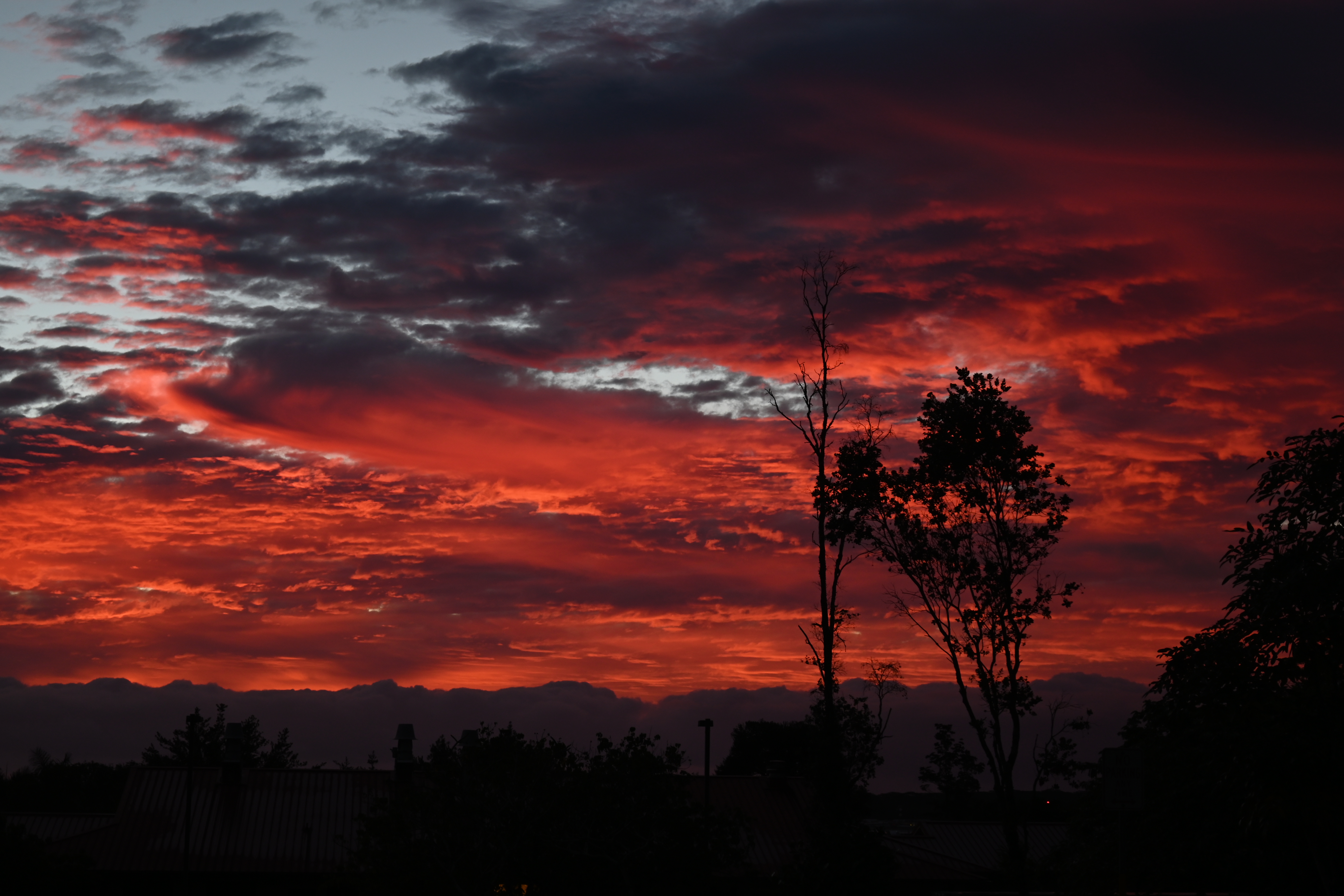
Photo by Eric Anderson

Story: Close to Heaven

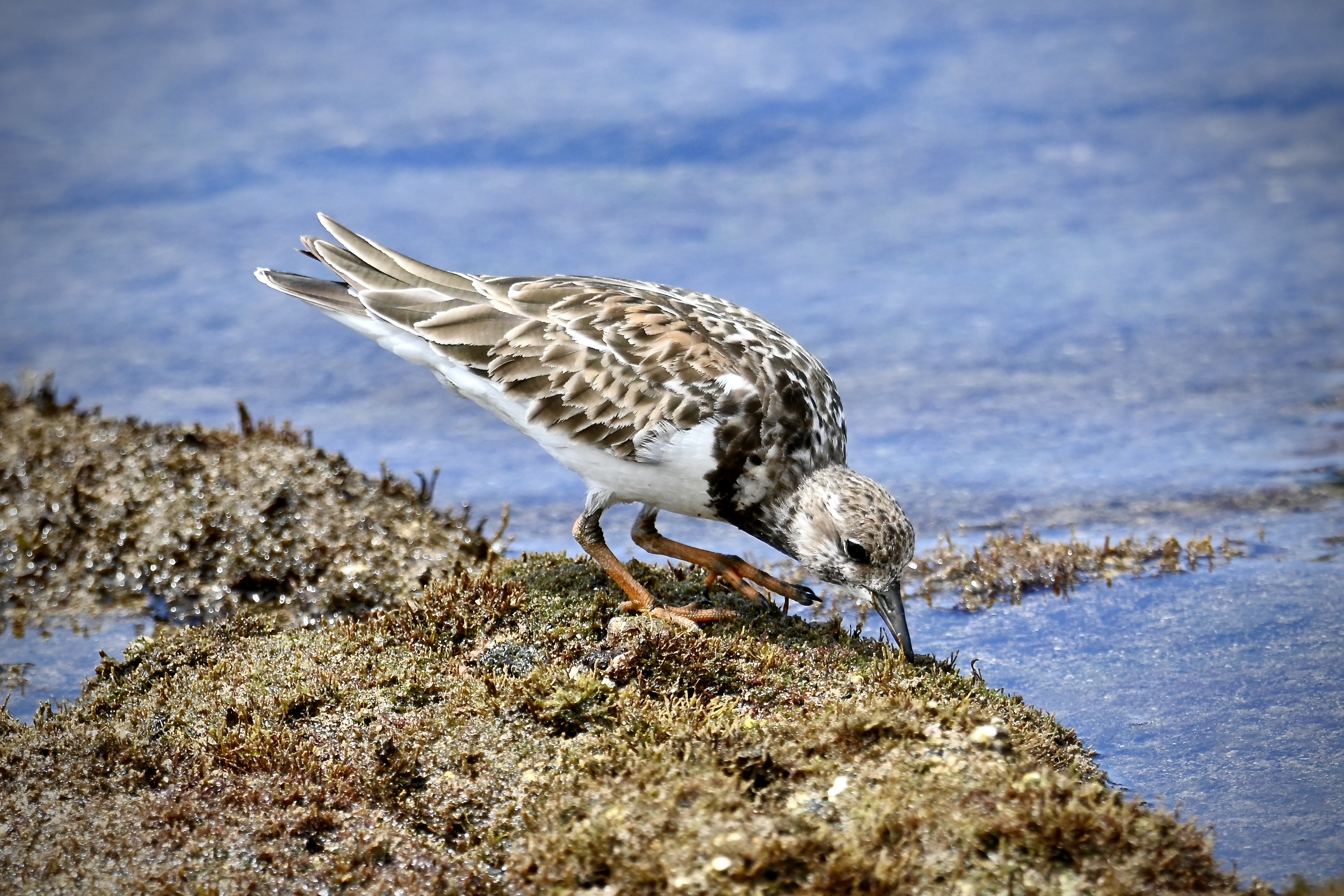
Photo of a kolea (a Pacific Golden Plover), a bird with a thin straight beak, white, brown, and tan feathering, walking along a grassy area.

November 3, 2024

Ruth 1:1-18
Mark 12:28-34

It’s a funny thing. When you hear just part of a conversation, it can be misleading. I mean, you might think you know what folks are talking about, but it turns out you might not.

In this case, it was a kolea, a Pacific Golden Plover, who overheard some people talking about heaven. And yes, he got confused.

He heard enough to learn that the people talking about heaven believed it was a really nice place. He heard enough to learn that the people talking about heaven didn’t expect to go there for some time. He heard enough to learn that the people believed that other creatures could also go to heaven.

He didn’t hear anything about it being a new life and a very different kind of place. He didn’t hear anything about dying as a transition from one kind of life to another kind of life. They just didn’t mention that while he was listening.

But at the end of the conversation, as the people were walking away, one of them said something about heaven being beyond the clouds.

People tend to talk that way about heaven because even though we have telescopes and can look a long way into space, “beyond the clouds” is something most of us don’t know much about, and the life God intends for us beyond our lives here is also something we don’t know much about. But the kolea didn’t know that. He said to himself:

“Those people can’t fly beyond the clouds, but I can. I can get to heaven myself.”

And he launched himself into the sky.

A kolea migrating from Hawai’i to Alaska, or from Alaska to Hawai’i, can get very high indeed. He flew up over the low clouds that were raining on Hilo. Then he flew up over the middle clouds that were spotted about around the slopes of Mauna Kea. Then he flew up even above the high wispy clouds above Mauna Kea.

Each time, he looked about for signs of heaven.

Each time, he didn’t see them.

“I must be close to heaven,” he said.

What he found as he circled higher and higher was that it got colder and colder. He’d felt that before, but as he flew higher than he had before it got colder than he’d ever known. He didn’t like that. He also didn’t like that the air got thinner. Not only was it harder to breathe, he had to flap his wings harder to move enough air to keep flying. In fact, there came a point that he just couldn’t go higher. Gasping, he let himself fall, then circle, and glide back down to the ground.

He landed, still winded, on some grass near another kolea, who hopped over to see what was wrong. “I tried to fly up to heaven,” he said sadly, and told her the story. “I must have been close, but I couldn’t get there.”

“That’s too bad,” she said to him. “Here, take a bite or two. There’s some tasty things here. And you’ll find some good water to drink just over this way.” She led him over to the food, and water, and a safe place to rest.

He ate. He drank. He rested. His breathing settled. His wings regained their strength. He looked at his new friend.

“You know, I flew a long way up to get close to heaven,” he said, “but you’ve been kinder to me than I can remember anyone else being. It might just be that I’ve been closer to heaven here than I ever was up there in the sky.”

by Eric Anderson

Watch the Recorded Story

I write these stories in advance, then tell them from memory during worship. The story you just read and the story as I told you will not be the same.

Photo of a kolea (a Pacific Golden Plover) by Eric Anderson.

First Commandment

A brightly colored painting showing two women facing forward, both showing grief, with a third holding the shoulders of one from behind, face hidden. Two other women show signs of grief at right and to the rear.

“One of the scribes came near and heard them disputing with one another, and seeing that he answered them well he asked him, ‘Which commandment is the first of all?’ Jesus answered, ‘The first is, “Hear, O Israel: the Lord our God, the Lord is one; you shall love the Lord your God with all your heart and with all your soul and with all your mind and with all your strength.” The second is this, “You shall love your neighbor as yourself.” There is no other commandment greater than these.'” – Mark 12:28-31

The scribe approved your words, or so says Mark,
and silenced all the snare-deploying crowd.
Yet he might ask (and yes, in Luke he did)
“Who is my neighbor to receive my love?”

Then you, Redeemer, might have said
(though you did not, or so says Luke),
“Look to the Book of Ruth, to what is written there:
‘I will not leave you. Do not press me.

“‘Where you journey, I will go.
And where you stop, there I will take my rest.
Your people shall be mine, and more:
Your God shall be my God.'”

A poem/prayer based on Mark 12:28-34, the Revised Common Lectionary Gospel Reading, and Ruth 1:1-18, the First Reading, for Year B, Proper 26 (31).

The image is Whither Thou Goest: Naomi and Ruth by Rupert Bunny – http://www.abc.net.au/radionational/programs/360/rupert-bunny-whither-thou-goest.jpg/4079790, Public Domain, https://commons.wikimedia.org/w/index.php?curid=56415654.

Story: Everybody’s Songs

An 'apapane, a red bird with black wings, singing in tree branches.

September 22, 2024

Jeremiah 11:18-20
Mark 9:30-37

Everyone thought she was one of the best singers among the ‘apapane. Her notes were clear, her improvisations were delightful, and she had the breath to sing long bubbling musical runs. Other ‘apapane used to listen for her in the mornings, and if they heard her, they’d take off in her direction.

It turned out that she used to sing loudest and longest when she found a grove of ohi’a with lots of blossoms, so everybody who flew into the neighborhood got a good meal. She’d sing, however, even in a tree between flowering times. When she did, the other ‘apapane – and the akepa, and the ‘alawi, and the ‘amakihi, and even the i’iwi – settled into nearby trees to listen.

It was like having a great concert every day.

She couldn’t help noticing that a fair number of birds got a free lunch, or breakfast, or dinner out of her songs. At the start she didn’t mind – she was pretty flattered that everyone flew to hear her sing – but as time went on it started to rankle. “Can’t they find their own trees?” she grumped to her brother one day, and if he had anything useful to say, she didn’t listen.

Then she had a bad scare. She’d landed on a branch near to the ground, which she rarely did, and began to sing. Suddenly the branch heaved with a heavy weight. She fluttered into the air, taken by surprise, and only then noticed the hunting cat which had leapt onto her branch and only just missed her.

She flew higher into another tree, whistling with alarm, and watched while the cat climbed back to the ground and disappeared into the forest.

The next day the sun rose, but her voice didn’t rise. The day grew brighter, but nobody heard her song. Other ‘apapane and ‘amakihi and mejiro and the rest begin to sing, but she remained silent.

She found a place deep within some leafy ohi’a branches and hid from the world.

They noticed that she wasn’t singing that day, the other birds did, but they mostly thought she’d gone to another part of the forest and would be back soon. But one day became two, and two became four, and four became over a week and nobody had heard her song. They began to look around, hoping to find her well, and terribly afraid that something bad had happened.

 Her mother found her – mothers often have a talent for finding their children – still huddled in her ohi’a tree, silent and afraid. She told her mother about what had happened with the cat.

“I don’t want to sing ever again,” she said.

“Your songs are beautiful,” said her mother. “Everybody loves you for them.”

“Everybody follows me because they think they’ll eat well,” said the daughter. “Somebody else can do that. Not me.”

“Listen for a moment, daughter,” said the mother, and the two were quiet. The forest, however, was not. The calls and songs of the forest birds sailed out over the trees.

“Listen to that,” said mother. “It’s everybody’s song.”

“Won’t they attract cats?” asked the singer.

“They might,” admitted her mother, “but there are ways to sing beyond their reach. Mostly, though, realize that it’s your voice, and your melodies, but it’s not really your song. It’s everybody’s song when you share it, greater and more wonderful than you know.

“What do you think, daughter? Can you sing with everybody’s song?”

In answer, the young ‘apapane opened her beak and sang.

by Eric Anderson

Watch the Recorded Story

I write these stories in advance, but I tell them in worship from memory and from improvisation. What you’ve just read will not match what you watch.

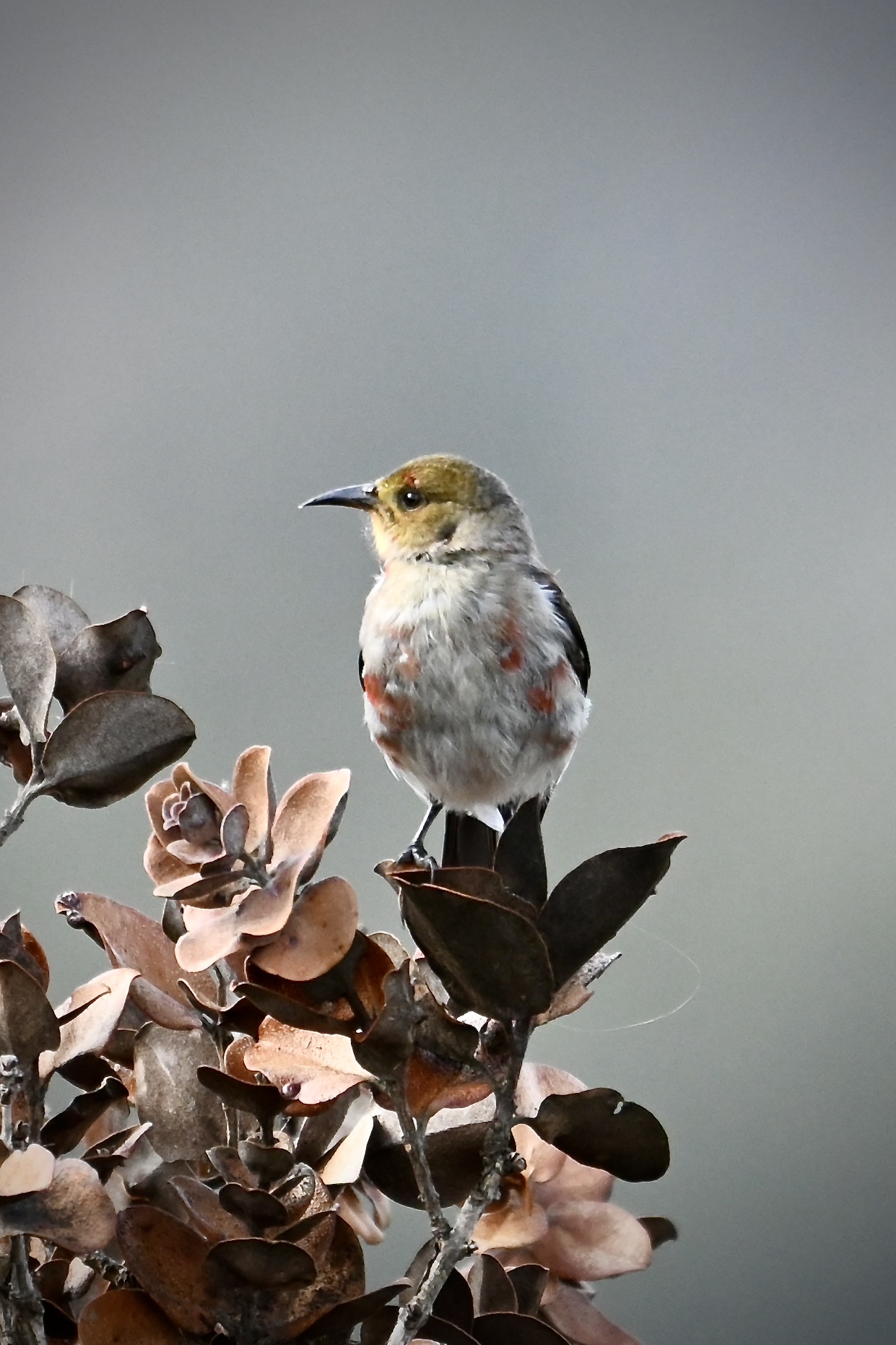
Photo of an ‘apapane by Eric Anderson.

Story: Fed Up

May 5, 2024

Acts 10:44-48
John 15:9-17

The noio (the English name is “black noddy,” but I like the Hawaiian “noio” better than “noddy”) – the noio was fed up. By which I mean that she was wet, and cold, and hungry. She circled over the ocean croaking unhappily as she looked for small fish and squid. She saw some. She swooped along, dipped her bill, then splashed into the water, and…

Missed.

For the eighth time.

Her mother was circling nearby as she lifted herself back into the air with her cold, wet, wings.

“That looked really good,” mother said. “You might try coming in behind the fish, so it’s less likely to dodge.”

That’s when she yelled at her mother.

She yelled about being wet. She yelled about being cold. She yelled most of all about being hungry. She yelled about being taught to do something that was plainly impossible. She yelled about being the most ignored daughter in her generation. She yelled that her mother didn’t love her. At all.

Then she flew back to the nest, because really, where else could she go?

She plopped herself down on the nest hard enough to make her feet uncomfortable. Her mother hadn’t flown back with her. She sat in the nest and cried with all the frustration of being young, and trying to do something that’s not easy, and failing, and being wet, and cold, and uncomfortable, and not being sure her mother loved her.

She was shivering and her eyes were closed when the nest rocked with someone landing in it. Whoever it was drew close and put their wings over her. Gradually her feathers dried and she started to feel warm. She was still hungry, though, when she opened her eyes to look at her mother.

But it wasn’t her mother. It was her father.

“Where’s mother?” she asked. “I thought she’d come here.”

“She had something to take care of,” said father.

“Did you hear what I said?” asked the daughter.

“Everybody heard what you said,” said father.

“Did I drive mother away?” asked the daughter.

“I don’t think so, but we’ll see,” said her father. She closed her eyes.

A little while later, the nest rocked again as another bird landed. Father’s wings lifted away from his daughter, and she opened her eyes again to see her mother.

“Why didn’t you come right back?” she asked her mother.

“Because it took some time to get you this. Those were sneaky fish you were trying to catch, daughter.” And mother served up some food, and daughter ate, and so she was fed, rather than fed up.

“I guess I’ll try again tomorrow,” said the daughter.

“Maybe they’ll be slower tomorrow,” said the mother.

“Will you help me learn?” asked the daughter.

“Of course,” said the mother, “because I love you.”

And her daughter gave a noio smile and said, “I know. I love you, too.”

by Eric Anderson

Watch the Recorded Story

I write these stories ahead of time (it’s the text you’ve just read) but I tell them from memory, anticipating some new creation as I tell them. So what I’ve written and what I say in the moment are not, cannot be the same.

Photo of a noio in flight by Eric Anderson.

I Fear I am not God

There is no fear in love, but perfect love casts out fear; for fear has to do with punishment, and whoever fears has not reached perfection in love. – 1 John 4:18

Fear is not just about punishment, John.
Fear is also about being hurt.
Fear is about taking a risk.
Fear is about the unknown.

I fear punishment, of course.
The pain is not just the harsh words,
hard tones, spoken to me.
I punish myself as well.

I fear as well the hurt
that is not punishment,
but comes from accident
or malice done around me.

I fear to take a risk, of course,
because, deserved or not,
if risk turns into failure,
I will feel the pain.

And I fear the unknown
because who knows (I don’t)
what dangers lurk for me,
what hurts I’ll face and feel?

So John, I know that God is love,
rejoice that God loves without fear.
I live in love and fear.
I fear I am not God.

A poem/prayer based on 1 John 4:7-21, the Revised Common Lectionary Second Reading for Year B, Fifth Sunday of Easter.

Self-portrait by Eric Anderson.

Story: Unbelief

March 31, 2024


Isaiah 25:6-9
John 20:1-18

In the gospel stories about Easter, there’s a common theme. It’s unbelief. People heard – from angels, initially – that Jesus had risen from the dead, and… they didn’t believe them. Later people heard from other people that Jesus had risen from the dead, and they didn’t believe the people. I guess that makes sense. If you don’t believe angels, how likely are you to believe people?

Once there was an ‘apapane who didn’t believe in love.

If that seems hard to believe, well, it was hard to believe. He had been raised with two sisters by attentive parents who fed them well, kept them warm in the rain, and taught them all to sing. They flew with him, they brought him to good trees to find bugs and nectar, and they kept him company when the nights got long and lonely.

But he didn’t believe in love.

You might be thinking that his sisters teased him all the time and that’s why he didn’t believe in love. It’s true. They teased him. But not much, really. More to the point, the teasing didn’t bother him. He teased them back and they all would laugh at the silly things they’d say.

Still, he didn’t believe in love.

“You’re just taking care of me because it keeps the family going,” he told his parents, who really didn’t know what to say about that.

“You’re just good to me because you expect I’ll be good to you,” he told his sisters, and he was good to them, but as he said, it was because he expected them to be good to him.

I suppose it might have been because nearly the entire time since he’d cracked the shell that the skies had been gray, the winds had been cold, and the rain had plummeted down.

I sometimes find it hard to believe in love after too many days of cold, grey, windy rain.

He and his sisters had put in a hard day of nectar- and bug-seeking. There might have been ohi’a flowers in blossom, but they were hard to see in the grey light. The bugs were hiding from the rain, not even troubling to go find nectar to eat. The three siblings huddled for the night on a branch, cold, wet, and hungry.

He was grateful for their warmth but he still didn’t believe in love.

When morning came, he blinked his eyes to an unfamiliar light. The clouds had cleared overnight, and the wind gently rustled the leaves. He and his sisters, all three, stared at the golden light of the sun rising over the trees. As it got higher, the ohi’a blossoms opened in scarlet and gold glory. As it got higher, its warmth dried their feathers.

“Wow,” said the sisters. “What a difference that makes.”

“More than you know,” said their brother. “It’s like a completely different world.”

“Is this a world where you can believe in love?” asked one sister.

He thought about it for a while.

“You know, I think it might be,” he said.

They helped one another get their drying feathers into shape – that’s kind of an ‘apapane hug – and flew off into the sunrise over the glorious bloom of ohi’a.

As they flew, they sang together. You know what they sang?

“I think I believe in love.”

by Eric Anderson

Watch the Recorded Story

I write these stories ahead of time, then tell them from memory – memory plus whatever I feel like saying in the moment.

Photo of an ‘apapane by Eric Anderson.

Story: Risky

March 31, 2024

Isaiah 25:6-9
John 20:1-18

You and I are familiar with mynas. They’re all over the place, for one thing. And they have a habit of shrieking at us for no particular reason. Here at Church of the Holy Cross, we’re also used to picking up after them because they try to build nests under the eaves and they’re remarkably bad at doing it.

You and I aren’t so familiar with the Manu-o-Ku, known in other parts of the world as the white tern. They tend to be a little bigger than a myna with longer wings. The myna has brown feathers with black feathers on the head and that distinctive yellow mask around the eyes leading to the bright yellow beak. The Manu-o-Ku is all white except for black eyes and a straight black beak. They don’t live here on Hawai’i Island, but you’ll find them – and mynas – living on O’ahu.

Two mynas were watching a manu-o-ku family prepare for laying an egg, and they were pretty critical about it. I may think mynas build messy nests, but the mynas were surprised that the manu-o-ku didn’t build a nest at all. “Where is the egg going to go?” asked one. “They haven’t done anything about a place to keep it from rolling away,” said the other.

The manu-o-ku ignored all this – they heard it, of course, because mynas aren’t usually quiet. They just flew from branch to branch, checking things out, and didn’t fetch a single piece of grass to build a nest.

Finally they settled onto a spot where a branch forked. It made a little spot with a hollow, like the bowl of a spoon – a very shallow spoon. I don’t think I’d have noticed it, but the manu-o-ku did. Somewhat later, the mynas returned to find that a single egg rested in that little depression, and that the father and mother manu-o-ku were taking turns keeping it warm.

“I’m shocked,” said one of the mynas. “I am, too,” said the other. “That egg is going to fall off.” “And if the egg doesn’t,” said the first, “the chick will.”

The manu-o-ku heard this and said nothing.

About a month later, the egg hatched, and the newborn chick’s feet were able to easily hold onto the forked branch of its nest. The parents brought fish and squid from the ocean to feed it. “That will never work,” said the mynas to one another. “That chick is doomed for sure.”

But it wasn’t. It took its first flight. It stayed nearby and the parents continued to bring it meals. It learned to catch its own food. It took to the skies.

“That shouldn’t have worked,” said the first myna. “It was an awful risk,” said the second.

“It’s a good thing that it worked, then, isn’t it?” called one of the manu-o-ku, and flew away in a flurry of white feathers.

You know, Jesus took a risk when he taught people to love one another, because some people don’t want to do that and they got angry about it. He took a risk when he loved people enough that he didn’t act violently when they came to be violent to him. He took a risk by going to the cross, and that risk took him to the grave. If you want to make things better, those actions shouldn’t work.

Jesus rose from the dead, and suddenly all those actions did work, all those risks of love and of peace and of death itself. It was more precarious than a manu-o-ku egg on a branch, but on that Easter Day love won, and it will always win.

By the way, we have taken a risk this morning. We’ve placed Easter eggs around the church and in a moment we’re going to ask you to find them. The risk is that if you don’t find all the real eggs, in a couple of days of sunshine they’ll get really warm and smelly. So help us out here. Make something good happen for yourself and for all of us. Find those eggs. It will be an Easter risk that worked.

by Eric Anderson

There is no video of this story, which I told before the young people headed out for their Easter Egg hunt. For the record, all the colored boiled eggs were retrieved.

Photo by Duncan Wright – USFWS Hawaiian Islands NWR, Public Domain, https://commons.wikimedia.org/w/index.php?curid=1167986

Story: Storing Up

November 12, 2023

Amos 5:18-24
Matthew 25:1-13

She was young, young enough that she took a nap every day. She was old enough to think that she didn’t need a nap every day, and she played hard enough that in mid-complaint about taking a nap every day, she’d fall asleep.

It didn’t stop her from complaining about it the next day, but I’m sure I did the same thing when I was that age.

Strangely, it was going to be her first Thanksgiving with a big group of her family. She had been born while her parents were living at quite a distance from grandparents and aunties and uncles and a big crowd of cousins. She’d only met a few of them, and only a household at a time: a couple of grandparents. An auntie and a cousin.

Thanksgiving promised to be a big crowd. She was all excited.

In the couple weeks before Thanksgiving, her parents started buying extra food for the things they’d bring to share: flour and sugar and eggs and pumpkin for pies. “Why are you getting those things?” she asked. “So we’ll have enough to share,” said her parents. “We don’t want to run out, do we?”

Oh, no, we don’t want to run out.

That took a new meaning about a week before Thanksgiving, because as the family was returning from some errands, the car ran out of gas. I guess everything had been so busy that the didn’t pay attention to the gas gauge. It all worked out fine. Some friends brought some gas so they could get to a gas station, and they got home a little later than expected, but it was barely an adventure.

“What happened?” she asked.

“The car ran out of gas,” said mother.

“Is that what happens when you don’t have enough?” she asked.

“It is with a car,” said father.

A couple days later she was all upset and started to cry.

“What’s wrong?” asked father and mother both.

“I don’t want to run out!” she sobbed.

“Run out of what?” they asked.

“I don’t want to run out of love on Thanksgiving!” she wailed.

“How are you going to run out?” asked mother, and she said, “Like the car! Or like falling asleep when I don’t want to nap!”

(I should probably mention that this was happening around nap time, which probably isn’t a surprise.)

“Tell you what,” said father. “We’ll see that you get filled up.”

“What?” she said.

“That’s right,” said mother. “We’ll take time each day to fill you up with love. You’ll have plenty of love for Thanksgiving.”

“How?” she asked, but you probably know the answer. Her parents gave her hugs, and they told her how much they loved her. They praised the cool and clever things she did, and when she misbehaved, they told her they loved her and how to do things better. They played games. They sang songs.

When Thanksgiving came she didn’t run out of love for her grandparents, or her aunties and uncles, or her big crowd of cousins. Nope. She didn’t run out of love at all.

She did skip her nap. She fell asleep in the car on the way home, but I’m sure it was because she was full of pie.

She never ran out of love at all.

by Eric Anderson

Watch the Recorded Story

I write these stories, then tell them from my memory of what I’ve written. Oh, and I improvise along the way, so what I wrote and how I tell it can be very different.

Photo by Eric Anderson

Story: Love Isn’t Fair

September 24, 2023

Jonah 3:10-4:11
Matthew 20:1-16

He was the oldest of the three ‘amakihi, so he thought he would get everything the first and the best.

In fact, he did get fed first after he’d emerged from the shell and was breathing deeply for the first time. Getting out of an eggshell sounds easy, but he didn’t find it so. Next to him the other two eggs continued to rock and creak for some time as he ate his first bug from his mother’s beak. It tasted wonderful.

I know you and I might not think so, but he thought it tasted wonderful.

Truly, though, he wasn’t born first by much. His sister emerged from her shell within an hour, and his brother was eating his first bug a half hour after that. Still, he was first. And if you’re the first born – um, first hatched – that comes with some benefits, right? First hatched, first fed – at every meal. First hatched, first flight lesson. First hatched, first singing lesson. First hatched, first… well, everything.

But his parents didn’t seem to have learned that rule.

When they came with bugs for their nestlings, they tended to put it in the first handy little beak. Our oldest little ‘amakihi didn’t like it, but in all the chaos of pushing about in the little nest he thought they were just careless and making mistakes. As they grew, he learned to get his beak in place just a little more quickly at mealtimes, but he thought his parents had figured out how to feed him first. And at singing lessons, he didn’t wait for them to say, “Who wants to sing first?” He just sang first.

Flying lessons, though, were different.

Flying, obviously, has to be taken seriously. ‘Amakihi may be small birds, but gravity pulls them just like it pulls you and me. Mother and father didn’t ask for volunteers or pay any attention to his volunteering. They called on the one who was ready, not the one who was eager.

It made him mad.

“That’s completely unfair!” he shrieked one morning when his younger sister took off before he did. He launched himself into the air, flapping madly (and angrily) and not very well, because he wasn’t paying attention to what he was doing, he was paying attention to what he was feeling. He landed rather painfully in a nearby tree and sulked.

The branch jumped a little bit as another bird landed near him. He looked up to see his mother.

“What’s not fair?” she asked.

“It’s not fair for you to teach the others before me. I was born first. I’m always first. I’m always supposed to be first. I’m first!” he said. And he cried angry tears.

She waited until the crying had settled down some, and said, “No, it’s not fair. And it won’t be fair. Not because being born first, you always go first – that’s not true, son, and it’s about time you learned that – but because love isn’t fair.”

It was a shock to hear that he wasn’t always going to be first, but it was more of a shock to hear that love isn’t fair.

“I love everyone in our family equally,” she said. “I love them equally even when they peck at me, like your sister did yesterday, or when they ignore me, like your brother did this morning. I love them equally when your father eats the bug I was following or when your grandmother tells me how to do something that I already know how to do. If I were being fair, I’d love your sister more when your brother annoys me, and I’d love your brother more when your father makes me angry.”

“And you’d love everyone else more when your oldest son gets mad and flies off in a huff,” said her oldest son.

She didn’t have to reply.

“Thank you for not being fair,” he said.

“You’re welcome,” she said. “Now, shall we work on that takeoff? And landing? And paying attention to where you’re going in flight?”

That little ‘amakihi family went right on being unfair – and loving one another each day.

by Eric Anderson

Watch the Recorded Story

I write these stories ahead of time, then tell the story from memory. Memory plus improvisation, that is.

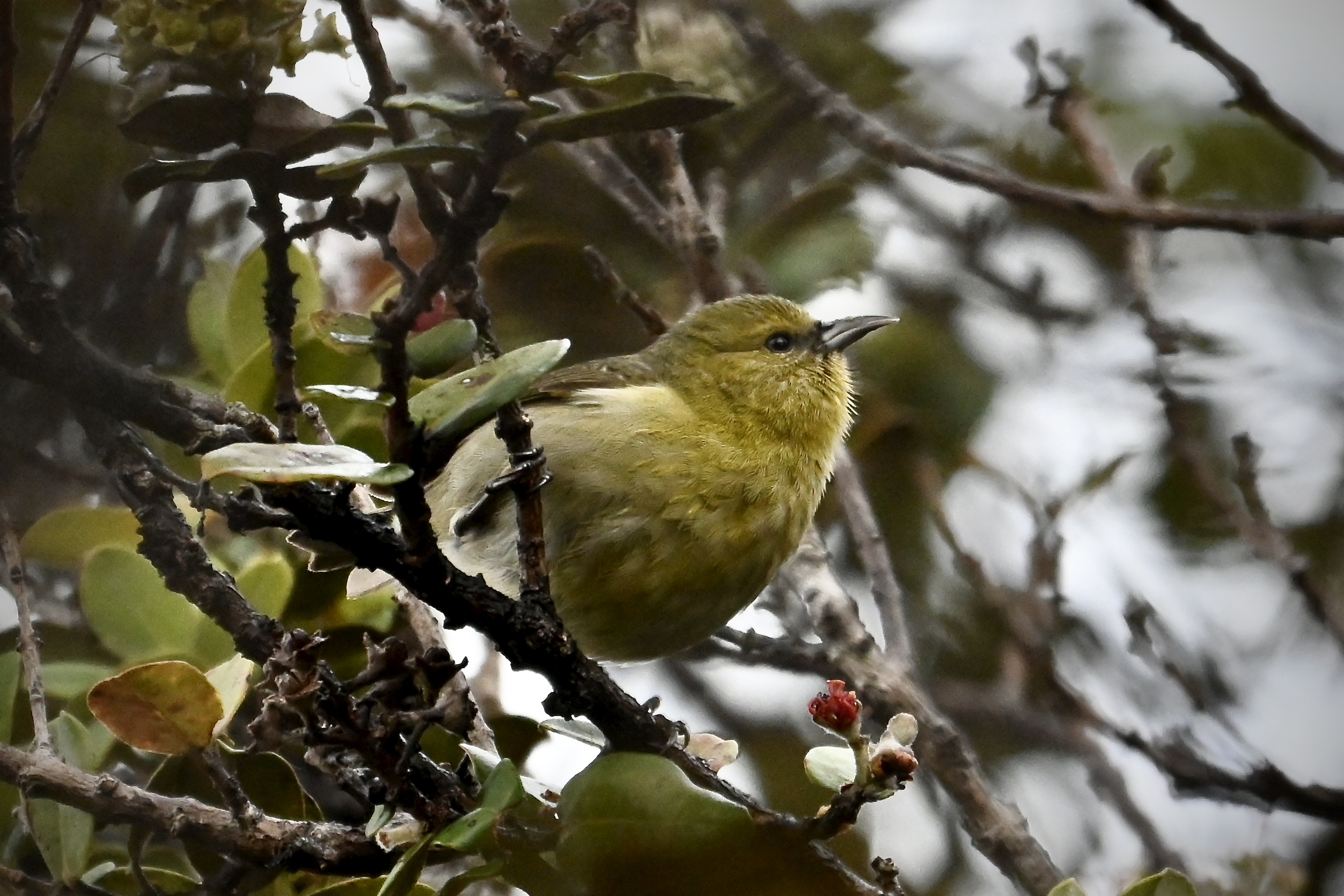
Photo of an ‘Amakihi by Bettina Arrigoni – Hawaii Amakihi (male) | Palilia Discovery Trail | Mauna Kea | Big Island | HI|2017-02-09|12-21-50.jpg, CC BY 2.0, https://commons.wikimedia.org/w/index.php?curid=74674240.