Story: Love Achieved

October 4, 2026

Isaiah 5:1-7
Philippians 3:4b-14

The first thing a newly hatched baby bird does is to teach. Teach? Teach. A hatchling teaches its parents what it needs, what they’ll eat, what makes them comfortable. Even an experienced parent will learn new things from a new chick. A first time parent learns more than I can describe in a short story like this.

A parent – in this case a mother – learns a lot about parenting from their own parents, of course, and from other friends and family who know more about it. Our first time mother had eagerly sought her own mother’s advice, not just when she had eggs, but before that when she’d sought a husband.

“How will I know that I’m in love?” she’d asked her mother.

“Look for a bird who is kind, attentive, responsible, and lifts your spirits,” said her mother. “The bird will show you those things. That’s how you’ll know you’re in love.”

Mother’s advice had been pretty good. She’d found a kind, attentive, and responsible bird, and he had raised her spirits. They’d built their nest together harmoniously and they’d eagerly awaited the hatching of their three eggs.

Then they’d hatched, and the learning began.

The first thing she learned was that the three hatchlings were all very different. They sounded different. They were hungry at different times, except for when they were all hungry at the same time. One liked to cuddle near her head, another liked to be beneath her wings. And then they’d shift what they liked.

It was so confusing.

Most confusing of all was that her chicks didn’t show her the things that she’d looked for in finding a husband. None of the chicks showed much kindness to her or to each other, especially when they were hungry. None of them were really attentive. They were constantly looking off at different things. They certainly weren’t responsible, hopping out of the nest at random times before they were even close to having the ability to fly.

It was really frustrating. How was she supposed to love these little bundles of needs?

“How am I supposed to love my chicks?” she asked her mother, and launched into describing all the ways in which they weren’t like her husband, or like her friends, or like her parents or aunties or uncles.

Her mother, I’m afraid to say, laughed out loud. “Children aren’t like husbands,” she said. “You love them before they learn how to be kind, or attentive, or responsible. You love them by teaching them to be those things, and you love them when they try and fail to be those things. You love them by keeping them fed and warmed and comforted and safe. You love them by guiding them to become the kind of bird you want to be, and the kind of bird you would fall in love with.”

“This will change?” said her daughter.

“It can,” said her mother. “I won’t lie – there are ‘apapane who prefer to remain selfish and flighty and irresponsible. But it will change. You’ll be surprised at how fast it does.”

“Did I do the same thing when I was newly hatched?” asked her daughter.

“Of course you did,” said mother, “and so did I. But you grew into a bird I’m proud of and delighted to be with. Now if you could use some help with the chicks?”

“Oh, yes,” sighed her daughter. “They’re all hungry again, and I could use the help.”

by Eric Anderson

Watch the Recorded Story

I write these stories in full ahead of time, but I tell them from memory and improvisation. The story as I wrote it and the story as I told it do not precisely match.

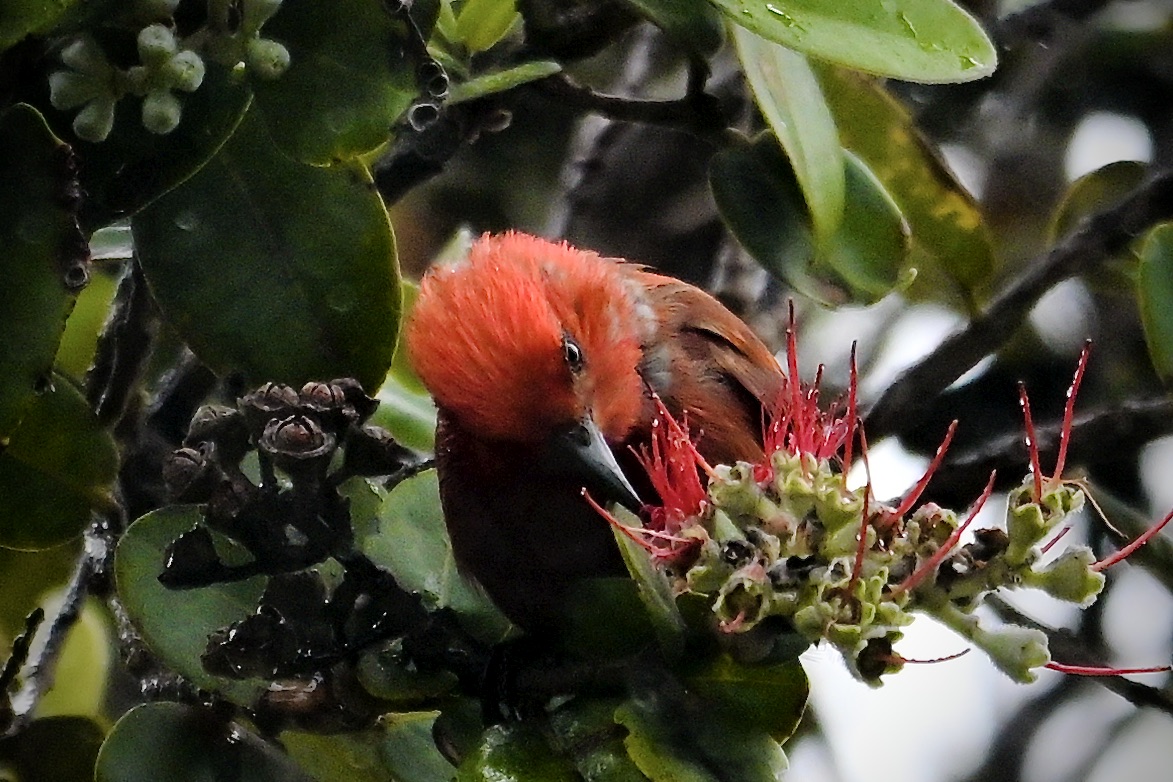
Photo of an ‘apapane by Eric Anderson.

Story: Noio’s Love

June 18, 2023

Romans 8:1-8
Matthew 9:35-10:8

The little noio chick was convinced that her father didn’t love her.

I have to admit that she had some reasons for thinking this. Noio (or black noddy) nests tend to be kind of shallow, and her parents had chosen a rather bumpy section of the cliff shelf to place their nest. She was never able to get really comfortable, because a bit of rock poked her if she was here, and another bit of rock poked her when she was there, and for quite some time listening to humans she thought of something very different to the word “poke.”

She had to admit that they’d found a spot that kept most of the rain off, but when it was sunny she thought she was going to become a baked noio. If the wind turned the wrong direction while it was raining, well, it blew the water right over her. Big waves would toss spray in her direction as well.

There were plenty of other nearby noio nests, none of which had any great advantages over hers and plenty of them were even pokier, but she wasn’t happy.

There was also the issue of what her father fed her, which was, and forgive me for being gross here, what her father had just eaten. Again, this was no different from what other nearby noio chicks were eating in their no-more-comfortable nests, but she thought that a loving father would have found a better way.

Her father had been a great comfort when she was small, keeping her warm and protected from rain and spray at night, and even shading her from the sun by day. Along the way, however, father had done less and less. As the chick grew, of course, there was less and less room on the nest for father or mother.

The worst, however, had come when it was time to fly. Suddenly father had become the nit-pickiest tyrant ever inflicted upon a daughter. “Spread your wings. Hold them up. Twist the left one. Hold it lower. Lower! Now flap. Not like that!”

She thought she heard the words, “Not like that!” more than any other words in the day.

After a particularly hard day when her flying had been quite erratic and her father quite emphatic about “Not like that!” she settled into the nest. Father perched silently and, she thought, judgmentally on the rocky shelf next to the nest. “Why, Father,” said the young fledgling bitterly, “don’t you love me?”

“Who said I didn’t love you?” asked father, who was quite shocked.

“You show it every day. You watch me so closely, you criticize all the time, you hardly ever hold me close any more, and let’s not even talk about the food.”

Father had to admit that there wasn’t much to say about the food, but he did hop over and sheltered his chick beneath his wings.

“I do love you, and I’m sorry I don’t say it clearly enough,” he said. “First thing in the morning, I’m here to make sure you awake safely. The last thing in the day, I’m here to make sure you’re able to sleep safely, too. I am strict with you about flying, because the ground is hard and the sea is harsh. Hit either of them wrong and I’d be crying for you rather than criticizing you.”

His chick snuggled into his feathers and felt somewhat better.

“I’ll tell you what,” said father. “The quicker you master flying, the quicker you can start catching fish for yourself.”

“Which means?” asked the fledgling.

“You’ll enjoy your meals a lot more -and so will I!”

by Eric Anderson

Watch the Recorded Story

I write the story. I memorize the course of the story… and when I tell the story, it’s simply not the same as the written version.

Photo by Eric Anderson

Author’s note: I originally wrote this story to be about a chick and her mother. Then I remembered it was Father’s Day. It does somewhat change the story’s character.