Story: The I’iwi Who Liked Spiders

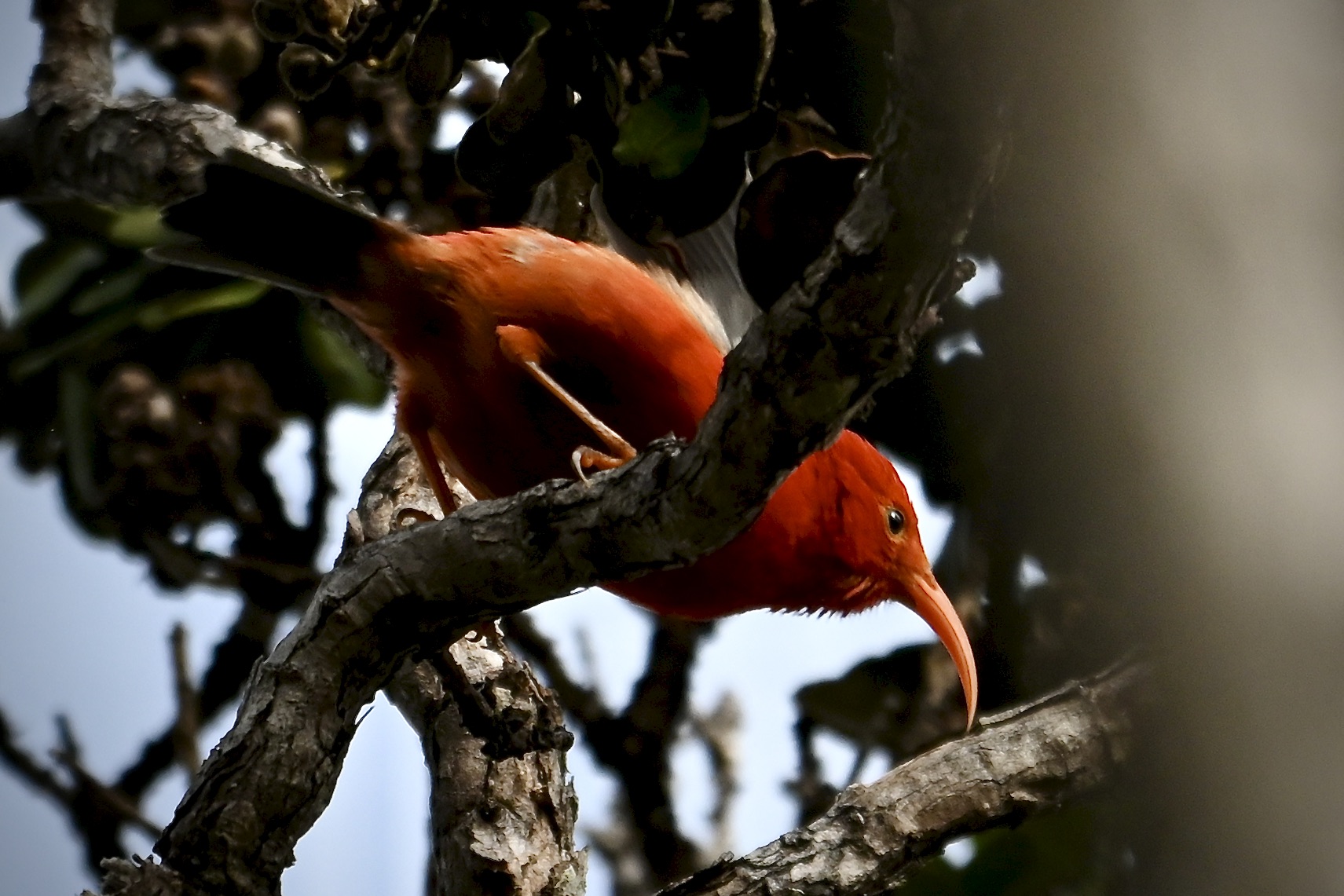
A red orange bird with a very long curved orange beak perched in a tree.

September 13, 2026

Romans 14:1-12
Matthew 18:21-35

I’iwi can be rather opinionated birds. They can also be very grumpy about their opinions. In their opinion, for example, blossoms full of nectar should be sampled by… me. That is, whatever i’iwi happens to have noticed those blooms at the time. ‘Apapane and ‘amakihi can go to another tree. Another i’iwi might be tolerated. Might. If they behave themselves. And aren’t greedy.

Most of all, though, they had to act like a proper i’iwi, and sip from the floral nectar. That’s how a proper i’iwi behaved. Most of all, they didn’t go looking for spiders.

I’iwi do eat spiders, but not very often by choice. They like the liquid diet of nectar, and they’ve got a long beak and a long tongue to drink it with. If a butterfly or moth happens by, they’ll eat it. They’ll fill in with other bugs as well. Far down the list, though, is spiders.

It’s something they’ll eat, but only if they’re really hungry.

Except for one i’iwi, who just so happened to really enjoy spiders. I don’t know why he did. He did. I’m pretty sure that if he explained it to me, I wouldn’t understand it, because I don’t like eating spiders. And I’m pretty sure that if I explained it to you, you wouldn’t understand it, since I suspect you’re not big fans of eating spiders.

If you are and I got that wrong, I apologize. You can explain it to me later.

The older i’iwi watched this younger one enthusiastically eating spiders with a certain feeling of, “Ick.” Most of them were content to let him enjoy his meals. After all, if he was eating the spiders, there was more nectar for them, wasn’t there?

One of those older i’iwi, though, got really annoyed with it all. He took it upon himself to fly over and grumble, “Knock it off, spider-lover. No more of this. Eat like a real i’iwi. Drink nectar.”

“I do,” said the i’iwi who liked spiders. “I drink plenty of nectar.”

“But you’re also eating all these spiders,” said the grumpy one. “Stop it.”

“I like spiders,” explained the younger i’iwi, which was really all that could be said, wasn’t it?

“No proper i’iwi likes spiders,” pronounced the elder. “No sensible i’iwi would make a full meal out of them. No real i’iwi prefers spiders to nectar.”

“And that’s how it is, youngster,” said that older i’iwi. “If you keep eating spiders like this, you’re not a real i’iwi, and we’ll treat you like a stranger and a nuisance.”

Word flashed around the little community of i’iwi about what had been said, and they called a very unusual little gathering to set matters straight. The older grumpy bird and the younger spider-eating bird perched before the flock.

“Do you eat spiders by choice?” they asked the younger one, who had to say, “Yes.”

“Did you tell him that eating spiders by choice meant he wouldn’t be a real i’iwi?” they asked the older one, who proudly said, “Yes.”

One of the grandmothers fluttered her wings at this, and said, “Diet does not make an i’iwi an i’iwi, or not an i’iwi. We’ve all eaten things we’d prefer not when times are lean, and we’ve all found that some of them tasted better than we’d expected. You’re just as much as i’iwi as anyone, youngster,” she said, “even if you eat things I’d rather not.”

“You, however,” she told the grumpy bird, “have taken it upon yourself and yourself alone to say what makes an i’iwi and what doesn’t. That’s something an i’iwi may do and remain an i’iwi, but they should not do it. The forest is hard enough with wind and rain and dry times. We do not need to make barriers for one another.

“You are an i’iwi. But you have not behaved like an i’iwi should. Make your apology to your cousin, and never let us hear you have done this again.”

by Eric Anderson

Watch the Recorded Story

I write these stories in full each week, but I tell them from memory and improvisation. The story you just read is not precisely the way I told it.

Photo of an i’iwi by Eric Anderson.
Story: Protecting the Tree

July 23, 2023

Genesis 28:10-19
Matthew 13:24-30, 36-43

An i’iwi overheard some people talking one day about a disease that was harmful and even fatal to ohi’a trees. He followed them and listened closely as they took care to clean their shoes and avoid bringing the fungus spores to where healthy trees were. The i’iwi decided that he would help protect his favorite ohi’a tree.

It wasn’t a very big tree, which was one of the reasons it was his favorite. It had a nice shape and plenty of leaves and it tended to blossom quite freely, which made it a great place to find safety and enjoy a good meal of ohi’a nectar. And because it wasn’t very big, it was a size that he could guard.

Guard it he did. When ‘apapane came by, he drove them off, and likewise amakihi, mejiro, and even the little ‘elepaio. They squawked and complained, but a determined i’iwi is difficult to convince, so they all went to other trees.

The i’iwi then set out to make sure that the tree was safe from being infected by insects that might carry the dangerous fungus. He flicked bugs off the leaves and branches with his wings, with his toes, and with his long curved beak. The spiders and insects didn’t try to argue. It’s hard to argue when something many times your size has kicked you off a branch when you’re a long way up in the air. Some tried a second or a third time, but found the i’iwi ready for them, and so they headed off as well.

The i’iwi found himself pretty much alone in the tree, and quite satisfied, settled down to sleep as night fell, prepared for another day of defending his favorite tree.

As the wind moved the tree limbs, however, his dreams turned strange. It seemed like the tree was speaking to him. “Why are you doing this?” asked the tree. “Why are you chasing everyone away?”

In a dream, of course, you can talk to trees, so the i’iwi said, “I’m keeping away everything that might make you sick. I want to keep you well.”

The tree creaked thoughtfully for a few minutes – trees think long and deeply – before replying.

“That’s good of you,” said the tree. “I appreciate the thought. But has it occurred to you that if no one visits me, my flowers don’t become seeds?”

That had not, in fact, occurred to the i’iwi, who hadn’t known it. Most plants blossoms attract creatures like honeybees, who in traveling from flower to flower bring the pollen that enables the blossoms to produce seeds. In the ohi’a forest, this gets done by bees, and by beetles, and by birds such as the amakihi and ‘apapane and yes, the i’iwi.

“If nobody visits other trees, and nobody visits me, there won’t be any seeds,” explained the tree.

The i’iwi didn’t know what to do. “If they visit you, you might get sick,” he said, “but if they don’t visit you, there won’t be new ohi’a trees.”

The tree limbs sighed in agreement.

“We’ll have to chance it,” said the tree. “But thanks for the effort.”

“We’ll have to chance it,” said the i’iwi. “May it all go well.”

You and I can still help protect ohi’a trees by cleaning our shoes before entering ohi’a forests and not moving ohi’a wood around and by taking care to not damage the tree bark when we’re in the forest. But the i’iwi and the birds and bees of the forest will also be sipping nectar and flying from tree to tree, and its risky – but it’s also how the next generation of ohi’a will take root and grow.

by Eric Anderson

Watch the Recorded Story

On Sundays I tell these stories from memory of the text I’ve prepared (which you’ve just read above). Between failures of memory and the creative impulse, they are not identical.

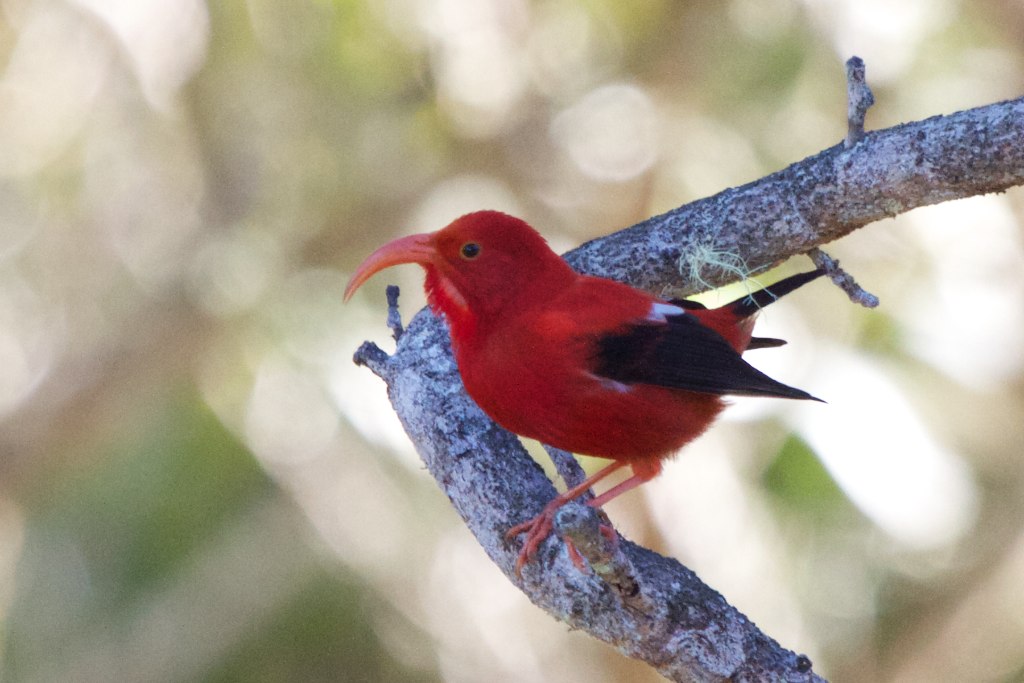
Photo of an i’iwi by HarmonyonPlanetEarth – I’iwi|Pu’u o’o Trail | 2013-12-17at12-43-209 Uploaded by snowmanradio, CC BY 2.0, https://commons.wikimedia.org/w/index.php?curid=30241880.

Rapid Ohi’a Death (ROD) is a real danger to Hawai’i’s ohi’a forests. Read more here about how to prevent its spread.