Desperately silenced. My only words not my own. Tongue in stocks.
Desperately bound. Daily divination’s coins presented to these human demons.
Desperately shackled to these evil spirits: one holds my body, the other holds my voice.
Desperately shouting: “These men are slaves of the Most High God!” But will they hear me?
Desperately hopeless, silently shouting, “Bring salvation to this soul!”
Desperately grateful, yet thanks go unheeded. They are hauled away in chains.
A poem/prayer based on Acts 16:16-34, the Revised Common Lectionary first reading for Year C, Seventh Sunday of Easter.
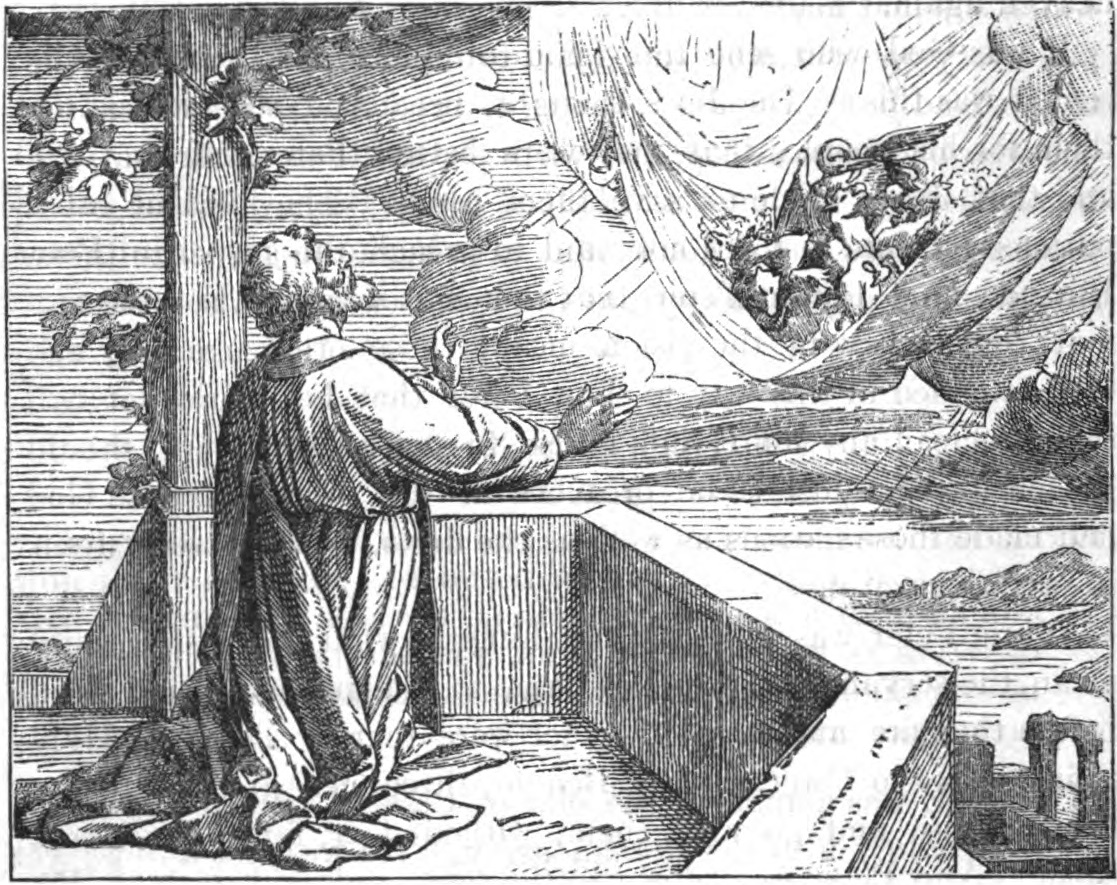
The painting of Saint Paul casting out the evil spirit from the unnamed woman (ca. 1860) is found outside the Basilica of Saint Paul, Rome, Italy. Photo by Richard Stracke: CC by-NC-SA 3.0.
They sent for you, dear Simon, Cephas, Petros: You’re the Rock. They sent for you, dear Simon, when their dear Tabitha had died.
Oh, what if they’d called me?
My heart would have been pounding in my chest so loud the village could have heard. Why send them all away (except to miss my failure)?
Oh, what if they’d called me?
A prayer. A tender summons: “Tabitha, get up!” That heart whose love so overflowed is beating even louder than my own. Look, she lives!
Oh, what if they’d called me?
Did you feel you were holding Jesus’ place? Did you ache for the Master’s steady poise? Did your heart falter before hers revived? How did you dare to call her name?
Oh, what if they’d called me?
A poem/prayer based on Acts 9:36-43, the Revised Common Lectionary first reading for Year C, Fourth Sunday of Easter.
From the Wikimedia Commons description of the photo: “The Sarcophagus of Marcus Claudianus (ca. 330-335, Palazzo Massimo, Rome): Detail, The Arrest of Peter. Peter is taken away by two soldiers in pillbox hats. On the left, the person pointing to Peter is most likely Herod, who orders his arrest in Acts 12. Or possibly the rolled-up scroll in his hands signifies that he is the high priest who orders all the apostles imprisoned in Acts 5.”
In shadow I approach you, Lord. Though other times, I would embrace the light this morning I will seek the dark avoiding watching hostile eyes.
An alleyway for shelter, then moon shadow of an overhanging roof. Step slowly, lest a watcher spot the motion of my furtive form.
I make this journey into shadow, Lord, as you embraced the darkness not three days ago, and gasped that it was finished to the broken beating of my heart.
And now, one shadow still remains, a deeper blanker blackness that should not be there. My heartbeat hammers in my throat to see
an open tomb.
A poem/prayer based on John 20:1-18, the Revised Common Lectionary Gospel reading for Year C, Easter Sunday.
Photo of the lunar eclipse of January 31, 2018, by Eric Anderson.
He was oppressed, and he was afflicted, yet he did not open his mouth; like a lamb that is led to the slaughter, and like a sheep that before its shearers is silent, so he did not open his mouth. By a perversion of justice he was taken away. – Isaiah 53:7-8a
Then Jesus said, “Father, forgive them; for they do not know what they are doing.” – Luke 23:34
Silence, Jesus? Excuses, Jesus? In truth, I want a louder Savior. I want a firebrand, I want a chief. I want a voice that echoes from the hills.
I do not want excuses. I do not want a suffering servant satisfied with our perverted justice, consenting with your silence.
For heaven’s sake, shake the heavens! For earth’s sake, rattle the earth! For the oppressed’s sake, break the bonds! For humanity’s sake, do something!
Don’t – don’t – make excuses. Not for them. Not for us. Not even – dare I say it? Don’t make excuses for me.
I do not need excusing, Jesus. No, I need forgiving. Excuses will not change the world: Repentance and forgiveness might.
Suffering Savior, keep your silence: but do not keep your peace. We who witness your great love weep for your peace.