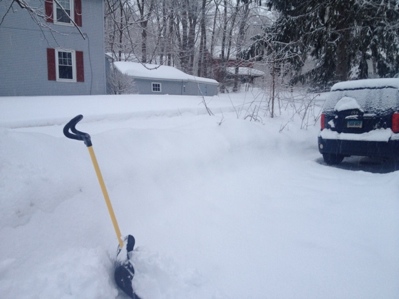
A Lapse in Lenten Discipline

Beauty rests upon the ground.

Dear God,

I had truly hoped

To give up shoveling snow for Lent.

I’ve failed.

I’m sorry.

Truly sorry.

Really really really really sorry.

I don’t think I can say

To even You

How really really sorry

That I am.

For beauty, I could hardly ask

For better than the place each grain of snow

Had chosen by the random flow of chance

To rest upon the ground.

Certainly each place I’ve labored to uncover

Lacks the sweet serenity

Of ground that still lies dreaming

Beneath its argent comforter

Of snow.

Nor can I claim the hills and ridges I’ve created

Match the simple loveliness,

The subtle curves,

That gentle the harsh character of earth.

My only claim upon your mercy

Is, as always, your great love,

And just perhaps, the promises I’ve made

To you and some among your children

Which now I may just keep

Because I’ve moved

Your miracle of snow.

Amen.

Judged

The logo on the vehicle before me

Solemnly declares its owner’s wealth.

The stubborn course the wheels pursue,

Firmly steady in their designated lane,

Unwilling to accommodate the vehicles oncoming,

Where snowbanks and parked cars

Constrict the open passage,

Proclaims the driver’s privilege.

And my internal satisfaction,

Linking signs of wealth

With signs of boorishness,

Will not I be judged

As I have judged?

Forgive me, God,

As I forgive.

First World Confession

Dear God, I confess

That earlier this week

When I forgot

To turn my thermostat

Down from its daytime temperature

To the colder level of the night

It was much easier

To leave my blankets,

Stand, and start the day.

Forgive me

Not because my human frame

Takes comfort in more clement air

And layer upon layer

Of cotton, wool, and nylon,

Nor because my weary mind

One evening left one task undone

Despite its firm belief.

No, forgive me,

Gracious God,

For my poverty of heart this day

That is not matched by poverty of wealth.

Move me to give

So that another may arise

From a bed as warm as mine

Into a home as warm as mine.

Amen.

Hearth Sonnet

Note: I first wrote this poem many years ago. I haven’t been able to find a written copy, but it has stayed in my memory, and this winter has certainly evoked it time and again. I suppose this is a re-written version, for in places I’ve made changes. Some are new and conscious, while others reflect the influence of years and the fragility of the mind.


A fire that is banked against the night

Will last, endure to meet the coming day

And with its own greet dawn’s pale gleaming light

In muted soft and sable rust display.

They covet fire to chase away the chill

Who rise amidst the rebirth of the sun,

Whose blazing beams ignite the pearly hill

While warming nothing but lands far beyond

The realm of snow where we have stirred the hearth

Beneath a kettle on an iron swing.

Its whistle trills its challenge to the dark,

The embers lift their burning heads to sing

The song they’ve sung from sunset until morn

While we in silence watch the new logs burn.

Grit

A gentle hand applied the consumed palm

Leaves to my skin last eve. No oil here,

Just coarse and grainy dust, a deep

Gray stain upon my brow. “Remember you

are dust, and that to dust you will return.”

The dust of Earth, as Genesis infers,

Is dust of all creation: Hydrogen

Which makes two-thirds of all the water in

My cells is even now ignited in

A conflagration glorious, that glows

Serenely in each star and bathes this globe

With energy that is the root of life.

Dust, yes, but dust of majesty! And when

I lay this body down at last, its dust

Can then return to Earth, stems spring from it

And reach unto the Sun: the living dust

Arising to the splendid, blazing dust

Of fire. Still, the coarse and grimy cross

Emblazoned on my countenance evokes

As well the harsh realities of life,

The grit of illness, pain, and death,

The grating sense of sorrow, injury’s

Affliction, and the misery of sin.

Gray grains of glory and gray grains of grief

Creation manifest in this crude cross

Of grit.

Ash Wednesday Before Dawn

So it begins…

Another Lent has come

With its demands of piety, privation,

Discipline, devotion,

Confession, contemplation,

Absolution, abstinence, 

And ashes.

Awake before the spinning world

Turns my face to the cheery sun

You summon me from rest

To this, a consecrated concentration

That rests, in its own way,

My whirling mind.

“Sufficient unto the day is the evil thereof,” 

You said so long ago,

That those who heard 

(And those who heard from them),

That even I

Might lay aside tomorrow’s cares and ills

To live entirely in today.

Such a facile phrase!

Yet has there ever been

A task more trying?

So here before dawn’s rosy fingers

Stretch across the hills

I tune my thoughts,

Settle my spirit.

Let the disquiet and distractions

Kindle with the leaves of last year’s palms

And fill this solemn season

With ashes of anxiety

All aglow with grace.


#face for #lookinlent

Saturday

Upon my shoulders I lay the stole

Rough-woven cotton dyed bright blue

The symbols of the faith shine boldly:

A chalice, a chi rho, a city gate, a cross.

This is a borrowed stole

I wear it as we celebrate the life

Of the kind soul who wore it

The soul now passed on to the One

He served so well.

Wednesday

I park the car and walk back down the hill

To where the door swings open

Before I even grasp the handle.

No stole upon my shoulders:

Instead the charcoal grey of my lapels

Bears only one small spark of color,

Red and gold proclaiming

That God has not stopped speaking

And even the finality of death

Is only a pause in the grand sentence

In which God speaks our lives.

Upon the satin pillows I regard the face

Of a man I’ve known for many years

Suddenly diagnosed, suddenly ill,

Suddenly critical, suddenly gone.

How strange the stillness

When what I remember best

Was the sudden smile

And the twinkling eyes

When he’d see me unexpectedly

And we’d catch up on the family news.

I pray God’s comfort for those who grieve his loss,

And I pray new joys for him.

“He’s due new joys,” I say,

And his sister agrees.

Thursday

Once again the charcoal suit.

Once again a door I need not touch

Swings open and I join another line.

Amidst the strangers suddenly

The familiar face whom I’d expected.

It is his sister whose life we mourn,

A woman whom I never knew as an adult –

I recall an adolescent girl

Sometimes amused by her big brother,

Sometimes annoyed, sometimes determined

She will get his goat (and the goats of all his friends);

Sometimes desiring her own space,

Sometimes wondering when she’ll be that old.

I greet her parents, who remember me

(and things about me I do not recall)

I greet her children, and her son’s companion,

I look upon the face that rests upon the satin,

A face that I had never seen in life

As an adult.

Thirty-one years ago, in this very room,

I looked upon the face of another woman,

A face which I had never seen as teen or child,

The face which had looked down on mine

In cradle, crib, and stroller.

Like this young man, like this young woman,

I waited as the line

Of mourners filed through

To take my hand, assure me of their sympathy,

Some family, some friends,

Some much like I would be, decades to come,

A stranger to the son whose mother lies

Where we so wish that she were not.

Saturday, Wednesday, Thursday

In just six days, three times I must #face death

In just thirty-one years, I have long since lost count

Of funerals and wakes, receptions and remembrances.

In just eight days, when Good Friday comes

I will recall another death

Endured by One I worship as the source of life,

Transformed by Jesus into life eternal,

Life redeemed.

A charcoal gray to demonstrate respect

An azure stole to celebrate a minister

A scarlet comma edged in gold

To faithfully declare

That Death’s is not the final word

And at the end of human life,

Our God has placed a comma,

For there is more to come

#blind for #lookinlent

Braille_text.JPG#blind may be an inevitable metaphor for a species that, in the main, relies so heavily on one particular sense to make its way through the world. It turns out there are other people in the world who see a greater range of colors than most; it turns out there are animals that see a greater range of colors than any human – and we see a greater range than any member of some other species.

Would we, would they, consider the others #blind?

Would a dog who could only smell scents in the range that I can suddenly feel blinded, with a more limited sense of the world? I wonder.

When a family member meets the legal definition of #blind – when she reads Braille in preference to monumentally magnified text – then the inevitable metaphor becomes a commentary, intended or not, on someone I dearly love.

Let’s face it, with blindness comes a certain degree of ignorance. I know more things about my environment, because I can see it, than someone who can’t see it does. I’ve spent a good deal of time serving as a guide through unfamiliar spaces. And I’ve read many, many menus aloud because there wasn’t one available in Braille.

Blindness, however, is not a moral condition, and that’s where the metaphor frequently fails. Ignorance is not a moral condition, either. It’s a state of knowledge, and best of all, it’s correctable. Someone who can’t see overcomes their ignorance of their environment in different ways – some with dogs, some with canes, some with a supportive elbow, and nearly all with repeated experience.

In short, the average #blind individual routinely seeks to learn what they do not know.

When we use the metaphor, however, all too frequently the person described as “blind” is one determined to maintain their ignorance. That’s a slander. I know from experience that a #blind person can be plenty stubborn, but determined to maintain her ignorance? No. What would be the point?

What is the point of determined ignorance?

Far better to feel your way through the world. Far, far better.