Story: God’s Creatures Dance

July 14, 2024

2 Samuel 6:1-5, 12-19
Psalm 24

You wouldn’t think it, if most of your experience of honu is when they’re napping on the shore, but they were the ones who got it started. They started the dance.

Which one it was nobody remembers, because it was a long time ago, and sometimes the beginnings of things get forgotten, like the way children really want to forget who broke the peanut butter jar. The story simply says that a honu looked up at the stars, and saw the clouds lit by the moon above, and felt the water splashing gently on his shell, and he said, “Gotta dance.”

Now, a napping honu looks like a clumsy thing, but a honu in water can dance circles around a human swimmer. He glided, and he shook, and he made tight circles, and he whirled in place. When his head broke water an ‘ulili on the shore called out, “What are you doing?”

“I’m dancing!” replied the honu. Then, after glancing about, “Lots of us are dancing!”

Sure enough, the water teemed with the shells of honu breaking the surface, and their flippers waving as they dove back down to soar below the waves.

“Why are you dancing?” asked the ‘ulili.

“With the world as glorious as it is, what else should I do?” called the honu, and then he glided beneath the water again.

“What else indeed?” said the ‘ulili, who took her next steps with even more bounce in her long legs than usual. It didn’t take long before she and the other shorebirds were highstepping and bouncing and gliding along the rocks.

“Are you dancing?” asked a myna, perched in a low tree.

“Of course we’re dancing!” said the ‘ulili. “Wouldn’t you?”

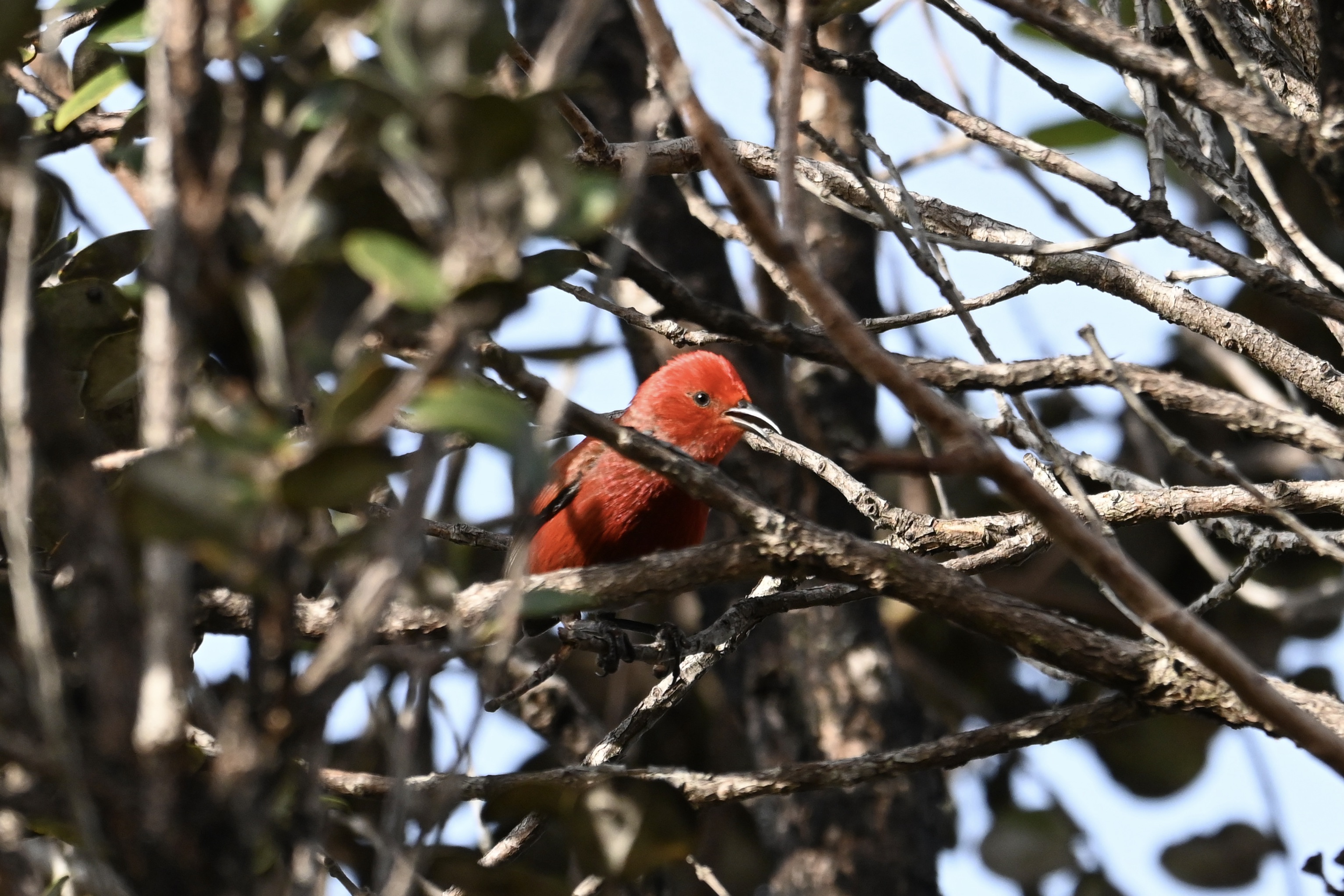
“I suppose I would,” said the myna, and he took off to do his own dance in the air. He was soon joined by other myna, and by mejiro and saffron finches. And because what one myna knows soon other mynas will know, because they’ve got loud voices and they use them, the word spread along the beaches and up the mountain slopes. ‘Apapane danced to the music of their songs. Noio made their dives for fish with flair and grace. Even the pigs in the forest hopped back and forth to their own private rhythm.

They all danced like the only ones watching were the ones dancing with them. They all danced with a deep sense of being the one and only star of their dance, and a deep sense of dancing in the biggest dance group ever. They danced, and I’m sorry to say that the only ones who didn’t recognize it, and didn’t join the dance, were the people. I grant you that most of us were asleep at the time.

As dawn approached, the creatures from the summits of the mountains to below the waters ceased their rhythmic movements. They stretched their wings or flippers and they took at look at tender feet. Without a sound, they settled into the activities of the day.

I’m afraid they heard no applause, but there was One who applauded, and that was God. God had made them to rejoice in who and what they were, from the ‘io to the ‘apapane, from the noio to the honu. God applauded, and if they didn’t hear as they sorted themselves into a good nap, they settled into rest with glad hearts.

by Eric Anderson

Watch the Recorded Story

I write these stories ahead of time, then tell them from memory. As a result, the stories I tell aren’t precisely the ones I prepare.

Photo of an ‘ulili (a Wandering Tattler) by Eric Anderson.

Fighting the Storm

July 7, 2024

2 Corinthians 12:2-10
Mark 6:1-13

I like honu (green sea turtles). How about you? It’s just so comforting to me watching those sea turtles raise their flippers to the surface to breathe and look around, and then taking them down to snack on the seaweed, then turning themselves about like the most agile of dancers, then hauling themselves out on the shore to get a good solid nap in the sun.

I like honu.

It’s hard to believe that one could be a bully, but I’m afraid this story is about a honu who did become a bully. He’d shove smaller turtles out of his way as he grazed on seaweed. He knocked shells with honu who were in the spot he wanted to sunbathe in. Actually, he’d knock shells with a honu just to get it to move, then he’d nap somewhere else. He slapped other turtles with his flippers, he nipped them with his mouth, he’d slide over them when they surfaced to breathe, he… well.

He was a bully.

I’m sorry to say that, mostly, it worked for him. He didn’t have a lot of friends, and I guess part of the reason he was mean was that he didn’t have a lot of friends. But he ate a lot, and he got comfortable spots on the beach, and other honu didn’t pick on him, no they didn’t. So, as I say, it mostly worked for him.

Until, one day, he decided to bully the ocean.

The winds were strong and the surf was high that day. Rain lashed down from overhead so that even a honu found it difficult to tell where the sea top ended and the air began. Spray flew in sheets. Wavetops tossed careless fish into the air.

And this honu decided to go nap on the beach. I don’t think he expected to find sunshine there, but when somebody expects to get things his way all the time, who knows?

The problem was that the waves at the surface tossed him about, and when he dove down, the currents underwater dragged him back to sea. He was trying to get to one specific part of the beach, but the wind carried him along past where he wanted to go, and when he tried to swim back against it, he couldn’t – at least not from where he was. He lashed his flippers at the water both at the surface and deeper down, and in neither place could he make much headway.

Eventually he let the underwater current carry him back out to sea, where he surfaced and howled in rage – which is very rare for a honu – at the winds and the surf.

An older honu drifted by and said, “What’s the matter, youngling?”

He wasn’t that young, but she was a lot older (and bigger), so he didn’t quite yell back when he said, “The stupid wind and waves won’t get me where I want to go!”

“Watch the youngling there,” said the older honu, and he did. A younger, smaller turtle, one that he’d bullied any number of times, had positioned himself in a place where the combination of wind, waves, and current would carry him toward the beach. He made just the smallest of adjustments with his flippers as the water bore him along. Just at the beach, he dipped down to slow himself in the current going back and to avoid being thrown onto the shore from the top of a wave. Then he slid onto the shore, and slowly moved up on his now-active flippers.

“You can’t bully the sea, youngling,” said the older honu. “You shouldn’t bully anything, but especially not the ocean, which won’t notice you at all.”

It took him a long time to learn that lesson deeply, I’m afraid, and he spent a number of storms tossing about in the surf. Eventually, though, he learned that sometimes you don’t fight, you follow. And when he did, he fought less with other honu, and a bully learned to do better.

by Eric Anderson

Watch the Recorded Story

Due to a technical error, the story was not recorded this week.

Photo of a honu (who showed no signs of being a bully) by Eric Anderson.

Story: Not Doing So Fine

June 30, 2024

Lamentations 3:22-33
Mark 5:21-43

He was the oldest pueo in the nest. He was the best. He did things right.

At least, that was his opinion.

It wasn’t his younger sister’s opinion, but that frequently happens with younger brothers or sisters. They tend to think an older (or a younger, come to think of it) sibling can’t do anything right. Oldest children, however, or oldest fledglings in this case, tend to think, “I’m right. I’ve got this. Depend on me.”

And before you ask, yes, I was the oldest child in my family.

To his sorrow, it turned out his mother didn’t think he did everything right, either. She wasn’t like his sister, who didn’t think he did anything at all right. No, Mother was far more specific. She didn’t like the way he flew, or hunted for food, or caught it. “You’re beating your wings too fast,” she’d tell him. “You’re not paying enough attention while you’re circling,” she told him. And, of course, “You’re coming down too fast.”

The problem was that everything she told him happened to be correct. He was an overeager flier, and he tired himself out. In that fatigue haze, he didn’t look carefully for mice on the ground, and he’d miss them. So far his dives to catch prey hadn’t been complete disasters, but they weren’t getting better, either.

“I’m doing fine,” he hooted at his mother.

“No, you’re not,” she hooted back.

Exasperated, he flew off alone, without his mother or his sister, to avoid her steady barrage of corrections.

That worked. Well, it stopped the criticisms. At least the ones he could hear with his ears. His mother had succeeded, however, in creating some mother memory in his head, and he could still hear her telling him to fly slower, look more carefully, and for pity’s sake, control your dives.

But he didn’t change any of that. Which is why, after missing several swoops and getting hungrier and hungrier, he made a desperate dive for a mouse and crashed right into a bush. He crawled out, leaving behind several feathers in the process, and found his little sister waiting for him.

“Are you OK?” she asked, and she meant it.

“Mostly,” he said, feeling rather bruised.

“You need to talk to Mom,” she said. “Actually, you need to listen to Mom.”

He knew he did, but he also knew how much he’d annoyed her. “I don’t think she’d help me after all I’ve put her through,” he said.

His sister shook her head. “She absolutely will,” she fussed at him. “Go ask Mom for help. Say you’re sorry. But ask her for help. She will.”

They flew back together, and he did say he was sorry, and he did ask for help, and he finally started following her instructions, and he finally started to learn.

His sister couldn’t resist telling him, “I told you so,” but he was grateful to both of them anyway.

by Eric Anderson

Watch the Recorded Story

I write these stories in advance, then tell them from memory. I improvise a lot.

Photo by Bettina Arrigoni, via HarmonyonPlanetEarth – Pueo (Hawaiian Owl)|Saddle Rd | 2013-12-17at17-45-012Uploaded by snowmanradio, CC BY 2.0, https://commons.wikimedia.org/w/index.php?curid=30241884

Story: Mother Memory

June 23, 2024

1 Samuel 17:32-49
Mark 4:35-41

The ‘amakihi was, everyone had to admit, an adult. Even her mother had to admit it. She was young, sure, but she had her adult feathering, she had lots of hours of flight time, and she knew the difference between a tasty bug and a yucky bug.

(Which I don’t, by the way. I’m inclined to think they’re all yucky bugs.)

Her mother, however, continued to give her good advice. She pointed out the tasty bugs. She pointed out the blooming ohi’a blossoms. She pointed out the ripe fruit. She even said, “Oh, look, it’s nighttime,” as the sun set beyond Mauna Loa.

“Mother is so boring,” said our adult ‘amakihi of a daughter.

“Why do you tell me these things all the time?” she asked one day, and her mother replied, “Because a day will come when I’m not around when you have a question. I want to make sure I’m always with you in your memories for such a time.”

“But it’s so boring,” said the daughter, but she said it to herself because she didn’t want her mother to hear.

One day, exasperated by another recital of the bugs that weren’t good to eat, she took off and flew fast and far. She didn’t pay a lot of attention to where she was going. When she got hungry, she’d stop for a nectar snack or a bug break. Then off she flew again.

When nighttime came, she realized that she had no idea where she was.

What should she do? she wondered. And as if her mother was there, but she wasn’t, she heard in her memory the words, “Look, it’s nighttime. Find a branch with greens around it and settle down to sleep.”

So she did. In the morning her mother’s voice in her memory guided her to tasty bugs and ripe fruit. But now she had to remember the more difficult thing: how to find her way home.

“Look at the slopes,” said her mother in her memory. “We don’t live on Mauna Loa, so don’t fly that way. But fly up the slopes of Kilauea until you find the crater at the top.”

She followed the rising slopes but didn’t turn up Mauna Loa. After some time, she saw some familiar trees. After a little longer, she saw the great crater at the summit. She made her way around it until she found the stand of trees where her nest had been.

And… found her mother.

Her mother fussed at her for a while about being away overnight, but her daughter said, “Please, let me say this,” and mother fell silent.

“Thank you,” said her daughter, “for being with me in my memory to get me home.”

I’m afraid that from time to time afterward, she did get exasperated with her mother and think she was boring, but… she never fussed or protested, because of how important it was to have her mother in her memory to help her find her way home.

by Eric Anderson

Watch the Recorded Story

I write these stories ahead of time, but I tell them from memory. And sometimes, as today, things happen that have to be acknowledged – like a mother clear saying to her son, “I told you so.”

Photo of an ‘amakihi by Eric Anderson.

Story: Over and Over

June 16, 2024

1 Samuel 15:34-16:13
Mark 4:26-34

The ‘apapane was still young. So young, in fact, that his feathers were black and brown, rather than black and red. He had another month or two to go before he’d wear red feathers.

So he was still young. It turns out that he was old enough to have had something very scary happen to him, and he still thought he’d had a very narrow escape. He’d been perched in a tree eating bugs and nectar from ohi’a flowers when he heard the rush of air moving quickly over big wings. He immediately hopped along the branch toward the tree trunk.

Sure enough, he saw an i’o had swooped down to a neighboring tree, where he landed. The i’o just sat there for a few minutes, looking all about. The young ‘apapane was absolutely certain the i’o looked directly at him at least three times. He stayed absolutely still. Then the i’o stretched his broad wings and climbed into the sky, where he vanished a minute later.

Now the ‘apapane started to tremble. Truthfully, the i’o probably hadn’t even noticed he was there and had just landed to catch his breath and consider where he’d go next. That never occurred to the ‘apapane, of course. He was convinced that the i’o had seen him, tracked him, and stooped down at him, and that he’d escaped in the nick of time.

He had to find a way to be more aware of potential dangers. Obviously sitting in a tree he was more distracted, but on the other hand he was only a hop or two from safety. The dangerous times, he decided, were in flight. How could he look all around?

I’ll just mention that an ‘apapane’s eyes are set on the sides of their heads, so they already can look all around. He wasn’t quite thinking about that.

Instead, he decided to fly with a series of barrel rolls.

That’s when a bird (or a plane, or Superman, I suppose) rolls over as they fly. If you or I did it, we’d be spinning. It did allow him to see above, below, and to each side. To that extent it worked.

The problem was that it made him dizzy. If you or I were to do a lot of spins, we’d get dizzy. When this ‘apapane did a lot of barrel rolls, it made him dizzy.

Dizzy enough that his next landing in a tree looked rather painful.

Still, he kept trying it. “Eventually it will work,” he told himself, so he did exactly the same thing in exactly the same way. And exactly the same thing happened. He got dizzy, and he landed badly.

He couldn’t really see what was in the sky around him, because when his head cleared after his latest rough landing, he saw his father perched on the branch beside him.

“What are you doing?” said father.

“Watching for i’o,” said his son.

“Is it working?” asked father.

“I’m sure it will,” said his son.

“What are you doing differently?” asked his father.

“Nothing,” said his son. “I’m doing the exact same thing every time.”

“And leads to the exact same problem every time, doesn’t it?” said his father.

“I have to watch for i’o,” mumbled his son.

“Try turning your head rather than your whole body,” said his father. “Try weaving your flight from side to side. Try anything that’s different – because, my son, what you’re doing right now isn’t working, and doing it over and over again the same way won’t make it better.”

You may sometimes see an ‘apapane do a barrel roll as it flies about the ohi’a forest, but when it does, it’s to pull off a fancy landing or just to celebrate the joy of flight. He’d learned something from the wisdom of his father: try something different.

by Eric Anderson

Watch the Recorded Story

I write these stories in advance, then tell them from memory and improvisation. As a result, what you’ll see and hear in the video recording does not match what you’ve just read above.

Photo of an immature ‘apapane by Eric Anderson.

Story: Part of the Flock

June 9, 2024

Genesis 3:8-15
Mark 3:20-35

The three nene goslings had grown from the day they’d hatched. They’d joined their parents on walks around the nest area, which had grown longer as they’d grown stronger, to find the grasses and berries that made them a good breakfast. And lunch. And supper. And any-time-of-the-day snack.

Nene don’t really have a lot of use for set times for their meals.

The three goslings had learned to fly once their feathers had grown in and their wing muscles had become strong enough. They’d flown with their mother, and they’d flown with their father, and they’d flown with them both, and a few times just the three of them alone. They’d had something of a scolding from their parents the first time, but not after that.

They thought they’d got themselves set up for living. They had family. They had food. They had flight. What more could you ask?

It turns out that there was something else. To family, food, and flight, they needed to add: flock.

“What’s that?” asked one of the goslings, who hadn’t heard the word before.

“It’s more nene, dummy,” said his slightly older sister, who had heard the word.

“Don’t call your brother dummy,” said their mother.

“Yeah, don’t call him dummy, even when he is,” said the youngest of the three, a little brother who had been practicing teasing his siblings and become good at it.

“Stop teasing,” ordered their mother, “and listen.”

“We’re part of a larger flock,” said father patiently. “We’re a small family, and the other nene are the bigger family. They help us find food when it’s scarce, and they help us keep i’o away, and, well, it’s good to have them there.”

“I don’t need anybody else,” said older brother. “Food, family, and flight. And even some of my family could be better behaved.”

“Look, son,” said mother, “when I was young I didn’t think I needed a flock, either. But the world is bigger than what you’ve seen so far, even though you can fly. There’s an ocean and there are people and there are other creatures. In the flock we get some help when we’re confused. We learn things we wouldn’t otherwise know.”

“Fly with me,” said father, and the little family took off and soon landed amid a larger, but still rather small, group of nene. He introduced the three youngsters to the others.

“You need to become part of the flock,” said one of the new nene, who was actually a kupuna nene. “Fly with us.”

So they did. They took off together and did a series of circles around the place where they’d met. It wasn’t elegant – none of the young nene had been to Nene School yet, so their formation flying was pretty awful. Still, they did their best, and as they flew they realized that the air flowed over them differently when it was shaped by other birds’ wings. As they landed, they realized that the group had chosen a different place, one where the ‘ohelo was abundant.

“You are now part of the flock,” said the kupuna nene. “We are glad to have you fly with us.”

The next day, of course, they began Nene School, so they could eat better and fly better. And they were glad to fly with their new flock.

by Eric Anderson

Watch the Recorded Story

I write these stories in full (it’s what you just read), but I tell them from memory during Sunday worship. Memory and improvisation creates some differences!

Photo of nene in flight by Eric Anderson.

Story: Nest Rest

June 2, 2024

Deuteronomy 5:12-15
Mark 2:23-3:6

Among the ‘apapane, both members of a couple, both the father-to-be and the mother-to-be, work together to build their nest. They collect some twigs and some grass, but mostly they roam the forest to find mosses that will be both strong and soft to hold the eggs while they wait for them to hatch.

As you might think, first time ‘apapane parents can get rather anxious about things. It’s like anything else: if you haven’t done something before, you probably have a lot to learn. You’ll do some of that learning while you do things, of course. It’s how an ‘apapane learns what moss will be strong and soft and how another moss dries up and crumbles. Those crumbly moments, however, can make them feel pretty upset. They get really keyed up about what isn’t working, rather than realizing that they’re learning as they go.

‘Apapane and people, too, can learn a lot from things that don’t work.

One first-time father-to-be got very excited about building his first nest. He and his wife worked hard to get all the pieces together, and to poke and weave them into place. They got up early in the morning and they worked until sundown. And they made a lot of progress.

But he couldn’t see it.

At first it was just a bit of moss or two, but somewhere on the first day he found a set of mosses that just didn’t hold up in the nest, and on the third day that part was coming apart. A big portion of the nest had to be redone. He started to panic.

That night he worked an hour, and then a second hour, after sundown, when there just wasn’t enough light in the forest to show him what mosses were what. Inevitably, the next morning they had to replace some of what he’d added. He panicked some more.

“We won’t have it ready on time!” he moaned.

“Of course we will. Don’t worry so much,” said his wife, but I’m afraid he didn’t listen.

That night, and the next, he didn’t work an hour or two after sunset. He worked all night long, with only a brief nap on the second night. The results were… uneven. Some parts of the nest showed great progress. Other parts of the nest suffered from poor materials. And other parts of the nest just didn’t look right, because he’d been trying to place pieces of moss without a good idea of where they should go.

Truthfully, it was kind of a mess.

That’s when his mother showed up.

“Don’t look! Don’t look, Mom!” he called. “I know it’s not much to look at, but we’re fixing it.” (In fact, his wife was quiet fixing the things he’d got wrong in the middle of the night.)

“I’m not worried about that,” his mother said. “I’m worried that you haven’t slept. Now have you?”

“I slept a little,” he protested.

“Enough?” said his mother.

With his spouse looking on he couldn’t lie, and lying to your parents is a bad idea anyway. “Not enough,” he said.

“Night is for resting,” Mother said, “not for guess-and-place nest building. You can’t find the right materials when you’re tired, and you can’t put them where they belong, either. Go get some sleep before you go back to it again.”

“I can’t leave her to do this all alone!” he protested, and mother-in-law and daughter-in-law looked at one another, then back at him.

“You won’t be helpful until you’ve slept. Go do that. I’ll fill in for you today. Tomorrow you can do it again, and do it right.”

So he did, and the next day he came back, and sure enough: well-rested and together, he and his spouse did it right.

by Eric Anderson

Watch the Recorded Story

I write these stories in advance, then tell them from memory in worship – which means that the version you just read and the version you might see in the recording will not be the same.

Photo of an ‘apapane in flight by Eric Anderson.

Story: Soar Loser

May 19, 2024

Acts 2:1-21
John 15:26-27, 16:4b-15

The koa’e kea is a distinctive bird, with its bright white wings and body set off with deep black feathers, and that amazing long trailing tail. It’s distinctive, but it’s not unique to Hawai’i Island or to the Hawaiian Islands. You’ll find white-tailed tropicbirds (to use their English name) flying above and feeding in the warm waters of both the Pacific Ocean, the Indian Ocean, and even the Atlantic Ocean. Although they fish for food in the sea, some of them like to nest on the cliffs of Kilauea. Quite a few of them like to relax by soaring on thermals. That’s the warm air that rises from the black rock of the volcano summit.

One day a visitor to the islands who was knowledgeable about birds was standing at the crater rim and saw the koa’e kea soaring on the thermals. “Look at that,” he said to someone standing nearby. “Those are white-tailed tropicbirds, and they’re quite a ways inland. How odd for a seabird.”

“And it’s even stranger,” said his equally knowledgeable companion. “They’re soaring. White-tailed tropicbirds don’t soar.”

“It’s very odd indeed,” agreed that man and that woman, and they went on to talk about something else.

I’m sure such conversations happen often at those overlooks, but I suspect that more often nobody comments on these things at all. And it is true that koa’e kea don’t soar very much in other places in the world. They’re strong, agile fliers, to be sure, but most white-tailed tropicbirds don’t live where there are steady, reliable rising thermals.

So this wouldn’t have mattered if a koa’e kea hadn’t overheard, and become very concerned, that by soaring on thermals she was doing The Wrong Thing.

So she stopped.

Oh, she’d still fly around the summit craters, and she wasn’t so silly as to leave her nice spot on the cliffside. But when she flew she beat her wings quickly and steadily, the way she flew in all the other places she went.

Since she’d stopped soaring, I guess you’d have to call her a soar loser.

And nobody noticed.

I suppose it wasn’t that big of a difference to spot, but her family didn’t, her husband didn’t, her friends didn’t. Maybe they thought she had somewhere urgent to go. I don’t know.

It was a really young koa’e kea, one who’d been flying for less than a month, who said something.

“Why don’t you soar?” she asked one warm afternoon after they’d returned from successful fishing in the ocean.

“White-tailed tropicbirds don’t,” she said in reply, beating her wings in steady time.

They flew side-by-side over the summit for a while, and the younger one looked at other koa’e kea soaring nearby.

“It looks to me like they soar,” she said.

“They don’t soar in other places in the world,” said the older one, maintaining her wingbeats. “I heard some people discussing it, and people would know.”

“OK,” said the youngster. “But those birds are there. We’re here. I think we can do things differently here.”

The older one said nothing. She just flew along. Until, in a minute or two, her wingbeats stopped, and she held them out straight and firm.

Side by side, the young bird and the older bird soared.

by Eric Anderson

Watch the Recorded Story

I write these stories in advance, in full. In worship I tell them from memory, with a little improvisation added. So what you read here and what you see in the video will not be the same thing.

Photo of a koa’e kea (white-tailed tropicbird) soaring over one of the Kilauea craters by Eric Anderson.

Story: Attempt to Deceive

May 12, 2024

Acts 1:15-17, 21-26
John 17:6-19

As I’ve said before, the ‘amakihi likes to eat lots of different things. I think it’s fair to say that the ‘amakihi likes to eat, and fortunately for the ‘amakihi, it has a wide range to its taste. Nectar is always good, and so are bugs and spiders, caterpillars, tree sap, fruits and berries. It will even eat pollen sometimes, which people with pollen allergies will find truly mysterious and a little uncomfortable.

But there was one ‘amakihi who didn’t eat nectar from ohi’a trees.

If that seems weird to you, it seems weird to me, too. There are a lot of ohi’a trees on the mountain slopes, and they have a lot of flowers. It’s a great food source for ‘amakihi and ‘apapane and ‘akepa and lots of birds up there. They’d happily perch near those flower clusters and merrily feed on the nectar while this one ‘amakihi watched.

He watched, and he felt sorry for them.

“Poor birds,” he told himself, “to be so desperately hungry that they’ll feed on ohi’a. I feel really sorry for them.”

Why, you ask, did he feel sorry for them, eating ohi’a nectar? Well, I’m afraid it’s because one day when he was young, and before he’d actually sampled any ohi’a nectar, he perched near an i’iwi. I’iwi can be kind of mean sometimes, and they will chase ‘amakihi away from a tree they want to feed at. This i’iwi, however, was feeling rather full and didn’t want to get up off his perch and chase this young ‘amakihi away. He decided to try words instead.

“Planning to feed at this tree?” he asked the young ‘amakihi.

“Oh, yes, uncle,” said the ‘amakihi. I’m afraid the i’iwi wasn’t happy to be called “uncle” by an ‘amakihi.

“You should search somewhere else if you want something good,” said the i’iwi. “This is a bad tree.”

“Ohi’a is bad?” said the young ‘amakihi.

“I’m afraid so,” said the i’iwi. “The nectar is sour, except when it’s bitter. When it gets old, it’s really bad. It will keep a bird going, of course, but nobody eats ohi’a nectar until they’re desperate.”

“Really?” said the ‘amakihi.

“Really,” said the i’iwi. “You can trust me. Go find something else you’ll like better. I’m sure it will be better for you, too.”

Misled by the i’iwi, the ‘amakihi avoided ohi’a from that day on. Eventually his mother noticed, and he told her the story.

“So one i’iwi told you this story, and you never checked it with anyone else, or tried ohi’a yourself?” she asked him in surprise, “even when so many other birds eat its nectar every day without signs of complaint?” Put that way, it did sound a little odd.

“Come along, son,” said Mother firmly. “You need to try what you’ve been avoiding, and see what you think yourself.”

Of course he found it delicious, which was a good thing to learn. But he also learned that some birds, and some people out there, will lie to you when it serves them, and sometimes you need to test their stories with the ones who love you and with your own experience, to learn the truth.

by Eric Anderson

Watch the Recorded Story

I write these stories ahead of time, then tell them from memory – well, lack of memory plus improvisation. The video does not match the text you’ve just read.

Photo of an ‘amakihi in the midst of ohi’a blossoms by Eric Anderson.

Story: Fed Up

May 5, 2024

Acts 10:44-48
John 15:9-17

The noio (the English name is “black noddy,” but I like the Hawaiian “noio” better than “noddy”) – the noio was fed up. By which I mean that she was wet, and cold, and hungry. She circled over the ocean croaking unhappily as she looked for small fish and squid. She saw some. She swooped along, dipped her bill, then splashed into the water, and…

Missed.

For the eighth time.

Her mother was circling nearby as she lifted herself back into the air with her cold, wet, wings.

“That looked really good,” mother said. “You might try coming in behind the fish, so it’s less likely to dodge.”

That’s when she yelled at her mother.

She yelled about being wet. She yelled about being cold. She yelled most of all about being hungry. She yelled about being taught to do something that was plainly impossible. She yelled about being the most ignored daughter in her generation. She yelled that her mother didn’t love her. At all.

Then she flew back to the nest, because really, where else could she go?

She plopped herself down on the nest hard enough to make her feet uncomfortable. Her mother hadn’t flown back with her. She sat in the nest and cried with all the frustration of being young, and trying to do something that’s not easy, and failing, and being wet, and cold, and uncomfortable, and not being sure her mother loved her.

She was shivering and her eyes were closed when the nest rocked with someone landing in it. Whoever it was drew close and put their wings over her. Gradually her feathers dried and she started to feel warm. She was still hungry, though, when she opened her eyes to look at her mother.

But it wasn’t her mother. It was her father.

“Where’s mother?” she asked. “I thought she’d come here.”

“She had something to take care of,” said father.

“Did you hear what I said?” asked the daughter.

“Everybody heard what you said,” said father.

“Did I drive mother away?” asked the daughter.

“I don’t think so, but we’ll see,” said her father. She closed her eyes.

A little while later, the nest rocked again as another bird landed. Father’s wings lifted away from his daughter, and she opened her eyes again to see her mother.

“Why didn’t you come right back?” she asked her mother.

“Because it took some time to get you this. Those were sneaky fish you were trying to catch, daughter.” And mother served up some food, and daughter ate, and so she was fed, rather than fed up.

“I guess I’ll try again tomorrow,” said the daughter.

“Maybe they’ll be slower tomorrow,” said the mother.

“Will you help me learn?” asked the daughter.

“Of course,” said the mother, “because I love you.”

And her daughter gave a noio smile and said, “I know. I love you, too.”

by Eric Anderson

Watch the Recorded Story

I write these stories ahead of time (it’s the text you’ve just read) but I tell them from memory, anticipating some new creation as I tell them. So what I’ve written and what I say in the moment are not, cannot be the same.

Photo of a noio in flight by Eric Anderson.