The Year of the Lord’s Favor

“[Jesus read from the scroll of Isaiah:] ‘The Spirit of the Lord is upon me, because he has anointed me to bring good news to the poor. He has sent me to proclaim release to the captives and recovery of sight to the blind, to set free those who are oppressed, to proclaim the year of the Lord’s favor.'”

“Today this scripture has been fulfilled
in your hearing.” Your own words, Jesus,
amazing them with graceful speech.
Until they turned upon you.

Remind us once again of what is grace.
I’m told that grace is strength, is force.
I’m told that power is right, and might is good.
I’m told that what we want we take.

Where is the news that sounds good to the poor?
Where is the vision for the ones who will not see?
Where is the freedom for the ones who are oppressed?
Where are the prisoners released into the light?

You did not speak the words of grace alone.
You needled them, you did, O Christ, until they burst
in rage, and nearly did the work of Pilate three years
earlier, by casting you to break upon a rock.

O, can we learn the lesson that you tried to teach?
We claim your name but do not tread your ways.
We leave the poor uncomforted, we close our eyes
to the oppressed, and those we free are those who’ve flattered us.

May there be good news for the poor.
May there be vision which will pierce the shade.
May there be freedom for those who have been bound.
Bring quickly, Jesus, the favored year of the LORD.

A poem/prayer based on Luke 4:14-21, the Revised Common Lectionary Gospel Reading for Year C, Third Sunday of the Epiphany.

The image is “The Rejection of Jesus in Nazareth” (“Prophets are not without honour, except in their hometown”); 18th-century tile panel by António de Oliveira Bernardes in the Igreja da Misericórdia, in Évora, Portugal, Public Domain, https://commons.wikimedia.org/w/index.php?curid=97133284.

Spirit and Fire

Now when all the people were baptized and when Jesus also had been baptized and was praying, the heaven was opened, and the Holy Spirit descended upon him in bodily form like a dove. – Luke 3:21-22a

The water gently swirled about their legs
as John and Jesus stepped into the stream,
the echoes of John’s fierceness still
perceivable in those who stood upon the bank,
and those who dripped the water of forgiveness.

The water may be gentle, but the fire promised
by the Baptist came descending. Like a dove,
indeed, but doves are sharp of claw
and though they promise coming home
they promise nothing gentle on the way.

The river’s soft embrace receded, puddling on
the riverbank. The Holy Spirit’s fire ignited
in the eyes beneath the water-speckled lashes.
The one who had, with hardly any word,
descended peacefully, has risen purposefully.

Was there a word for John? Who knows.
Perhaps a hand to brush the drying skin
which shortly would be washed again
with washing someone else. The fire drove
him from the water to the wilderness.

O Gentle Spirit, how do humans dare
to call You gentle, source of prophets’ words,
apostles’ energy, and martyrs’ blood?
Indeed the Baptist said it true, that though he washed
with water, You baptize your followers with fire.

A poem/prayer based on Luke 3:15-17, 21-22, the Revised Common Lectionary Gospel Reading for Year C, Baptism of the Lord.

The image is a mosaic of the Baptism of Jesus in the Arian Baptistery, Ravenna, Italy (late 5th early 6th century). Photo by Flying Russian – Own work, CC BY-SA 3.0, https://commons.wikimedia.org/w/index.php?curid=21723466.

You Warned Us, John

John said to the crowds coming out to be baptized by him, “You brood of vipers! Who warned you to flee from the coming wrath?” – Luke 3:7

Who warned us, John? You did.
We heard your words through others,
much as those you called “a brood of vipers” heard
your words through rapid rumor’s run.

We heard your warning through
the memories and tongues and pens
of those you had impressed with word,
with deed, with baptism, with righteousness.

We heard because they passed along
your warning that to wash with water would
not cleanse the soul, but full repentance, all
enacted, would receive the nod of God.

They came to hear themselves.
They came to learn how they might change.
They came to leave upon a road that might look like
the one on which they had arrived, but was a road made new.

They came. They heard. They washed.
They went away and told the tale.
More came. More heard. More washed. More told.
Soon one would come to wash though you would tell him, “No.”

You warned us, John, across the years.
But tell me, we who follow him whom you baptized,
have we been heedful of your warning? Do
we bear the fruits of righteousness?

I fear, old harsh-voiced friend,
that you would find us heedless of your words
despite our claim to follow Christ. I fear you’d rail
once more at broods of serpents writhing in the dust.

I fear it would not only be
the ones I judge as frauds,
or casual extortionists,
or simply selfish souls withholding all their wealth,

But also me, secure in my
self-righteousness, and satisfied
with my reputed rectitude.
What sins do I ignore, refuse to cleanse?

Shout on, old Baptist friend.
Across the years, through others’ words
I hear your call. Shout on, and by the grace of God
may I repent, and wash, and bear good fruit.

A poem/prayer based on Luke 3:7-18, the Revised Common Lectionary Gospel Reading for Year C, Third Sunday of Advent.

The image is John Preaching in the Desert, a mosaic in the series of the Life of John the Baptist in the Florence Baptistery, Florence, Italy (ca. 1225-1330). Photo by Sailko – Own work, CC BY 3.0, https://commons.wikimedia.org/w/index.php?curid=41892069.

Stripped Down

A painting showing a man with a long white beard in a prison cell holding a book and quill and looking at a sheathed sword.

“And this is my prayer, that your love may overflow more and more with knowledge and full insight to help you to determine what really matters, so that in the day of Christ you may be pure and blameless, having produced the harvest of righteousness that comes through Jesus Christ for the glory and praise of God.” – Philippians 1:9-11

I am stripped down. I wait my fate.
What will it be? Will it be gain?
Will it be Christ? I will not choose,
except, of course, that I have chosen
by the words I’ve spoken,
by the things I’ve done.

I am stripped down.

I have been stripped of agency.
Another will decide my course.
I’ve lived in faith that God has set
my way, but set my way through me.
A crueler hand now rests upon the tiller
of my time. Does it grow short?

I am stripped down.

I struggle to bring influence,
to speak good news, for few
may hear me now. Is it hubris to
believe that they who hold me in
this place consider what I’ve said
and turn their souls toward Christ?

I am stripped down.

Thank God Epaphroditus has
recovered, though for him, like me,
to die is gain. For Jesus and for me
he’ll carry word to those I love
that… well, that I love them from the heart.
I am stripped down. What more to say?

Just that I love.

A poem/prayer based on Philippians 1:3-11, the Revised Common Lectionary Second Reading for Year C, Second Sunday of Advent.

The image is St. Paul in Prison by Rembrandt van Rijn (1627) – photo by anagoria, Public Domain, https://commons.wikimedia.org/w/index.php?curid=27638749.

Aren’t You?

“[Jesus said,] Then they will see ‘the Son of Man coming in a cloud’ with power and great glory.” – Luke 21:27

I’m looking, Jesus.
I’m looking for those terrible disasters.
I’m looking for the sun-signs, moon-signs, star-signs.
Where is the earth distressed?
Where are the nations fuddled by the roaring of the seas?

I’m looking, Jesus,
and I’m finding all those terrible disasters.
The sun burns warmer on the sands than once it did.
Distressed, the earth would wrap itself in coolness,
water rising, inundating coastlines of both continents and islands.

I’m looking, Jesus:
where to find you?
The clouds still float along without your figure
stepping down to earth in glory and in power.
Where are you, Jesus, when the seas are salt with tears?

I’m looking, Jesus,
as disciples have been looking
for two thousand years, to see the reign of God
in light and thunderclaps and incense-scented wonder, but…
You’re just behind my shoulder, aren’t you?

A poem/prayer based on Luke 21:25-36, the Revised Common Lectionary Gospel Reading for Year C, First Sunday of Advent.

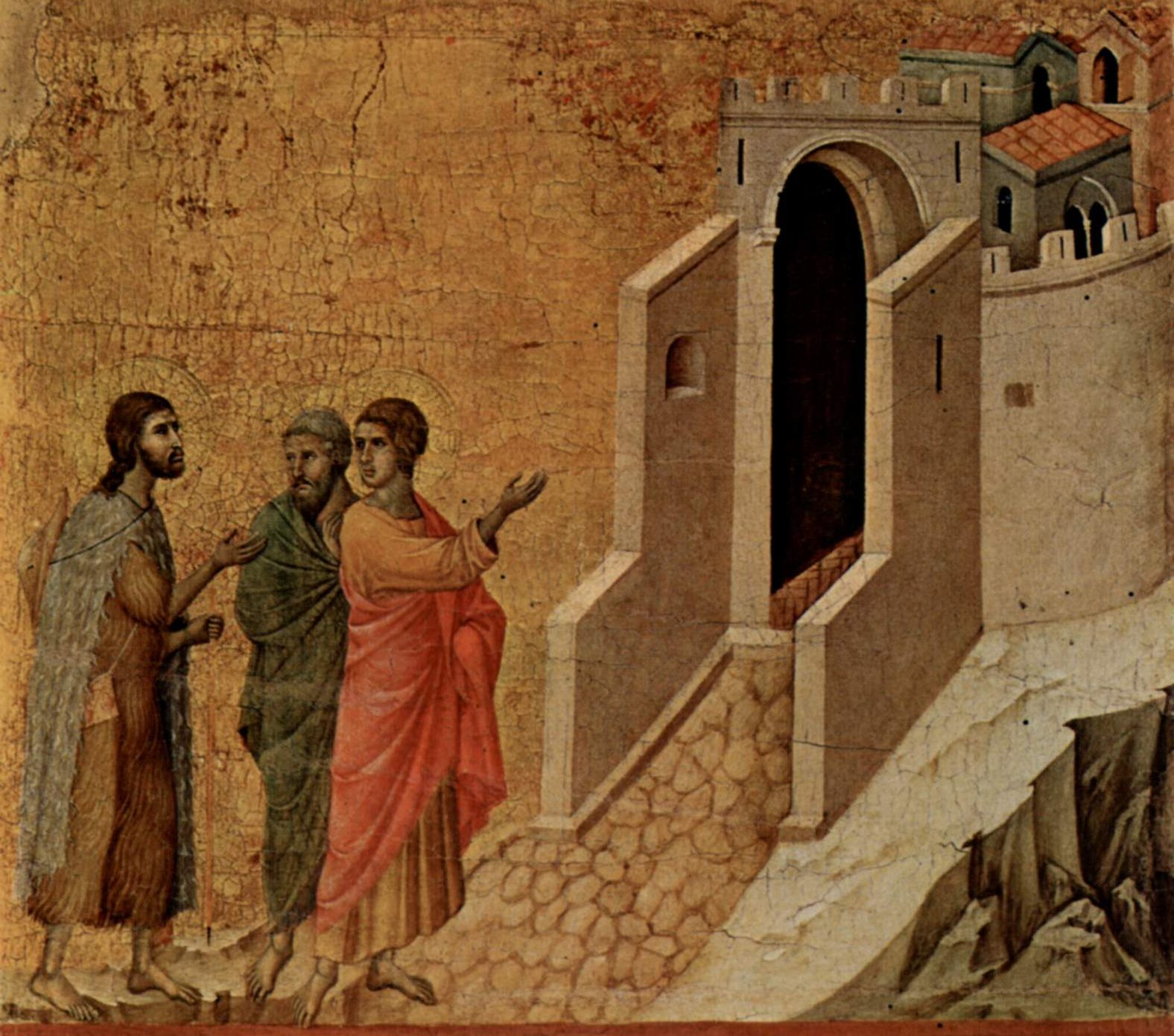
The image is Christ Appears to Two Apostles in Emmaus by Duccio di Buoninsegna – The Yorck Project (2002) 10.000 Meisterwerke der Malerei (DVD-ROM), distributed by DIRECTMEDIA Publishing GmbH. ISBN: 3936122202., Public Domain, https://commons.wikimedia.org/w/index.php?curid=3799693.

First Commandment

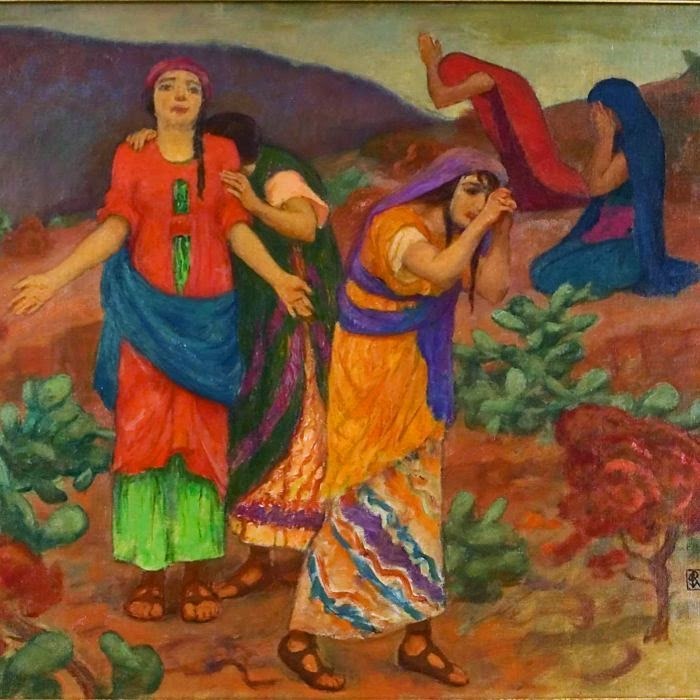
A brightly colored painting showing two women facing forward, both showing grief, with a third holding the shoulders of one from behind, face hidden. Two other women show signs of grief at right and to the rear.

“One of the scribes came near and heard them disputing with one another, and seeing that he answered them well he asked him, ‘Which commandment is the first of all?’ Jesus answered, ‘The first is, “Hear, O Israel: the Lord our God, the Lord is one; you shall love the Lord your God with all your heart and with all your soul and with all your mind and with all your strength.” The second is this, “You shall love your neighbor as yourself.” There is no other commandment greater than these.'” – Mark 12:28-31

The scribe approved your words, or so says Mark,
and silenced all the snare-deploying crowd.
Yet he might ask (and yes, in Luke he did)
“Who is my neighbor to receive my love?”

Then you, Redeemer, might have said
(though you did not, or so says Luke),
“Look to the Book of Ruth, to what is written there:
‘I will not leave you. Do not press me.

“‘Where you journey, I will go.
And where you stop, there I will take my rest.
Your people shall be mine, and more:
Your God shall be my God.'”

A poem/prayer based on Mark 12:28-34, the Revised Common Lectionary Gospel Reading, and Ruth 1:1-18, the First Reading, for Year B, Proper 26 (31).

The image is Whither Thou Goest: Naomi and Ruth by Rupert Bunny – http://www.abc.net.au/radionational/programs/360/rupert-bunny-whither-thou-goest.jpg/4079790, Public Domain, https://commons.wikimedia.org/w/index.php?curid=56415654.

Camels and Needles

“But Jesus said to them again, ‘Children, how hard it is to enter the kingdom of God! It is easier for a camel to go through the eye of a needle than for someone who is rich to enter the kingdom of God.'” – Mark 10:24b-25

A camel, which is a beast with sense,
will cast a jaundiced eye upon a needle’s eye
if told that they’re to pass on through.
At most, a knobby hoof may paw the ground.

Yet I engage in exercise of needle-passing
almost every day, and have for one score years,
and ten, and six, endeavoring to tell
a story so it lifts a heart or redirects a mind.

A task for fools, I say, as those I teach
nod sagely in agreement with my words,
then go to do the opposite of what I’d said,
and what they’d then approved,

Because, you know, though there’s a better way,
the one we know is still the one we’ll do.
We thank you for the wisdom of your words
and hope the world one day works as you say.

If only it were only “they,” the ones to whom
I speak! For it is also “Me,” the one I seek
to govern by your guidance, Christ, the “I”
who also cannot seem to follow you.

I would despair, save that some seeds I never thought
would bloom have grown, have blossomed, borne
sweet fruit as marginalized people claim
their place and power where they once had none.

So take my challenge, camel. I will make
my painful way through this so-tiny eye,
and once we’re through, what visions might we see,
what glory celebrate, in God’s sweet possibility.

A poem/prayer based on Mark 10:17-31, the Revised Common Lectionary Gospel Reading for Year B, Proper 23 (28).

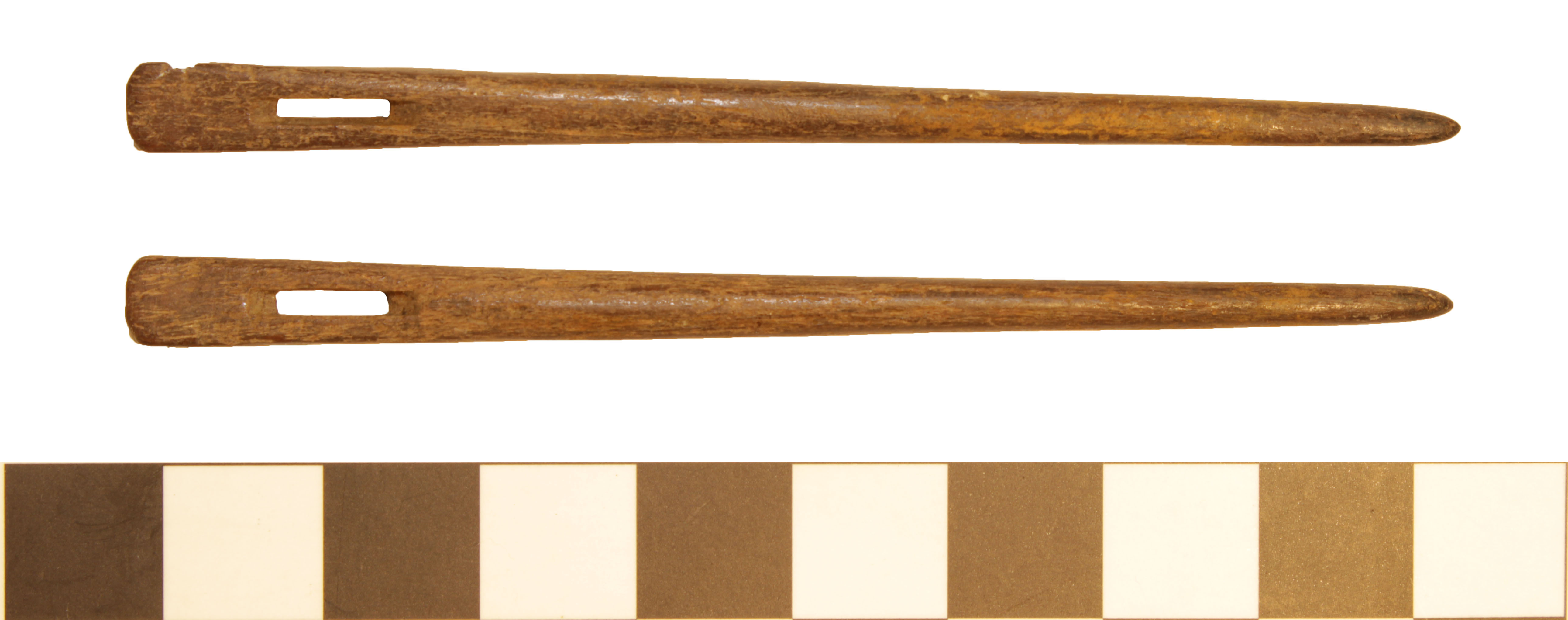
The image is a Roman needle of a type found in first to fourth century contexts. All rights reserved, Philippa Walton, 2014-11-29 19:38:23 – https://finds.org.uk/database/ajax/download/id/494882Catalog: https://finds.org.uk/database/images/image/id/494882/recordtype/artefacts archive copy at the Wayback Machine Artefact: https://finds.org.uk/database/artefacts/record/id/652383, CC BY-SA 2.0, https://commons.wikimedia.org/w/index.php?curid=77020469.

This poem/prayer was written on the thirty-sixth anniversary of my ordination. I rather regret not having taken (that I can find) a photo of a camel.

Teach Us, Jesus

“As he went ashore, he saw a great crowd, and he had compassion for them, because they were like sheep without a shepherd, and he began to teach them many things.” – Mark 6:34

Bring your compassion, Jesus,
for our shepherds howl like wolves.
They lay the rod of law with harshness
on the poor and spare the ones in power.

Teach us, Jesus.

Bring your compassion, Jesus,
for our shepherds carelessly use words
that others hear, and hearing ponder.
Pondering, they set themselves to violence.

Teach us, Jesus.

Bring your compassion, Jesus,
for the shepherds cannot find the way
that leads between our Scyllas and Charybdises,
and lost, we founder in moral morass.

Teach us, Jesus.

Bring your compassion, Jesus,
and teach us many things,
like how the shepherd cares first for the sheep,
whereas the predator consumes them.

Teach us, Jesus.

We are sheep without a shepherd.
Teach us many things.
And may we, by God’s grace,
learn.

A poem/prayer based on Mark 6:30-34, 53-56, the Revised Common Lectionary Gospel Reading for Year B, Proper 11 (16).

The image is Christ Preaching Amongst a Crowd of People, pen and ink. Artist unknown. Found at WellcomeImages. https://wellcomeimages.org/indexplus/obf_images/a0/a1/69c69bd8f2f91424aa360aeb47d6.jpg
Gallery: https://wellcomeimages.org/indexplus/image/V0049499.html
Wellcome Collection gallery (2018-03-28): https://wellcomecollection.org/works/ycntxjvs
CC-BY-4.0, CC BY 4.0, https://commons.wikimedia.org/w/index.php?curid=36668704.

Weakness Obstructed

“…but [God] said to me, ‘My grace is sufficient for you, for power is made perfect in weakness.'” – 2 Corinthians 12:9

In weakness God makes power.
In the stammering speech.
In the thinning skin.
In the cane-assisted stride.

In weakness God makes power.
In the eyes that do not see.
In the ears that do not hear.
In the legs that do not bear.

In weakness God makes power.
In the mind that cannot focus.
In the hand that cannot grasp.
In the appetite that cannot resist.

In weakness God makes power.
But those who are made
in the image of God
make obstacles; and why?

In weakness God makes power.
In the root that makes its soil.
In the child that makes its generation.
In the death that promises eternal life.

In weakness God makes power.

A poem/prayer based on 2 Corinthians 12:2-10, the Revised Common Lectionary Second Reading for Year B, Proper 9 (14).

Photo by Eric Anderson

Proposal

Jesus bar-Yosef
House with a hole in the roof
Capernaum, Galilee

Dear sir:

In light of recent events which have damaged your public image, we offer our services as public relations consultants. We believe that we can increase your name recognition and your positive reputation.

To give you some idea of the value of our services, we would like to comment on two recent encounters that resulted in unnecessary conflict with significant public figures. You can evaluate our suggestions here and realize the benefits you would realize from a permanent business relationship with us.

We realize that your followers – or students; one of the things we’d like to clarify is their role in representing you and your ideas – were hungry while you were out walking with them that day. It is regrettable that they had not prepared for a trip. While we are not event planners, we recommend that you get some additional support to see that you are properly supplied.

The public relations concerns arose when they began to pluck grain on the sabbath. Everyone knows that the followers of a religious leader will be properly scrupulous about following the sabbath regulations. Indeed, a higher degree of respect for those practices is simply expected by the populace. In the moment, it would have gone much better if you had said, “Not now, friends. We don’t have far to go. There will be something to eat soon.”

You were walking just a short distance, weren’t you? We’re confident you were.

Alternatively, as noted above, you could have redirected them to use their pre-prepared foods. Best of all, you might have carried some yourself, and distributed those to your hungry followers. Imagine the positive responses to your generosity!

Then there was the man with the hand. We acknowledge that you actually broke no sabbath regulation at all. You didn’t anoint his hand with oil, which is permitted by most authorities. You didn’t even touch it.

Our concern is with your interaction with the other religious leaders in the room. Granted, they didn’t say anything to you. You might have interpreted that as consent, rather than challenging them for hardness of heart. You might also have said, “Let us see what miracles God will do on the sabbath,” which would have been very pious and quite successful.

Best of all, you could have said to the man, “Come see me tomorrow and we will see what God will do. Today we will rest, and God will rest.”

Frankly, Jesus, he’d been living with that hand for some time. One more day would not have been a burden.

These two events, and a couple of others, have generated some opposition to you and to your message. We firmly believe that you can move past them to a better, more productive relationship with the public at large and with your peers among the religious leadership. We think that some circumspection in some areas, and more emphasis of some elements of your teaching, will really resonate with the population. In short, we believe you have potential and hope to represent you.

The proposal in full is attached.

A poem/prayer based on Mark 2:23-3:6, the Revised Common Lectionary Gospel Reading for Year B, Proper 4 (9).

The image is Christ Heals the Man with a Paralyzed Hand, a mosaic in the Cathedral of Monreale, Sicily, Italy (late 12th – mid-13th cent.). Photo by Sibeaster – Own work, Public Domain, https://commons.wikimedia.org/w/index.php?curid=4515630.