“So again Jesus said to them, ‘Very truly, I tell you, I am the gate for the sheep.'” – John 10:7
It’s not your most compelling image, Jesus. In a section where you said, “I am…” three times, how many hold this one in memory? To say the truth, I barely do.
And yet a gate is comforting. It guards a home, a sheepfold, or a soul from harm. It’s hardly perfect, since a thief may climb the wall: They’ll have to work to work their ill.
The beauty of a gate is not protective force, but its capacity to swing, admitting those outside who’ve recognized the voice and come to claim their place and home.
You tell us you are gatekeeper and gate. May we remember that the gate is you, and when we close it, we usurp your power, your authority. and you yourself.
May we have faith and wisdom both to hold the gate wide open for the gathering flock and only close it in the most compelling circumstance, then open it with welcome love.
A poem/prayer based on John 10:1-10, the Revised Common Lectionary Gospel Reading for Year A, Fourth Sunday of Easter.
Today’s story doesn’t take place in the forests of Hawai’i. Nor does it take place in our time. It starts in a small village not far from Jerusalem, and it takes place on a day we’re familiar with because we celebrate it each year.
Surprise! It’s Palm Sunday.
He was a very young donkey. He’d only lived in one place, and he’d only really experienced one other creature, and that was his mother. He drank his milk and experimented with grass and hay and basically thought that life was pretty good, if a little dull.
On that day, however, a couple strangers came by and began to untie his halter and his mother’s halter from the fence. “What’s going on?” he asked his mother, who understood human language better than he did.
“These men say that the Lord needs us,” she said with some surprise.
“What does that mean?” he wondered, and his mother didn’t know, either.
Mystified, they followed the two strangers to a group of strangers. They put cloaks over his mother’s back and over his back, and then one of them sat on his mother while his friends cheered.
“What’s going on?” he asked his mother in some fright.
“They’ve asked us to carry Jesus to the city,” said his mother. “Just walk by me and everything will be fine.”
Off they went. One of the men led his mother along the road, though she seemed to know where she was going anyway. He trotted alongside – his legs were shorter than his mother’s, so he had to go faster to keep up.
As they made their way down a hill, other people began to gather along the road. They began to shout at Jesus and his companions. Some of them took their cloaks off and laid them on the road in front of the two donkeys. Others had taken branches from the trees and were waving them in the air as they shouted. Some of the leaves covered the road and the cloaks, and as the donkeys’ hooves stepped on them, they made a lovely scent rise.
“What are they saying?” he asked his mother, a little frightened by all the shouting.
“Blessed is the one who comes in the name of the Lord,” said his mother with wonder in her voice. “And they’re calling, ‘Help us! Save us!’”
The little donkey didn’t know how they were going to do that. He didn’t even know how he was going to help his mother carry Jesus. Abruptly, he knew that the thing he wanted most in the world, in fact, was to help his mother carry Jesus. He nuzzled up to her side.
“Let me help,” he said plaintively.
She said nothing at all, because Jesus reached over and rested his hand on the little one’s head. Just his hand. It didn’t weigh much at all. Jesus even scratched him behind the ears a little. But he proudly carried that hand along the way, through the city gates, and up the streets as the crowds grew and kept calling out in joy and with need:
“Help us! Save us! Blessed is the one who comes in the name of the Lord!”
by Eric Anderson
Watch the Recorded Story
I write these stories in full ahead of time, but I tell them from memory (and a certain amount of improvisation). The story as you read it is not necessarily as I told it.
“Then the devil left [Jesus], and suddenly angels came and waited on him.” – Matthew 4:11
He challenged you, Jesus. Summon the angels! They won’t let you fall. You won’t have a bruise on your heel, Nor a strike from a snake.
You said no. No to bread. No to flight. No to glory (that fails to transcend all the kingdoms of earth).
Then he left. And who came? Yes, the angels. The angels. They were hovering ’round, And they brought you relief.
Well, Jesus, I’m tempted. So tempted, you know, so hungry and weary, confused and distressed.
Where are the angels? Will they tend my bruises? Will they feed my hungers? Where are the angels, Jesus the Christ?
“There are angels hov’ring ’round.”
A poem/prayer based on Matthew 4:1-11, the Revised Common Lectionary Gospel Reading for Year A, First Sunday in Lent.
The image is Weite Gebirgslandschaft mit der Versuchung Christi (Vast Mountain Landscape with the Temptation of Christ) by Jan Brueghel the Elder – dorotheum.com heruntergeladen am 30. September 2012, Public Domain, https://commons.wikimedia.org/w/index.php?curid=21801997.
“Six days later, Jesus took with him Peter and James and his brother John and led them up a high mountain, by themselves. And he was transfigured before them, and his face shone like the sun, and his clothes became bright as light.” – Matthew 17:1-2
Bright with light, walking with the prophets, hailed by holy voice that stunned the clouds and silenced even Simon Peter: Jesus the Beloved Son of God.
Transfigured on the mountaintop.
At mountain’s foot, however, trouble lay, because a demon would not be rebuked by any of the nine disciples there. “Where can I find the mustard seed of faith?” they asked.
I grant you they had missed the mountaintop.
But Peter, James, and John, who’d seen the sight, had heard the voice, been silenced clean: how had they been transfigured? Were they changed? Did they bring nourishment to their own mustard seeds?
For they had known the mountaintop.
Yet Peter asked if there were limits on forgiveness. He wondered what he’d gain from following his Lord. While James and John coopted their own mother to secure a place of power.
Though they had been upon the mountaintop.
When Jesus brought the three apart again, this time into a corner of Gethsemane, their bodies ruled their spirits, and they slept, while Jesus wept the bitter tears of grief and fear.
Had they forgotten about the mountaintop?
Approaching soldiers woke them. Weariness no longer slowed them. As blood streamed from a stricken servant’s ear, the three who’d seen and heard the most took to their heels and fled.
Had they been changed upon the mountaintop?
One found his courage and his way back to the courtyard of the trial, but did not bring his name. Three times they asked, three times he cried, “I do not know the man!”
He’d known him on the mountaintop.
So Jesus, here I stand, at best an image in a mirror darkly of those first disciples. I am not the person I would like to be, say nothing of the follower whom you expect.
And I was never on that mountaintop.
Yet truly, you have summoned me by less dramatic means than brilliant clouds and stunning voices on the wind, to be your follower, your servant, and your friend.
But have I been transfigured by the mountaintop?
A poem/prayer based on Matthew 17:1-9, the Revised Common Lectionary Gospel Reading for Year A, Transfiguration Sunday.
Salt is a funny thing. Your body, my body, pretty much every body of every person and every creature needs some salt. Without salt, we get sick. On the other hand, if we have too much salt, we also get sick. Not too much, not too little. That’s the way to do it.
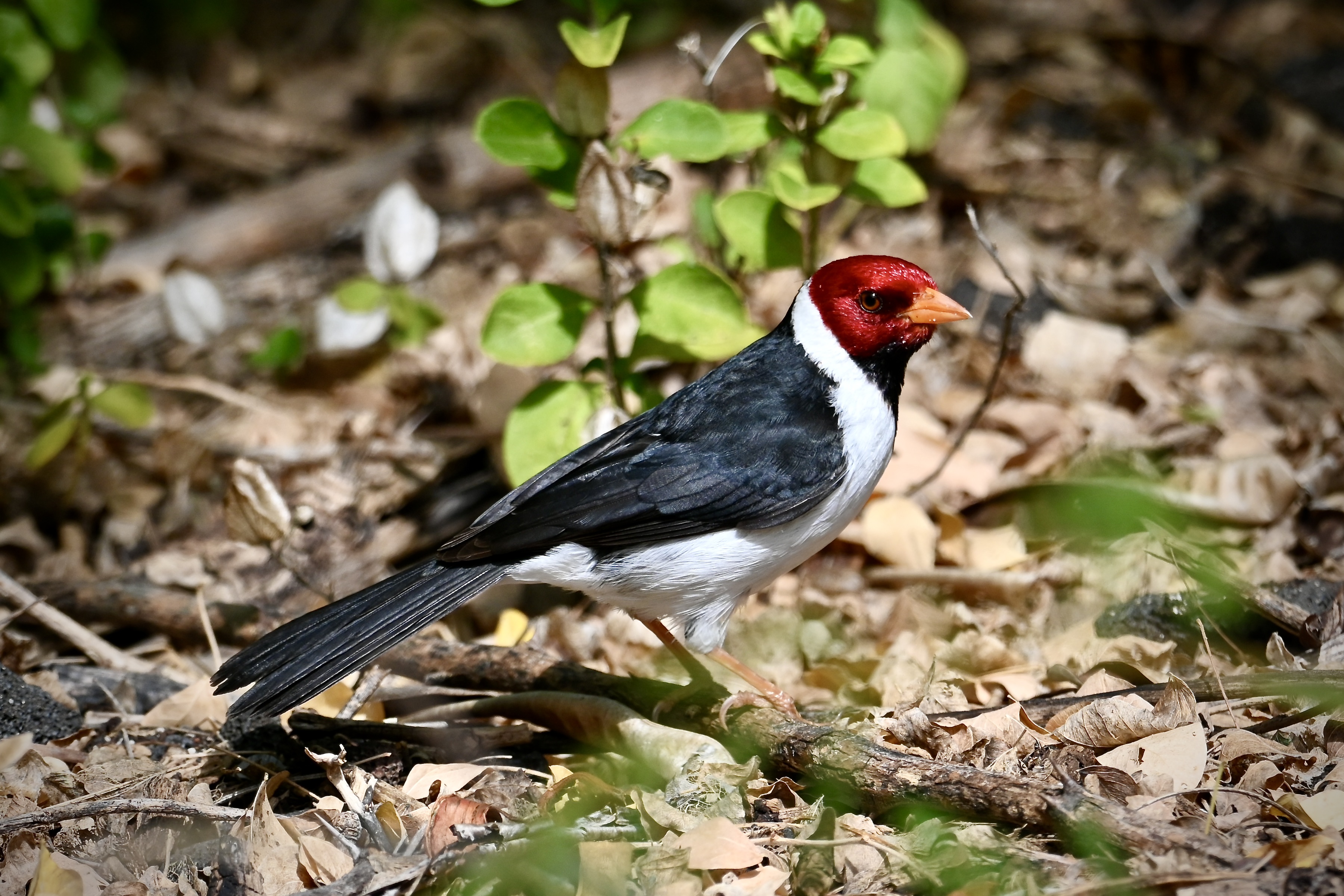
Most of the birds, including yellow-billed cardinals, manage to get the right amount of salt just by what they eat. Seeds have a little salt. So do berries. But every once in a while things don’t go the same way, and one yellow-billed cardinal found himself feeling hungry in a very odd way.
He was hungry for salt.
Personally, I’m rarely hungry for salt itself. I’m not likely to go find a salt shaker and sprinkle some on my tongue. I mean, yuck. Put salt on fried potatoes, though, or popcorn, or…
Well. Let’s just say I’ll eat those up.
Nobody was going to make popcorn or French fries for a yellow-billed cardinal, especially one who couldn’t cook. He hopped around the shore looking for salt, and although there was plenty of it in the ocean, he wasn’t about to drink salt water. He already knew from painful experience that he’d get sick from that.
To his amazement, as he looked, he saw white crystals glistening on the rocks, and even on some of the leaves of the bushes. He thought at first it might be salt left by ocean spray, but it was too far from the breaking waves. Regardless, he pecked a couple of those crystals, and felt much better, even if he did feel pretty thirsty from it.
He didn’t know where it came from, but from time to time when he got hungry for salt again, it was there.
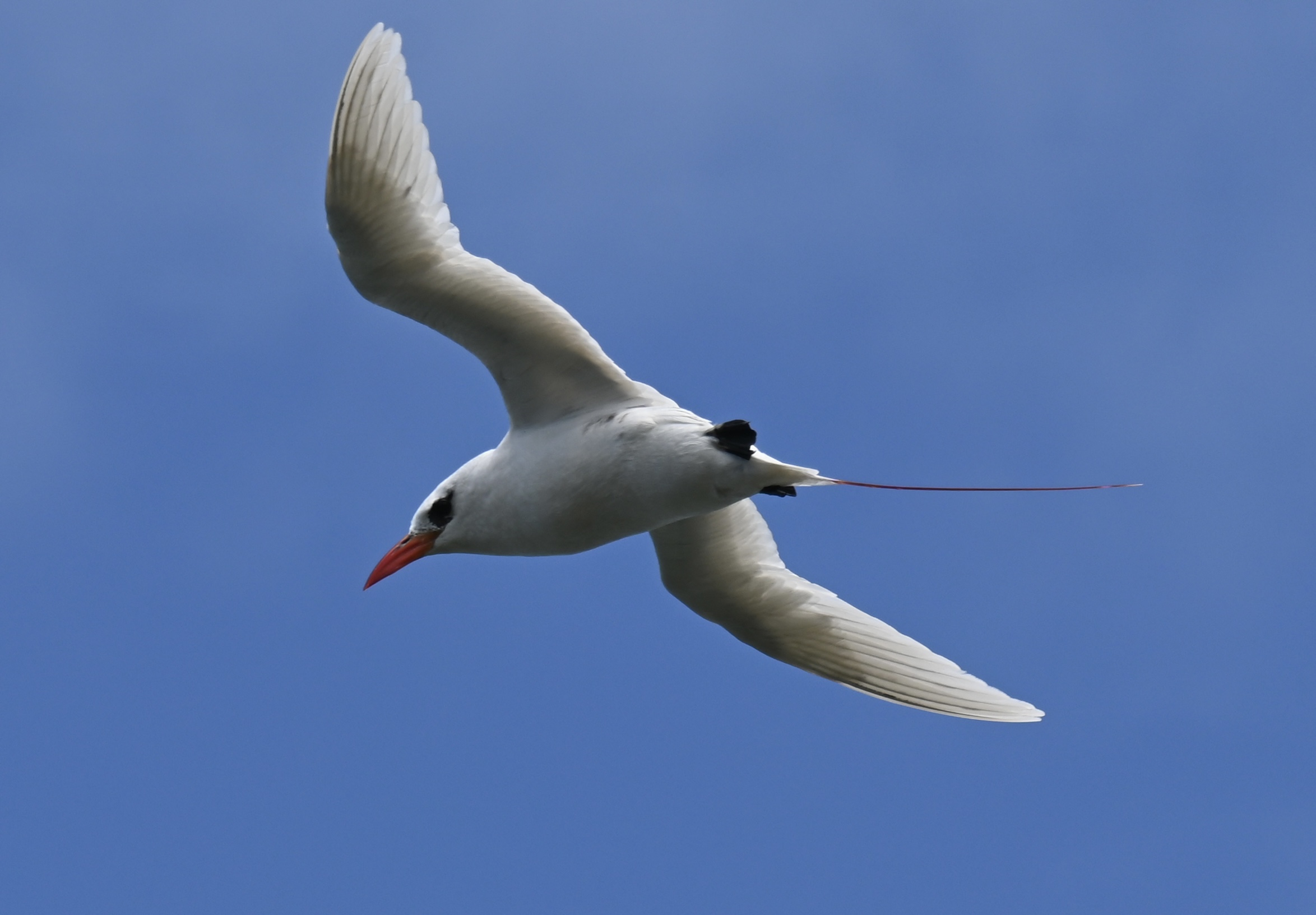
In the meantime, overhead flew the koa’e ‘ula, who spend much of their time far out to sea where there’s too much salt in the water and, for that matter, in the fish that they eat. One of them, in fact, had just had a good long drink of sea water with more salt in it than was good for her.
Unlike the yellow-billed cardinal on the shore below, she could take in more salt because her body could get rid of the excess. Something like tears, salt crystals formed along her beak and sprinkled down on the ground below, where a salt-hungry bird might pick them up.
Neither the koa’e ‘ula nor the yellow-billed cardinal knew anything about the other. Neither of them thought much about it, in fact, but one of them was doing something really important for the other, and didn’t know it.
The same is true of us. Jesus called us the salt of the earth, and he meant that we help other people live and thrive. Sometimes we know we’re doing it, but sometimes we don’t. Just like the koa’e ‘ula, we do ordinary things in our ordinary lives, and someone else lives better because of it.
May we always be the salt of the earth.
by Eric Anderson
Watch the Recorded Story
I write these stories ahead of time, but I tell them from a combination of memory and improvisation. As a result, the story as I wrote it does not match the story as I told it.
Photos of a yellow-billed cardinal and a koa’e ‘ula by Eric Anderson.
You are the light of the world. A city built on a hill cannot be hid.
“[Jesus said,] ‘People do not light a lamp put it under the bushel basket; rather they put it on the lampstand, and it gives light to all in the house. In the same way, let your light shine before others, so that they may see your good works and give glory to your Father in heaven.'” Matthew 5:15-16
You sure do build on Scripture, Jesus. God told Abraham that he and Sarah would become a blessing to the nations of the world, to all the families of Earth.
A pity that he promptly lied and said his wife was not his wife, and gave her up to Pharaoh for a concubine, which cursed the land, afflicted every family.
Isaiah comforted survivors of a great destruction after years had passed, declaring that the people, soon renewed, would shine a beacon to the aching world.
A pity that so many kept the ways that frustrated the prophets years before, preferring their own wealth and potency and damming justice’ waters lest they flow.
Well, Jesus, to fulfill the broken Law and bring to life the prophets’ promised call will call for more than human frailty, unseasoned salt, or lamp without a flame.
Can we fulfill what you came to fulfill? Can we preserve and season all the Earth? Can we be candles brilliant in the dark? Can we be great in Heaven’s realm of life?
A poem/prayer based on Matthew 5:13-20, the Revised Common Lectionary Gospel Reading for Year A, Fifth Sunday after the Epiphany.
The image is “The Candle,” an etching by Jan Luyken illustrating Matthew 5:15 in the Bowyer Bible, Bolton, England (1795). Bowyer Bible photos contributed to Wikimedia Commons by Phillip Medhurst – Photo by Harry Kossuth, FAL, https://commons.wikimedia.org/w/index.php?curid=7550068.
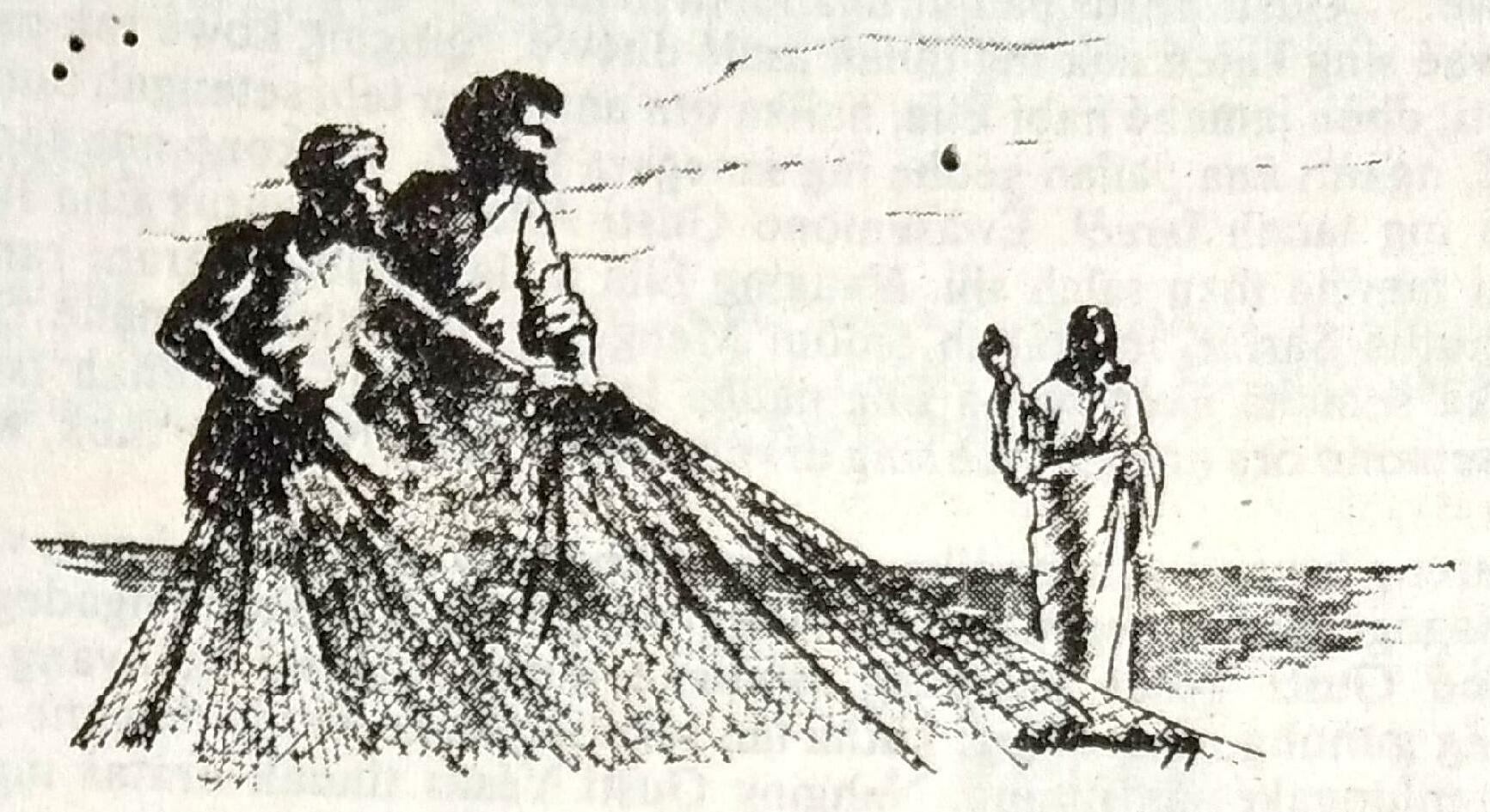
“As he walked by the Sea of Galilee, he saw two brothers, Simon, who is called Peter, and Andrew his brother, casting a net into the sea for they were fishers. And he said to them, ‘Follow me, and I will make you fishers of people.'” – Matthew 4:18-19
Matthew left it out, of course. What did you tell them, Jesus?
“Hey, guys, I’m sort of on the run since they took John, although they probably don’t know my name, so that’s all right, you think? Come follow me.
“Now mind you, folks will hear my name, and quickly, too, if I am any judge. They’ll come even from Syria to seek some healing for their bodies and their souls. Come follow me.
“I’m sure no one will think to look for me atop a mountain peak – unless they follow those who follow me, and frankly guys, I hope to leave a wide and beaten track. Come follow me.
“Now come along. We’ve work to do that doesn’t need a net. No, we’re as likely to be caught in Roman or Herodian nets as John. They’ll lift us high – but not as high as God will raise us all. Come follow me.”
A poem/prayer based on Matthew 4:12-23, the Revised Common Lectionary Gospel Reading for Year A, Third Sunday after the Epiphany.
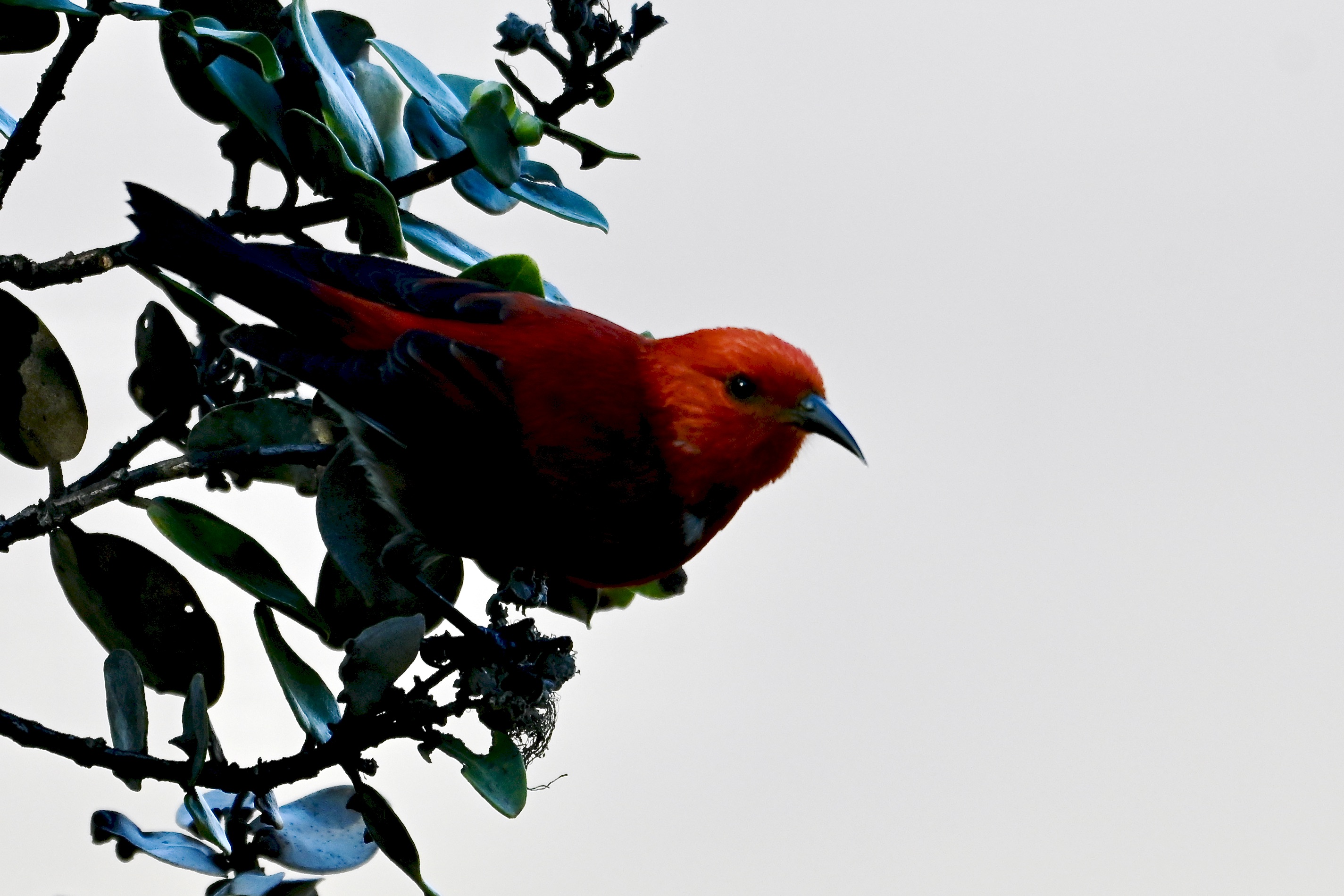
At this time of the year, you might forgive an ‘apapane for looking a little flustered. Or just for looking around. And flying around. A lot. This time of the year can be complicated.
For one thing, it’s time to get pairs together. When two birds have decided they’ll be parents with one another, they’ve got to find a spot for a nest. Then they’ve got to build the nest. Then there are eggs to lay and brood over, and then there will be chicks to feed and fledglings to teach fly, and during all of that, they still need to watch out for cats and hunker down in the storms and, of course, find themselves enough to eat.
One ‘apapane, one who had become something of a tutu to the younger birds, noticed another ‘apapane looking a little frantic.
“What are you looking for?” she asked.
“I can’t remember,” said the other ‘apapane.
“Have you eaten?” said the first one.
“I don’t think so,” said the frantic one.
“Go eat something,” she told him. “There’s some ohi’a in blossom over there, and there will be plenty of bugs there, too. I’m sure you’ll remember better after that.”
Another frantic ‘apapane landed nearby.
“What are you looking for?” asked the tutu.
“I can’t find my husband,” she said.
“Did you find a place for a nest?” asked the tutu.
“We found two, and they’re not in the same tree,” said the younger bird.
“Perch half way between the two, and watch for him,” said the tutu. “I’m sure he’s looking for you, too.”
About a minute after the younger bird flew off, a male ‘apapane flew up.
“What are you looking for?” said the tutu.
“I can’t find my wife!” he said.
“Did you pick two likely nest sites?” asked the tutu. When he said yes, she sent him off to find his wife between those two trees. “You’ll find her,” she said. “She’s looking for you.”
She did this all day, in between sipping nectar and snacking on bugs. She sent some birds after nest materials and some after food and more than you’d expect to find their missing spouses.
“How do you do it?” asked another ‘apapane who’d been watching it all.
“It’s simple,” she said. “I ask them what they’re looking for. Once I know that – actually, once they know that – I can probably help them, or send them to somebody who can help them.
“It’s really hard to find anything when you don’t know what you’re looking for.”
by Eric Anderson
Watch the Recorded Story
I write these stories in advance, but I tell them from memory plus inspiration. The story you just read does not precisely match the way I told it.
“When Jesus turned and saw them following, he said to them, ‘What are you looking for?'” – John 1:38
Well, Teacher, I’ve been following you for forty-five years and more, and yet: I don’t think I can tell you what I’m looking for.
It’s such an awkward question.
Like Andrew and his long-forgotten friend (what happened to him, anyway?), if you asked me I’d say something inane.
“Where are you staying, Teacher?”
You know, I know, they knew that wasn’t why they took those steps from John the Baptist’s side to yours.
But how were they to answer what they didn’t know?
And I, with decades as a follower, with decades as a teacher of your flock, with years of writing poem prayers to you,
I still don’t know.
What am I looking for in you? A place of honor, a big frog in what seems like a shrinking pond?
That would be silly, wouldn’t it?
Might I be looking for some meaning in a world that seems to shed its sense and sense of morals, too?
Can you make sense of what’s nonsensical?
Could I be looking for a safe embrace, for arms extended wide, to hold me fiercely, gently, for all time?
I could. I could indeed.
But most of all, dear Teacher, I suspect I’m looking for the One who’ll listen to my babbled nonsense answer, and
Reply with, “Come and see.”
A poem/prayer based on John 1:29-42, the Revised Common Lectionary Gospel Reading for Year A, Second Sunday after the Epiphany.
The image is Vocation de Saint Jean et de Saint André (The Calling of Saint John and Saint Andrew) by James Tissot (between 1886 and 1894) – Online Collection of Brooklyn Museum; Photo: Brooklyn Museum, 2008, 00.159.55_PS2.jpg, Public Domain, https://commons.wikimedia.org/w/index.php?curid=10195829.
“He opposes and exalts himself above every so-called god or object of worship, so that he takes his seat in the temple of God, declaring himself to be God. Do you not remember that I told you these things when I was still with you?” – 2 Thessalonians 2:4-5
I remember lots of things. I remember grandiosity and pride. I recall my own, of course, and sometimes mourn its passing, though more often I regret its resurrection.
I remember lots of things, including those who, yes, exalt themselves. They openly accept the praise that’s due to God, declaring that they stand for God.
What law except their own will they obey? What limits place upon their power and their pride? What wisdom will they own except the rules of ownership and privilege?
In times like these, I fear I may be like your troubled friends in Thessalonica, dear Paul. With evil rampant, justice tossed aside, I say: “Come Jesus, now, and bring us your relief.”
Though twenty centuries have passed since Thessalonians cried out for the same thing, dear Paul advises us the same: Stand firm. Hold fast. Be filled with Spirit’s love. And may God strengthen you in doing good.
A poem/prayer based on 2 Thessalonians 2:1-5, 13-17, the Revised Common Lectionary Second Reading for Year C, Proper 27 (32).
The image is The Apostle Saint Paul by El Greco (between 1610 and 1614; painting displayed at the El Greco Museum, Toledo, Spain – 1QEs4novinaf3A at Google Cultural Institute, zoom level maximum, Public Domain, https://commons.wikimedia.org/w/index.php?curid=29844105.